
Treat AI change management as an ongoing, people-first capability, not a rollout project with an end date. Success depends on three levers working together: outcome-driven goals instead of tool mandates, governance that builds trust rather than just restricting behavior, and continuous measurement that tracks real adoption, not just license counts.
TL;DR:
- Building trust and governance through visible oversight, clear policies, and audit trails is essential to increase AI adoption and manage risks effectively.
- Redesigning workflows around AI tools involves gradual progression from task augmentation to full-team agent-assisted processes, paired with cross-functional ownership.
- Role-based training with champions and continuous, spaced refreshers are crucial for developing AI fluency and sustaining adoption over time.
- Outcome-focused KPIs, such as task completion time and error rates, provide more meaningful measures of AI success than activity metrics like license counts.
- Regular, observability-driven reviews enable proactive intervention, preventing adoption stalls and turning change management into an ongoing operational rhythm.
Table of Contents
- What Is AI Change Management, and Why Does It Need a New Playbook?
- How Do You Build Trust and Governance Around AI?
- How Should Workflows and Team Structures Change for AI?
- What Skills and Training Actually Drive AI Adoption?
- Which KPIs Actually Prove AI Is Working?
- How Do You Keep AI Adoption From Stalling Over Time?
- What Changes When You Can Actually See AI Adoption Happen
- Turn AI Spend Into Measurable Adoption With Tekkr
- Where to Go Deeper on AI Change Management
- Sources
What Is AI Change Management, and Why Does It Need a New Playbook?
AI change management is the discipline of guiding people, processes, and structures through the disruption that artificial intelligence brings to how work gets done. It borrows heavily from classic change frameworks like ADKAR, but it has to answer for something older methods never faced: tools that keep changing shape after they’re deployed.
Prosci’s research found that a people-first approach, one that engages workers on what’s in it for them before anyone even picks a vendor, is the strongest predictor of whether an AI rollout actually sticks. That single finding upends how most organizations approach digital transformation with AI: they buy the software first and ask “how do we get people to use it” second. Flip that order and adoption rates improve.
Here’s the practical roadmap for getting there.
-
Set the North Star on outcomes, not tools. The goal is never “get everyone using Claude.” It’s “cut proposal turnaround from five days to two.” McKinsey’s five-step approach to change management for AI starts here, and the owner should be a business unit leader, not IT. First action: pick one workflow with a measurable bottleneck and define the target number before touching any tool.
-
Establish governance and trust before scaling. A visible oversight structure, usually a small cross-functional committee, reduces the fear that quietly kills adoption. The owner is typically a compliance or risk lead working alongside IT. First action: publish a one-page acceptable-use policy before the next pilot launches.
-
Redesign the workflow, not just the task. Bolting AI onto an existing process rarely pays off. Owned by operations leaders and team managers, the first action is mapping one end-to-end process to find where a human handoff could become an AI-assisted step.
-
Build skills and name champions. Role-based training beats generic AI literacy sessions every time. HR and functional leaders own this. First action: identify five superusers in the target workflow and give them early access plus a feedback channel.
-
Measure and iterate. Adoption without measurement is a guess dressed up as a strategy. Analytics or finance leaders typically own this. First action: define one adoption metric and one outcome metric before the pilot goes live.
Each of these steps maps directly to the mandatory ingredients of a real AI maturity model assessment: strategy, governance, talent, and operating model. Skip one, and you’re not doing AI change management. You’re just buying software.
How Do You Build Trust and Governance Around AI?
Trust is the currency that determines whether employees actually use the tools you’ve paid for. IBM frames it directly: trust reduces resistance and helps people feel secure rather than threatened by the technology sitting on their desktop. Without it, adoption stalls no matter how good the tool is.
The stakes are rising, too. IBM projects that annual costs tied to managing enterprise AI risk will climb by 15% as deployment complexity grows. That’s not a reason to slow down. It’s a reason to build governance that’s proportionate and visible, rather than governance that shows up only after something breaks.
Practical governance for AI implementation usually includes:
- An oversight committee with representation from legal, IT, and the business units actually using the tools.
- A written acceptable-use policy that spells out what data can and can’t go into a prompt.
- Audit trails that log AI-assisted decisions, especially anywhere customer or financial outcomes are involved.
- Human-in-the-loop checkpoints on any output that touches a customer, a contract, or a regulatory filing.
Good governance for AI in organizational change isn’t a brake pedal. It’s what lets you say yes to more pilots, faster, because the guardrails are already in place. Teams that have to invent a review process from scratch for every new use case slow themselves down far more than a standing policy ever would. For a deeper look at building these frameworks, see Tekkr’s guide to AI governance.
Pro Tip: Publish your acceptable-use policy in plain language, not legal language. A policy nobody reads doesn’t reduce risk, it just creates the appearance of governance.
How Should Workflows and Team Structures Change for AI?
Most organizations get stuck treating AI as an add-on: a chatbot bolted onto an existing process that nobody redesigned. That’s phase one, and it’s fine as a starting point, but it’s not where the value lives.
McKinsey describes a progression worth following deliberately. It starts with task augmentation, where AI handles a discrete piece of a job a person still owns end to end. It moves to agent-assisted workflows, where an AI agent handles a full sub-process with a human reviewing outputs at defined checkpoints. It ends with teams of coordinated agents working under human oversight on a whole business function.
You don’t jump to phase three. You earn it, one workflow at a time. Consider what this looks like in practice:
- Procure-to-pay: Start by having AI draft purchase order summaries for human approval. Graduate to an agent that flags anomalies and routes exceptions, with a human approving only the flagged ones.
- Marketing content: Begin with AI drafting first versions of campaign copy. Move toward an agent-assisted workflow that pulls performance data and adjusts messaging variants automatically, with a strategist reviewing before launch.
- Customer support: Start with AI-suggested responses for agents to edit. Progress to an agent that resolves tier-one tickets independently, escalating anything outside defined confidence thresholds.
Structurally, this requires pairing business and technical ownership directly. A “two-in-the-box” model, where a business process owner sits alongside a technical lead for every reimagined workflow, prevents the common failure where IT ships a tool nobody redesigned their process around. Some organizations formalize this further with augmented teams that blend human specialists and defined agent roles, but the two-in-the-box structure works well as a starting point before you build anything more elaborate. For engineering-heavy functions, a structured technical approach to this handoff matters as much as the org chart.
What Skills and Training Actually Drive AI Adoption?
AI fluency isn’t the same as knowing how to write a good prompt. It’s the ability to judge when AI output is trustworthy, when it needs a second look, and when a task shouldn’t go near an AI tool at all. That judgment doesn’t come from a one-hour onboarding video. It comes from role-based, hands-on practice tied to real work.
The half-life of AI skills is short. A prompting technique that worked well six months ago may be outdated as models change, which means training can’t be a one-time event bolted onto onboarding. It has to repeat.
What actually moves adoption:
- Role-based curricula built around the specific tasks a finance analyst, a support rep, or a marketer does daily, not generic “intro to AI” sessions.
- Champion or superuser networks: a handful of early adopters per team who field questions before they escalate to IT.
- Gamified rollouts with playbooks and leaderboards, which make adoption visible and a little competitive instead of invisible and optional.
- Short, spaced-out refreshers instead of a single long training block that people forget within a month.
Sequence matters. Train the champions first, let them work out the rough edges, then roll out to the broader team with the champions embedded as support. Measure proficiency with something concrete, like task completion time or error rate on a defined task, not a self-reported confidence survey.
Pro Tip: Ask your champions what questions they get asked most. That list is your next training module, already written for you by the people closest to the friction.
Which KPIs Actually Prove AI Is Working?
Activity metrics lie. Login counts and license utilization tell you people opened the tool, not that it changed anything about how work gets done. The metrics that matter are outcome metrics: task completion time, error rates, revenue per rep, cost to serve a customer ticket, or hours reclaimed on a specific process.
Before you can set targets, you need a baseline. That’s where an AI maturity assessment earns its place. Gartner’s AI maturity model scores an organization across strategy, data, governance, talent, technology, and operating model, then produces a prioritized roadmap rather than a vague “you’re behind” verdict. MITRE’s framework does something similar across six pillars, including ethical and responsible use, and generates visual scoring you can put in front of a board. Forrester’s assessment approach leans on benchmarking across competencies to align investment with actual business value rather than hype.
A workable measurement plan looks like this:
- Establish a baseline for the target workflow before the pilot starts, not after.
- Set one leading metric (adoption rate among the target group) and one lagging metric (the business outcome you actually care about).
- Build a dashboard that a non-technical executive can read in under a minute.
- Review it on a set cadence, monthly for fast-moving pilots, quarterly once a workflow stabilizes.
Skipping the baseline is the single most common measurement mistake. Without it, every improvement claim is unverifiable.
How Do You Keep AI Adoption From Stalling Over Time?
There’s no finish line here. Model updates, new use cases, and shifting employee skill levels mean AI change management runs as a continuous operational rhythm, not a project with a launch party and a wrap-up report.
That means building a cadence, not a schedule of one-off checkpoints. Governance reviews need a regular slot on the calendar, not an ad hoc trigger when something goes wrong. Executive reporting should run on the same rhythm, so leadership sees drift before it becomes a crisis rather than after.
Predictive analytics and sentiment tracking can catch early warning signs, usage dropping in a team that adopted enthusiastically three months ago, or feedback sentiment turning sour before anyone files a formal complaint. Catching that signal early is far cheaper than rebuilding trust after a stall.
Tactics that keep adoption alive past the initial excitement:
- Leaders visibly using the tools themselves, not just mandating them for everyone else.
- Recognition programs that reward good use cases publicly, not just usage volume.
- Periodic use-case reviews where teams share what’s working and what quietly got abandoned.
- Refreshed playbooks every quarter as models and best practices shift.
Readiness checks belong on the same cadence as governance reviews. Ask the same three questions each time: Are people still using it? Is the outcome metric moving? Has anything about the tool or the risk profile changed?
What Changes When You Can Actually See AI Adoption Happen
Most AI change management advice assumes leaders are flying blind, guessing at adoption from anecdote and survey fatigue. That assumption is outdated. Observability into who’s actually using AI, what it costs by team, and which use cases are gaining traction turns change management from a guessing game into a feedback loop you can actually run on a cadence.
The interventions this unlocks are specific. A team lead can see that a workflow with high license spend has almost no active usage and intervene with targeted training before the renewal conversation gets awkward. A finance leader can break down AI spend by department and redirect budget toward the use cases producing measurable time savings, instead of renewing every seat by default.
This doesn’t replace the people-first fundamentals. It operationalizes them. Governance means less when you can’t see what’s actually happening inside it, and training programs are hard to prioritize when you don’t know which teams have already stalled.
— TekkrTools
Turn AI Spend Into Measurable Adoption With Tekkr
Everything in this framework, the North Star metrics, the governance checkpoints, the training sequencing, depends on knowing what’s actually happening with the AI tools you’ve already paid for. That’s the gap Tekkr’s Configurato closes. It tracks who’s genuinely using tools like Claude and Codex, breaks spending down by team, and surfaces which use cases are gaining traction versus quietly dying on the vine.
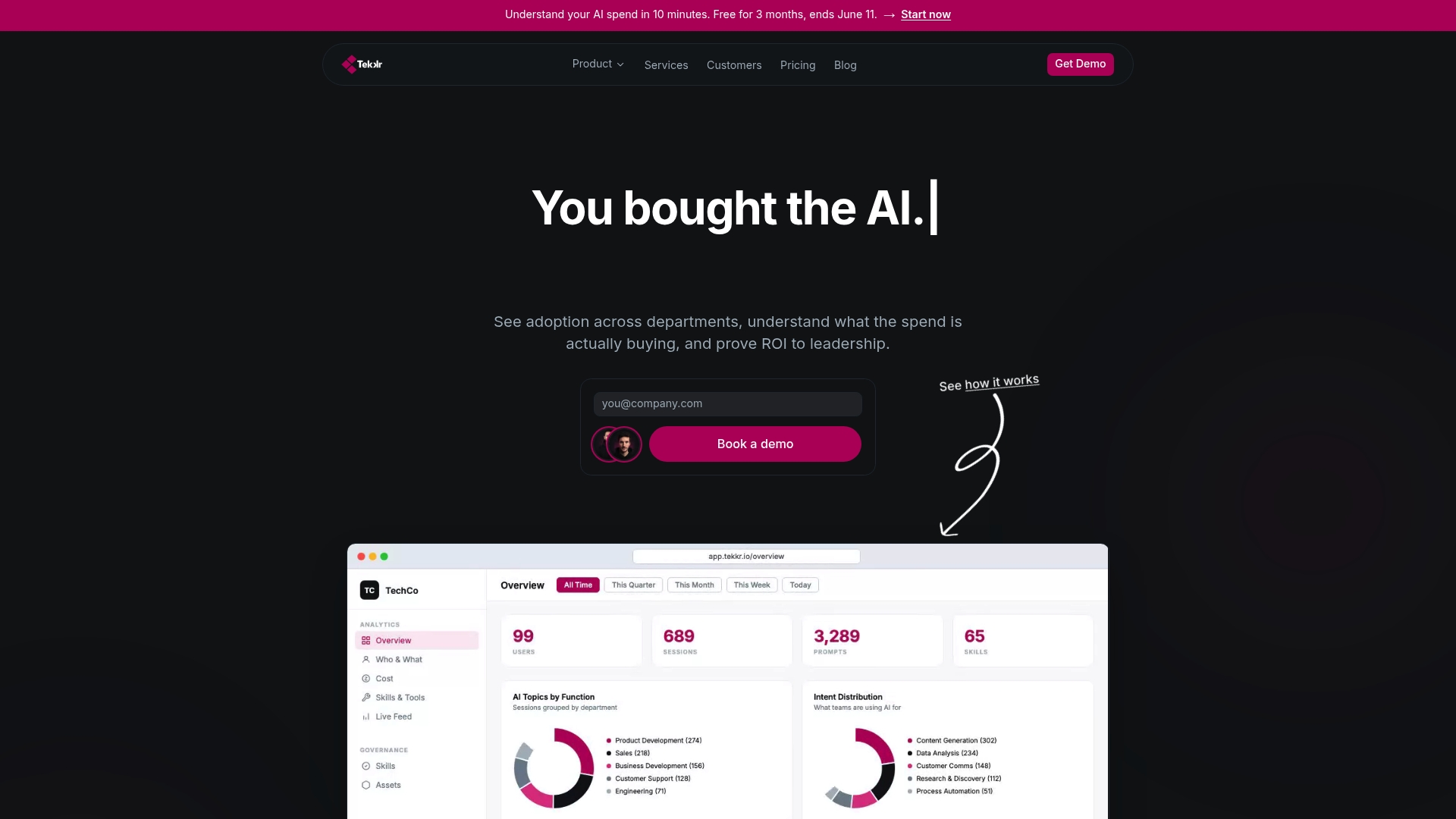
Rollouts can include gamified leaderboards and company-wide playbooks, making adoption more visible and engaging rather than invisible and optional. The architecture follows privacy-first principles including encryption and data protections, operating without the need for browser extensions.
If you’re running the framework above, starting with an audit to assess current adoption and spend before your next pilot launches is recommended. Visit the provider’s site to learn more about account setup and options. Visit Tekkr’s AI adoption solution to see how the audit, pilot, and governance sprint fit together.
Where to Go Deeper on AI Change Management
- How AI Is Used in Change Management — IBM’s overview of AI-driven analytics for detecting adoption stalls and enterprise risk trends.
- AI Adoption: Driving Change With a People-First Approach — Prosci’s research on why people-first sequencing predicts adoption success.
- Reconfiguring Work: Change Management in the Age of Gen AI — McKinsey’s five-step framework for outcome-driven workflow redesign.
- Gartner AI Maturity Model Toolkit — a structured framework for benchmarking readiness across strategy, data, and governance.
- MITRE AI Maturity Model and Organizational Assessment Tool Guide — a six-pillar scoring tool for AI readiness and roadmap planning.
- Assess Your AI Maturity — Forrester’s competency-based benchmarking approach for prioritizing AI investment.
Sources
- How AI is used in change management | IBM
- AI Adoption: Driving Change With a People-First Approach | Prosci
- Reconfiguring work: Change management in the age of gen AI | McKinsey
- Gartner AI maturity model toolkit
- MITRE AI maturity model and organizational assessment tool guide