
AI-powered behavioral analytics models what “normal” looks like for a given identity, workload, or user, then surfaces statistically meaningful deviations using machine learning. The core practical implication: it catches threats and anomalies that rule-based systems miss entirely, because it does not require you to know what you are looking for in advance. It is the right tool when you need to detect subtle or unknown deviations across large, dynamic populations, and when context, not just raw signals, determines whether something is actually risky.
Three risks deserve attention before any deployment: data quality problems corrupt baselines faster than most teams expect, model drift quietly degrades detection accuracy over time, and governance gaps, especially around feedback loops and explainability, can turn a well-designed system into a liability.
- Best fit: detecting novel threats, insider risk, fraud, and cloud compromise where static rules fail
- Top risks: concept drift, feedback-loop contamination, label sparsity, and interpretability gaps
- Governance minimum: audit trails, retraining cadence, held-out validation, and PII handling from day one
Table of Contents
- How AI behavioral analytics works end to end
- Which algorithm types actually fit your use case?
- What signals and features actually feed these models?
- How model outputs become operational alerts
- How to measure whether your deployment is actually working
- What behavioral analytics does well and where it breaks
- Where behavioral analytics fits in your security and operations stack
- A practical implementation roadmap and governance checklist
- What the research says about model monitoring and the agentic shift
- Key Takeaways
- The part most implementation guides skip
- Useful sources for deeper reading
How AI behavioral analytics works end to end
The pipeline has six stages, and every one of them can break the system if it is underbuilt.
Telemetry ingestion is where raw signals arrive: authentication logs, API call traces, process activity, data access events, and UI interactions. The quality of what enters here determines everything downstream. Feature engineering transforms those raw events into predictive signals, things like session velocity, access volume normalized against peer activity, time-of-day patterns, and cross-entity relationship counts.
Baseline modeling is where the system learns what normal looks like. Baselines can be scoped per identity (this specific user’s typical behavior), per peer group (how this user compares to their cohort), or across temporal patterns (what Monday morning looks like versus Friday afternoon). The model does not need labeled examples of bad behavior to build a baseline. It just needs enough clean history of normal behavior, which is why data quality at ingestion matters so much.
Scoring and contextualization happen together. A raw anomaly score means little without context: is the resource being accessed high-value? Does the identity have elevated permissions? Is the network path unusual? Behavioral signals become actionable when fused with asset criticality, permission scope, and network exposure. Without that fusion, you get high alert volumes and low analyst confidence.
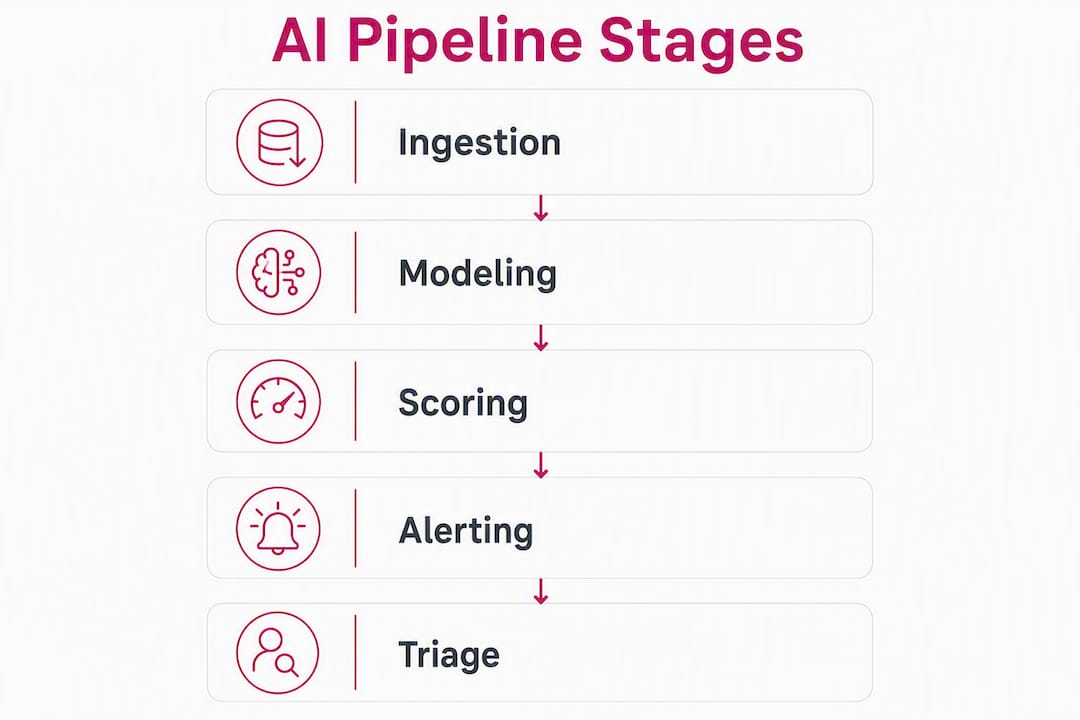
Alerting and triage close the loop. Scored events pass through threshold logic, get enriched automatically, and route to analysts or automated response workflows. Agentic analytics systems can now trigger write-backs to enterprise systems directly, but that requires a governed semantic layer and explicit auditability for every automated decision.
Pro Tip: When designing baselines, hold out a clean slice of historical data before the model ever trains on it. Use that slice for ongoing validation. If you let all historical data flow into training, you have no independent ground truth to catch drift later.
Which algorithm types actually fit your use case?
No single model architecture handles every behavioral analytics problem well. The choice depends on whether you have labeled examples of bad behavior, how much interpretability you need, and how fast the underlying behavior changes.

| Algorithm | Best for | Main downside |
|---|---|---|
| Isolation Forest | High-dimensional anomaly detection with no labels | Poor calibration; scores are not probabilities |
| Autoencoder (neural) | Detecting subtle reconstruction errors in sequences | Requires significant compute; hard to explain |
| Density estimation / clustering (e.g., DBSCAN, GMM) | Peer-group baselining and cohort deviation | Struggles with high-cardinality identity spaces |
| Supervised classification | Known fraud or threat patterns with labeled data | Needs labeled examples; misses novel attacks |
| Hidden Markov Models / RNNs | Sequential behavior, session modeling, step-order anomalies | Training complexity; sensitive to sequence length |
| Transformer-based sequence models | Long-range behavioral dependencies, API call chains | Compute cost; interpretability requires extra tooling |
| Graph neural networks | Relationship-based signals (lateral movement, collusion) | Data pipeline complexity; sparse graph updates |
Architecture patterns worth knowing:
- Feature store + online scorer: pre-computed features served at low latency for real-time decisions
- Streaming anomaly detection: models that update incrementally as events arrive, useful for high-volume API or auth logs
- Hybrid rules + models: rules handle known-bad patterns instantly; models catch the unknown; combining both reduces both false negatives and false positives
- Agentic orchestration layers: multi-agent systems that trigger downstream workflows based on model outputs, requiring explicit governance at each decision node
The practical trade-off most teams underestimate: unsupervised models are easier to deploy (no labels needed) but harder to evaluate and explain. Supervised models give you precision and recall metrics you can actually defend to a board, but they are blind to attack patterns you have never seen before. Most mature deployments run both in parallel.
What signals and features actually feed these models?
Raw telemetry is not a feature vector. The gap between what your systems log and what a model can use is where most behavioral analytics projects stall.
Common signal categories:
- Identity and authentication events: login times, MFA outcomes, credential reuse, geographic anomalies, device fingerprints
- API and RPC traces: call frequency, endpoint combinations, payload sizes, error rates, unusual method sequences
- Process and activity logs: application launches, privilege escalations, scheduled task creation, shell command patterns
- Data access events: file reads, database queries, export volumes, access to sensitive classifications
- UI interaction signals: click patterns, time-on-element, navigation sequences, form abandonment
- System telemetry: network connections, DNS queries, memory and CPU usage spikes correlated with identity activity
Feature engineering patterns that matter:
- Sequence windows: rolling counts of events in a 15-minute or 1-hour window per identity
- Time-series aggregates: hourly and daily baselines per user, per resource, and per peer group
- Cross-entity embeddings: representing users, resources, and their relationships as vectors to capture graph-level signals
- Derived ratios: a user’s data export volume divided by their 30-day median, normalized against peer-group activity
A minimal feature vector for an insider-threat model might include: login hour (deviation from median), data volume (ratio to 90-day baseline), number of distinct resources accessed (z-score vs. peer group), and a sequence flag for access patterns that match known exfiltration paths.
Mature organizations design telemetry deliberately rather than mining inconsistent log exhaust. That means defining an explicit event schema upfront, with high-context fields baked in, rather than trying to reverse-engineer meaning from whatever your infrastructure happens to emit.
How model outputs become operational alerts
A model output is a number. Turning that number into something an analyst can act on requires several layers of logic, and each layer introduces a place where signal can be lost or noise can be amplified.
Scoring approaches:
- Probability scores (0–1): output of supervised classifiers; directly interpretable as likelihood of a bad event
- Anomaly scores (distance or reconstruction error): output of unsupervised models; require calibration before they mean anything operationally
- Composite risk scores: weighted combinations of multiple model outputs, normalized and scaled to a common range
Thresholding strategies:
- Static thresholds are fast to implement but drift as behavior patterns change seasonally or organizationally
- Adaptive thresholds recalibrate based on recent score distributions, reducing alert fatigue during high-activity periods
- Percentile-based baselines flag the top N% of scores per day, keeping alert volume predictable regardless of absolute score shifts
- Peer-normalized thresholds compare an identity’s score against their cohort, not the global population
Contextual aggregation is where weak signals become strong detections. A single anomalous API call is noise. That same call, combined with an off-hours login, a spike in data access volume, and a target resource with elevated sensitivity, becomes a high-confidence alert. Fusing behavioral signals with asset criticality and permission scope is what separates actionable detections from alert fatigue.
A concrete example: a user logs in at 2 AM (unusual for their baseline), accesses a database they have not touched in 60 days (low-frequency access flag), and exports 400 MB (3.2 standard deviations above their 90-day median). Each signal scores modestly on its own. Combined in a temporal window with an asset-criticality weight applied to the database, the composite score crosses the high-confidence threshold and routes to an analyst with automated enrichment already attached.

Triage flow: automated enrichment pulls in asset owner, recent ticket activity, and HR signals. Confidence bands separate “investigate now” from “monitor.” Maker-checker approvals gate any automated response action. Analyst feedback on each closed alert feeds back into threshold calibration, not directly into model retraining (to avoid feedback-loop contamination).
How to measure whether your deployment is actually working
Deploying a behavioral analytics model without a measurement plan is how organizations end up running systems that look healthy on dashboards while missing real threats.
- Precision measures what fraction of your alerts are real. Low precision means analysts spend most of their time on false positives, which erodes trust in the system faster than almost anything else.
- Recall measures what fraction of real threats your model surfaces. Low recall means the system is missing events. For security use cases, this is the more dangerous failure mode.
- False positive rate is the operational metric that determines analyst workload. Even a 1% false positive rate at high event volumes can generate hundreds of useless alerts per day.
- F1 score balances precision and recall into a single number, useful for comparing model versions during offline evaluation.
- AUC-PR (area under the precision-recall curve) is the right metric for rare-event detection. AUC-ROC overstates performance when positive examples are scarce, which is almost always true in fraud and insider-threat contexts.
- Calibration matters when you use probability scores for risk triage. A model that outputs 0.8 should be right about 80% of the time. Poorly calibrated models produce scores that cannot be compared or thresholded reliably.
- Operational metrics: alerts per day, analyst time per investigation, mean time to detect (MTTD), and mean time to respond (MTTR) tell you whether the system is actually reducing workload and improving response speed.
- Business impact metrics: reduced fraud losses, prevented data exfiltration incidents, and compliance audit outcomes connect the model to organizational value.
Validation checklist: held-out behavioral datasets (time-aware splits, not random), backtesting against historical incidents, bias and subgroup analysis to check for differential false positive rates across user populations, and quarterly model revalidation against fresh held-out data.
AI augments analyst productivity but does not replace domain expertise. SHAP values and feature attribution outputs help analysts understand why a specific alert fired, which is critical for both validation and for explaining detections to stakeholders. Attention visualization works for transformer-based sequence models. Rule extraction from tree-based ensembles gives compliance teams something they can audit.
What behavioral analytics does well and where it breaks
Genuine strengths:
- Detects novel and unknown threats that have no rule or signature
- Scales to large, dynamic identity populations without manual rule maintenance
- Reduces reliance on brittle static rules that attackers learn to evade
- Surfaces subtle, low-and-slow attack patterns that accumulate over days or weeks
- Adapts to organizational change when retraining cadence is properly managed
Where it breaks:
- Data quality: a model trained on noisy or incomplete telemetry builds an inaccurate baseline; garbage in, garbage out applies with particular force here
- Concept drift: user behavior changes over time (new tools, reorganizations, seasonal patterns), and a model that does not retrain regularly will start flagging normal activity as anomalous
- Feedback-loop contamination: when model outputs influence behavior, and that changed behavior is reingested as training data, the model can learn to treat model-influenced patterns as normal, hiding real threats
- Label sparsity: supervised models need labeled examples of bad behavior; in most organizations, confirmed incidents are rare, making it hard to build a balanced training set
- Interpretability limits: deep learning models, particularly autoencoders and transformers, produce scores that are difficult to explain to analysts, legal teams, or regulators
Behavioral models can learn risky operations as normal unless peer-group baselining and regular retraining are applied. This is not a theoretical risk. It happens in production deployments where retraining cadence slips or where a major organizational change (a merger, a cloud migration) is not flagged to the ML team.
Pro Tip: Maintain a permanently held-out validation dataset that the model never trains on. Run it through the model quarterly. If precision and recall on that set degrade while operational metrics look stable, you have drift that downstream monitoring is hiding.
Where behavioral analytics fits in your security and operations stack
The highest-value use cases share a common profile: large populations of identities or transactions, dynamic behavior that rules cannot keep up with, and high cost of both false negatives (missed threats) and false positives (analyst burnout).
Primary use cases:
- Fraud detection: transaction-level behavioral models catch account takeover, synthetic identity fraud, and payment anomalies that velocity rules miss
- Insider threat detection: per-identity baselines flag data exfiltration, privilege abuse, and policy violations before they become incidents
- Cloud compromise detection: behavioral models applied to cloud identities, workloads, and API calls surface lateral movement and credential misuse in environments too dynamic for static rules
- Automation and bot monitoring: behavioral signals distinguish legitimate automation from malicious scripting or compromised service accounts
- Product personalization: combining event-level behavior with transactional and demographic data enables customer journey predictions and campaign optimization, though recommendation systems require separate fairness and feedback-loop controls
Integration points:
- SIEM and SOAR platforms receive enriched alerts and trigger automated response playbooks
- ITSM and ticketing systems (ServiceNow, Jira) receive investigation tasks with pre-populated context
- Feature stores (Feast, Tecton) serve pre-computed behavioral features to online scorers at low latency
- Data warehouses (Snowflake, BigQuery) host training data, offline evaluation pipelines, and audit logs
- CRM and ERP systems receive agentic write-backs for fraud flags or customer risk scores, with governance gates
Security platforms apply behavioral models to cloud identities and workloads and emphasize explainability and context to reduce analyst workload. The pattern that works: behavioral detection surfaces the signal, automated enrichment adds context, and a human analyst makes the final call on high-stakes actions.
Behavioral analytics is not the right tool when you have a small, static user population with well-understood access patterns, when your telemetry is too sparse or inconsistent to build reliable baselines, or when your organization lacks the ML engineering capacity to maintain models in production.
A practical implementation roadmap and governance checklist
A minimal viable deployment runs as a 3–6 month pilot scoped to one well-instrumented surface (a single application, a cloud environment, or a specific identity population) with defined success metrics and governance controls in place before the first model trains.
Numbered implementation steps:
- Define the tracking plan: document every event you will collect, its schema, and the business question it answers. Do not start with logs you already have; design for the signals you need.
- Build or connect a feature store: centralize feature computation so the same features used in training are served at inference time. Schema drift between training and serving is a common production failure.
- Establish labeling strategy: for supervised components, define how confirmed incidents become training labels. For unsupervised components, define what “normal” periods look like and how to exclude known-bad history from baseline training.
- Run offline evaluation: use time-aware train/test splits. Evaluate precision, recall, AUC-PR, and calibration on held-out data before any model goes near production.
- Deploy online scoring with shadow mode first: run the model in parallel with existing detection logic for 2–4 weeks. Compare alert overlap, false positive rate, and coverage before cutting over.
- Set up alert routing and analyst feedback loops: route alerts to the right queue, attach enrichment automatically, and capture analyst disposition (true positive, false positive, inconclusive) for threshold calibration.
- Implement drift monitoring: track model-layer accuracy metrics weekly. Set automated alerts when precision or recall on the held-out validation set drops below defined thresholds.
Governance roles:
| Role | Responsibility |
|---|---|
| Data engineer | Telemetry schema, feature store, pipeline reliability |
| ML engineer | Model training, evaluation, deployment, drift monitoring |
| Security / product owner | Use-case definition, alert triage, feedback to ML team |
| Compliance officer | PII handling, consent, audit trails, regulatory alignment |
| Analyst | Alert investigation, disposition logging, model feedback |
Privacy and compliance controls: strip PII from behavioral features before they enter training pipelines. Encrypt data at rest and in transit. Maintain audit trails for every model decision that triggers an automated action. For US deployments, align data retention and consent practices with applicable state privacy laws (CCPA, state biometric data statutes) and sector-specific regulations (GLBA for financial services, HIPAA for health data).
Timeline: a well-scoped pilot reaches initial production scoring in months 1–3. Months 4–6 focus on threshold calibration, analyst feedback integration, and governance documentation. Scaling to additional surfaces or identity populations follows after the pilot’s precision and recall targets are met. For practical adoption guidance on scoping AI pilots and measuring ROI, the principles apply directly to behavioral analytics rollouts.
What the research says about model monitoring and the agentic shift
The most important finding from recent drift literature is also the most counterintuitive: monitoring downstream business outcomes (revenue, churn, fraud loss rates) is not sufficient to detect model degradation. Downstream outcome proxies often fail to detect model degradation; model-layer accuracy monitoring is required to catch drift early. A model can appear to be performing well on business KPIs while its internal precision and recall have quietly collapsed, because the business metric is too coarse and too lagged to reflect what the model is actually doing.
Relying on downstream outcome proxies to monitor AI models is fundamentally flawed. Enterprises must shift to intent-structure modeling and direct model-layer accuracy monitoring to avoid hidden degradation. Feedback-loop contamination, where model outputs influence behavior that is then reingested as training data, can cause a system to reinforce incorrect patterns silently. Rigorous audit trails and maker-checker approvals are necessary to separate baseline behavior from model-influenced outcomes.
The second major shift is architectural. AI analytics is moving from assistive dashboards to agentic systems that trigger automated workflows across enterprise systems. Multi-agent orchestration introduces new governance requirements: a semantic layer that standardizes how agents interpret behavioral signals, deterministic calculation paths for high-stakes decisions, and explicit auditability for every automated write-back.
Actionable recommendations from the research:
- Adopt held-out revalidation on a quarterly cadence, not just at initial deployment
- Run bias and subgroup audits to check for differential false positive rates; NIST SP 1270 provides a defensible framework for AI bias evaluation
- For agentic deployments, require explicit human approval for any write-back action above a defined risk threshold
- Treat feedback-loop contamination as a first-class engineering problem, not an edge case
Tekkr’s privacy-first architecture, with automatic PII stripping and end-to-end encryption, reflects the same principle: governance controls need to be baked into the platform, not bolted on after deployment.
Key Takeaways
AI-powered behavioral analytics delivers its highest value when model-layer monitoring, deliberate telemetry design, and feedback-loop controls are treated as core engineering requirements, not afterthoughts.
| Point | Details |
|---|---|
| Model-layer monitoring is non-negotiable | Downstream metrics miss drift; track precision and recall on held-out data quarterly. |
| Telemetry design precedes modeling | Define your event schema and feature store before training; ad hoc logs produce unreliable baselines. |
| Context fusion reduces false positives | Combine behavioral scores with asset criticality and permission scope to make alerts actionable. |
| Feedback loops require active controls | Separate analyst-disposition data from model retraining inputs; use maker-checker gates for automated actions. |
| Pilot scope determines success | Start with one well-instrumented surface, defined success metrics, and governance in place before the first model trains. |
The part most implementation guides skip
Most articles on behavioral analytics spend their word count on algorithm taxonomies and use-case lists. The part that actually determines whether a deployment succeeds or quietly fails is almost always left out: the governance of the feedback loop.
Here is the practical reality. When a behavioral analytics model starts influencing analyst behavior, and analysts start closing alerts faster or ignoring certain signal types, that changed behavior gets reingested into the system. If you are not actively separating model-influenced outcomes from ground-truth labels, your model starts learning to replicate analyst shortcuts rather than detect actual threats. The model looks healthy. Alert volume stays manageable. Precision on the dashboard holds steady. And the system is slowly becoming blind to the exact patterns it was built to catch.
The fix is not complicated, but it requires discipline: maintain a permanently held-out validation set that no model ever trains on, run it quarterly, and treat any degradation there as a production incident regardless of what the operational dashboard shows. Scope pilots to surfaces where you have clean, high-context telemetry rather than trying to cover everything at once. And for agentic write-backs, start with low-risk workflows where a wrong automated action is recoverable. The enterprise AI adoption blockers that kill behavioral analytics programs are almost never algorithmic. They are governance and instrumentation failures.
Tekkr works with organizations at exactly this stage: after the AI investment is made, when the question shifts from “which model?” to “is this actually working, and can we prove it?”
Useful sources for deeper reading
- Behavioral AI | CDP.com — Concise glossary definition covering how machine learning applies to customer behavioral data for intent detection and personalization; useful for grounding stakeholder conversations.
- What Is AI Analytics? | Tableau — Broad overview of AI analytics combining LLMs, NLP, and ML for business insight; useful for framing the analytics layer above behavioral models.
- AI for Data Analytics | Google Cloud — Cloud provider guidance on scaling analytics with AI while preserving domain expertise; relevant for infrastructure and human-in-the-loop design.
- AI-Powered Behavioral Analytics | Wiz Academy — Security-focused explanation of behavioral baselining, context fusion, and cloud threat detection; strong reference for security architects.
- Wiz Defend | Wiz — Platform documentation on applying behavioral models to cloud identities and workloads with explainability emphasis; useful for evaluating cloud security deployment patterns.
- What Is Behavioral Data? | Snowplow — Explains the data creation methodology and why deliberate telemetry schema design outperforms log mining; foundational for instrumentation planning.
- What Is Behavioral Analytics? | Microsoft Dynamics 365 — Marketing and CRM perspective on cross-channel behavioral analytics for customer journey prediction; useful for product and growth teams.
- Tekkr | AI Productivity, Adoption & Governance — Tekkr’s end-to-end AI adoption and analytics platform; relevant for organizations ready to scope a behavioral analytics pilot with governance and privacy controls built in.