
An AI adoption roadmap sequences prioritized use cases and foundational work into three horizons: foundations, scale, and transform. The immediate next step isn’t picking a tool or a vendor. It’s running a maturity assessment that tells you honestly where your organization stands before you commit budget to anything else.
TL;DR:
- A thorough AI maturity assessment is essential before starting a roadmap to identify critical gaps in strategy, data, governance, and organizational skills.
- Prioritize one or two well-defined use cases aligned with top business KPIs and score them on value, feasibility, effort, and risk to ensure focused execution.
- Establish concrete decision gates with pre-defined metrics and thresholds to evaluate pilot success or failure and prevent resource wastage on ineffective initiatives.
- Build a modular, well-documented platform architecture and explicitly allocate resources for integration challenges to avoid delays in implementing AI solutions.
- Continuously measure adoption, outcomes, model health, and costs, updating the roadmap regularly based on real usage data and lessons learned from pilots or stalled projects.
Table of Contents
- What Does an AI Adoption Roadmap Actually Look Like?
- How Do You Assess Your Organization’s AI Maturity?
- How Do You Prioritize and Score AI Use Cases?
- What Foundational Work Should You Schedule First?
- How Do You Design Decision Gates Between Phases?
- How Do You Scale a Pilot Into Production?
- What KPIs Actually Prove AI Adoption Is Working?
- What Are the Most Common Roadmap Failures?
- Why Measurement Makes Every Gate Decision Better
- How Do You Manage Change and Keep Stakeholders Engaged?
- What Risks and Ethical Issues Need Managing?
- How Should the Roadmap Keep Learning and Iterating?
- What Integration Problems Should You Expect?
- How Do You Keep Business and Technical Teams Aligned?
- The Uncomfortable Truth About Most AI Roadmaps
- Turn Your Roadmap Into Something You Can Actually Measure
- Sources
What Does an AI Adoption Roadmap Actually Look Like?
Most enterprise roadmaps compress into three horizons, and the timeline you pick depends on how urgent your executive mandate is and how clean your data already is.
Horizon 1 (0 to 6 months) is about foundations plus one to three quick wins. This is where you fix data access, set governance guardrails, and pick a single use case that proves the concept without betting the company on it.
Horizon 2 (6 to 18 months) scales whatever won in Horizon 1. You move from a pilot running on goodwill to a system with monitoring, budget, and a named owner.
Horizon 3 (18-plus months) is where the transformative bets live: the initiatives that change how a business unit operates, not just how one team works faster.
Practitioner guidance from Thinking, Inc. puts standard enterprise timelines at 12 to 18 months for the full assessment-to-scale cycle, with fast-track programs compressing to 6 to 9 months, and extended, more regulated rollouts stretching to 18 to 24 months. Three things determine which version fits you:
- How much executive air cover the initiative has (a CEO mandate moves faster than a department-level pilot)
- How ready your data infrastructure is before day one
- Whether the scope is a single function or an enterprise-wide transformation
An AI transformation framework built around this horizon structure gives you room to adjust the pace without losing the plan’s shape.
How Do You Assess Your Organization’s AI Maturity?
You can’t sequence a roadmap you haven’t measured. Run a maturity assessment before writing a single milestone, because it tells you where the gaps actually are instead of where you assume they are.
MIT CISR’s Enterprise AI Maturity Model maps four stages, and the distribution is sobering: A significant portion of organizations are in the initial stages of AI maturity, with others piloting, industrializing, or reaching a future-ready state as identified in the MIT CISR model. Advanced-stage companies consistently outperform peers financially, which is the strongest argument for taking the assessment seriously rather than skipping to pilots.
The SEI, developed with Accenture, built a companion AI Adoption Maturity Model that scores organizations across dimensions rather than a single number. A useful assessment covers:
- Strategy and executive alignment
- Data quality and accessibility
- Governance and risk controls
- Engineering and platform capability
- Organizational culture and skills
- Measurement and reporting discipline
The output should be concrete: a maturity score, a gap analysis showing where you lag, and a prioritized list of what to fix first. Anything vaguer than that isn’t an assessment, it’s a slide deck.
How Do You Prioritize and Score AI Use Cases?
Score every candidate use case on the same four axes: business value, feasibility (data readiness plus integration complexity), implementation effort, and regulatory or risk exposure. A use case that scores high on value but low on data readiness belongs in Horizon 2, not Horizon 1.
Pick your anchor use case by matching it to a top business priority, not to whatever team is loudest in the planning meeting. IDC’s practitioner guidance makes the case plainly: one well-defined anchor use case tied to a real KPI builds more organizational trust than five scattered experiments running in parallel.
Balance the portfolio deliberately:
- One or two quick wins that prove value inside 90 days
- One anchor use case tied directly to a board-level metric
- One or two strategic bets held in reserve for Horizon 2
Pro Tip: Score your anchor use case against a metric your CFO already tracks. Revenue per rep, cost per ticket, days to close. If the metric doesn’t already exist on someone’s dashboard, it will be too easy to dismiss later.
What Foundational Work Should You Schedule First?
Foundations that get skipped in Horizon 1 tend to resurface as blockers in Horizon 2, at a much higher cost to fix. C5 Insight’s research on AI transformation identifies skipping the foundation layer as a leading cause of stalled adoption, because governance and data problems don’t disappear when you ignore them, they just compound.
Before your first pilot launches, you need:
- Data access and quality audits covering the systems your anchor use case actually touches, not your entire data estate
- Platform direction, cloud, hybrid, or on-premises, decided in principle even if implementation details evolve
- Governance policies covering data use, model risk, and approval rights, documented before pilots need them
- Training and change-management plans for the teams who will use the tools, not just the teams who will build them
Split your budget roughly in thirds between foundations, the pilot itself, and a reserve for whatever the pilot reveals you missed. Keep platform choices modular during Horizon 1. Standardize only once Horizon 2 scaling decisions force the issue, otherwise you lock in infrastructure before you know what you’re scaling.
How Do You Design Decision Gates Between Phases?
Every gate needs a launch, continue, or drop verdict tied to specific, pre-agreed metrics, decided before the pilot starts, not after results come in and someone needs to justify the spend.
- Set the metric before the pilot launches. A gate written after the fact always bends toward whatever result you got.
- Tie each gate to a threshold, not a feeling. Adoption rate above 40% among target users, a validated business case showing positive ROI within 12 months, or technical uptime above 99% are the kinds of thresholds that hold up under scrutiny.
- Build in a pause and drop path, not just a launch path. A pilot that fails its gate should be decommissioned or paused, not quietly extended.
Organizations that tie maturity scores directly to funding decisions move faster, because every investment carries a pre-defined evidence requirement instead of a political argument. That single habit, evidence before funding, is the difference between a roadmap that self-corrects and one that just accumulates sunk cost.
How Do You Scale a Pilot Into Production?
Pilots designed only to prove a concept usually die at the gate, because nobody built them to survive contact with production. Design every pilot with production-ready acceptance criteria from day one: real users, tracked adoption, and a validated business case, not a demo running on sample data.
Scaling itself requires different muscles than piloting:
- Automation and monitoring replace the manual babysitting a pilot tolerates
- ModelOps and model governance processes catch drift before it becomes a business problem
- A center of excellence takes ownership of governance, enablement, and measurement cadence once a use case graduates from pilot status
The CoE’s job isn’t to run every AI project. It’s to own the standards, track the machine learning adoption plan across teams, and manage the handoff from the project team that built the pilot to the operations team that runs it daily.
What KPIs Actually Prove AI Adoption Is Working?
Track four categories, and resist the temptation to report only the flattering one: adoption metrics (active users, frequency of use), business outcomes (revenue, cost, cycle time), model health (accuracy, drift, uptime), and cost per outcome.
- Weekly active users as a percentage of the target population, not just total logins
- Business outcome tied directly to the use case’s original business case
- Model health metrics reviewed on a cadence, not only when something breaks
- Cost per outcome, tracked by team, to catch spend that isn’t translating into value
Industry reporting has flagged that AI adoption growth may be moderating after the initial rush of investment. That’s an argument for leaning on your own internal metrics rather than industry hype when deciding what to fund next. Re-run your maturity assessment every 6 to 12 months, not just at the start.
What Are the Most Common Roadmap Failures?
Skipping foundations to chase a quick demo is the single most common failure mode, closely followed by launching too many parallel pilots with no named owner accountable for any of them.
- No accountable owner for the anchor use case beyond the pilot phase
- Foundations treated as optional instead of scheduled work
- Gates that exist on paper but never actually kill an underperforming initiative
- Capacity spread across too many pilots at once, starving all of them
The fix is boring but effective: one anchor use case, one named owner, gates enforced without exception, and capacity planned before the second pilot gets approved.
Why Measurement Makes Every Gate Decision Better
Roadmaps stall when leaders guess at adoption instead of measuring it. Knowing which teams actually use the tools you bought, and at what cost, turns a gate decision from a political negotiation into a data review.
Observability feeds every stage of the roadmap: it tells prioritization which use cases are gaining real traction, it gives gates the adoption percentage they need to make a launch or drop call, and it gives your board report a number instead of an anecdote. Operationalizing usage and cost data is what separates roadmaps that self-correct from roadmaps that drift on momentum alone.
- Usage data by team surfaces which departments need enablement, not just more licenses
- Cost-per-team visibility catches spend that isn’t converting into adoption
- Use-case intelligence tells you which workflows are actually sticking, versus which ones got a one-time trial and were abandoned
How Do You Manage Change and Keep Stakeholders Engaged?
A roadmap dies quietly when the people expected to use the new tools were never consulted about them. Change management for AI adoption isn’t a training deck at launch, it’s a continuous relationship with the people whose daily work is about to shift.
Start stakeholder mapping in Horizon 1, before the anchor use case is even built. Identify who benefits, who loses convenience or control, and who has the influence to kill the initiative quietly if they’re ignored. Executives sponsoring the roadmap need to communicate a clear vision repeatedly, not just once at kickoff. Microsoft’s research on AI value drivers found that leadership alignment and clear communication correlate strongly with execution readiness, more so than technical sophistication alone.
Middle managers deserve particular attention. They’re the ones who translate an executive mandate into daily behavior, and if they see the AI rollout as a threat to their team’s headcount or their own relevance, adoption stalls regardless of how good the tool is. Give them a role in the rollout, gamified leaderboards, early access, recognition for high adoption, rather than treating them as an obstacle to route around.
Build feedback loops that run both directions. Employees using the tool daily notice friction points executives never see, and a roadmap that only pushes information downward loses that intelligence. Regular office hours, an internal channel for reporting issues, and visible responses to that feedback keep skepticism from hardening into quiet resistance. The goal isn’t universal enthusiasm. It’s enough trust that people give the tool a real try before deciding it doesn’t work for them.
What Risks and Ethical Issues Need Managing?
AI deployment carries risk categories that a generic software rollout doesn’t: model bias, data privacy exposure, regulatory noncompliance, and the reputational cost of a public failure. Each needs its own mitigation, not a single blanket policy statement.
Bias risk shows up when training data reflects historical patterns you don’t want to repeat, hiring tools trained on past hiring decisions, for instance. Test outputs against protected categories before launch, not after a complaint. Data privacy risk compounds when prompts or outputs contain personal information that flows through third-party AI services without controls. Any governance policy needs an explicit answer to where sensitive data can and cannot go.
Regulatory exposure varies heavily by industry and jurisdiction, and it changes fast enough that a policy written a year ago may already be outdated. Rather than treating compliance as a one-time checklist, build a governance function that reviews regulatory changes on a quarterly cadence and can pause a use case if the rules shift underneath it.
The ethical dimension that gets underweighted most often is transparency with the people affected by an AI decision, whether that’s a customer denied a loan or an employee whose performance review used AI-assisted scoring. Decide, before deployment, whether affected parties will be told AI was involved and what recourse they have if the outcome seems wrong. Building that answer into the governance layer, rather than improvising it after the first complaint, is what separates a governance framework that holds up from one that exists only on paper.
How Should the Roadmap Keep Learning and Iterating?
Treat the roadmap as a living document, reviewed on a fixed cadence, not a plan you write once and defend for two years. The three-horizon structure only works if what sits in Horizon 2 and Horizon 3 gets re-evaluated as Horizon 1 delivers real evidence.
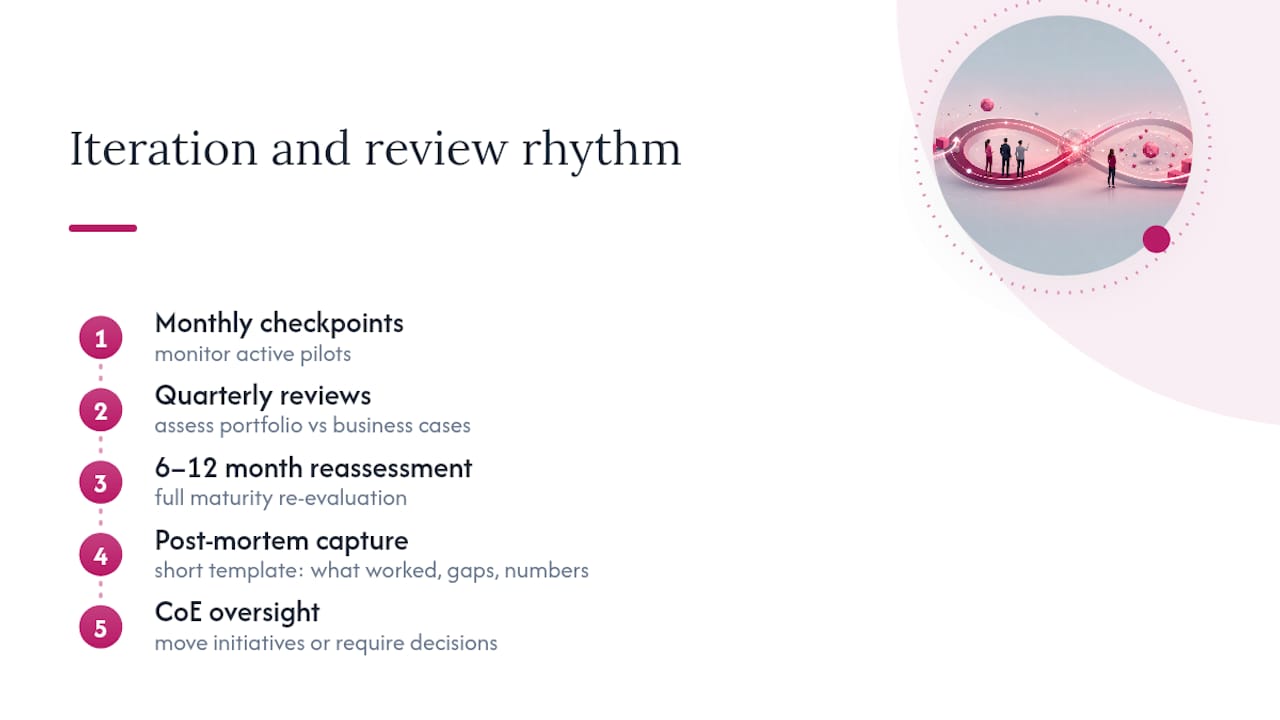
Build a formal review rhythm: monthly checkpoints on active pilots, quarterly reviews of the full portfolio against original business cases, and a full maturity re-assessment every 6 to 12 months. Each review should be able to move an initiative between horizons, not just report on its status. A use case that looked like a Horizon 3 transformative bet a year ago might prove feasible sooner than expected once your data foundation matures, or a use case with early promise might reveal integration costs that push it out of the current planning window entirely.
Capture lessons from every pilot, whether it succeeds or gets killed at a gate, in a format the next team can actually use. A failed pilot that never got documented teaches the organization nothing; the same integration problem resurfaces eighteen months later under a different project name. A short post-mortem template, what worked, what the data readiness gaps actually were, what the adoption numbers showed, turns every pilot into institutional knowledge rather than a one-off experiment.
The center of excellence is the natural owner of this iteration cycle, since it sits across every active initiative and can spot patterns no single project team would notice. Its job includes watching for use cases that are ready to graduate from pilot to scale, and just as importantly, initiatives that have quietly stalled and need a decision rather than another extension.
What Integration Problems Should You Expect?
Legacy systems rarely expose clean APIs, and that single fact derails more AI pilots than any modeling problem does. Before committing to a use case, audit whether the systems it needs to touch can actually exchange data with a modern AI platform, because retrofitting integration after a pilot has already proven the concept is expensive and slow.
Common integration failure points include authentication systems that weren’t built for machine-to-machine access, data formats that require heavy transformation before an AI system can use them, and organizational silos where the team that owns the legacy system has no incentive to prioritize your integration request. The technical problem is often the easier one to solve; the organizational one requires an executive sponsor willing to make integration support a stated priority for the owning team.
A platform architecture built with modular, well-documented interfaces makes this dramatically easier than a monolithic legacy stack where every integration is custom work. If your organization is early in Horizon 1, this is exactly the moment to evaluate platform direction with integration flexibility as a real criterion, not an afterthought weighed only after a vendor contract is signed.
Middleware and integration layers exist for a reason: they let you connect AI tools to legacy systems without rewriting the legacy system itself. Budget for this layer explicitly in Horizon 1 foundational work rather than discovering the need for it mid-pilot, when the discovery usually comes with a deadline attached.

How Do You Keep Business and Technical Teams Aligned?
Most roadmap friction traces back to one root cause: business leaders and technical teams are having two different conversations and calling it one. Business stakeholders talk in terms of outcomes and timelines; technical teams talk in terms of data quality and model constraints. Without a shared vocabulary, both sides walk away from the same meeting with different expectations.
Build a communication cadence with three distinct audiences. Executives need a monthly summary tied to the gate metrics and business outcomes they actually care about, not a technical status update. Technical teams need a working session, ideally biweekly, where blockers get surfaced and resourced before they become gate failures. End users need shorter, more frequent updates focused on what’s changing for them and why, since they’re the group most likely to disengage if communication goes quiet.
A shared dashboard showing adoption, cost, and business outcome data, visible to both business and technical stakeholders, removes a huge amount of translation friction. When the CFO and the engineering lead are looking at the same number instead of two different reports built by two different teams, disagreements shift from “whose data is right” to “what should we do about this,” which is a far more productive argument to have.
Document decisions in a place both audiences can access, and revisit them at each gate review. A decision made in a hallway conversation between one executive and one engineer has a way of getting reinterpreted differently by each side a month later. Written gate criteria, shared in advance and referenced at the review itself, keep that reinterpretation from happening.
The Uncomfortable Truth About Most AI Roadmaps
Most AI roadmaps fail quietly, not dramatically. Nobody announces the pilot is dead. Budget just stops flowing to it, and everyone moves on without a formal decision ever getting made. That’s worse than an honest failure, because nothing gets learned and nothing gets reallocated.
Three lessons show up over and over in client rollouts. First, the organizations that move fastest aren’t the ones with the biggest AI budgets, they’re the ones who measured adoption honestly from week one instead of assuming usage matched licenses purchased. Second, a CoE without measurement authority becomes a governance committee that approves things nobody tracks afterward. Third, the maturity assessment matters less as a diagnostic and more as a forcing function, it makes leadership commit to a gap analysis they can’t quietly ignore later.
Start with the assessment, name an owner before you name a use case, and bring your CFO into the KPI conversation early rather than after the first budget review goes sideways. If you want a structured way to see where your organization actually stands, a readiness conversation is a lower-stakes place to start than a pilot.
— TekkrTools
Turn Your Roadmap Into Something You Can Actually Measure
A roadmap is only as good as the evidence behind its gate decisions, and most organizations discover too late that nobody was tracking real usage, real cost, or real adoption once the initial rollout excitement faded. Some platforms track who’s actually using AI tools, break down spend by team, surface which use cases are gaining real traction, and drive adoption higher through gamified rollouts and company-wide playbooks, so the numbers feeding your decision gates are real instead of estimated.
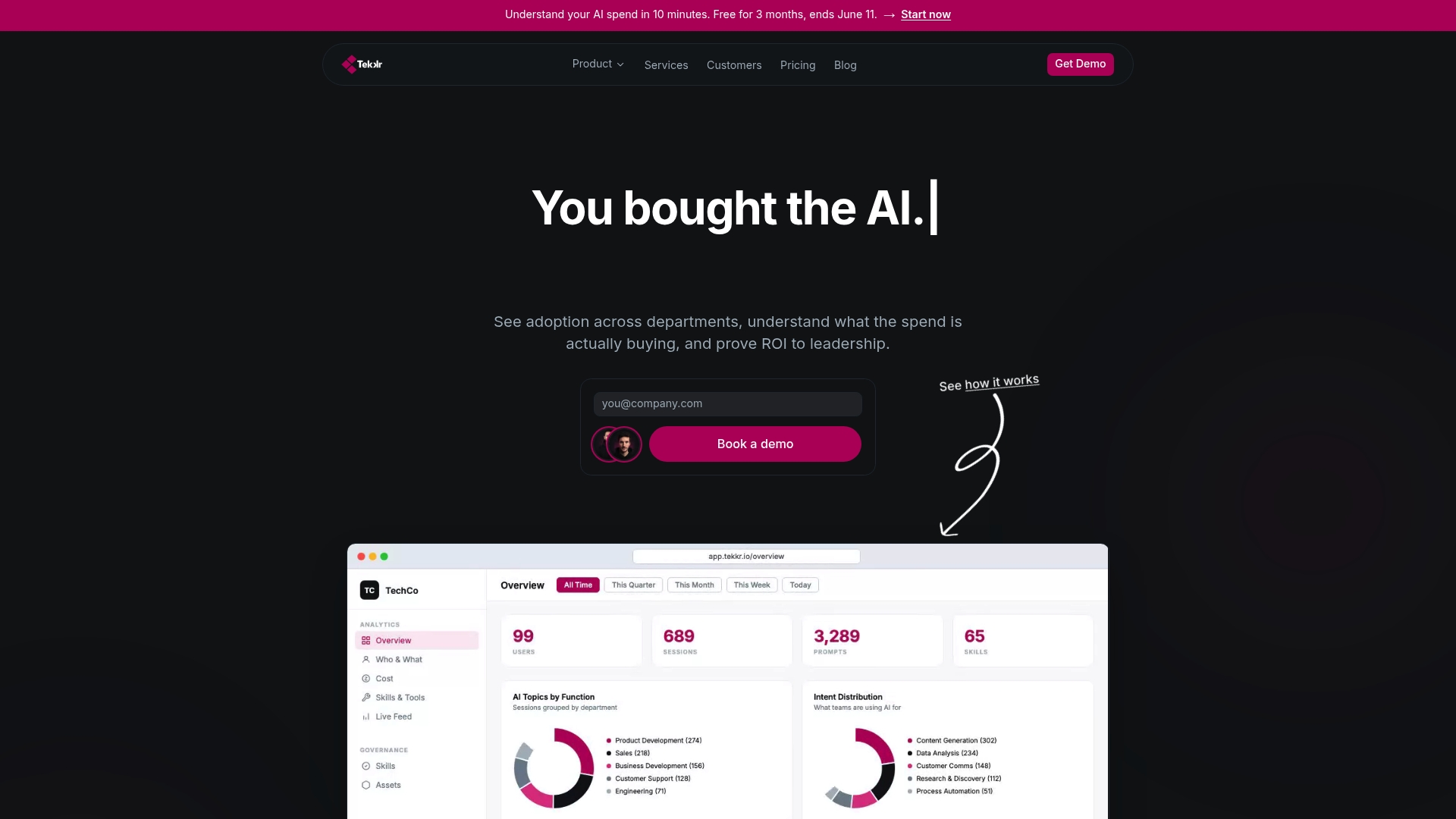
Some platforms run on a privacy-first, end-to-end encrypted architecture that’s GDPR-compliant and strip personal information from prompts automatically, with no browser extensions required. Setup is designed to be quick, and some offer a free tier with no credit card needed. Consulting services are also available from some providers for AI transformation strategy and rollout design. If your Horizon 1 foundations include a way to prove adoption is real, start with the AI adoption and Tekkr consulting solution and see what your organization’s actual usage data looks like.
Sources
- What’s your company’s AI maturity level? — MIT CISR
- AI Adoption Maturity Model — SEI/Carnegie Mellon
- AI Adoption Roadmap: The 5-Phase Plan for Enterprise AI Transformation — Thinking, Inc.
- The AI strategy roadmap — Five drivers of successful AI transformation — Microsoft