
Agentless usage analytics measures AI adoption, spending, and return on investment across an organization without installing endpoint agents or browser extensions. For executives, that means visibility into who is actually using tools like Claude or Codex, what each team spends, and whether the investment is paying off. The recommended next step is a scoped pilot: connect billing and identity data, define KPIs, and validate results before a wider rollout.
TL;DR:
- Agentless analytics quickly consolidates AI usage and cost data from APIs and billing records, enabling organizations to track spending without installing endpoint software.
- Focusing on one or two high-cost tools in a 30-day pilot allows organizations to identify waste such as idle prompts or high-retry patterns before broader deployment.
- Metrics should be set at the team level, and paired with outcome data, to effectively measure adoption, value, and detect wasted spend across different AI stacks.
- Data privacy measures, like anonymization and encryption, are essential to ensure compliance and build trust when tracking AI usage in sensitive environments.
- Setup can be completed within about 10 minutes using purpose-built tools, with a clear playbook for iterating from pilot to enterprise-scale measurement.
Table of Contents
- Why agentless usage analytics matters to enterprise leaders now
- How agentless architectures collect usage and cost data
- The metrics that matter for adoption, cost, and ROI
- A 30-day pilot playbook for fast implementation
- Aligning measurement with NIST AI RMF and enterprise requirements
- Realistic timelines for measuring AI ROI
- What pilots actually teach executive teams
- Getting started with Configurato for agentless analytics
- Primary sources and further reading
- Sources
- FAQ
Why agentless usage analytics matters to enterprise leaders now
GenAI budgets keep climbing. A large majority of enterprise leaders expect increased GenAI spending over the next year, with many anticipating growth rates hitting at least double-digit percentages, according to the 2025 AI Adoption Report from Knowledge at Wharton. Yet the same report found that a significant portion of leaders consider traditional business metrics insufficient for capturing AI’s actual impact, even though many say they formally track GenAI ROI in some form.
That gap between spending confidence and measurement confidence is the problem agentless analytics addresses. Vendor dashboards only show what happens inside one tool, and siloed telemetry leaves finance and engineering working from different numbers.
- Vendor-native dashboards rarely reconcile with actual cloud billing or headcount data.
- Board-level accountability now requires a single, auditable view of AI spend and outcomes.
- Finance teams need cost allocation by team and use case, not aggregate vendor invoices.
Wharton’s research also points to a fix: successful programs build one system of record for AI usage that unites finance and engineering, which is exactly what surfaces wasted spend like high retry rates or unused prompt caches.
How agentless architectures collect usage and cost data
Agentless usage analytics pulls data from the systems that already exist, rather than installing software on every employee’s device. Provider API logs, cloud billing exports, and identity systems each contribute a piece of the picture, and Snowflake’s documentation on AI cost governance describes this as the standard pattern: server-side monitoring and billing reconciliation instead of endpoint instrumentation.
- Ingest usage data through provider APIs and server-side logs rather than device software.
- Reconcile that usage against cloud billing records to attribute real dollar costs.
- Connect identity and SSO systems so consumption maps to teams, not just individual logins.
- Normalize the data across different AI stacks, including internal models, Claude, Codex, and other provider APIs, into one reporting layer.
Provider-agnostic, API-driven collection also avoids the lock-in that comes with relying on a single vendor’s native reporting, and it scales across heterogeneous tool stacks without asking every team to standardize first.
There are limits worth naming. Without an agent on the device, you cannot capture local file activity or offline usage, and some nuance in how a person actually works with a tool is lost. What you gain is usage and cost data that is consistent, auditable, and far faster to deploy across a large organization.
Pro Tip: Start with the two or three AI tools that carry the largest bill, not the longest list of integrations, and expand from there.
The metrics that matter for adoption, cost, and ROI
Three categories of metrics cover most of what an executive team actually needs. Adoption metrics show who is using what: active users, sessions per user, use-case penetration, and how quickly new hires activate. Cost metrics show where the money goes: cost by team, cost per use case, token or session costs, and the retry or wasted spend that inflates invoices without adding value. Outcome metrics connect usage to results: time saved, throughput improvement, revenue influence, and cost avoidance.
- Track adoption at the team level, not just company-wide, since penetration varies widely by function.
- Report cost per use case alongside total spend so finance can compare value, not just outlay.
- Pair every cost figure with an outcome metric so a dashboard shows spend and payoff together.
One system of record for AI usage unites finance and engineering data and is what lets teams spot wasted spend such as high-retry patterns or idle prompt caches, according to Wharton’s 2025 AI Adoption Report.
Chargeback or showback models built on these metrics work best on a monthly cadence, tight enough to catch runaway spend before a quarterly review, loose enough to avoid noise from daily usage swings. Dashboards similar to Databricks Governance Hub’s active-user and AI-spend tiles illustrate the kind of reporting executives now expect as a baseline, not an add-on.

A 30-day pilot playbook for fast implementation
A focused pilot beats a sprawling rollout. The goal is a working dashboard with real numbers inside 30 days, not a six-month integration project.
- Define the scope: pick two or three teams and the KPIs that matter most to them.
- Connect provider API ingestion, cloud billing, and SSO or identity data first.
- Apply tagging so usage maps cleanly to cost centers and use cases.
- Set anonymization, encryption, retention, and access controls before any data flows.
- Run the pilot for 30 days, establish a baseline, and validate that the numbers match finance’s own records.
Tools built specifically for this, such as Tekkr’s Configurato, claim setup in around 10 minutes with no browser extensions required, and Tekkr also publishes a 30-day AI use case analytics playbook that walks through the same sequence for teams that want a template rather than a blank page.
Pro Tip: Lock in your PII and retention policy before the pilot starts, not after the first dashboard goes to the board.
Aligning measurement with NIST AI RMF and enterprise requirements
The NIST AI Risk Management Framework’s generative AI profile defines a Measure function that calls for repeatable metrics, testing, and documentation to inform management action. Agentless usage analytics fits neatly into that function: it turns adoption and cost data into the kind of continuous, auditable evidence NIST expects, feeding directly into the Manage function where leaders act on what measurement reveals.
- Anonymize or strip personally identifiable information from prompts before they reach any dashboard.
- Encrypt data end to end and apply role-based access control so only the right people see spend by team.
- Set clear retention periods rather than storing usage data indefinitely.
- Document supplier practices and data flows so the program holds up under an internal or external audit.
NIST recommends treating measurement as a continuous governance activity with periodic review, not a one-time report, which matters when regulators or auditors ask how AI risk is being tracked. Industry surveys back this shift: KPMG’s Q3 2025 AI pulse survey found organizations moving AI from experiments into production increasingly treat measurement as accountability, using it to surface emergent risks and calibrate spending policy.
Realistic timelines for measuring AI ROI
ROI timing depends heavily on what kind of AI initiative you’re measuring. Deloitte’s analysis of AI ROI found that GenAI productivity projects tend to show value faster, while agentic AI initiatives often take one to five years, and currently only around 10% of organizations report significant ROI from agentic AI specifically. Executives should set different KPI timeframes for each category rather than judging both against the same clock.
- Build a baseline before rollout so any later gain has something real to compare against.
- Attribute impact with targeted experiments, comparing before and after usage on a narrowly scoped use case.
- Run sensitivity checks on your assumptions before presenting a dashboard as a final ROI number.
Only about 10% of organizations report significant ROI from agentic AI so far, according to Deloitte, which makes patience and staged measurement more useful than a single early verdict.
The common pitfall is attributing productivity gains to a tool without a baseline or a control group. Agentless analytics helps here simply because the usage and cost data already exist in one place, so attribution work starts from consistent numbers instead of guesswork across separate vendor reports.
What pilots actually teach executive teams
Pilots that work tend to be narrow: two teams, one dashboard, thirty days. The quick wins, like catching wasted spend on unused seats or high-retry usage, build enough trust to justify expanding scope. Privacy-first, agentless approaches also cut rollout friction because IT and legal don’t need to approve device-level software before a pilot can start. Run the playbook, look at the baseline honestly, and iterate from there rather than waiting for a perfect measurement plan.
— TekkrTools
Getting started with Configurato for agentless analytics
Certain analytics platforms track who is really using tools like Claude and Codex, break costs down by team, and surface use-case intelligence without installing anything on employee devices. They run on privacy-first, end-to-end encrypted architectures that are GDPR-compliant and strip PII from prompts automatically, with no browser extensions required.
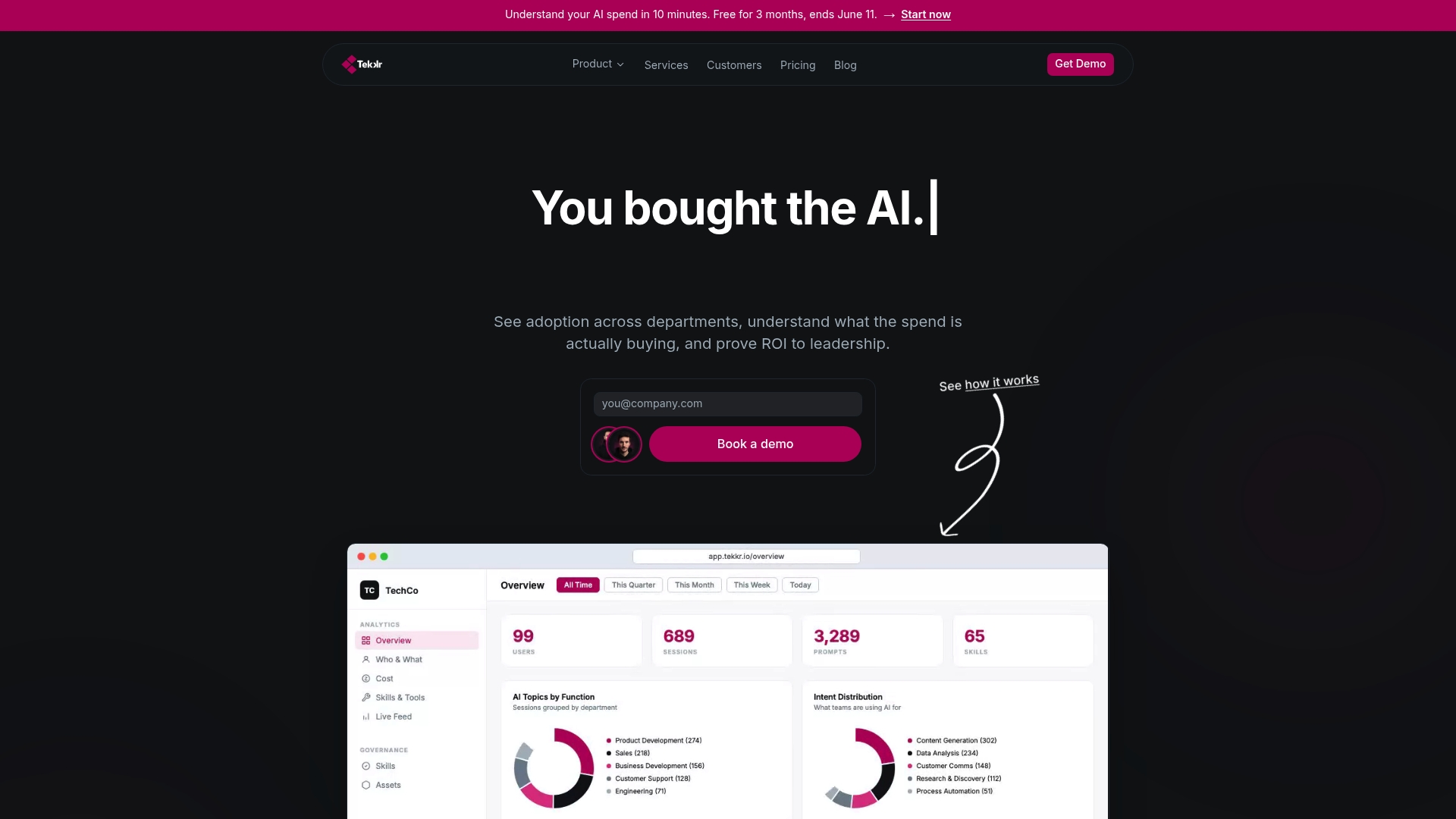
Setup takes about 10 minutes, and a free tier is available with no credit card required, which matters if your team wants to see real numbers before committing to anything larger. Beyond the dashboard, Configurato drives adoption itself through gamified rollouts and company-wide playbooks, so measurement turns into actual usage rather than a report nobody acts on. For teams that want hands-on help designing the rollout, Tekkr’s AI Adoption Programs pair the software with a structured playbook. Check Configurato’s product page or view pricing to see which option fits your team’s next 30 days.
Primary sources and further reading
This article draws on the 2025 AI Adoption Report from Wharton, the NIST AI RMF generative AI profile, KPMG’s Q3 2025 AI pulse survey, and Deloitte’s AI ROI analysis. For related benchmarking, see this partner analysis of AI productivity ROI.
Sources
- 2025 AI Adoption Report: Gen AI fast-tracks into the enterprise - Knowledge at Wharton
- KPMG AI quarterly pulse survey Q3 2025
- Artificial Intelligence Risk Management Framework: Generative AI profile (NIST)
- Snowflake Cortex: AI cost management and governance
- AI ROI: the paradox of rising investment and elusive returns — Deloitte
FAQ
What does “agentless” mean in usage analytics?
Agentless means the system collects usage and cost data through provider APIs, cloud billing records, and identity systems rather than installing software on employee devices. This avoids the deployment friction and privacy concerns that come with endpoint agents or browser extensions.
How long does it take to see ROI from AI tools?
Timelines vary by initiative type. Deloitte’s research found GenAI productivity projects tend to show value faster, while agentic AI initiatives often take one to five years to produce measurable returns.
How does agentless analytics support AI governance requirements?
It feeds the Measure function in the NIST AI Risk Management Framework generative AI profile, which calls for repeatable metrics, testing, and documentation to inform management action. Centralized usage and cost data give governance teams the continuous evidence auditors and regulators expect.
How fast can a company set up agentless usage tracking?
Setup speed depends on the tool, but platforms built specifically for this task can connect within a short window rather than requiring months of integration work. Configurato, for example, is designed for setup in about 10 minutes with no browser extensions needed.