
Agentless AI analytics measures who uses enterprise AI tools, how much is spent, and the return on those investments, without installing endpoint agents or browser extensions. It works through API logs, identity events, and billing connectors instead of software on every device, so most organizations can connect their first data sources and surface usage and spend signals within days rather than quarters.
TL;DR:
- Most enterprises can connect their AI usage and spend data within days by integrating existing logs from API providers, billing systems, and identity services.
- Visibility into actual tool adoption and ROI helps reduce shadow subscriptions, optimize renewal decisions, and prioritize use cases with proven value.
- Privacy considerations are built into agentless analytics through encryption, automatic PII stripping, and GDPR-compliant data handling, enabling quick legal approval.
- Key metrics for tracking AI success include active user counts, spend breakdowns, cost per outcome, and a defined return-on-AI ratio, with early indicators predicting sustained adoption.
- A 30-day setup plan involves selecting use cases, connecting data sources, launching pilots, and producing initial ROI reports, with early wins accelerating broader adoption.
Table of Contents
- What agentless AI analytics means in practice for enterprises
- Why it matters: outcomes agentless analytics unlocks for enterprise leaders
- How agentless analytics captures usage, cost, and outcomes without installing agents
- Key metrics and KPIs leaders should track on the RoAI dashboard
- 30-day starter: a checklist to stand up agentless analytics
- Tactics that use analytics to increase adoption and sustainable ROI
- Perspective from TekkrTools: realistic expectations and common pitfalls
- How Tekkr helps you measure and increase AI adoption, spending, and RoAI
- FAQ
- Sources
- Selected authoritative reports and studies
What agentless AI analytics means in practice for enterprises
Agentless AI analytics is the measurement layer that tells you who is actually using tools like Claude or Codex, what each team spends, and whether that spend produces results. It is distinct from device or network monitoring: nothing installs on an endpoint, and no browser extension tracks individual clicks. Instead, the system pulls signal from systems that already exist.
Inside most enterprises, three groups own this data. The CFO wants spend visibility by cost center. The CIO or AI transformation lead wants adoption and governance data. Product owners want to know which workflows actually improved.
Typical integration points include:
- API usage logs from AI providers and internal gateways
- Single sign-on and identity provider events for attribution
- Billing and procurement connectors for spend data
- Collaboration tools where AI features get embedded
That combination lets a team see usage and cost together, without chasing manual spreadsheets across departments.
Why it matters: outcomes agentless analytics unlocks for enterprise leaders
Most enterprises buy AI tools faster than they can account for them, which creates shadow subscriptions, duplicated licenses, and budget nobody can fully explain. Visibility fixes that first: once leaders can see who actually opens a tool each week versus who was issued a license, renewal decisions get easier and cheaper.
A large majority of enterprise decision-makers now use generative AI weekly, according to the 2025 AI Adoption Report from Wharton, and most of them already track some form of ROI metric. That means the pressure to measure spend and return is already the norm at the leadership level, not a future requirement.
Visibility also reshapes prioritization. Instead of funding every pilot equally, teams can:
- Redirect budget toward use cases with proven repeat usage
- Cut licenses for tools with low adoption before renewal
- Flag teams needing enablement rather than more software
Deloitte’s research adds a timing reality check: most organizations see satisfactory ROI on a typical AI use case within two to four years, which argues for measurement systems built for a multi-year view rather than a single quarterly snapshot.
How agentless analytics captures usage, cost, and outcomes without installing agents
The system observes activity where it already exists: API calls to AI providers, billing records from procurement, and identity events from SSO. Nothing runs on an employee’s laptop or browser. Each event gets mapped to a person, team, and use case using identity data already present in the directory.
The mechanics generally follow this path:
- Connectors pull usage and billing data from AI providers and internal systems
- API-layer telemetry logs calls, tokens, and cost without touching the endpoint
- Mapping logic ties each event to a team, department, or use case
- Anonymization strips or tokenizes any user-entered text before it is stored
Deterministic mapping, using employee IDs from the identity provider, handles most attribution; probabilistic mapping fills the gaps, and low-confidence matches get flagged for manual review rather than guessed.
Privacy controls matter as much as the data itself. End-to-end encryption, automatic PII stripping at ingestion, and GDPR-aligned data handling let legal and privacy teams sign off without a lengthy review cycle, since raw prompts never reach storage in readable form.
Pro Tip: Loop legal and privacy review into the connector setup stage, not after launch, so compliance questions never stall the first report.
For a deeper look at the mechanics of attribution, see this guide to AI usage tracking.
Key metrics and KPIs leaders should track on the RoAI dashboard
A useful dashboard answers three questions: who is using the tools, what it costs, and what it returns. Overloading it with every available metric defeats the purpose.
- Active users and usage depth: track daily, weekly, and monthly active users (DAU/WAU/MAU) to separate real adoption from a one-time login.
- Spend by team: break out subscription and API costs by department so finance can see where budget actually goes.
- Cost per outcome: tie spend to a measurable result, hours saved, tickets resolved, content shipped, rather than raw usage alone.
- RoAI: define return on AI as the ratio of measured outcome value to total AI spend for a given use case, and keep the formula consistent across teams.
- Leading indicators: enablement completion, leaderboard participation, and repeat-use rate predict whether adoption will stick before RoAI numbers mature.
A one-page executive summary should show adoption trend, spend trend, and one or two RoAI figures per priority use case, nothing more. For dashboard templates, this guide to executive AI dashboards offers layout examples worth adapting.
30-day starter: a checklist to stand up agentless analytics
A working analytics program does not need a quarter to show value. A tight, sequenced month gets most enterprises to a first real report.
- Week 0 to 1: pick two or three priority use cases, name an owner for each, and inventory existing AI tooling and billing contracts.
- Week 2: connect API, SSO, and billing data sources, and configure team mappings with PII stripping and encryption enabled from the start.
- Week 3: finalize the KPI list, launch a pilot with a small group, and introduce gamified enablement to drive early engagement.
- Week 4: compile the first RoAI report for executives, covering adoption, spend, and outcome signals, then decide what scales.
Pro Tip: Run the pilot with a team that already has an enthusiastic champion. Early wins spread faster through a willing team than a mandated one.
A more detailed version of this sequence lives in this 30-day AI use case analytics playbook.
Tactics that use analytics to increase adoption and sustainable ROI
Measurement only pays off when it changes behavior. Usage data tells you exactly where to intervene next.
- Build gamified rollouts and leaderboards around the use cases with the strongest early RoAI signal, not the ones with the loudest internal advocates.
- Target micro-learning and short training sessions at teams showing high license counts but low repeat usage, since that gap usually points to a skills issue rather than a tool issue.
- Publish team-level playbooks drawn from your highest performers’ actual workflows, so adoption spreads from evidence rather than guesswork.
- Align incentives across finance, product, and IT: finance tracks spend efficiency, product tracks outcome quality, IT tracks security and uptime, and all three need the same underlying data.
These tactics work best when they come from current data rather than a one-time launch campaign. For more structured tactics, see this guide to AI adoption strategies.
Perspective from TekkrTools: realistic expectations and common pitfalls
Generative and agentic AI need different ROI clocks. Generative tools tend to show productivity gains within months; agentic systems that redesign a process often take longer, and judging them on the same timeline sets leaders up to kill a promising project early.
The most common mistake is counting raw API calls and calling it adoption. A spike in calls can mean genuine use or a single automated script running in a loop. The second most common mistake is skipping enablement: tools without training plateau fast, no matter how good the dashboard looks.
Governance works best as a shared responsibility. Finance, product, and IT each hold a piece of the picture, and a program that reports to only one of them tends to miss the other two.
— TekkrTools
How Tekkr helps you measure and increase AI adoption, spending, and RoAI
A product called Configurato addresses the problem this article describes: enterprises buy AI tools faster than they can measure them. It tracks usage of tools, breaks down spend by team, and surfaces use-case intelligence so leaders see exactly where AI is working and where it is not.
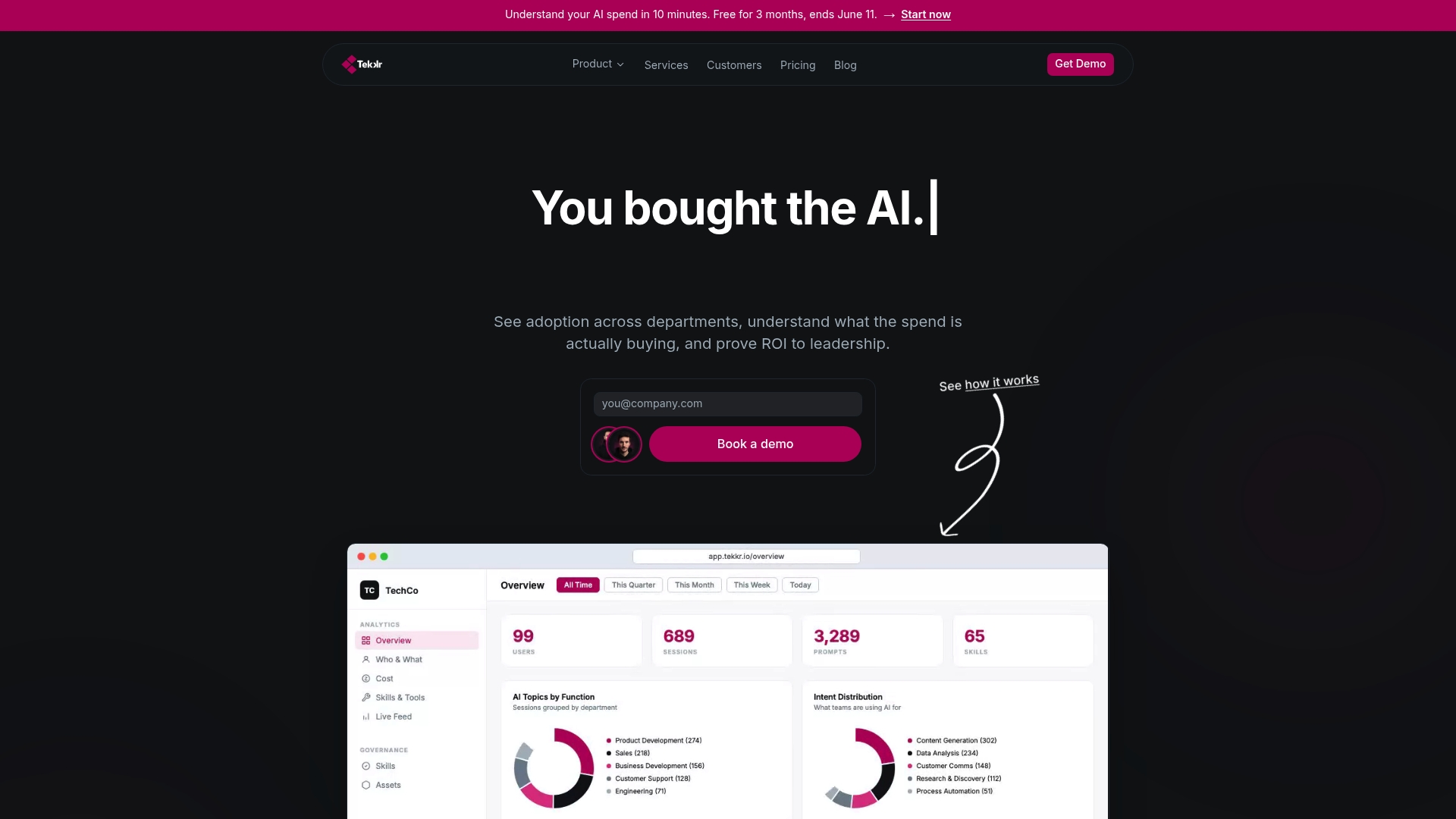
The architecture is privacy-first by design with end-to-end encryption, automatic PII stripping, and GDPR-aligned data handling, with no browser extensions required. Setup takes a short time, and a free tier is available without a credit card, making the 30-day starter plan realistic rather than aspirational. Gamified rollouts and company-wide playbooks are built in, so adoption measurement and improvement run from the same system.
Full details live on the Configurato product page, and plan information is on the pricing page. Start with the free tier to see your own usage and spend data before committing to anything further.

FAQ
What is agentless AI analytics, in simple terms?
Agentless AI analytics measures who uses enterprise AI tools, what they cost, and what return they produce, using existing data sources like API logs, billing records, and identity events rather than software installed on each device. It avoids endpoint agents and browser extensions entirely.
How long does it take to see a return on AI investment?
Most organizations see satisfactory ROI on a typical AI use case within two to four years, though generative AI tools often show productivity gains sooner than agentic systems that redesign entire workflows. Early adoption signals, such as repeat usage, can appear within the first 30 days.
What metrics matter most for tracking enterprise AI adoption?
Active user counts (daily, weekly, monthly), spend by team, cost per outcome, and a consistent RoAI definition form the core of most executive dashboards. Leading indicators like enablement completion and repeat-use rate help predict adoption trends before RoAI numbers fully mature.
Does agentless analytics require installing software on employee devices?
No. Agentless analytics pulls data from API logs, single sign-on events, and billing connectors instead of installing agents or browser extensions on endpoints. Configurato, for example, needs about ten minutes to set up and avoids endpoint software entirely.
How does agentless analytics stay compliant with privacy regulations?
Agentless systems typically strip or tokenize personally identifiable information at the point of ingestion, encrypt data end to end, and align with regulations like GDPR before any prompt content reaches storage. This lets legal and privacy teams review the setup without months of back and forth.
Sources
- The state of AI: How organizations are rewiring to capture value (McKinsey, 2025)
- 2025 AI Adoption Report: Gen AI fast-tracks into the enterprise (Wharton)
- AI ROI: The paradox of rising investment and elusive returns (Deloitte, 2025)
- 2025 State of Enterprise AI Adoption (ISG)
Selected authoritative reports and studies
These reports informed the adoption, ROI, and measurement guidance in this article and are worth consulting directly for deeper benchmarking.
- 2025 AI Adoption Report: Gen AI fast-tracks into the enterprise (Wharton): weekly and daily generative AI usage among enterprise decision-makers.
- The state of AI: How organizations are rewiring to capture value (McKinsey, 2025): governance structures linked to AI impact.
- AI ROI: The paradox of rising investment and elusive returns (Deloitte, 2025): realistic ROI timelines for AI use cases.
- 2025 State of Enterprise AI Adoption (ISG): production adoption rates and revenue impact gaps.