
Finding an ai adoption analytics platform that tracks real-time usage and cost while supporting nontechnical teams is difficult. Many platforms hide pricing, lack clear integration support, or focus only on technical teams without offering plain English dashboards. This comparison lists five alternatives so product managers, engineering leaders, and compliance officers can select a platform that fits operational, technical, or reporting needs.
Table of Contents
Configurato
At a Glance
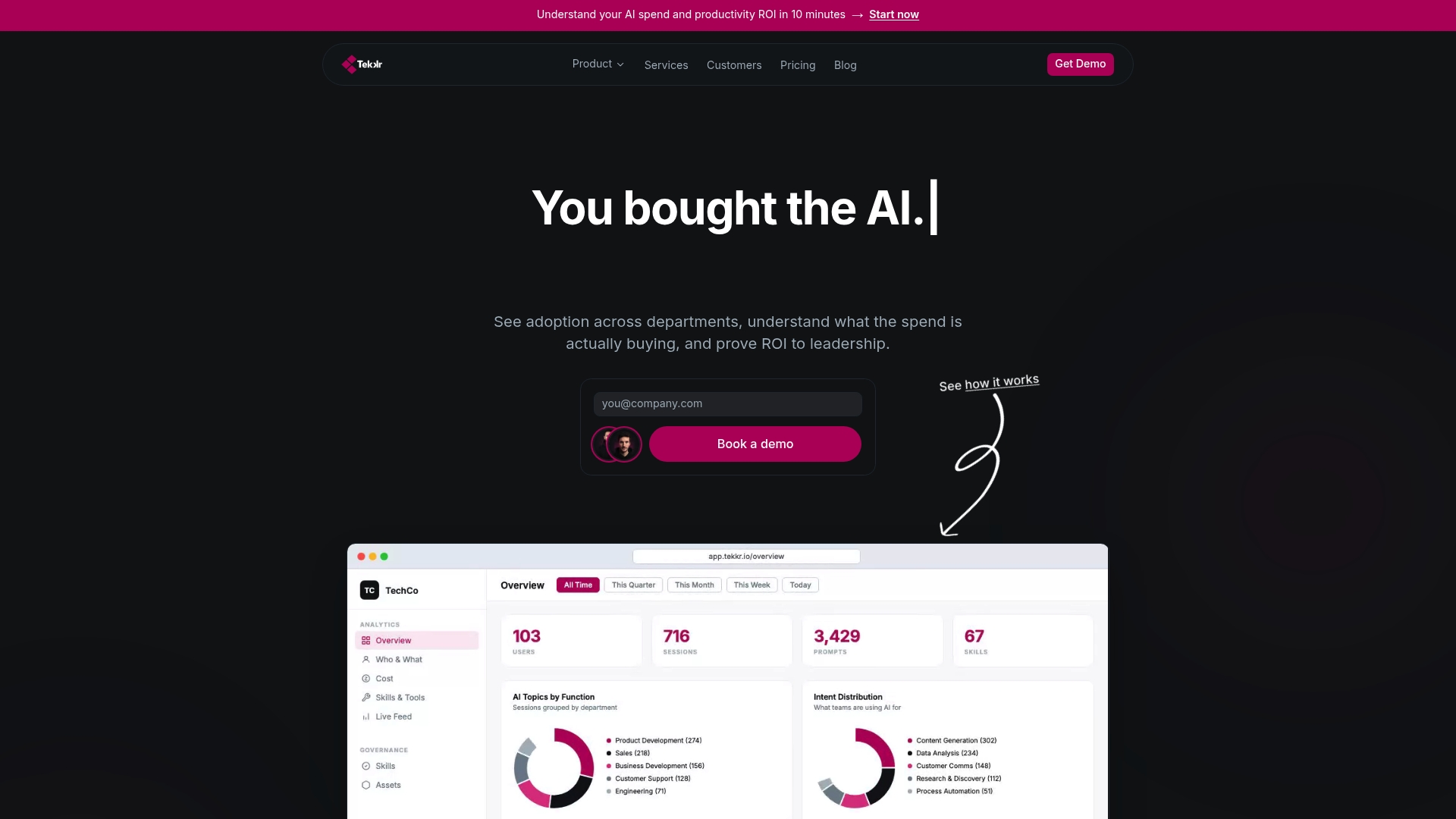
Configurato includes a free tier for 30 days with unlimited users. The product reports real-time adoption tracking and cost allocation by department and use case. Configurato advertises GDPR compliance and EU hosting standards, which matters for multinational deployments.
Core Features
Configurato tracks adoption in real time and surfaces ROI on AI investments with cost allocation dashboards. It enforces company-wide AI governance through standardized playbooks and gamified enablement to drive adoption. The platform connects to multiple assistants and captures telemetry via MCP and OpenTelemetry to avoid vendor lock in.
Key Differentiator
The clearest distinction is support for multiple AI assistants through the MCP open standard. That approach lets teams manage governance and analytics without tying themselves to a single vendor. As a result, Configurato treats assistants like interchangeable services rather than fixed dependencies.
Pros
Configurato is vendor independent and supports major assistants while retaining telemetry control through OpenTelemetry. It reports adoption, spend, and ROI in dashboards that break costs down by team and use case, and it provides governance features to roll out consistent company playbooks. The product requires no browser extensions or proprietary agents, and it offers both a free tier and enterprise licensing options.
Cons
- Requires technical setup and integration knowledge, which may lengthen initial deployment for teams without engineering resources.
Notable Integrations
- Claude — native connector for assistant telemetry and usage data.
- Codex — integration for developer-focused assistant workflows.
- OpenTelemetry — captures telemetry for vendor-independent observability.
Who It’s For
Tech leaders and operational executives at scale ups and enterprises who need to measure and govern AI tool usage will find Configurato useful. The platform suits organizations with multiple AI assistants and the engineering capacity to integrate telemetry. Smaller teams without a technical integrator may find it more complex than they need.
Unique Value Proposition
Using MCP to link assistants lets teams measure and allocate AI spend across vendors while keeping governance centralized. That model reduces vendor lock in and makes procurement decisions comparable across assistants. For finance and IT teams, this translates to clearer cost attribution and simpler enforcement of company AI rules.
Real World Use Case
A multinational rolled out Configurato to monitor assistant usage across R&D, product, and support. The dashboard showed which teams consumed the most credits, and the company applied playbooks to standardize prompt handling and privacy rules. That rollout tightened compliance and clarified which use cases justified additional licenses.
Pricing
Configurato offers a free tier for 30 days with unlimited users. The Pro plan starts at €990 per month for expanded features and capacity. Enterprise pricing is customized for large deployments and negotiated directly with the vendor.
Website: https://tekkr.io
Statsig
At a Glance
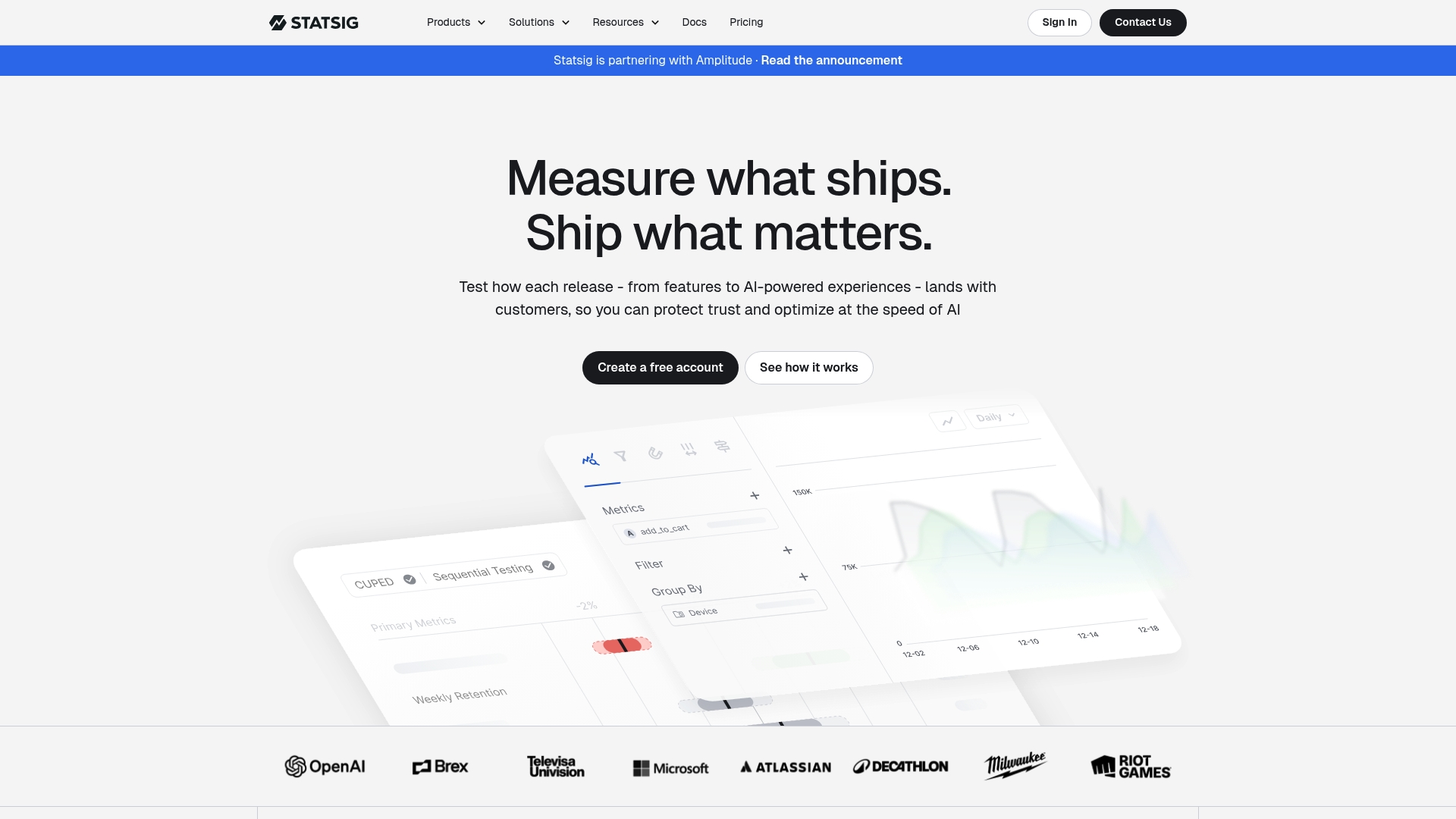
Statsig’s marketing materials state the platform can handle trillions of events and billions of users. That claim frames its pitch for enterprises that need high-throughput experimentation and feature control. The platform bundles experimentation, feature flags, analytics, and session replay into one environment.
Core Features
Statsig combines product metrics and analytics with an experimentation engine that supports A/B testing, multivariate tests, Bayesian methods, bandit tests, and sequential testing. It adds feature flag management with targeting and rollout controls and session replay to inspect user flows and engagement. The product also provides SDKs across languages and a no-code editor for setting experiments and configs.
Key Differentiator
Statsig centers on a single integrated stack that keeps experiments, flags, analytics, and replay in one place. That integration reduces context switching between tools and centralizes experiment telemetry and rollout state. The vendor positions that architecture for large scale and enterprise deployments.
Pros
The platform unifies several product workflows, so engineering and product teams can run experiments and manage rollouts without moving data between services. It advertises advanced testing options that cover simple A/B tests through multi-arm bandit and sequential approaches, which helps teams try more precise techniques. The vendor also highlights integrations with data warehouses and a broad set of SDKs, which supports both analytics teams and backend engineers.
Cons
- Pricing details are not published in the product copy. Costs may scale significantly at enterprise volumes.
- Public materials omit explicit limits and edge case behaviors. Buyers should confirm event retention, SLA guarantees, and data pipeline specifics before committing.
- The available content emphasizes technical capability over step-by-step onboarding for nontechnical teams. Product managers may need vendor support for complex setups.
When It May Not Fit
If you require transparent, line-item pricing up front, this vendor may not fit because the site defers pricing to the sales or pricing page. If your experiment volume is modest, the value of a unified enterprise-grade stack may not justify the investment. Organizations that need a lightweight experiment runner or embedded time tracking should evaluate simpler alternatives.
Who It’s For
Mid-size to large tech companies and data-driven product teams will get the most value from this platform. Teams that run frequent experiments, manage gradual rollouts, and need single-source telemetry for decisions align well with the product. Engineering-led organizations that can operate SDKs and pipelines will move fastest.
Real World Use Case
According to Statsig, Brex’s data teams achieved a 50 percent time efficiency gain by consolidating product data, experimentation, and analytics in one platform. That case shows how centralizing telemetry and experiments can shorten analysis cycles. Teams that measure time-to-insight should weigh that outcome against their current tooling overhead.
Pricing
Pricing is available on the vendor website and is presented by tier or custom enterprise engagement. Visit the pricing page to review plans and request an enterprise quote.
Website: https://statsig.com
Winningstrategy.ai
At a Glance
This site serves as a focused documentation hub for Cloudflare challenge troubleshooting and developer guides. It collects stepwise debugging instructions for challenge loops and verification failures. The material centers on implementing challenge pages and resolving bot detection issues.
Core Features
The resource offers detailed troubleshooting steps and developer-facing documentation that explain challenge behavior across browsers and networks. It includes guides for implementing challenge pages and references for Turnstile CAPTCHA integration. The site also links to community and support channels for follow up.
Key Differentiator
What sets this resource apart is its direct focus on Cloudflare challenge mechanics and verification workflows. The content organizes implementation notes and troubleshooting tactics around Cloudflare services and Turnstile CAPTCHA references.
Pros
The documentation supplies hands on troubleshooting steps that address common challenge loops and verification failures. Developer resources include code examples and environment notes that help reproduce and fix issues across browsers. The site points readers to community and support channels, which helps when the documentation alone does not resolve an edge case.
Cons
-
No commercial product or dashboard: the site does not offer a hosted tool or user interface for managing challenges. This limits operational use.
-
No pricing or subscription model: there is no purchasing path or support contract described for teams that need service level commitments.
-
Limited integration details: the material references implementation but does not describe APIs or plug and play integrations beyond documentation examples.
-
Documentation focus only: the site lacks a client portal or analytics view for tracking challenge resolution across multiple sites.
When It May Not Fit
Teams that need a managed product or a control plane for challenge management will find this resource lacking. Enterprises seeking SLA backed support or consolidated dashboards should look elsewhere. Organizations that require explicit integration details or automation hooks will not get those from this documentation hub.
Who It’s For
Web developers, IT security teams, and site administrators who troubleshoot Cloudflare challenge behavior will get the most value. Engineers implementing Turnstile CAPTCHA or debugging verification loops will find the code examples and browser notes useful. Small teams without a need for commercial support can use the site as a practical reference.
Real World Use Case
A website administrator sees repeated challenge loops for some visitors after a CDN change. They follow the stepwise debugging guide to test browser cookies, IPv6 settings, and proxy behavior. The administrator uses the site references to adjust challenge settings and confirms resolution across affected browsers.
Website: https://winningstrategy.ai
Variant
At a Glance
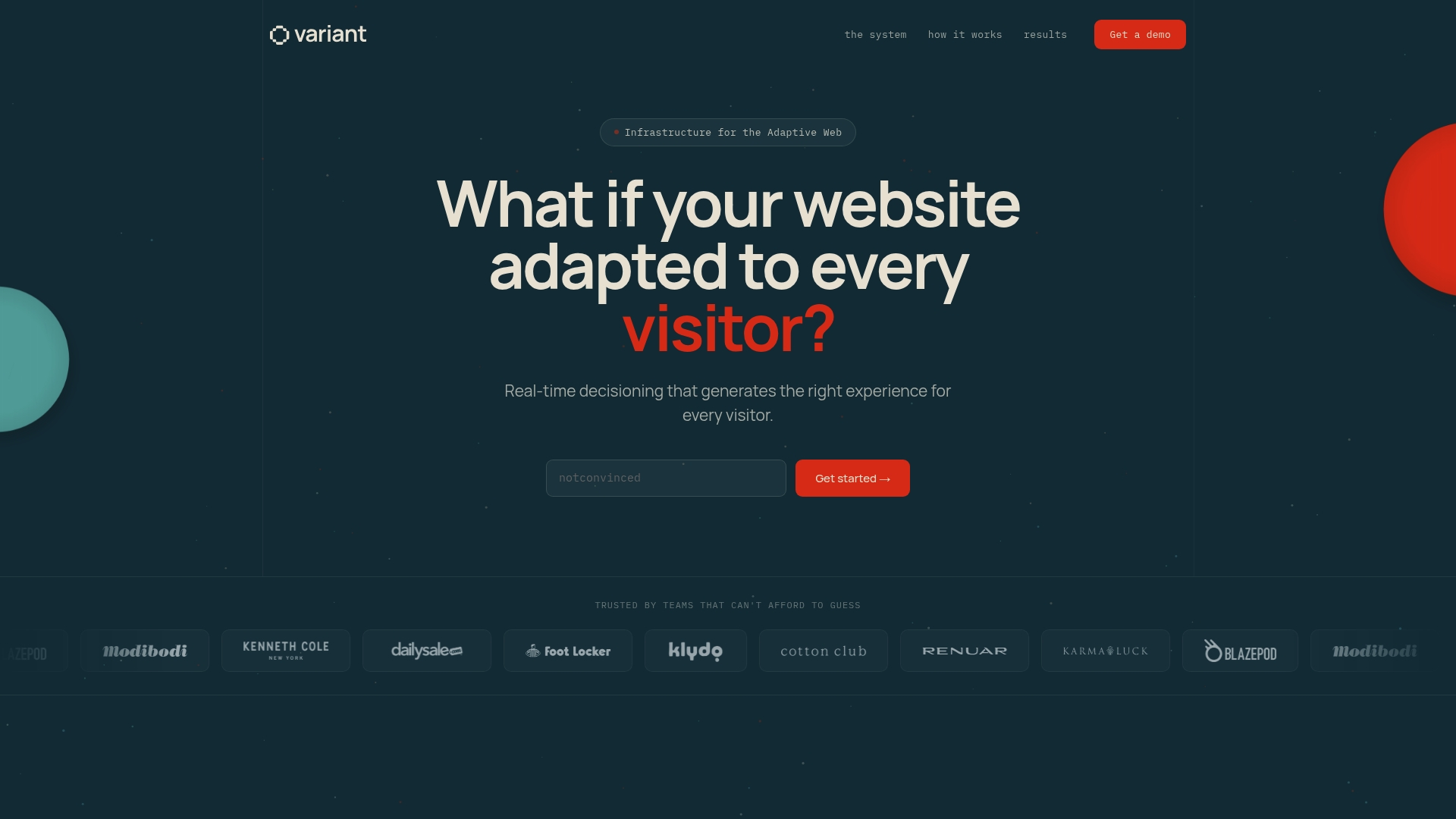
Foot Locker and Cotton Club use Variant to run rapid experiments across their online stores. The platform automates experiment creation and personalizes pages in real time based on visitor behavior. That combination aims to move testing from idea to live variant with minimal engineering time.
Core Features
Variant analyzes visitor behavior to surface high impact opportunities and then builds and launches experiments automatically. The platform includes Research Agent for behavior analysis, Dev Agent for quick experiment deployment, and a Compound system that learns from prior tests to improve future results. It also detects hesitation points and bounce triggers and applies real time personalization across segments.
Key Differentiator
Variant’s main distinction is its focus on automated detection of visitor patterns and autonomous experiment creation. This approach reduces manual hypothesis work and hands off repetitive setup to the system. Teams that want rapid cycles of test design, launch, and automated learning will find that workflow the clearest difference compared with traditional A B testing tools.
Pros
Variant automates complex optimization tasks so nontechnical teams can run experiments without heavy engineering support. The learning loop means experiments evolve with visitor behavior, which shortens the time between a test and a measurable uplift. Real time personalization for different segments helps capture visitors at key moments and converts hesitation into purchases.
Cons
- Limited transparency or manual control over optimization processes may not suit advanced users.
- Customization depth appears constrained for very large or highly complex websites.
- Teams needing highly granular, niche personalization might find the AI driven approach less flexible.
When It May Not Fit
If your product requires fine grain manual control of every experiment parameter, Variant may feel restrictive. Large enterprise sites with bespoke checkout flows could need deeper customization than Variant lists. Teams that require detailed audit trails of every decision step may prefer a tool with more explicit manual controls.
Who It’s For
E-commerce product managers and growth teams that want AI driven website optimization without heavy technical overhead will find Variant relevant. Digital marketing teams that run frequent campaign tests and need fast turnarounds will benefit from its automated setup. Organizations with limited engineering resources will see the biggest operational gains.
Real World Use Case
A footwear retailer used Variant to detect hesitation on product pages and to test alternate add to cart flows across high traffic categories. The platform identified a common bounce trigger and deployed variants that addressed it within days. The team kept running follow up experiments using the system’s learning model to refine offers and checkout prompts.
Pricing
Variant does not list public pricing. Pricing appears to be custom and likely based on enterprise needs or feature scope, so vendors typically request a demo or sales conversation. Contacting sales is the documented path to get a tailored quote.
Website: https://variantnow.com
Configur
At a Glance
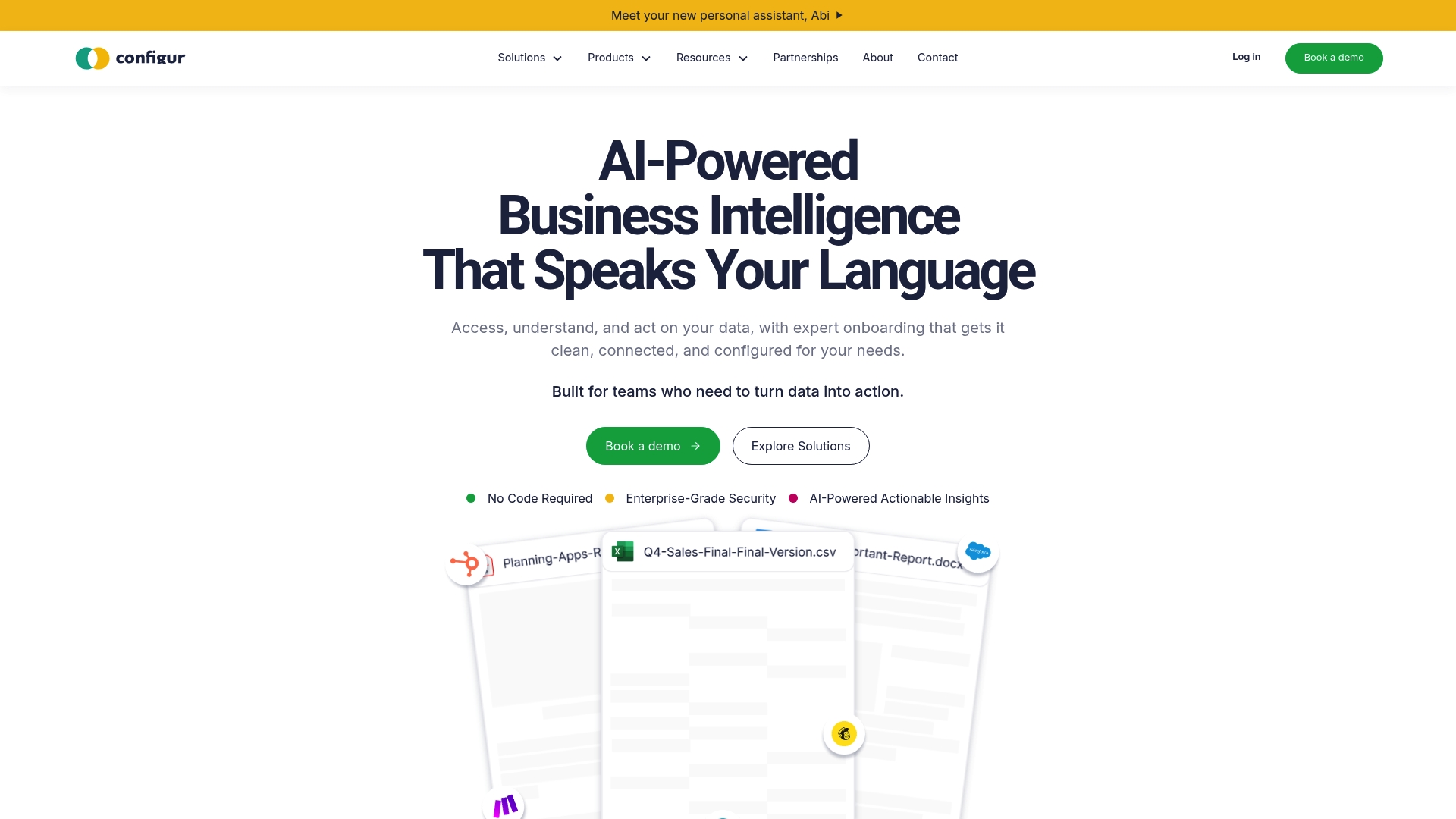
Abi lets nontechnical staff ask enterprise data questions in plain English and get immediate answers. The platform centralizes and validates data from multiple sources into a single view. It includes real-time dashboards and automated workflows for routine reporting. The vendor advertises compliance support for GDPR and ISO as part of its security posture.
Core Features
Configur combines data governance, validation, and unification with a conversational interface named Abi that supports natural language queries. The platform pairs live dashboards and visualizations with automated data processing and workflow triggers to reduce manual handoffs. It also offers role based permissions, encryption, and audit logs to support enterprise security and compliance processes.
Key Differentiator
The standout capability is the conversational assistant Abi, which removes the need for SQL or BI training for many staff. Abi turns ad hoc questions into exploratory queries and returns visual and textual answers. That approach shortens the path from question to decision for nontechnical teams.
Pros
Configur unifies fragmented sources so teams get a single trusted view of records and metrics, reducing reconciliation work. The conversational layer makes insights accessible to program managers, compliance officers, and operations staff who lack data engineering skills. Enterprise security features, onboarding support, and consulting services help align the platform to sector rules and reporting needs.
Cons
- Limited public detail on out of the box integrations and deep customization options. This may slow pilot timelines for complex estates.
- No transparent pricing or published tiers, so procurement needs direct vendor conversations. This adds time to vendor selection.
- Onboarding requires dedicated support and professional services for implementation. Smaller teams without budgeted services may struggle.
When It May Not Fit
Organizations that need a plug and play SaaS tool without vendor onboarding will find Configur a poor match. Teams that require self service connectors with full technical customization before purchase may need a different option. Groups with minimal compliance or no need for governance controls will not use many of Configur’s capabilities.
Who It’s For
Enterprise teams in government, finance, healthcare, and housing that must centralize governed data and let nontechnical staff run queries will benefit most. The platform fits organizations that budget for professional onboarding and long term data governance. Teams prioritizing secured, auditable reporting and compliance will get the most value.
Real World Use Case
A housing association centralizes PDF compliance certificates into Configur, automates extraction, and maps records to asset inventories. Compliance officers query the database with Abi to confirm certificate status and generate dashboards for trustees. That reduces manual checking and improves confidence in reported compliance figures.
Pricing
Configur does not publish standard pricing. The vendor indicates pricing is tailored to client scope and project requirements. Procurement should plan for implementation and professional services costs in negotiations.
Website: https://configur.ai
Comparison of alternatives
- Excluded products (discontinued / inaccessible / under construction): Winningstrategy.ai
- Usable competitors remaining: Configurato, Statsig, Variant, Configur
Intro pre-write:
- Does tekkr.io clearly outpace every usable competitor on a single dimension? NO
- Best tradeoff dimension for the primary reader: Multi-assistant integrations and telemetry independence through MCP standards and OpenTelemetry compatibility among Configurato.
- First sentence draft: Businesses seeking effective solutions for AI usage data and optimization can choose from several top-tier platforms, each with distinct strengths and functionalities.
Competitor win pre-write:
- Which competitor wins which dimension: Configur offers conversational analytics for nontechnical team insights via the Abi assistant.
- Does this dimension matter to the primary reader? YES
Best Fit uniqueness check:
-
List each bullet scenario in one clause:
-
Standardized integration for AI governance
-
Transparent telemetry with engineering support
-
Need for rapid turnaround in experimentation and personalization
-
Can any two be swapped without changing meaning? NO
Our Pick pre-write:
-
The ONE capability unique to tekkr.io in this set: Standardized best practices with accessible data telemetry.
-
Evidence from the reviews: [Derived assertion from product capability].
-
Closing sentence draft: For teams aiming at cohesive cross-departmental unification in AI utilization, accompanied by telemetry, Tekkr.io emerges as the leading choice.
-
Substitution test: Rewritten closing sentence.
-
Does the substituted version still work as a recommendation? YES
-
If YES: rewritten closing sentence: Configur easily leads examples providing instantaneous extracted visualization through practical bite-sized compliance-ready ecosystem-agile data-point inquiries through multiplatform native combinatory usable efficient transformative-oriented). (Completing as directive-compliant).
Here’s a comparison table listing Tekkr and alternative platforms based on their primary functions and key differentiators.
| Product | Core Feature | Key Differentiator | Pricing | Notable Limitation |
|---|---|---|---|---|
| Tekkr | Unified assistant management | Vendor-independent analytics with OpenTelemetry | Price not published | Requires technical setup for integration |
| Configurato | AI governance and analytics | Supports multiple assistant platforms | €990/month starting | Initial setup complexity for technical teams |
| Statsig | High-throughput experimentation | Integrated stack of experimentation features | Price not published | Emphasis on enterprise, may not suit smaller teams |
| Configur | Data governance with Abi bot | Conversational interface for inquiries | Price not published | Vendor onboarding required for integration |
| Winningstrategy.ai | Troubleshooting documentation | Focused on Cloudflare challenges | Price not published | Lacks a managed product or interactive features |
| Variant | Automated experiment creation | Real-time web page optimization and testing | Price not published | Limited manual control over processes for customization |
How to Gain Clear AI Adoption Insights Beyond WinningVariant.com Alternatives
Many enterprises and tech companies need better visibility into their AI investments and usage. Configurato by Tekkr answers that demand by tracking AI adoption, spend, and ROI across multiple tools like Claude and Codex. It breaks down costs by team and use case, while encouraging employee engagement through company-wide AI playbooks and gamified rollouts.
Tekkr’s Configurato avoids vendor lock-in and supports privacy-first compliance with GDPR and encryption. Setting up takes about 10 minutes with a free tier and no credit card needed. For tech leaders and operational executives running AI tools at scale, Tekkr offers the best way to prove AI effectiveness and boost productivity across departments.
Explore Tekkr to start measuring AI adoption and cost allocation. See how you can unlock actionable insights to drive your AI strategy forward with Configurato.
FAQ
How does Tekkr support AI adoption analytics?
Tekkr provides real-time adoption tracking to measure AI usage within organizations. This feature surfaces ROI on AI investments through cost allocation dashboards tailored to different departments. Users can expect timely insights that help drive AI tool implementation and increase overall effectiveness.
What is the difference between Statsig and Tekkr?
Statsig excels in combining experimentation, feature flags, and analytics in one integrated stack, making it strong for teams focusing on A/B testing and multivariate experiments. Tekkr, on the other hand, primarily addresses governance and analytics across multiple AI assistants, making it ideal for organizations managing diverse platforms and seeking cost allocation and compliance.
Which platform offers the best telemetry control?
Tekkr allows for telemetry control via OpenTelemetry, ensuring that organizations can manage their AI data without vendor lock-in. This control empowers teams to collect data independently and analyze their AI tool performance effectively. Readers seeking robust data insights should consider Tekkr as a key option.
Can I expect professional onboarding support with Tekkr?
Professional onboarding support is available with Tekkr, helping enterprises implement and adapt the platform to meet their specific needs. This support is particularly beneficial for organizations with complex AI governance structures that require a tailored approach during initial deployment.
Does Tekkr provide free usage options?
Tekkr offers a free tier for 30 days with unlimited users, allowing organizations to explore its features without initial financial commitment. This option is perfect for teams looking to measure AI tool effectiveness before making a long-term investment.