
AI tool adoption failure is defined as the gap between purchasing AI capabilities and generating measurable business value from them. That gap is wider than most executives realize. Workforce access to AI tools rose from under 40% to roughly 60% in a single year, yet only 20% of organizations generate revenue from those investments. The reasons why AI tools go unused have little to do with the technology itself. They trace back to organizational design, psychological friction, and governance gaps that no software license can fix on its own.
Why AI tools go unused: the organizational design problem
The most common explanation executives reach for is training. Teams need more workshops, better documentation, or a sharper onboarding flow. That explanation is wrong. 84% of organizations have not redesigned jobs around AI capabilities. That single fact explains more about low adoption than any training gap ever could.

Deploying an AI tool without changing how work is structured is like installing a factory robot and leaving the assembly line unchanged. The robot sits idle because no process feeds it work. The same logic applies to tools like Claude, Microsoft Copilot, or Grammarly when they are dropped into workflows built for manual effort. Employees open the tool once, find no clear fit for their actual tasks, and return to what they know.
Effective job redesign means identifying specific, repeatable tasks that AI can own or assist with, then rebuilding the workflow around that division of labor. A legal team that redesigns contract review so that AI handles first-pass redlining, and lawyers handle judgment calls, sees daily usage because the tool has a defined role. A team that simply gets access to the same tool without that redesign sees sporadic use at best.
- Audit current workflows to identify tasks that are repetitive, time-consuming, and rule-based.
- Assign AI a specific role in each workflow rather than offering it as an optional add-on.
- Update job descriptions and performance metrics to reflect AI-assisted output expectations.
- Pilot redesigned workflows in one team before scaling across departments.
Pro Tip: Integrate AI tasks into existing daily rituals. If a team already does a morning standup, add a step where AI-generated summaries are reviewed and corrected. Repetition inside familiar routines builds habit faster than standalone training sessions.
What psychological barriers block AI adoption?
Wharton research identifies three core psychological frictions that prevent employees from using AI tools consistently: doubts about AI competence, lack of trust in the system, and discomfort with delegating control. Each friction operates independently, and all three must be addressed for adoption to take hold.
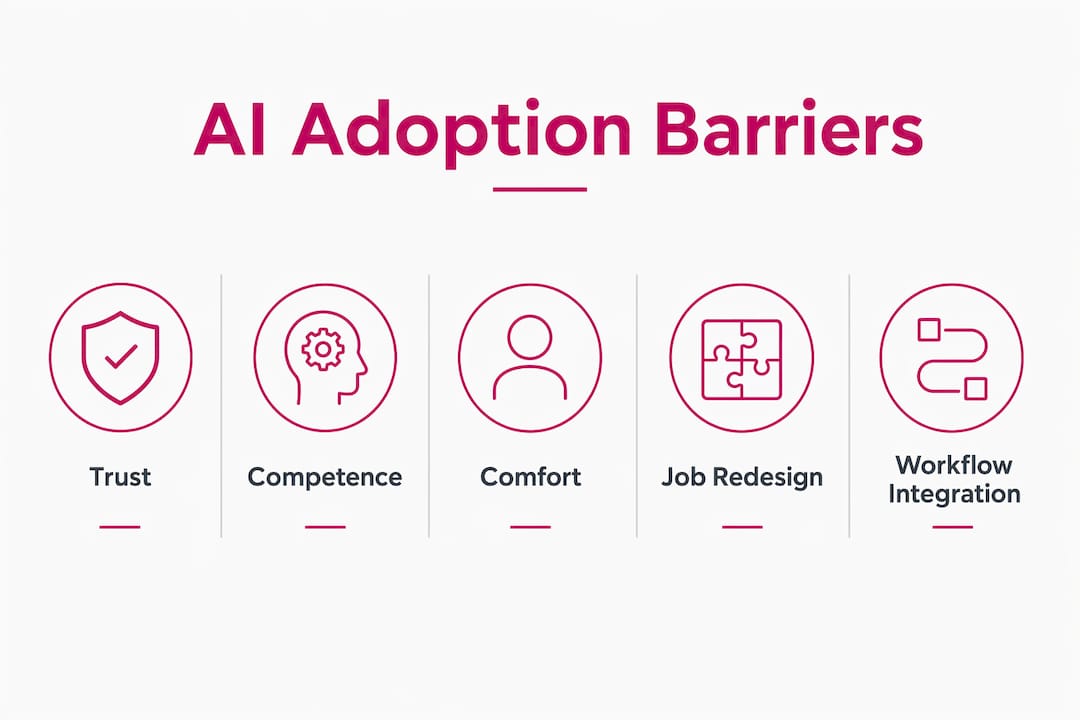
Perceived competence is the most counterintuitive barrier. When AI interfaces are made highly conversational and human-like, employees often trust them less, not more. A tool that sounds confident but makes errors damages credibility faster than a tool that is transparent about its limits. Framing AI as a capable assistant with known boundaries outperforms framing it as an all-knowing system.
Trust and delegation comfort are closely linked. A Cambridge Core study of 1,224 working adults found that perceived usefulness and trust predict AI usage far more strongly than ease of use. Employees who find a tool easy to navigate but do not trust its outputs will not use it for anything that matters. Ease of use is a threshold condition, not a driver.
- Communicate what the AI tool can and cannot do before rollout, not after the first failure.
- Frame AI as a helper that reduces low-value work, not a replacement for professional judgment.
- Create a visible feedback channel where employees can report errors without fear of blame.
- Share real examples of colleagues using AI successfully to normalize experimentation.
- Measure and celebrate error reporting as a sign of healthy engagement, not a sign of failure.
Pro Tip: Run a short “break the AI” session during onboarding. Ask employees to find edge cases where the tool fails. This builds psychological safety, sets realistic expectations, and turns skeptics into informed users faster than any polished demo.
How governance gaps prevent AI from scaling beyond pilots
MIT Sloan research shows that organizations treating AI like legacy IT, as a new skill to acquire rather than a new way to work, consistently stall at the pilot stage. They invest in training and tool access, then measure success by completion rates and license counts. Neither metric captures whether AI is changing how decisions get made or how value gets created.
The governance gap shows up in three places. First, decision rights remain unchanged. No one knows who owns AI-generated outputs, who is accountable when the tool is wrong, or who approves new use cases. Second, performance metrics still reward manual effort. A sales rep who uses AI to draft 50 outreach emails is measured the same way as one who writes 10 by hand. Third, IT and compliance teams apply legacy security reviews to AI tools, adding months of delay that kills momentum before adoption begins.
Governance and operating model gaps are the primary reason AI initiatives produce activity without transformation. Teams complete training, attend demos, and log into platforms. None of that translates to business value without accountability structures that reward actual AI-driven outcomes.
- Redefine decision rights to clarify ownership of AI outputs at the team level.
- Update KPIs to measure AI-assisted output quality and volume, not just tool access.
- Create a fast-track review process for low-risk AI use cases to reduce compliance delays.
- Assign an AI champion in each department who owns adoption metrics and escalates blockers.
Why do AI initiatives fail despite early promise?
Around 80% of enterprise AI projects fail to deliver measurable business value. That figure covers projects that never reach production, projects that reach production but do not recoup costs, and projects that get abandoned after initial pilots. The causes cluster into three failure modes that executives rarely diagnose correctly.
Poor data ownership is the first failure mode. AI tools produce outputs that are only as reliable as the data they draw from. When no one owns data quality, the tool generates outputs that employees distrust, stop using, and eventually report as broken. The tool is not broken. The data pipeline is.
Scope drift is the second failure mode. A project starts as an AI-assisted customer service tool and expands to include sentiment analysis, churn prediction, and agent coaching within six months. Each expansion adds complexity without adding the governance or workflow redesign needed to support it. The original use case gets diluted, and none of the expanded use cases reach maturity.
Training without workflow integration is the third failure mode. Generic training sessions teach employees that AI exists and what it can theoretically do. They do not teach employees which specific task to do differently tomorrow morning. Without that specificity, experimentation fades within two weeks of any training event.
| Failure symptom | Root cause | Organizational remedy |
|---|---|---|
| Employees stop using the tool after week two | No workflow integration or defined AI role | Redesign specific tasks around AI before rollout |
| AI outputs are distrusted or ignored | Poor data quality and no data ownership | Assign data stewards and audit inputs before deployment |
| Pilots succeed but never scale | Governance and decision rights unchanged | Update accountability structures before scaling |
| Scope expands but value declines | Use-case drift without added governance | Lock scope for 90 days and measure one outcome at a time |
| High license costs, low productivity gains | Access without adoption infrastructure | Measure usage depth, not just login frequency |
What should executives do to drive real AI adoption?
The access-to-value gap closes when executives treat adoption as an organizational change program, not a technology deployment. That shift in framing changes what gets funded, what gets measured, and who is held accountable.
Executives who have driven sustained AI adoption share a common pattern. They start with one high-value workflow, redesign it completely around AI capabilities, measure the output change, and use that result to build internal credibility for the next redesign. They do not start with company-wide rollouts. They start with proof.
Psychological safety at the organizational level predicts willingness to experiment with AI. Executives who publicly acknowledge their own AI learning curve, share failures alongside wins, and protect employees who report tool errors create the conditions where adoption accelerates naturally.
- Identify one workflow per department where AI can own a defined, repeatable task.
- Redesign that workflow before deploying the tool, not after.
- Communicate AI limitations to the team before the first use, not after the first complaint.
- Update performance metrics to reward AI-assisted output within 30 days of deployment.
- Review adoption data monthly, tracking usage depth and output quality, not just login counts.
- Expand to a second use case only after the first delivers a documented outcome.
Pro Tip: Measure AI adoption beyond logins. Track whether employees are completing AI-assisted tasks at a higher rate, producing outputs faster, or escalating fewer low-complexity decisions. Logins tell you access. Output metrics tell you value.
Key Takeaways
AI tools go unused because organizations deploy access without redesigning workflows, building trust, or updating governance structures to support sustained use.
| Point | Details |
|---|---|
| Access does not equal adoption | 60% of organizations provide AI access, but only 20% generate revenue from it. |
| Job redesign is the missing step | 84% of organizations have not restructured work around AI, leaving tools idle. |
| Psychology drives usage more than ease | Employees need to trust AI outputs and feel safe experimenting before they adopt consistently. |
| Governance gaps stall scaling | Without updated decision rights and metrics, AI initiatives produce activity but not transformation. |
| Measure depth, not logins | Output quality and task completion rates reveal true adoption; login counts do not. |
The uncomfortable truth about AI adoption most executives miss
Most AI adoption problems I see are not technology problems wearing an organizational disguise. They are organizational problems that executives have been sold a technology solution for. The pitch is always the same: deploy the tool, run the training, watch productivity climb. That sequence has a near-perfect failure rate.
The human factors get underestimated every time. Employees do not resist AI because they are afraid of being replaced, at least not primarily. They resist because no one has told them exactly which task to do differently, who is responsible when the AI is wrong, or whether experimenting with the tool will be rewarded or penalized. Those are solvable problems. They just require executive attention, not another software purchase.
The executives who get this right share one habit: they treat their first AI deployment as a learning investment, not a productivity guarantee. They expect friction, instrument it, and use it to redesign the next rollout. The ones who struggle expect the tool to carry the change program on its own. It never does.
The cross-team adoption challenges that derail most enterprise rollouts are predictable and preventable. The data on what works is clear. The gap is almost always in execution, not in knowledge.
— TekkrTools
How Tekkr helps organizations close the adoption gap
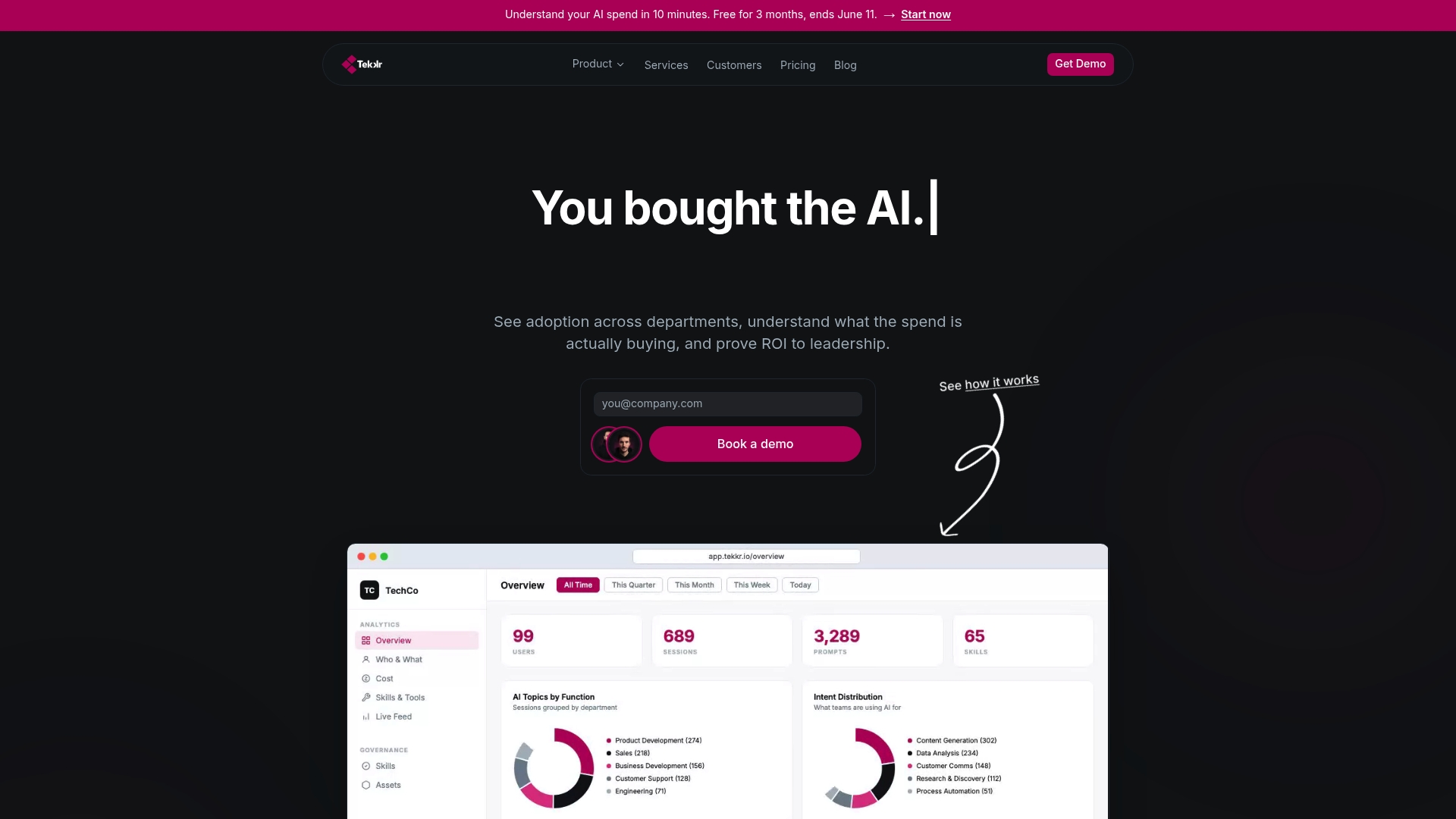
Tekkr’s Configurato platform is built for exactly the problem this article describes. It tracks who is actually using tools like Claude and Codex across your organization, breaks down AI spend by team, and surfaces which use cases are generating value and which are sitting idle. That visibility alone changes the conversation executives can have with their teams.
Beyond measurement, Tekkr drives adoption through gamified rollouts and company-wide AI playbooks that give employees specific, workflow-integrated tasks rather than generic training. The platform is end-to-end encrypted, GDPR-compliant, and takes about 10 minutes to set up with no credit card required. Executives evaluating AI adoption solutions can start with a free tier or book a demo to see adoption metrics across their organization within the same week.
FAQ
Why do employees stop using AI tools after initial rollout?
Employees stop using AI tools when the tools have no defined role in their daily workflow. Without a specific task to complete with AI, experimentation fades within two weeks of any training event.
Is lack of trust the main reason AI is underused?
Trust is one of three core barriers. Wharton research identifies perceived AI competence, trust in outputs, and comfort with delegating control as the primary psychological factors that prevent consistent use.
Why do AI pilots succeed but fail to scale?
Pilots succeed in controlled conditions where governance is informal and scope is narrow. Scaling fails when decision rights, performance metrics, and accountability structures are not updated to support broader deployment.
What is the most common AI tool adoption issue executives overlook?
The most overlooked barrier is job redesign. Deploying a tool without restructuring the workflow around it means employees have access but no clear reason to change how they work.
How should executives measure AI adoption effectively?
Executives should track output quality, task completion rates, and AI-assisted decision volume rather than login frequency. Logins measure access. Output metrics measure whether the tool is actually changing how work gets done.