
Most enterprises roll out AI tools expecting an immediate productivity surge, then quietly wonder why the needle barely moves. The gap is rarely the tool itself. The real problem is that generic AI treats every company the same, ignoring your workflows, your terminology, and your quality standards. Understanding why AI customization matters is not an academic exercise. It is the difference between AI that generates output your team reworks for an hour and AI that produces work your team ships the same day.
Table of Contents
- Understanding AI customization in enterprise contexts
- Business impact: How AI customization enhances productivity and revenue
- Technical nuances: Custom AI development approaches enterprises should consider
- AI customization for employee engagement and operational excellence
- Navigating regulation and governance with AI customization
- Rethinking AI adoption: Why customization is a strategic imperative
- Take control with Configurato: AI assistant analytics and governance
- Frequently asked questions
Key Takeaways
| Point | Details |
|---|---|
| AI customization defined | AI customization adapts generic models to unique enterprise data and workflows for improved outcomes. |
| Revenue impact | Enterprises with advanced AI personalization generate up to 40% more revenue than average performers. |
| Boosting employee productivity | Customized AI enhances employee engagement with personalized workflows and timely nudges. |
| Technical best practices | Fine-tuning techniques like LoRA enable scalable, resilient AI customization without rebuilding base models. |
| Governance and compliance | Customization supports legal compliance through integrated risk management and continuous monitoring. |
Understanding AI customization in enterprise contexts
To appreciate why AI customization matters, we first need to understand what it encompasses in an enterprise setting.
AI customization is not simply toggling a setting in your software. It covers a spectrum of technical approaches: fine-tuning a model on your proprietary data, adapting it to your domain’s vocabulary, engineering precise prompts, and building retrieval pipelines that pull live company knowledge into every response. As one useful framing puts it, AI personalization adapts experiences using real-time data and advanced models, moving well beyond static rules that were set once and forgotten.
Standard AI deployments are built for breadth. They know a little about everything, which means they know nothing specific about your company’s PDLC, your architecture standards, or the compliance language your legal team requires. Hyper-personalization flips this. The model learns your context, your edge cases, and your non-negotiables.
What makes customization stick over time is data unification and continuous learning. These are not one-time projects. They are ongoing processes where feedback loops improve the model as your company evolves. You can also explore how AI assistant analytics and governance platforms accelerate this, keeping customization aligned with real usage data. For organizations assessing their infrastructure readiness first, enterprise AI infrastructure consulting is a practical starting point.
Key dimensions of AI customization in enterprise settings include:
- Domain adaptation: Teaching the model your industry’s language and regulatory context
- Workflow integration: Embedding AI into role-specific processes rather than asking employees to switch contexts
- Real-time personalization: Serving responses that reflect current project state, team norms, and company policy
- Governance alignment: Ensuring outputs meet internal quality gates before employees ever see them
Business impact: How AI customization enhances productivity and revenue
With a clear definition in hand, let’s look at the tangible ROI and productivity benefits AI customization delivers.
The revenue case is hard to ignore. Companies excelling at personalization generate 40% more revenue from those activities than average performers as of 2026. That is not a marginal improvement. It is a structural advantage. The same research shows that brands using advanced personalization achieve a 16 percentage point lift in conversions, with 80% of US consumers more likely to purchase from brands that personalize their experience.
The workforce angle matters just as much. When AI is configured to reflect how a specific role actually works, employees stop treating it as a novelty and start treating it as a reliable colleague. By 2028, over 20% of digital workplace apps will use AI-driven personalization specifically to boost productivity and employee satisfaction.

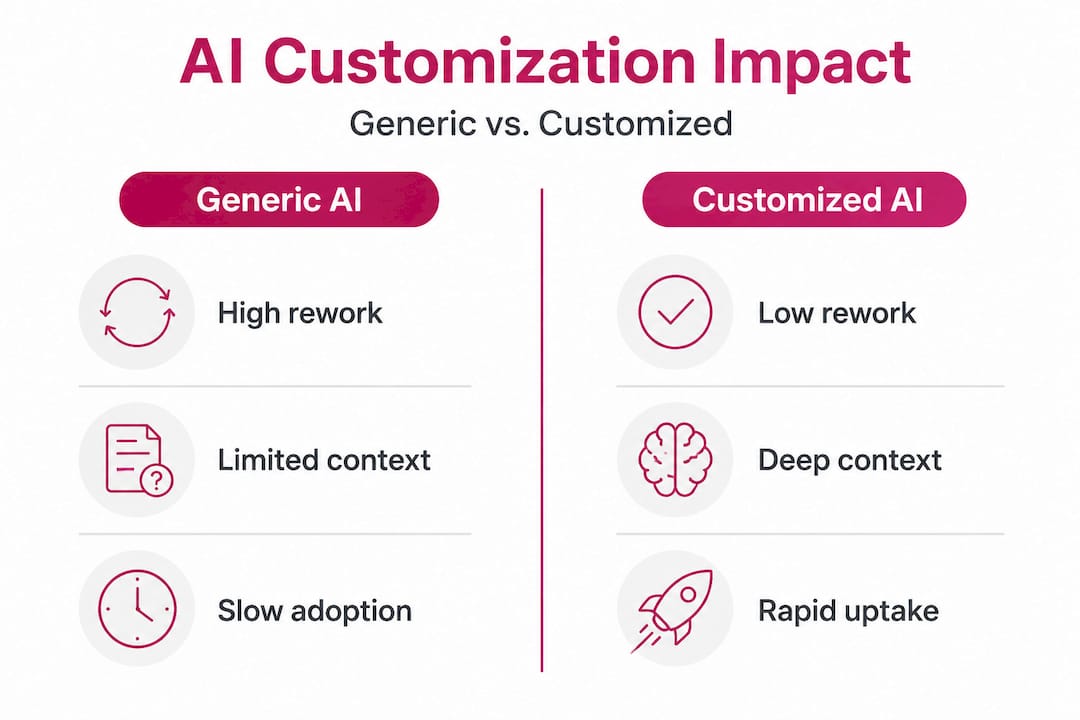
Here is a snapshot of what customized versus generic AI typically delivers across key business metrics:
| Metric | Generic AI deployment | Customized AI deployment |
|---|---|---|
| Output rework rate | High (frequent corrections needed) | Low (aligned to standards) |
| Employee adoption after 90 days | ~30-40% active use | ~70-80% active use |
| Revenue lift from personalization | Baseline | Up to 40% above average |
| Conversion rate improvement | Minimal | Up to 16 percentage points |
| Time-to-proficiency for new hires | Standard onboarding curve | Accelerated with AI-guided context |
The financial case for customization extends beyond direct revenue. Personalization reduces customer acquisition costs because relevance drives conversion without additional spend. It improves retention, both of customers and employees, because people stay where they feel understood.
Benefits that compound over time:
- Fewer hallucinations and off-brand outputs mean less legal and quality review overhead
- Role-specific AI reduces context-switching, which is one of the biggest hidden productivity drains in large organizations
- Compliance-ready outputs reduce the risk of costly rework late in project cycles
- Governed AI usage, tracked through an AI assistant analytics platform, lets you pinpoint exactly where AI is accelerating work and where it is stalling
Pro Tip: Do not measure AI ROI at the tool level. Measure it at the workflow level. If a product manager’s first draft spec still needs three rounds of revision, the AI is not customized enough for that role.
Technical nuances: Custom AI development approaches enterprises should consider
Having seen the business impact, let’s dig into the technical approaches that make AI customization practical and effective.
There are four main methods, and choosing the right one depends on your data maturity, your update frequency, and how much control you need over model behavior.
- Prompt engineering: The fastest entry point. You shape the model’s behavior through carefully structured instructions without touching the weights. Low cost, high agility, but limited depth for complex domain needs.
- Retrieval-augmented generation (RAG): The model retrieves relevant documents from your knowledge base at query time. Strong for keeping AI current with fast-changing company knowledge like policy documents or product specs.
- LoRA (Low-Rank Adaptation): A method for fine-tuning large models efficiently. Fine-tuning with methods like LoRA allows incremental adaptation without disrupting base models, making it practical for enterprises that want domain depth without the cost of full retraining.
- Full fine-tuning: The most resource-intensive approach, reserved for cases where your domain is genuinely unique and your data is extensive. High payoff but high commitment.
Data quality is the variable that separates successful customization from expensive failure. Quantity is a distraction. A model trained on 10,000 curated, accurate examples of your workflow outperforms one trained on 100,000 messy records. Invest in data quality tools for AI before scaling your customization effort.
Architecture choices matter too. Treating customization as infrastructure with ModelOps, the practice of managing AI models the way engineering teams manage software, enables continuous updates and drift management. Without this, your carefully tuned model degrades silently as the world changes around it.
Common pitfalls that kill AI customization efforts:
| Pitfall | Why it happens | How to avoid it |
|---|---|---|
| Brittle model silos | Each team customizes independently | Centralize governance with shared configuration layers |
| No feedback loops | Outputs never improve post-deployment | Build review mechanisms into every AI workflow |
| Missing version control | Changes cannot be traced or rolled back | Treat model configs like code with custom AI model governance |
| Over-reliance on quantity | Teams dump all data in without curation | Define data quality standards before training begins |
Pro Tip: Treat your first custom AI deployment like a pilot, not a rollout. Pick one high-volume, well-documented workflow, get it right, then replicate the process. Trying to customize everything at once is how teams end up with nothing working well.
AI customization for employee engagement and operational excellence
Beyond development, the real value of AI customization lies in boosting workforce effectiveness and engagement.
When AI knows how your company operates, employees stop fighting it. They stop rewriting outputs, stop second-guessing suggestions, and stop defaulting back to manual processes. AI personalization in HR lifts employee Net Promoter Scores by tailoring workflows and engagement moments to what each role actually needs. That is not a soft metric. Net Promoter Scores for employees correlate directly with retention and discretionary effort.
Practical applications your teams can activate today:
- Onboarding acceleration: New hires interact with an AI that already knows your processes, reducing the time it takes to produce work that meets your standards
- Training nudges: Deploying AI agents that monitor moments that matter sends timely, contextual nudges that compound engagement and reduce time-to-proficiency
- Automated workflow reminders: Role-specific AI surfaces the right checklist, template, or approval step at the right time, without requiring employees to remember where to look
- Quality gate enforcement: AI checks output against your standards before it reaches a reviewer, reducing back-and-forth and preserving senior capacity for high-judgment work
The consumer-grade AI experience has raised employee expectations. Your team members use personalized tools at home and expect the same sophistication at work. When enterprise AI feels generic and slow by comparison, adoption stalls. Customization closes that gap.
Explore how AI for workplace productivity intersects with engagement to see where teams are finding the most traction.
Pro Tip: Map your top three highest-volume employee workflows before configuring anything. AI customization delivers the fastest returns where volume is high and the task pattern is repetitive. That is where rework costs the most, and where configuration saves the most.
Navigating regulation and governance with AI customization
Finally, we address the crucial compliance and governance dimensions that AI customization helps enterprises manage responsibly.
Regulation is no longer a future concern. EU AI Act high-risk obligations from August 2026 require governance, risk management, and data quality controls in customized AI systems. If you are deploying AI in HR, legal, finance, or any function that affects employees or customers, you are likely in scope.
Customization, done correctly, is your compliance ally rather than your liability. Here is why:
- Auditability: Custom AI systems with version-controlled configurations let you trace exactly which model produced which output. Generic AI tools rarely offer this.
- Transparency: When you define what the AI knows and how it behaves, you can explain its outputs to regulators. Black-box AI cannot do this.
- Data quality controls: Compliance requires documented evidence that your training data was accurate and representative. Custom pipelines enforce this by design.
- Continuous monitoring: Drift detection and output review, core elements of a governed custom AI system, satisfy the ongoing monitoring requirements regulators are increasingly mandating.
The governance layer is where most enterprises underinvest. They focus on the model and neglect the infrastructure around it. Building AI governance for enterprises into your customization architecture from the start is far less costly than retrofitting compliance controls after the fact.
Rethinking AI adoption: Why customization is a strategic imperative
Here is the uncomfortable truth: most enterprises are still treating AI like software. They evaluate vendors, buy licenses, run a change management program, and expect ROI to follow. It rarely does.
Generic AI is an entry point. It is not a destination. The productivity gains from off-the-shelf tools plateau fast, usually within the first quarter of adoption. After that, teams who have not customized their AI hit a ceiling. Teams that have customized their AI keep compounding.
The deeper issue is that every organization holds proprietary knowledge that took years to build. Your engineering standards, your sales qualification criteria, your risk thresholds, your product development cadence. Generic AI knows none of this. It produces output that is technically correct and contextually wrong, which is often worse than no output at all, because now someone has to fix it.
AI customization institutionalizes organizational expertise, creating a compounding competitive moat as models evolve with proprietary data. Your customized AI gets better as your company grows. Your competitor’s generic AI stays the same.
The enterprises that view customization as infrastructure rather than a feature unlock a fundamentally different trajectory. They do not ask “how do we get our team to use AI more?” They ask “how do we make AI reflect how our best people work?” That is the right question. Explore AI customization insights to see how leading organizations are making this shift operationally.
Ignoring customization does not keep you neutral. It actively transfers competitive advantage to organizations that are investing in it. The window to build a proprietary AI advantage is open now. It will not stay open indefinitely.
Take control with Configurato: AI assistant analytics and governance
If this article has made one thing clear, it is that AI customization is not a one-time configuration project. It requires continuous monitoring, governance, and measurement to deliver sustained value.
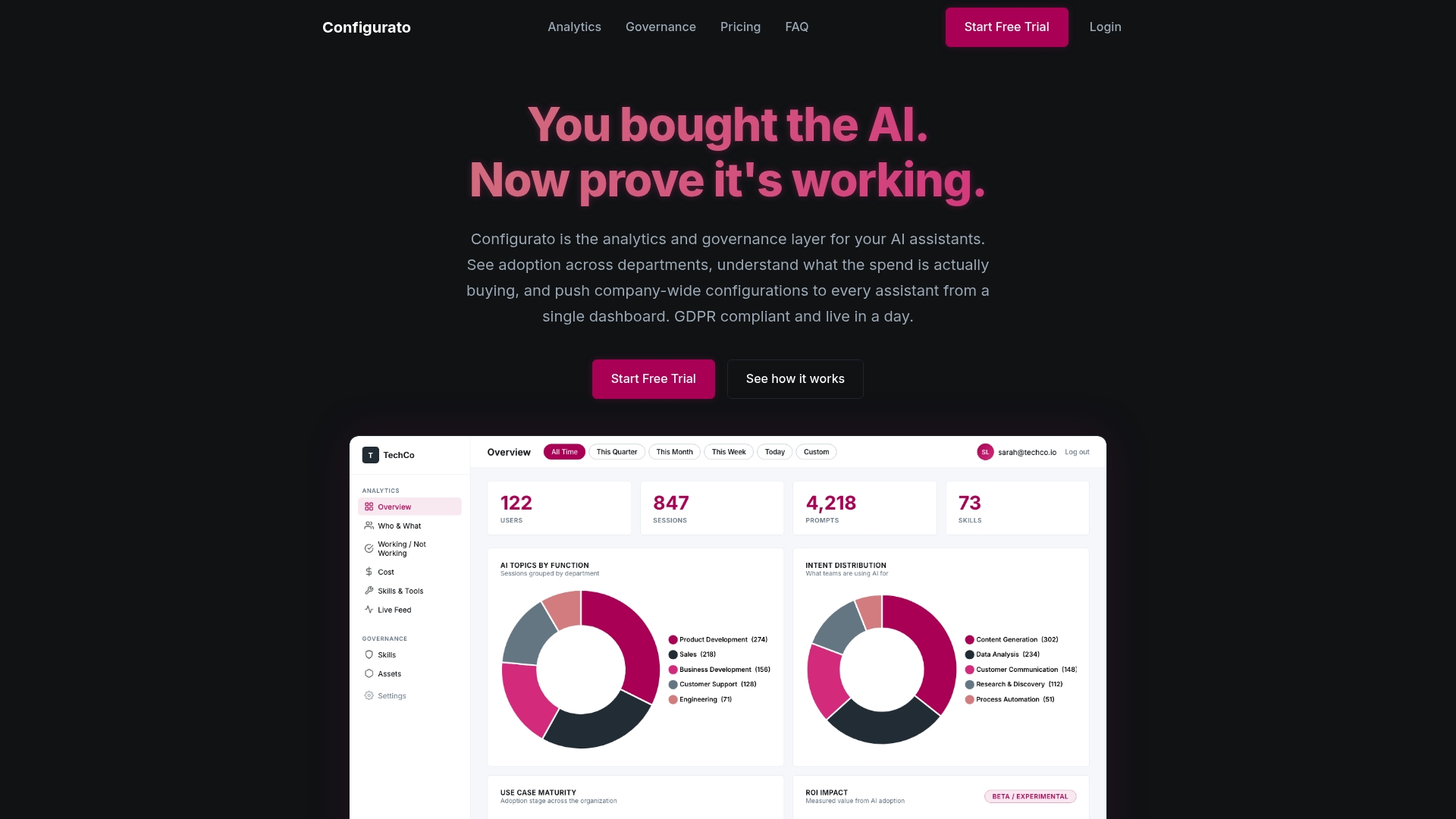
Configurato, built by Tekkr, is designed for exactly this. It embeds your company’s processes, quality standards, and domain knowledge directly into the AI assistants your teams already use, with no retraining required. It supports compliance with emerging regulations like the EU AI Act, provides analytics to measure AI personalization impact on revenue and productivity, and gives you the governance infrastructure to trace, benchmark, and continuously improve how AI works across your organization. If you are ready to close the gap between AI adoption and AI advantage, Configurato is where that work starts.
Frequently asked questions
What is AI customization and why is it important for enterprises?
AI customization adapts generic AI models to your organization’s unique data, terminology, and workflows, enabling higher accuracy and more relevant outcomes. Custom AI models learn domain-specific terminology and context for performance that generic deployments simply cannot match.
How does AI customization improve employee engagement?
By tailoring AI-driven workflows and delivering personalized prompts at critical moments, customization enhances employee satisfaction and accelerates onboarding. AI personalization in HR lifts employee Net Promoter Scores by addressing consumer-grade expectations workers now bring to enterprise tools.
What are common challenges in implementing AI customization?
Enterprises most often struggle with fragmented data, brittle model architectures, and missing governance structures that cause deployments to stall or degrade. Most failed AI personalization initiatives fail due to messy data, missing feedback loops, and no human review process built into the workflow.
How does AI customization support regulatory compliance?
Custom AI systems designed with governance, risk management, and data quality controls help enterprises meet obligations under frameworks like the EU AI Act. EU AI Act high-risk obligations require precisely the governance infrastructure that well-built customization delivers as a baseline, not an afterthought.