
The AI value gap is defined as the difference between the business value AI technology is capable of delivering and the value organizations actually capture from their AI investments. Only 5–6% of generative AI pilots deliver sustained value at scale, meaning 94% of executives see no significant return despite real spending. The industry term for this phenomenon is “AI value realization failure,” though “AI value gap” has become the working shorthand across boardrooms and analyst reports. Understanding this gap is the first step toward closing it.
What is the AI value gap and why does it exist?
The AI value gap is the measurable distance between what AI can theoretically produce and what a business actually books as results. Nearly 90% of organizations report getting some value from AI, but only 25% say their AI investments have a transformative impact. That gap between “some value” and “transformative value” is where most organizations are stuck.
The gap exists because technology deployment outpaces organizational readiness. Companies buy AI tools before they have the governance, the workflows, or the measurement systems to extract real returns. The result is a library of underused subscriptions and a growing list of pilots that never graduate to production.

Three structural problems define the gap. First, AI is treated as a technology project rather than a business transformation. Second, success metrics are vague or absent. Third, the workforce and processes that AI is supposed to improve are not redesigned before automation is applied. Each of these problems compounds the others.
What drives the AI value gap? Key causes and strategic misalignments
Strategic misalignment is the primary driver. Leaders focusing on incremental productivity gains instead of deeper business model transformation consistently fail to close the gap. Shaving 10% off a process cycle time is not the same as redesigning how value flows through the business. The first is a cost reduction. The second is a competitive repositioning.
Governance and measurement failures make the problem worse. Consider these numbers:
- 63% of organizations rely on gut instinct or one-off metrics to evaluate AI returns.
- Only 25% track AI returns in real time.
- Just 2% assign CFO-level responsibility for AI value.
Each of these figures points to the same root cause: AI investment decisions are made without the financial discipline applied to any other capital allocation. No CFO would approve a factory expansion without a clear return model. AI deserves the same rigor.
Workforce and process gaps are the third major cause. Value leaks occur when workforce change and process redesign lag behind technology automation. Organizations deploy AI on top of existing workflows without asking whether those workflows are worth automating in the first place.
Pro Tip: Before deploying AI on any process, map that process end to end and identify every step that adds no value. Automating a broken process does not fix it. It makes the broken parts faster and harder to change later.
Finally, pitching AI as a technology initiative instead of a business solution with measurable outcomes is a reliable path to failure. When the business problem is not clearly defined upfront, no one can agree on what success looks like. Without that agreement, funding decisions become political rather than analytical.
How does the AI value gap affect business outcomes and competitive advantage?
The AI value gap is not a neutral condition. It actively redistributes competitive advantage toward organizations that close it first.
“AI is not just a productivity tool. It is a competitive reset that redistributes value, so early movers in transformation gain outsized advantage.” — McKinsey
This framing matters because it changes the urgency calculation. If AI were only a productivity tool, a two-year lag in adoption would cost you some efficiency. Because AI reshapes profit pools and market position, a two-year lag can lock you out of entire revenue categories.
The competitive consequences of failing to close the gap follow a predictable sequence:
- Competitors capture cost advantages. Organizations that close the gap first reduce unit costs faster, giving them pricing flexibility you cannot match.
- Product differentiation widens. AI-embedded products improve continuously through feedback loops. Products built without AI integration stagnate.
- Talent concentrates at leaders. Engineers and operators who work with AI tools daily develop skills that compound. Organizations without real AI adoption fall behind in capability building.
- Profit pools shift. McKinsey research identifies specific industries where AI will create net new value and others where it will primarily redistribute existing value. Being on the wrong side of that redistribution is an existential risk for some sectors.
The organizations capturing early advantage share one characteristic: they treat AI as a capability to build, not a tool to buy. That distinction drives every downstream decision about governance, workforce development, and measurement.
What practical steps can business leaders take to close the AI value gap?
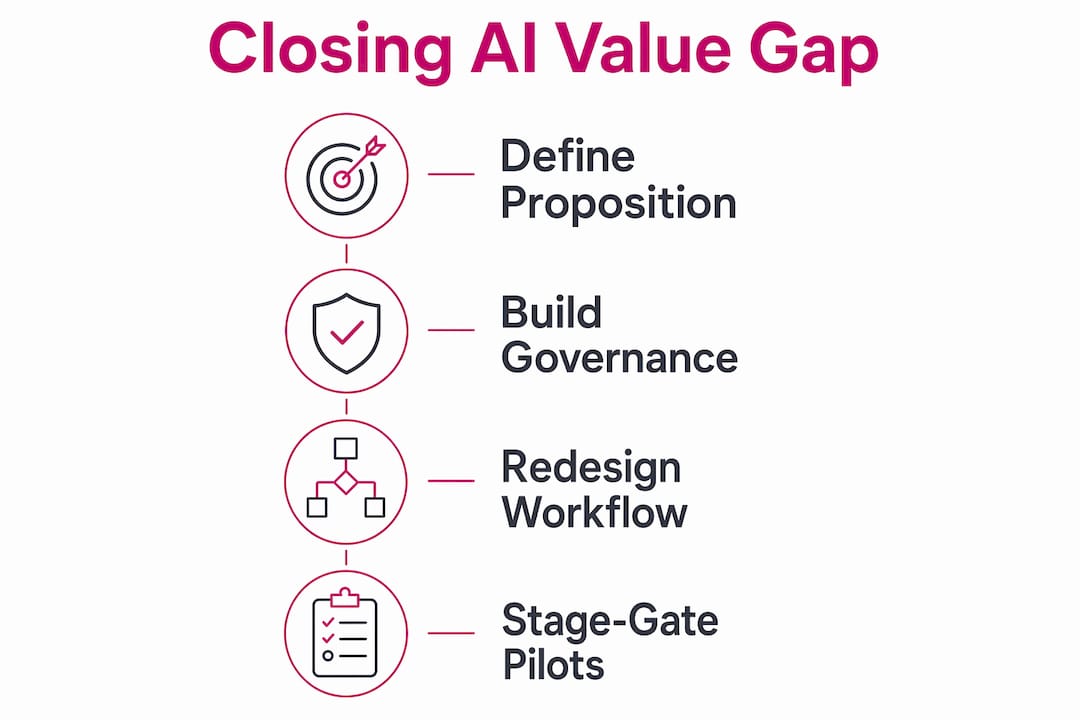
Closing the gap requires changes in four areas: value proposition design, governance, workflow redesign, and pilot discipline.
Define a clear AI value proposition
Linking specific AI initiatives directly to measurable business outcomes via a Value Proposition Canvas is the method that works. The canvas forces you to name the business problem, the customer or internal stakeholder affected, and the metric that will confirm success. Generic pitches like “AI will improve efficiency” do not survive this exercise. Specific claims like “AI-assisted contract review will cut legal turnaround from 14 days to 3 days, reducing deal cycle time by 20%” do.
Build governance with real accountability
AI governance structures must include executive-level ownership of AI value, not just IT ownership of AI tools. Assign a senior leader, ideally at the CFO or COO level, to own the return on AI investment. That person needs real-time data on adoption, spend, and outcomes across every department.
Redesign workflows before automating them
Automating broken workflows without redesign increases complexity and long-term costs. The fix is to treat workflow redesign as a prerequisite for AI deployment, not an afterthought. Map the current process, eliminate steps that add no value, then apply AI to the redesigned version.
Apply stage-gate discipline to pilots
Most organizations fund pilots indefinitely, hoping they will eventually prove value. Stage-gate models set clear criteria at each phase: if a pilot does not hit its target by a defined date, it is stopped or redesigned. This prevents sunk-cost thinking from consuming budgets that could fund initiatives with real potential.
Pro Tip: Set a kill criterion before you start every pilot. Define the minimum result the pilot must achieve by month three to continue funding. Writing this down before launch removes the emotional attachment that keeps failing pilots alive.
The table below contrasts two approaches to AI deployment:
| Approach | Governance model | Measurement | Workforce readiness |
|---|---|---|---|
| Technology-led deployment | IT ownership, no CFO visibility | One-off or gut-feel metrics | Automation applied to existing workflows |
| Business-led transformation | Executive accountability, real-time tracking | Unified metrics across cost, revenue, and risk | Workflow redesign before automation |
The business-led approach consistently produces higher rates of sustained value. The technology-led approach is how organizations end up in the 94% that see no significant return.
How to measure and track AI value continuously to sustain growth
Measurement is where most organizations fail after a promising start. Without a common value language consolidating cost, revenue, and risk metrics, teams waste resources funding both value-generating and cash-burning AI initiatives simultaneously. The fix is a unified measurement framework applied consistently across every AI initiative.
The four metric categories that matter are:
- Cost reduction: Direct savings from automation, headcount reallocation, and process efficiency.
- Revenue growth: New revenue enabled by AI-powered products, faster sales cycles, or improved customer retention.
- Risk avoidance: Reduction in compliance failures, fraud losses, or operational errors.
- Product embedding: The degree to which AI is embedded in customer-facing products, measured by usage rates and feature adoption.
Tracking AI returns in real time is the standard that separates high-value organizations from the rest. Real-time tracking allows leaders to redirect investment quickly when an initiative underperforms, rather than discovering the problem at the annual review. Tekkr’s Configurato platform does exactly this: it tracks adoption, spend, and return by team, surfaces which use cases are generating value, and flags where investment is stalling.
Stage-gate models connect measurement to funding decisions. Each initiative passes through defined checkpoints with clear pass/fail criteria. Initiatives that pass get scaled. Initiatives that fail get stopped or redesigned. This structure prevents the common failure mode where organizations fund dozens of pilots indefinitely and scale none of them.
Key takeaways
Closing the AI value gap requires governance, measurement, and workflow discipline applied before technology deployment, not after.
| Point | Details |
|---|---|
| Define the gap precisely | The AI value gap is the distance between AI’s potential and actual business results, affecting 94% of organizations. |
| Governance drives returns | Only 2% of organizations assign CFO-level responsibility for AI value, leaving most investments unaccountable. |
| Redesign before automating | Applying AI to broken workflows locks in complexity. Fix the process first, then automate the improved version. |
| Measure with unified metrics | Track cost reduction, revenue growth, risk avoidance, and product embedding together to avoid funding the wrong initiatives. |
| Use stage-gate discipline | Set kill criteria before every pilot to prevent sunk-cost thinking from draining budgets that could fund real value. |
The uncomfortable truth about AI investment in 2026
Most executives I work with already know their AI investments are underperforming. What they lack is a clear diagnosis of why, and the organizational permission to change course.
The uncomfortable truth is that the AI value gap is almost never a technology problem. The tools work. Claude, Codex, and the enterprise AI platforms available today are genuinely capable. The gap is a management problem. It lives in the space between the tool purchase and the business outcome, in the governance structures that were never built, the workflows that were never redesigned, and the metrics that were never defined.
The second uncomfortable truth is that automating broken processes is the most common mistake I see, and it is also the hardest to reverse. Once a broken workflow is automated at scale, the cost of fixing it multiplies. The organizations that close the gap fastest are the ones that slow down before deployment, map their processes honestly, and redesign before they automate. That discipline feels slow in the moment. It pays back in months, not years.
My advice to any executive reading this: treat AI as a capability your organization is building, not a product you are buying. Capabilities require investment in people, processes, and measurement systems. Products require a purchase order. The distinction determines whether you end up in the 6% or the 94%.
— TekkrTools
Tekkr’s approach to AI value realization
Tekkr built Configurato specifically for the problem this article describes. Organizations that have bought AI tools but cannot prove they are working now have a direct path to visibility and accountability.
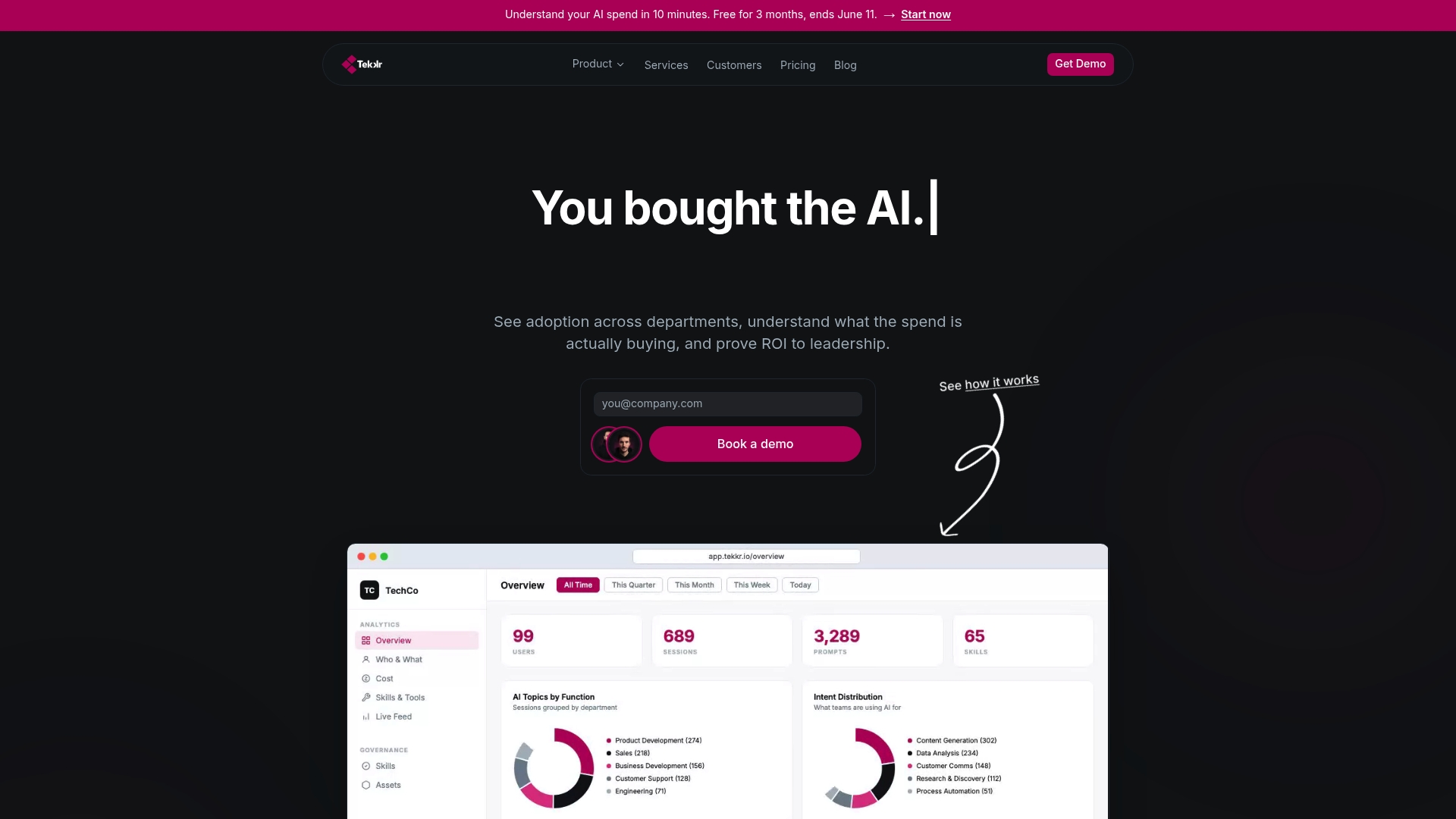
Configurato tracks who is actually using tools like Claude and Codex, breaks down AI spend by team, and surfaces which use cases are generating real returns. It enables employees through gamified rollouts and company-wide AI playbooks, so adoption rises without top-down mandates. The platform is end-to-end encrypted, GDPR-compliant, and takes about 10 minutes to set up, with a free tier and no credit card required. For organizations ready to move from AI spending to AI value realization, Tekkr provides both the measurement infrastructure and the consulting expertise to close the gap.
FAQ
What is the AI value gap in simple terms?
The AI value gap is the difference between what AI investments are supposed to deliver and what they actually produce. Most organizations see some benefit but very few achieve transformative business impact.
Why do so few AI pilots deliver sustained value?
Only 5–6% of generative AI pilots scale successfully because most lack clear business outcomes, governance accountability, and redesigned workflows before automation is applied.
How can executives measure AI value effectively?
Track four integrated metrics: cost reduction, revenue growth, risk avoidance, and product embedding. Assign executive-level ownership and use real-time tracking rather than one-off assessments.
What is the biggest mistake organizations make with AI investments?
Automating broken workflows without redesigning them first is the most common and costly mistake. It locks in inefficiency at scale and makes late-stage corrections expensive.
How does the AI value gap affect competitive position?
Organizations that fail to close the gap lose cost advantages, product differentiation, and access to profit pools that shift as AI reshapes industries. Early movers in transformation gain advantages that compound over time.