
Most executives know their organizations need AI. Fewer know what “enterprise AI” actually means beyond the press releases and vendor pitches. There’s a critical distinction between deploying a handful of AI tools and building AI as a true organizational capability. As Microsoft’s partner research highlights, the real shift is from AI as isolated technology projects to AI as an enterprise capability layer with reusable services spanning data ingestion, model management, decision orchestration, and governance. That gap, between scattered pilots and a coherent AI foundation, is where most organizations quietly lose the race.
Table of Contents
- Defining enterprise AI: Beyond automation
- Key building blocks of an enterprise AI platform
- Common pitfalls: Why enterprise AI initiatives fail
- Making enterprise AI work: Best practices and real-world examples
- The uncomfortable truth: Enterprise AI is a culture shift, not just a tech upgrade
- Accelerate your AI journey with Configurato
- Frequently asked questions
Key Takeaways
| Point | Details |
|---|---|
| AI as a capability layer | Enterprise AI works best as a reusable organizational capability, not isolated projects. |
| Foundation matters | Success requires strong data, model management, governance, and integration. |
| Avoid common pitfalls | Lack of alignment and poor governance often undermine enterprise AI efforts. |
| Culture drives results | Mindset and process shifts across the organization are crucial for true AI transformation. |
| Get expert support | Leverage specialized partners and platforms for faster, scalable implementation. |
Defining enterprise AI: Beyond automation
With the context set, let’s clarify exactly what enterprise AI means for forward-thinking organizations. If you still think of AI as a collection of productivity tools or departmental automation scripts, you’re working with an outdated map.
Enterprise AI is the integration of AI capabilities directly into your organization’s core systems, workflows, and decision-making infrastructure. It is not about buying the most licenses or running the most pilots. It’s about creating a shared, reusable foundation that any team, function, or process can draw on, with consistent governance, quality controls, and measurable outcomes built in from the start.
The competitive AI strategies that separate market leaders from followers aren’t rooted in access to the latest models. They’re rooted in how well organizations have built the infrastructure to apply AI at scale, repeatedly, and with accountability.
“A key enterprise methodology shift is from AI as isolated technology projects to AI as an enterprise capability layer with reusable services such as data ingestion, model management, decision orchestration, and governance.”
This reframing changes everything. Instead of asking “Which team should pilot this AI tool?”, you start asking “How do we build AI capabilities that every team can use without reinventing the wheel?” That mental model shift is where real enterprise value begins.
Here’s what that strategic shift actually delivers:
- Scalability: Build once, deploy across multiple functions without starting from scratch each time.
- Reusability: Shared AI services, like data pipelines and governance controls, reduce redundant work across departments.
- Organization-wide impact: AI that integrates with core systems affects outcomes at the business level, not just team level.
- Governance by design: Compliance, security, and quality standards are embedded into the capability layer, not bolted on afterward.
- Faster ROI: Teams spend less time on setup and more time generating real output.
The foundation for all of this starts with robust AI training infrastructure and principled AI analytics and governance. Without those, you’re building on sand.
Key building blocks of an enterprise AI platform

Now that you know what enterprise AI is, it’s crucial to understand the foundation it requires. You cannot layer strategy on top of weak infrastructure and expect it to hold. The following building blocks are what transform good intentions into scalable, measurable AI capability.
| Building block | What it does | Why it matters |
|---|---|---|
| Data ingestion | Continuously pulls structured and unstructured data into the platform | AI is only as good as the data it receives |
| Model management | Tracks model versions, performance, and deployment lifecycle | Prevents “black box” drift and enables improvement |
| Decision orchestration | Routes AI outputs into the right systems and workflows | Connects AI reasoning to actual business action |
| Governance framework | Enforces policies, access controls, and audit trails | Keeps organizations compliant and accountable |
| Core system integrations | Links AI to CRMs, ERPs, HR systems, and more | Enables AI to work within existing business logic |
Effective enterprises design these shared capabilities from the beginning and integrate them with core business systems, not as an afterthought. This is what separates organizations that see compounding AI returns from those stuck in pilot purgatory.
To move from project-specific AI to an enterprise-wide platform, follow these steps:
- Audit your current AI landscape. Identify every existing AI initiative, tool, and vendor relationship. Understand which are producing value and which are isolated experiments that haven’t scaled.
- Define your shared data infrastructure. Work with your data and engineering teams to establish centralized AI data transformation pipelines that any AI system can draw from.
- Select an orchestration approach. Decide how AI outputs will feed into business decisions, whether through APIs, middleware, or embedded AI layers in existing tools.
- Establish your governance framework early. Before scaling, define who owns AI decisions, how errors are reported, and how compliance is tracked.
- Partner with the right AI training data providers to ensure your models are learning from high-quality, representative, and continuously updated information.
- Build for reuse. Every new AI capability should be designed so another team can adopt it with minimal additional engineering.
Pro Tip: Invest in your governance framework at step one, not step six. Organizations that retrofit governance onto scaled AI systems spend two to three times more effort correcting problems than those who build controls in from the start. Governance is not overhead. It’s architecture.
Common pitfalls: Why enterprise AI initiatives fail
Having explained how to build enterprise AI, it’s equally important to recognize what can undermine these efforts. Even well-resourced organizations with strong leadership make predictable mistakes that stall or kill AI programs.
“Scaling failure often comes from treating AI as isolated projects rather than building the shared infrastructure that allows AI capabilities to compound over time.”
This is the pattern we see most often. A team gets excited about a new AI tool, spins up a proof of concept, sees some early wins, and then hits a wall when they try to expand. The issue is rarely the AI model itself. The issue is that the infrastructure, the data plumbing, the governance, the integration points, were never built to scale.
Here are the pitfalls that consistently derail enterprise AI programs:
- Poor integration with core systems: AI that can’t access or write to your CRM, ERP, or core databases is just a fancy chatbot. Integration is non-negotiable for enterprise impact.
- Lack of governance from the start: Without clear ownership, audit trails, and policy enforcement, AI decisions become unaccountable. This is how organizations end up in regulatory trouble or facing internal trust breakdowns.
- Project silos: When each team builds its own AI stack independently, you get duplicated effort, inconsistent quality, and zero organizational learning. The left hand never knows what the right hand is doing.
- Compromised data quality: AI amplifies whatever data you feed it. Dirty, incomplete, or outdated data doesn’t just produce bad outputs, it produces bad outputs fast and at scale. A review of AI risk safeguards consistently surfaces data quality as the top risk factor in enterprise AI failures.
- Underestimating change management: You can deploy the best AI platform on the market and still see zero adoption if employees don’t trust it, understand it, or feel it’s relevant to their work.
- No feedback loops: AI systems degrade without continuous monitoring and correction. Many organizations deploy and forget, only discovering the problem months later when outputs have quietly worsened.
The most dangerous pitfall is the one that looks like success. High adoption numbers on dashboards, low actual productivity gains in practice. This is the “adoption looks good on paper” trap. Employees are using the tools, but not in ways that produce aligned, high-quality output.
Pro Tip: Standardize your AI interfaces and build in continuous feedback loops from day one. When employees can flag low-quality AI outputs through a simple mechanism, and those signals feed back into your AI project governance insights, the entire system improves over time. Without that loop, you’re flying blind.
Making enterprise AI work: Best practices and real-world examples
Armed with knowledge of both pitfalls and foundations, let’s look at how leaders turn enterprise AI into transformative success. The organizations seeing the biggest returns in 2026 share a common approach: they treat AI as organizational infrastructure, not a departmental experiment.
The contrast between siloed AI and a capability layer approach is stark.
| Dimension | Siloed AI projects | Enterprise capability layer |
|---|---|---|
| Deployment speed | Slow (rebuilt each time) | Fast (reusable components) |
| Cost per use case | High (duplicated effort) | Lower over time (shared infrastructure) |
| Governance | Inconsistent or absent | Embedded by design |
| Organizational learning | Minimal (knowledge stays in team) | Compounds (shared benchmarks and data) |
| Integration with systems | Partial or manual | Deep and automated |
| Quality consistency | Variable (depends on team) | Standardized across functions |
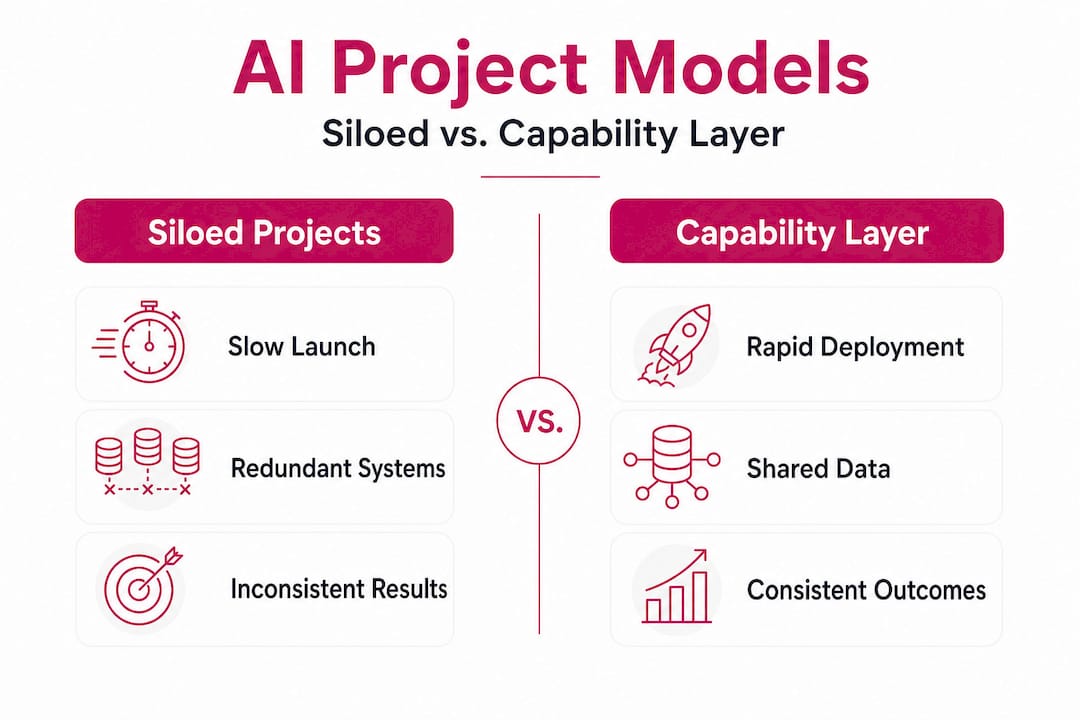
Enterprises that design shared AI capability layers consistently report greater productivity and better outcomes than those running isolated projects. The math is simple. When you build once and reuse, every subsequent deployment gets cheaper and faster.
Here’s how leading organizations implement reusable AI assistants at scale:
- Define role-specific configurations. A product manager’s AI assistant should understand your product development lifecycle. An engineer’s assistant should know your architecture standards. Don’t settle for generic prompts.
- Embed company context at the system level. Your processes, quality gates, and domain knowledge should live inside the AI layer itself, not in a document employees have to remember to reference.
- Connect AI assistants to your core systems. When an AI assistant can pull from live data in your CRM or project management tool, its outputs go from plausible to genuinely useful.
- Track output quality, not just usage. Measure whether AI-generated work requires rework. High usage with high rework is not a success metric. It’s a warning sign.
- Benchmark against external data. Understanding how your AI adoption compares to high-performing organizations in your industry reveals where you have leverage and where you’re leaving value on the table. Reviewing scalable AI SaaS solutions that support this kind of benchmarking accelerates the learning curve considerably.
- Expand iteratively. Start with one or two high-impact roles, prove the model, then extend the capability layer to adjacent functions.
The productivity gains that come from this approach are not incremental. When a product manager’s AI output already reflects your PDLC without any additional prompting, and when an engineer’s AI scaffold already follows your architecture standards, you’re not saving minutes. You’re collapsing hours of rework into zero. That kind of AI assistant analytics and embedded context is what separates organizations that are winning with AI from those still chasing the right use case.
The uncomfortable truth: Enterprise AI is a culture shift, not just a tech upgrade
We’ve explored technology and tactics. Now let’s confront the deeper, organizational truths about enterprise AI that most strategy decks carefully avoid.
Here’s the uncomfortable reality: you can implement every building block described above, pick the right vendors, establish governance frameworks, and still see disappointing results. The reason isn’t technical. It’s cultural.
Most organizations underestimate how profoundly AI-at-scale requires rethinking how work actually gets done. It’s not enough to give employees a better tool. You have to redesign the processes those tools operate within. When AI can produce a first draft in seconds, the bottleneck shifts from creation to review and judgment. That changes how teams are structured, how roles are defined, and how success is measured. Few organizations are making those process changes explicitly. They’re deploying AI and hoping the workflow adjusts itself. It doesn’t.
Governance, collaboration, and training matter more than isolated pilots precisely because AI doesn’t operate in a vacuum. An AI assistant is only as aligned as the organizational knowledge it has access to. If that knowledge lives in people’s heads rather than structured systems, the AI will produce generic output, and employees will correctly distrust it.
True ROI from enterprise AI emerges when AI capabilities are embedded across teams, when leadership actively aligns incentives around AI-assisted quality work rather than just AI-assisted speed, and when middle management understands that their role shifts from directing tasks to directing AI-powered judgment. That is a culture change, and it requires explicit C-level sponsorship.
No vendor, platform, or configuration layer can substitute for a leadership team that’s genuinely committed to rethinking how work happens. The organizations we see winning aren’t necessarily the ones with the best AI tools. They’re the ones where leadership has created the conditions for AI to be used well. That means protecting time for process redesign, rewarding teams that produce high-quality AI-assisted output rather than just volume, and treating the enterprise AI culture insights you gather along the way as a strategic asset.
“The companies that win with AI won’t be the ones that deploy the most tools. They’ll be the ones that teach AI how they work.”
That’s the mindset shift. And it starts at the top.
Accelerate your AI journey with Configurato
If you’ve recognized your organization in any part of this article, whether it’s the siloed pilots, the governance gaps, or the adoption-without-impact problem, the next step is embedding your company’s way of working directly into the AI your teams already use.
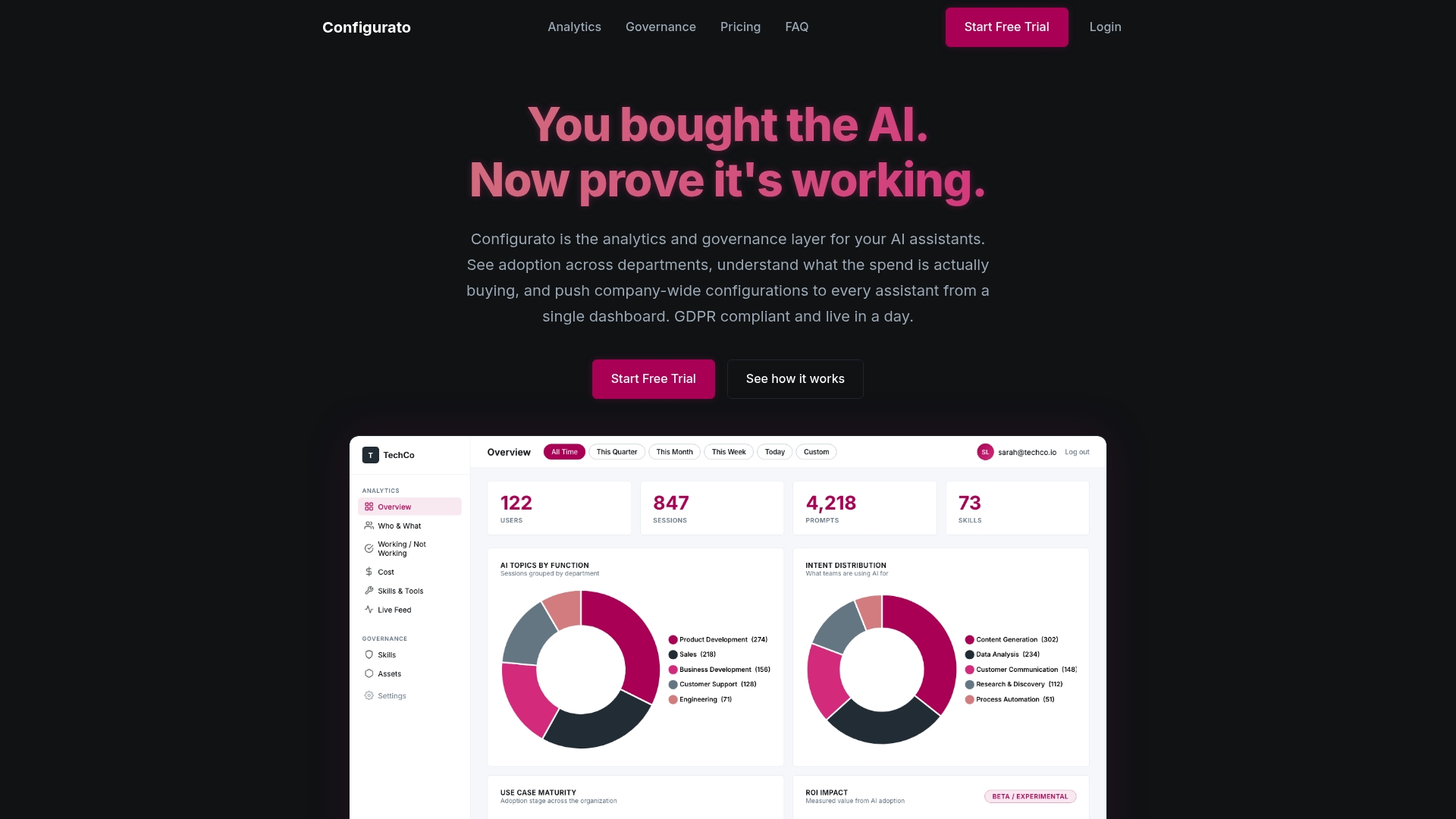
Configurato for enterprise AI gives you the governance layer, AI assistant management, and analytics infrastructure to close the gap between AI adoption and AI impact. You don’t need to retrain your workforce or change the tools they’re already using. Configurato works in the background, agent-to-agent, so your employees get AI output that already reflects your processes, quality standards, and domain knowledge. No prompting tutorials. No rework. Just faster, more relevant output from day one. If you’re ready to move beyond pilots and build enterprise-scale AI, this is where you start.
Frequently asked questions
How is enterprise AI different from traditional AI projects?
Enterprise AI is an integrated capability layer that spans the organization with reusable services, governance, and system integration, unlike traditional AI projects which are typically isolated, team-specific, and difficult to scale.
What are the operational benefits of a capability-layer approach?
Organizations that build shared AI capabilities see faster deployment, lower per-use-case costs, and consistent governance because infrastructure is reused rather than rebuilt for every initiative.
Why do many enterprise AI initiatives struggle or fail?
Most failures trace back to treating AI as isolated projects without the shared data infrastructure, governance frameworks, and system integrations needed to sustain and scale impact.
What should executives prioritize to enable enterprise AI success?
Prioritize integrated data management and shared enterprise capabilities built into core systems, combined with genuine cultural alignment across leadership and teams, because neither technology nor culture alone is sufficient.