
Employee AI engagement is defined as the strategic use of AI technologies, including natural language processing, real-time sentiment analytics, and autonomous AI agents, to personalize communications, automate employee listening, and give managers the data they need to act fast on retention and performance. The industry term for this practice is “AI-driven employee engagement,” and it marks a clear shift from periodic surveys and gut-feel management to continuous, data-backed leadership. Organizations using AI to deliver immediate insights to managers see faster engagement improvements than those relying on traditional reporting cycles. For HR professionals and managers, understanding what is employee AI engagement is no longer optional. It is the foundation of any serious workforce strategy in 2026.
What is employee AI engagement and how does it work?
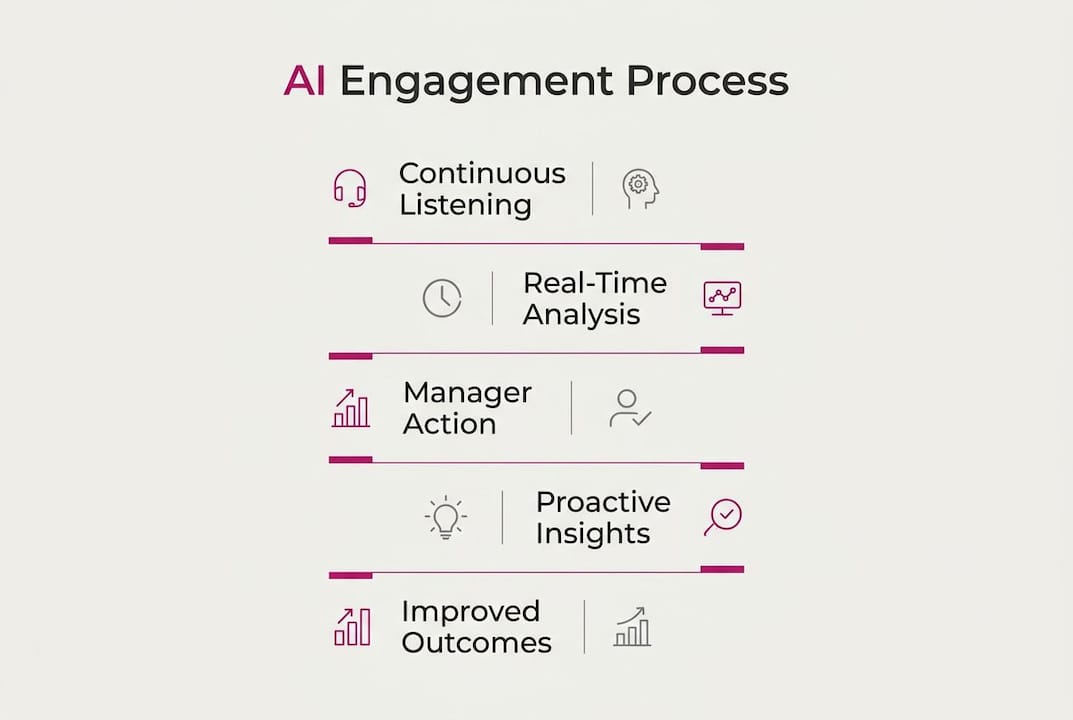
Employee AI engagement combines three layers of technology to move from passive data collection to active workforce improvement. The first layer is listening: AI tools replace annual surveys with always-on systems that pull signals from pulse surveys, communication patterns, and workflow data. The second layer is analysis: natural language processing reads open-text responses at scale, sentiment dashboards surface mood trends by team, and predictive analytics flag disengagement before it becomes turnover. The third layer is action: AI generates specific next steps for managers and, in the most advanced deployments, autonomous agents execute tasks without waiting for human input.

The distinction between recommendation AI and agentic AI matters here. Recommendation AI tells a manager, “Your team’s satisfaction scores dropped this week.” Agentic AI goes further. It resolves the scheduling conflict that caused the drop, corrects the missed time punch, and logs the action, all without a ticket being filed. Over 50% of talent leaders plan to deploy agentic AI by 2026. That number signals a fundamental shift in how workforce management operates.
Key AI technologies that power employee engagement programs include:
- Sentiment analysis dashboards that track team mood in real time across multiple data sources
- AI-powered survey tools that automatically surface themes from open-text responses
- Autonomous task agents that handle credential management, scheduling conflicts, and timecard exceptions
- Predictive attrition models that identify flight-risk employees weeks before they resign
- AI-powered recognition tools that assess message quality and identify leadership behaviors worth reinforcing
Pro Tip: Deploy sentiment dashboards at the team level, not just the company level. Aggregated scores hide the pockets of disengagement that cause your best people to leave quietly.
How does AI improve the speed and quality of employee feedback?
Traditional feedback cycles create a structural problem: by the time a manager sees survey results, the moment to act has passed. AI eliminates that lag. AI-powered survey analysis automatically surfaces themes and importance rankings from open-text responses, so a manager reviewing 200 comments gets a prioritized list of issues in minutes, not days.
The practical impact on manager behavior is significant. When AI generates specific next-step suggestions, managers spend more time leading and less time figuring out what to do after a feedback round. That shift matters because manager quality remains the strongest predictor of team engagement, consistently outranking compensation and company-wide initiatives.
Here is how AI transforms the feedback cycle from slow to fast:
- Continuous listening replaces periodic surveys. AI integrates multiple data sources to give a live engagement view rather than a quarterly snapshot.
- Sentiment analysis reads tone, not just scores. A 7/10 satisfaction rating with anxious language in the comments tells a different story than a 7/10 with neutral language.
- AI summarizes open-text at scale. A manager with 50 direct reports cannot read every comment. AI reads all of them and returns the top three themes.
- Generated action plans close the feedback loop. Rather than leaving managers to interpret data alone, AI recommends specific conversations, recognition moments, or process changes.
- Real-time alerts flag urgent issues. When sentiment drops sharply in a single team, AI notifies the manager the same day, not at the next review cycle.
Organizations that move from reactive problem solving to anticipating engagement issues before escalation report stronger retention outcomes. The mechanism is straightforward: the faster a manager can act on a signal, the less likely a disengaged employee is to start a job search.
What operational challenges does AI solve to enhance employee engagement?
The most underrated driver of disengagement is not a lack of recognition or poor management. It is friction. Paycheck errors, scheduling conflicts, and unresolved administrative issues drain employee energy faster than almost any cultural problem. Agentic AI bots resolving micro-stresses like missed time punches and scheduling conflicts correlate more strongly with higher engagement scores than corporate messaging campaigns.
The friction-reset model addresses this directly. Before adding new AI tools, organizations identify and remove the operational bottlenecks that sap employee energy. AI then handles those bottlenecks autonomously, freeing managers to focus on leadership rather than administration.
Specific operational problems AI solves include:
- Payroll exception handling that catches and corrects errors before payday, eliminating one of the most trust-damaging employee experiences
- Automated scheduling that fills gaps and resolves conflicts without requiring manager intervention on every change
- Credential and access management that removes the first-day friction that shapes a new hire’s impression of the organization
- Audit trail generation that replaces manual record-keeping with automatic documentation
Pro Tip: Map your top five employee complaints before selecting an AI engagement tool. If three of them are operational, start with an agentic AI solution, not a survey platform.
| Challenge | Traditional approach | AI-driven approach |
|---|---|---|
| Payroll errors | Manual correction after complaint | Autonomous detection and resolution before payday |
| Scheduling conflicts | Manager intervention per request | Agentic bot resolves and logs automatically |
| Feedback processing | Manual theme identification | NLP surfaces themes in minutes |
| Attrition risk | Identified at exit interview | Predicted weeks in advance by analytics model |
AI automates repetitive HR tasks and transitions workforce management from reactive record-keeping to proactive, predictive systems. The result is a manager who spends their time on conversations that matter, not on administrative cleanup.
What are the best practices for implementing AI-driven engagement programs?
The most common mistake in AI engagement rollouts is treating the technology as the solution rather than the enabler. Organizations that treat AI as a manager enablement tool rather than a tech replacement see better engagement outcomes. The distinction shapes every implementation decision.
Building a culture with a high Learning Quotient (LQ), meaning the capacity to learn, unlearn, and relearn, is the cultural prerequisite for successful AI adoption. Organizations fostering LQ culture empower rapid adaptation and maximize AI benefits across teams. Without it, even well-designed tools sit unused.
Practical steps for a successful implementation:
- Start with manager enablement. Give managers AI-generated insights on their specific teams before rolling out company-wide dashboards. Adoption follows when managers see personal value first.
- Avoid the feedback lag trap. Collect data only if you have a system to act on it. Unacted feedback damages trust faster than no feedback program at all.
- Embed AI into existing workflows. Tools that require separate logins or new habits fail. AI engagement features should appear inside the platforms managers already use daily.
- Train for AI literacy, not just tool use. Managers need to understand what the sentiment score means and what it does not mean. Misreading AI output is as damaging as ignoring it.
- Measure adoption, not just outcomes. If managers are not using the AI insights, engagement scores will not improve regardless of tool quality.
Knowing why AI tools go unused is as important as knowing which tools to buy. Rollouts that skip the adoption layer consistently underperform, regardless of the technology’s capability.
What measurable benefits do organizations experience from AI engagement?
The business case for AI-driven employee engagement is grounded in cost and retention data, not theory. Autonomous AI agents reduce labor costs by 10–15% while increasing employee satisfaction by removing administrative friction. That combination, lower cost and higher satisfaction, is rare in workforce management.
“Timely, specific recognition powered by AI keeps employees feeling valued during periods of AI uncertainty and change. AI-powered recognition tools assess message quality and identify leadership behaviors, supporting a culture of contribution that rebuilds trust and discretionary effort.”
The leadership quality finding reinforces the ROI case. Only 7% of leaders successfully balance high performance with genuine team care. AI tools help close that gap by giving the other 93% real-time, data-backed visibility into team well-being. A manager who can see that their team’s anxiety spiked after a product announcement can address it the same day, rather than discovering the damage weeks later.
| Benefit | Mechanism | Outcome |
|---|---|---|
| Lower labor costs | Agentic AI handles admin tasks | 10–15% cost reduction |
| Higher satisfaction | Friction removal via autonomous bots | Fewer micro-stresses, stronger trust |
| Faster feedback loops | AI summarizes and prioritizes themes | Managers act in hours, not weeks |
| Better recognition | AI assesses message quality | Employees feel valued during change |
AI-powered recognition tools that identify leadership behaviors create a measurable culture of contribution. That culture is what drives discretionary effort, the difference between employees who do their job and employees who go beyond it.
Key Takeaways
AI-driven employee engagement works because it combines continuous listening, real-time analysis, and autonomous action to give managers the speed and specificity they need to retain people and reduce operational friction.
| Point | Details |
|---|---|
| AI engagement is always-on | Continuous listening replaces periodic surveys, giving managers a live view of team health. |
| Agentic AI removes friction | Autonomous bots resolve payroll errors and scheduling conflicts before they damage trust. |
| Manager enablement drives results | AI generates specific action plans so managers close feedback loops fast, not just collect data. |
| LQ culture enables adoption | Teams that learn and adapt quickly extract more value from AI engagement tools. |
| Measurable ROI exists | Agentic AI deployments reduce labor costs by 10–15% while increasing employee satisfaction. |
The part most HR teams skip
The organizations I see struggle most with AI engagement are not the ones that chose the wrong tool. They are the ones that launched a tool without fixing the operational problems underneath it. You cannot survey your way out of a broken payroll process. You cannot recognize your way past a scheduling system that creates weekly conflicts. The friction-reset model gets this right: start by identifying what drains your employees’ energy, then deploy AI to eliminate it. The engagement scores follow.
Real-time data access for managers is the second thing most teams underinvest in. A sentiment dashboard that only the HR director can see is not an engagement tool. It is a reporting tool. The value of AI in workforce management comes from putting the right signal in front of the right manager at the right moment. That requires both the technology and the organizational design to support it.
The third gap is continuous learning. AI tools change fast. The cross-team AI adoption strategy that worked in 2024 needs updating now. HR leaders who build LQ into their culture, meaning the habit of learning, unlearning, and relearning, will consistently outperform those who treat AI rollouts as one-time projects. Technology is not the constraint. Adaptability is.
— TekkrTools
How Tekkr helps organizations turn AI into real engagement results
Tekkr’s Configurato platform was built for exactly the gap this article describes: organizations that have bought AI tools but cannot prove they are working.
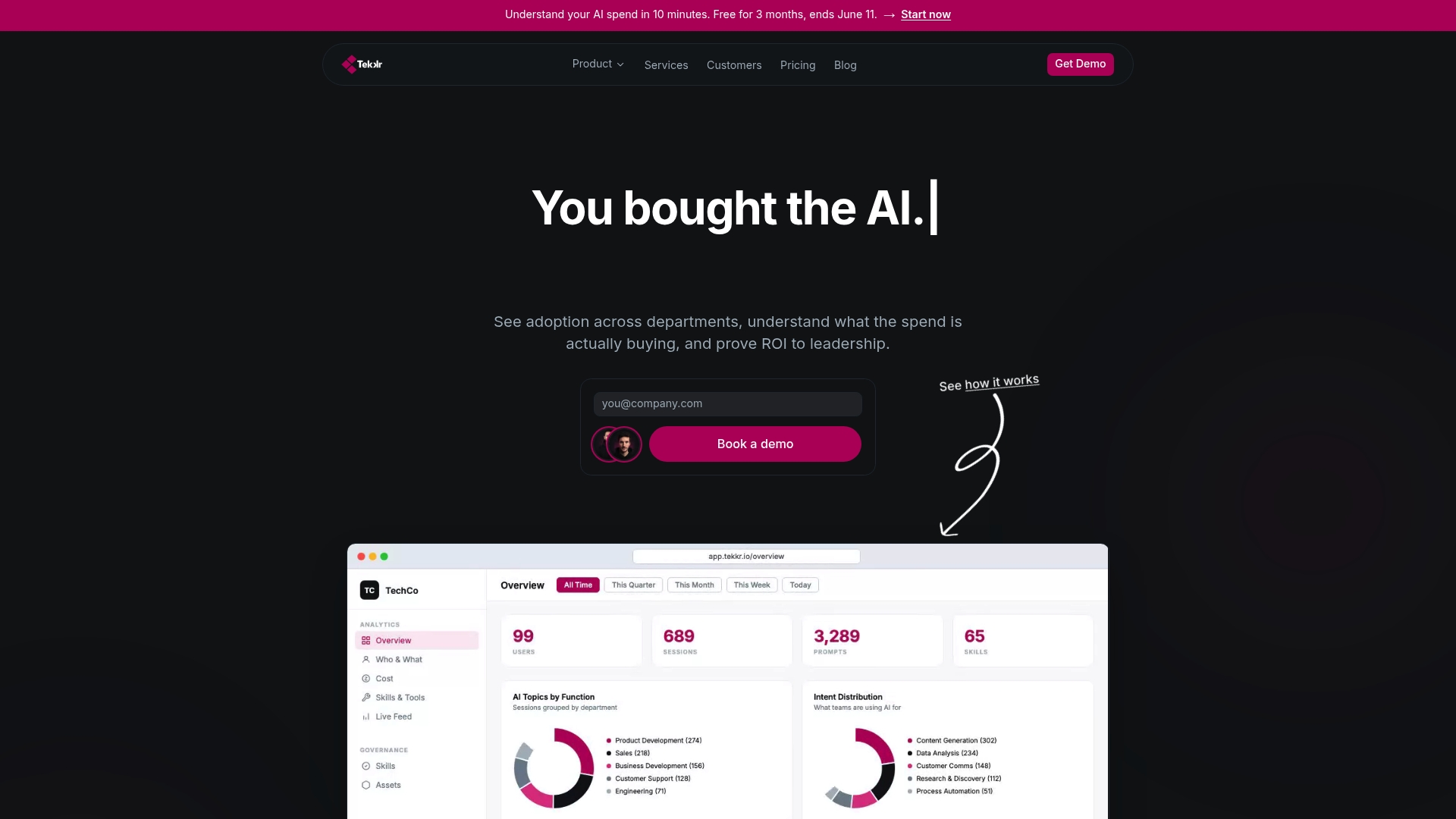
Configurato tracks who is actually using tools like Claude and Codex, breaks down costs by team, and surfaces use-case intelligence so HR leaders and managers know where AI is creating value and where it is sitting idle. The AI adoption consulting layer goes further, running gamified rollouts and company-wide AI playbooks that lift adoption across every department. Setup takes about 10 minutes, there is a free tier, and no credit card is required. If you have already bought the AI, Tekkr helps you prove it is working.
FAQ
What is employee AI engagement in simple terms?
Employee AI engagement is the use of AI tools to continuously listen to employees, analyze their feedback, and give managers specific actions to improve retention and satisfaction. It replaces periodic surveys with always-on, real-time insight.
How does AI improve employee engagement faster than traditional methods?
AI processes open-text survey responses in minutes, surfaces the top themes, and generates manager action plans immediately. Traditional methods require manual analysis that can take weeks, by which point the moment to act has passed.
What is agentic AI and why does it matter for HR?
Agentic AI executes entire workflows autonomously, such as resolving payroll errors or scheduling conflicts, without waiting for human input. It reduces labor costs by 10–15% and removes the micro-stresses that damage employee trust.
How do you measure the ROI of AI-driven employee engagement?
Track labor cost reduction from automated admin tasks, changes in employee satisfaction scores, manager response time to feedback, and attrition rates before and after deployment. Agentic AI deployments show measurable cost and satisfaction improvements within months.
What is the biggest risk when implementing AI engagement tools?
The biggest risk is collecting feedback without acting on it. Unacted feedback damages trust faster than having no feedback program. AI tools must be paired with manager enablement and clear workflows for closing the feedback loop.