
Bottom-up AI adoption is defined as a structured enterprise discovery method that surfaces AI use cases directly from workflow owners and employees across every organizational layer, rather than waiting for executive mandates. As of 2026, 66% of firms use AI for specific task-level operations through worker-led adoption independent of centralized directives. That figure tells you something critical: most AI activity in your organization is already happening without you seeing it. Understanding what is bottom-up AI adoption means recognizing it as a formal discipline, not a grassroots free-for-all. Organizations like PwC and MIT Sloan have established AI strategy benchmarks that consistently show the gap between executive AI visibility and actual workflow-level AI activity is wide and costly.
What is bottom-up AI adoption and how does it work?
Bottom-up AI adoption is best understood as structured enterprise discovery rather than crowdsourcing. It focuses on operational friction that sits below executive visibility, the kind of friction that never makes it into a board deck but costs thousands of hours per year. The method uses three distinct discovery channels working in parallel: deep workflow interviews, asynchronous surveys, and passive telemetry data.

The three discovery channels
Workflow interviews target 30–50 workflow owners selected based on their operational impact. These are not senior leaders. They are the people who actually run recurring processes: the ops manager who handles vendor onboarding, the analyst who produces weekly reports, the engineer who triages support tickets. Each interview maps where time goes, where handoffs break down, and where AI could realistically intervene.
Asynchronous surveys broaden the signal without creating survey fatigue. They reach employees who would never be selected for a 45-minute interview but who carry valuable ground-level knowledge. The format lets respondents answer on their own schedule, which increases completion rates and reduces the social pressure to give “approved” answers.
Passive telemetry is the most underrated channel. Telemetry data corrects for memory bias by capturing actual workflow signals: calendar patterns, document usage frequency, and ticket category volumes. When an employee says they spend 20% of their week in meetings, telemetry often reveals the real number is closer to 40%. That gap is where AI opportunity hides.
Launching all three channels simultaneously from day one produces more accurate insights than running them sequentially. Sequential launches create stale data: by the time telemetry runs, the interview findings are weeks old and workflows may have shifted. Synthesis typically happens around week six, producing a prioritized map of AI efficiency opportunities scored at the workflow level.
Pro Tip: Resist the urge to start with interviews alone. Telemetry running in parallel from day one gives you an objective baseline that makes every interview finding sharper and more defensible.
What are the benefits and limitations of bottom-up AI adoption?
The benefits of bottom-up AI adoption are real and well-documented. Employee-led innovation improves agility, reduces decision delays, and surfaces use cases that no executive would have identified from a conference room. The approach also builds genuine engagement: employees who shape AI adoption in their own workflows are far more likely to actually use the tools.
The specific operational benefits include:
- Deeper workflow intelligence: Discovery reaches friction points that never appear in top-down audits.
- Higher employee engagement: Teams that contribute to AI discovery feel ownership over the outcome.
- Hidden inefficiency identification: Telemetry and interviews together surface time sinks that self-reporting misses.
- Faster experimentation: Workflow owners can test AI tools within their own processes without waiting for IT approval cycles.
- Scalable use-case generation: A structured bottom-up program produces a pipeline of prioritized AI opportunities across every department.
The limitations are equally real and often underestimated.
Pure bottom-up AI initiatives frequently produce fragmented, low-impact activities that fail to generate scalable business transformation without strategic oversight. Internal hackathons, shadow AI tools, and disconnected pilots are the most common symptoms.
Purely decentralized AI transformation often fails mid-market companies because the energy concentrates on activities that feel productive but do not move the P&L. Without a top-down spine to filter and prioritize, bottom-up programs generate noise alongside signal. The result is a long list of interesting ideas and very little implementation at scale.
How do bottom-up, top-down, and hybrid AI strategies compare?
Each AI adoption model produces a different type of output and serves a different organizational need. Understanding the differences helps you choose the right structure, or the right combination.
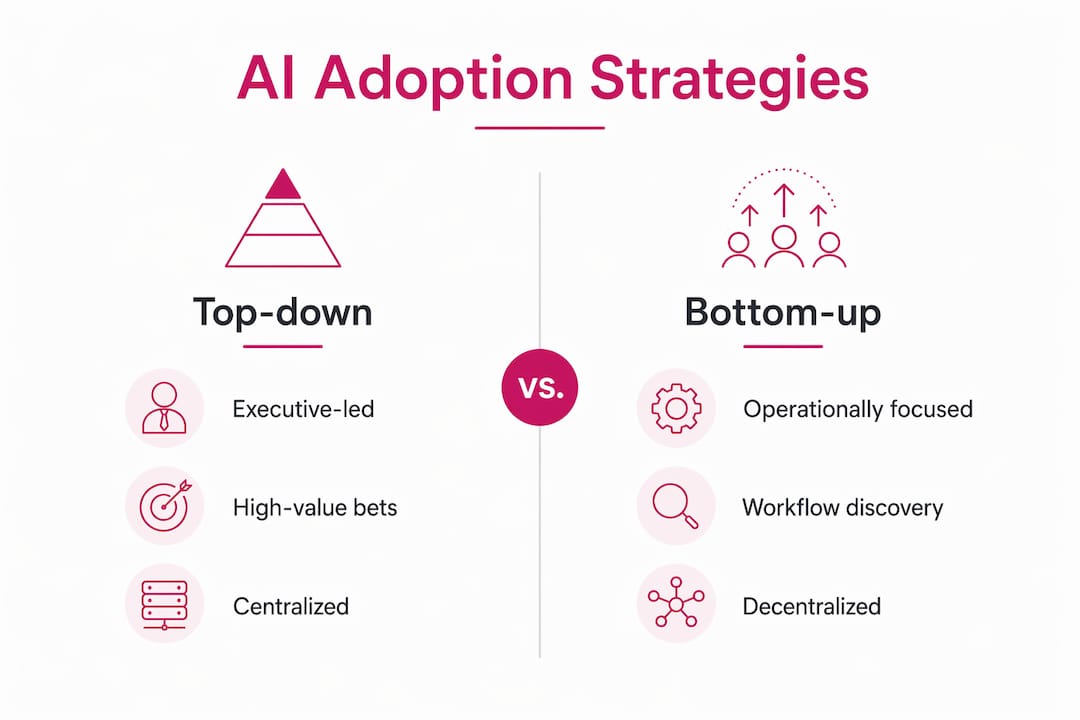
Top-down AI strategy is executive-led. Leadership identifies three to five high-value AI bets, allocates budget, and drives adoption through mandate. The deliverable is typically a long static deck presented to the board. Top-down approaches move fast on priorities but miss the operational texture that only workflow owners can provide.
Bottom-up AI strategy is operationally focused. Its primary deliverable is a persistent intelligence layer: a queryable atlas of AI efficiency opportunities indexed by workflow and scored by impact. Unlike a static report, this atlas updates continuously as new telemetry and survey data arrives. The limitation is that without executive sponsorship, the atlas sits unused.
Hybrid or hub-and-spoke models combine central governance with decentralized experimentation. Leadership owns the strategic spine and selects which bottom-up findings get resourced and scaled. The most effective AI strategies in 2026 use exactly this model: leadership governs centrally while bottom-up teams experiment within defined boundaries.
| Dimension | Top-down | Bottom-up | Hybrid |
|---|---|---|---|
| Who drives it | Executive leadership | Workflow owners and employees | Both, with defined roles |
| Primary deliverable | Board narrative and portfolio decisions | Queryable intelligence atlas | Governed use-case pipeline |
| Speed to strategic alignment | Fast | Slow without sponsorship | Moderate |
| Depth of operational insight | Low | High | High |
| Risk of fragmentation | Low | High | Low |
| ROI potential | Moderate alone | Moderate alone | Highest combined |
Top-down strategies alone deliver 10–45% higher ROI than purely bottom-up approaches. The best results come when both are combined. That range is wide because the gap between a well-governed hybrid and a purely grassroots program is enormous.
Pro Tip: Build your AI adoption program so that leadership selects and owns three to five high-value bets, then uses bottom-up discovery to populate the candidate list. The top-down spine gives bottom-up energy somewhere to go.
How to implement bottom-up AI adoption in your organization
Implementing a decentralized AI adoption program requires structure from the start. Without it, you get the fragmentation problem described above. The following steps give you a repeatable framework.
-
Map your workflow landscape. Before selecting interview candidates, list every major recurring workflow across departments. Group them by estimated time cost and strategic importance. This map becomes your sampling frame.
-
Select 30–50 workflow owners. Choose based on operational impact, not seniority. The best candidates run processes that touch multiple teams, repeat weekly or monthly, and involve significant manual effort. Aim for cross-functional coverage.
-
Launch all three channels on day one. Set up telemetry access, distribute asynchronous surveys, and begin scheduling interviews in the same week. Parallel data collection produces a richer, more accurate picture than sequential approaches.
-
Build for a living artifact, not a static report. The output of your discovery program should be a queryable intelligence atlas indexed by workflow and scored by AI impact potential. Static decks go stale within weeks. A living document with source attribution stays useful for months.
-
Secure executive sponsorship before synthesis. At week four, brief a senior sponsor on early findings. This creates a pull mechanism: leadership is already invested in the output before it arrives, which dramatically increases the chance that findings get acted on rather than filed.
-
Integrate findings into the strategic agenda. Bottom-up discovery produces the candidate list. Top-down governance selects which candidates get resourced. Connect these two processes explicitly, with a defined review cadence, so the program produces decisions rather than reports.
Tekkr’s AI adoption best practices framework reinforces this sequence, particularly the importance of combining workflow-level intelligence with executive accountability to maximize ROI.
Pro Tip: Avoid the most common implementation mistake: launching interviews first and adding telemetry later. By the time telemetry data arrives, your interview findings are already outdated. Start everything together.
Organizations without large IT teams can still run this program effectively. Tekkr’s guide on bootstrapping AI adoption covers how to set up telemetry and survey infrastructure without heavy technical overhead.
Key Takeaways
Bottom-up AI adoption delivers the deepest operational intelligence available, but it requires top-down governance to convert that intelligence into business results.
| Point | Details |
|---|---|
| Definition matters | Bottom-up AI adoption is structured enterprise discovery, not grassroots experimentation. |
| Three channels, run in parallel | Interviews, surveys, and telemetry must launch simultaneously for accurate synthesis at week six. |
| Telemetry corrects memory bias | Passive data reveals actual workflow patterns that self-reporting consistently underestimates. |
| Hybrid models outperform either alone | Top-down strategies combined with bottom-up discovery deliver the highest AI ROI. |
| Living artifacts beat static reports | A queryable intelligence atlas stays useful; a long deck goes stale within weeks. |
Why most organizations are doing this backwards
The conventional wisdom says: get leadership aligned first, then roll AI out to the workforce. I have seen that approach produce beautiful strategy decks and almost no measurable change at the workflow level. The problem is not the strategy. The problem is that leadership is making bets without knowing what is actually happening on the ground.
Bottom-up adoption flips the sequence in a useful way. You discover what is broken before you decide what to fix. That sounds obvious, but most enterprises skip this step entirely. They buy AI tools, run a few pilots, and then wonder why adoption numbers are flat six months later. The answer is almost always that the tools were chosen without understanding the workflows they were supposed to improve.
The part that gets overlooked most often is the telemetry layer. Leaders are comfortable with interviews and surveys. Passive data collection feels invasive to some, so it gets deprioritized. That is a mistake. Telemetry is the only channel that tells you what people actually do, not what they think they do or what they are willing to admit in a survey. Without it, your discovery program is built on self-reported data, which is systematically optimistic.
The future of AI governance in enterprises will be built on this kind of persistent, workflow-level intelligence. Organizations that build that capability now will have a structural advantage when AI tools continue to evolve. Those that rely on periodic top-down audits will keep chasing a moving target. The role of leadership is not to replace bottom-up discovery. It is to give it direction and resources so the signal does not get lost.
— TekkrTools
How Tekkr supports bottom-up and hybrid AI adoption
Organizations that run structured bottom-up discovery programs still need a way to track what happens after the atlas is built. Knowing where AI opportunities exist is only half the problem. The other half is measuring whether teams actually adopt the tools and whether that adoption produces results.
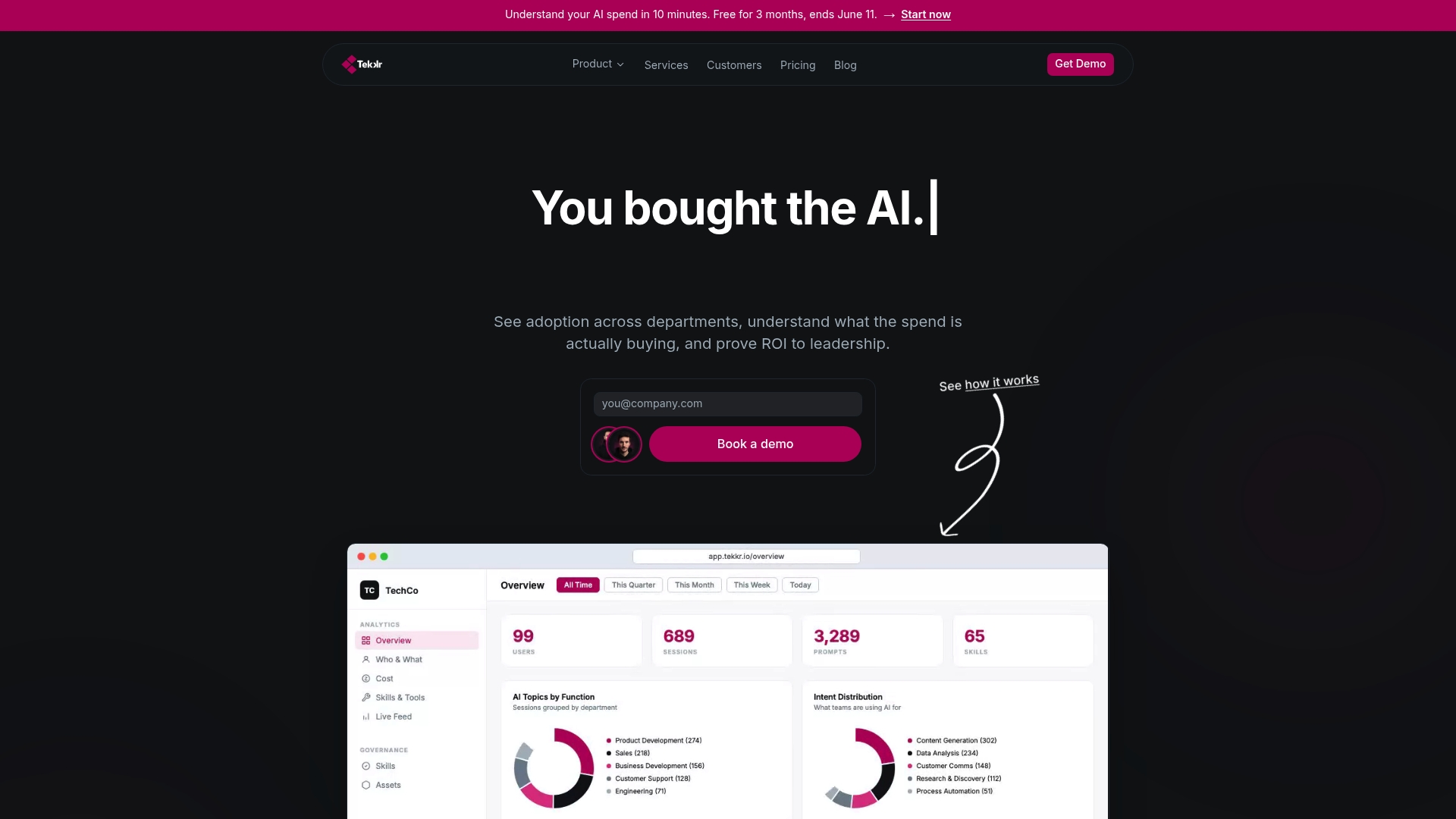
Tekkr’s flagship product, Configurato, connects both halves. It tracks real AI tool usage across teams, breaks down spend by department, and surfaces which workflows are generating returns and which are not. The platform supports gamified rollouts and company-wide AI playbooks so that bottom-up findings translate into actual behavior change, not just recommendations. Setup takes about 10 minutes, with a free tier and no credit card required. Explore Tekkr’s full AI adoption solutions to see how structured discovery and measurable enablement work together.
FAQ
What is bottom-up AI adoption in simple terms?
Bottom-up AI adoption is a structured method for discovering AI use cases by interviewing workflow owners, surveying employees, and analyzing telemetry data across an organization. It surfaces operational friction that executive-led approaches typically miss.
How does bottom-up AI adoption differ from top-down AI strategy?
Top-down AI strategy is driven by executive decisions and board-level priorities. Bottom-up adoption starts with workflow owners and employees, producing operational intelligence that feeds upward into strategic decisions rather than flowing down from them.
What are the biggest risks of a purely bottom-up AI approach?
Purely decentralized programs tend to generate fragmented, low-impact activities that do not scale. Without top-down governance to prioritize and resource the best findings, bottom-up energy disperses into pilots that never reach production.
How long does a bottom-up AI discovery program take?
A structured program running interviews, surveys, and telemetry in parallel typically synthesizes its first actionable findings around week six. The resulting intelligence atlas then updates continuously rather than requiring a full restart.
What is a persistent intelligence layer in AI adoption?
A persistent intelligence layer is a continuously updated, queryable atlas of AI efficiency opportunities scored at the workflow level. It replaces static reports and gives leadership an always-current view of where AI can generate the most value across the organization.