
An AI tool audit is a structured evaluation of every AI-powered tool an organization uses, assessing usage patterns, data flows, risks, and governance controls. It goes far beyond a simple inventory. Where a spreadsheet lists tools like ChatGPT, Grammarly, or GitHub Copilot, an audit answers harder questions: Who actually uses them? What data flows through them? Are the controls working? For business leaders managing growing AI portfolios, this process is the difference between informed investment and expensive guesswork.
What is an AI tool audit and why does it matter?
An AI tool audit is a structured review that assesses usage, business alignment, data processed, risks, and controls across all AI tools in an organization. The output is a prioritized list of tools and use cases, each tagged with a risk level, remediation plan, and named owner. That output is what separates an audit from a one-time checklist.
The business case is direct. Organizations that cannot answer basic questions about their AI tools cannot manage them. Regulators, auditors, and boards increasingly expect documented evidence of AI governance. Without a formal AI tools evaluation process, organizations expose themselves to compliance gaps, data breaches, and wasted spend on tools nobody uses effectively.

The term “AI tool audit” is the common shorthand. The recognized industry term is an AI governance audit, which covers the full lifecycle of AI systems from procurement through decommissioning. Both terms describe the same core practice, and both appear in frameworks like ISO/IEC 42001:2023 and the EU AI Act.
What does a comprehensive AI tool audit include?
A thorough AI governance audit covers six interconnected areas. Each one generates evidence. Together, they form a defensible record of how AI operates inside your organization.
- Tool inventory and shadow AI discovery. The inventory must capture shadow AI tools that employees use without IT approval, including the data classes those tools process, retention periods, processing locations, and whether they inform consequential decisions. Inventories built only from approved software lists routinely miss the tools doing the most sensitive work.
- Usage and data flow mapping. For each tool, auditors trace what data enters the system, where it goes, and who has access. This step surfaces unexpected data sharing with third-party vendors and identifies tools processing personal or regulated data without adequate controls.
- Risk classification. Tools are rated by operational risk, reputational risk, and regulatory exposure. A customer-facing AI making credit decisions carries a different risk profile than an internal writing assistant.
- Governance controls review. This covers human oversight mechanisms, security configurations, access controls, logging, and vendor management. AI governance audits cover the full lifecycle, and audits are most valuable as repeatable operating models rather than one-time checklists.
- Compliance mapping. Auditors map each tool against applicable laws and frameworks. The EU AI Act, for example, requires event logging over the system lifetime, with logs kept for a minimum of six months and tested for retrievability and completeness. Logs that cannot be retrieved count as ineffective evidence.
- Performance evaluation. Rubric-based, pass/fail testing tailored to specific prompts and use cases produces more reliable results than generic benchmarks. Google’s GenAI evaluation approach uses adaptive rubrics for this reason.
Pro Tip: Audit AI tools as fully integrated systems, not as isolated models. Testing a tool in a sandbox environment without its real data inputs and workflow connections will miss the failure modes that matter most in production.
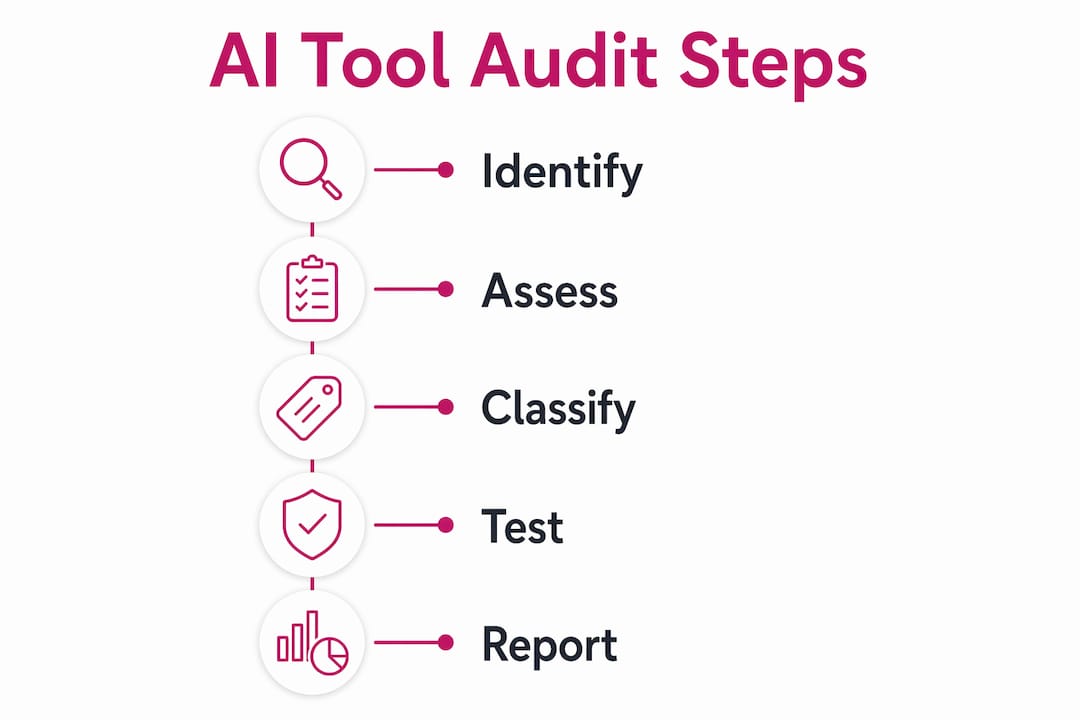
How to conduct an AI tool audit effectively in your organization
A phased approach prevents the process from collapsing under its own scope. Each phase has a clear output that feeds the next.
- Tool discovery. Pull data from IT procurement records, expense reports, and browser-based tool usage. Then run workshops with department heads to surface tools IT does not know about. Shadow AI is common in marketing, finance, and legal teams where productivity pressure is high.
- Data assessment. For each discovered tool, map the data it touches. Classify that data by sensitivity. Identify whether the tool sends data to external servers and whether vendor contracts address data retention and deletion.
- Risk and compliance mapping. Score each tool against your regulatory obligations. For organizations subject to the EU AI Act or ISO/IEC 42001:2023, certification requires document review, evidence sampling, corrective actions, and re-verification. Build your compliance matrix with named accountable owners for each control gap.
- Controls review. Test human oversight controls on real cases, not just on paper. Auditors sitting with operators during live work confirms whether human-in-the-loop controls are actually effective, not just documented.
- Vendor assessment. Request model cards, AI governance policies, and contract clauses from every AI vendor. Missing vendor documentation is itself an audit finding that weakens your vendor risk management posture.
- Remediation planning. Assign every finding an owner, a remediation action, and a target date. Findings without owners do not get fixed.
- Ongoing audit cycle. AI tools change rapidly. A single audit becomes stale within months. Build a review cadence into your AI governance framework so the process repeats as tools and regulations evolve.
Pro Tip: Do not rely on vendor-supplied documentation alone to assess compliance. Vendors have incentives to present their tools favorably. Your audit must independently verify that controls work as claimed.
Common challenges and risks that AI tool audits uncover
Shadow AI is the most common and most dangerous finding. Employees adopt AI tools quickly when they solve real problems. Without a discovery phase, organizations have no visibility into what data those tools process or where it goes. The risk is not hypothetical. An employee pasting customer records into an unapproved AI tool creates a data exposure that compliance teams may never detect without an audit.
Human oversight failures are the second most common finding. Many organizations treat human-in-the-loop controls as checkboxes rather than verifying that operators actually review AI outputs before acting on them. Documentation says the control exists. Reality often differs.
“A typical AI audit answers three questions: What AI is used? What data flows into it? Which obligations apply? Everything else flows from those answers.” — AI governance audit practice
Other common findings include:
- Incomplete logging. High-risk AI systems under the EU AI Act must maintain retrievable logs. Incomplete or inaccessible logs are a compliance failure, not just a technical gap.
- Vendor documentation gaps. Vendors who cannot produce model cards or AI governance policies represent unmanaged risk in your supply chain.
- Tool overlap and redundancy. Organizations frequently pay for multiple tools that perform the same function across different teams, with no shared learning between them.
- Misalignment with business goals. Tools adopted for one purpose often drift into other use cases that carry higher risk and were never evaluated.
What are the business benefits of regular AI tool audits?
The return on an AI tools evaluation is measurable across three areas: cost, risk, and performance.
| Benefit area | Without an audit | With a regular audit |
|---|---|---|
| AI spend visibility | Fragmented, team-by-team | Consolidated, with cost by tool and department |
| Shadow AI exposure | Unknown and unmanaged | Discovered, classified, and controlled |
| Compliance readiness | Reactive, gap-driven | Proactive, with documented evidence |
| Tool performance | Assumed based on vendor claims | Tested against real use cases with pass/fail results |
| Vendor risk | Unverified documentation | Reviewed contracts, model cards, and governance policies |
Optimizing AI investments is the most direct financial benefit. Audits routinely surface tools that teams stopped using after the first month, tools that duplicate each other’s function, and tools processing sensitive data without adequate contracts. Eliminating or consolidating those tools reduces spend and reduces risk simultaneously.
Compliance preparedness is the second major benefit. AI governance audits that connect inventory, risk classification, evidence, vendor oversight, and remediation into a repeatable model give organizations a defensible record when regulators ask questions. That record is not just a legal shield. It signals to customers and partners that AI is being managed responsibly.
The third benefit is performance improvement. Audits that use adaptive evaluation rubrics tailored to specific tasks produce findings that teams can act on. Generic benchmarks tell you a model scores well on a standard test. Task-specific rubrics tell you whether the tool actually works for your use case. That distinction drives better decisions about which tools to keep, which to replace, and which to configure differently. Aligning AI integration with business goals is what converts audit findings into measurable productivity gains.
Key takeaways
An AI governance audit is the foundational practice that turns AI tool investments from unmanaged risk into documented, measurable value.
| Point | Details |
|---|---|
| Define scope beyond inventory | Audits must cover usage, data flows, risk levels, and controls, not just a list of tools. |
| Discover shadow AI actively | Workshops and expense data surface tools that IT procurement records miss entirely. |
| Test controls in practice | Human-in-the-loop controls must be verified with live operator observation, not just documentation review. |
| Build a repeatable model | A single audit becomes outdated quickly. Quarterly or biannual cycles keep governance current. |
| Tie findings to owners | Every remediation item needs a named owner and a target date or it will not get resolved. |
Why I think most organizations are auditing AI the wrong way
The most common mistake I see is treating an AI audit as a compliance exercise rather than an operational one. Teams build a spreadsheet of approved tools, check a few vendor boxes, and call it done. That approach satisfies nobody. It does not satisfy regulators who want evidence of actual control effectiveness. It does not satisfy finance teams who want to know whether the AI spend is working. And it does not satisfy the employees who are quietly using tools that never made the approved list.
The second mistake is auditing AI tools in isolation. Testing a model’s performance in a sandbox tells you almost nothing about how it behaves when it is connected to your CRM, your customer data, and your actual workflows. Real audit value comes from testing integrated system behavior against task-specific criteria, not from running a model through a generic benchmark.
The insight that most surprises business leaders is this: bias and fairness are best audited as control processes, not as system-wide certifications. You are not certifying that a model is fair. You are verifying that your organization has defined the attributes it monitors, runs tests on a defined cadence, and has an escalation path when results fall outside acceptable ranges. That framing makes the audit tractable and the findings actionable.
The organizations that get the most value from AI audits treat them as a continuous operating model. They connect AI governance strategies to their audit cycle so that new tools, new regulations, and new use cases feed back into the same evidence framework. That is not a compliance burden. That is how you run AI responsibly at scale.
— TekkrTools
How Tekkr supports AI audit readiness and governance
Tekkr built Configurato specifically for organizations that need visibility into how AI tools are actually being used, not just which ones were purchased. Configurato tracks adoption by team, breaks down costs per tool, and surfaces use-case intelligence across the organization.
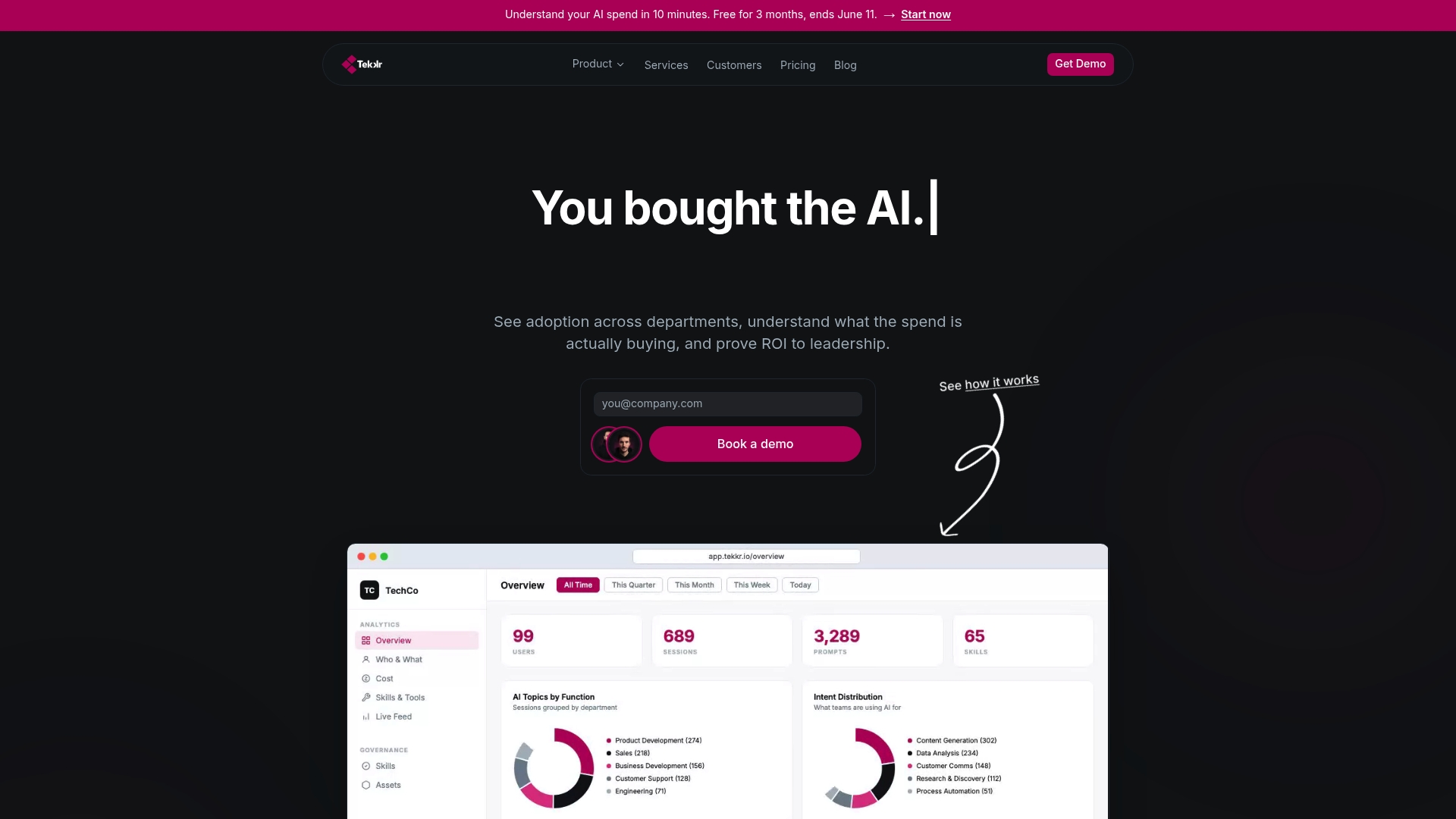
For business leaders working through an AI tools evaluation, Tekkr’s AI adoption solutions connect audit findings directly to adoption programs, so remediation is not just documented but acted on. The platform runs on a privacy-first architecture with end-to-end encryption, GDPR compliance, and automatic PII stripping, which means the audit process itself does not create new data exposure. Setup takes about 10 minutes, with a free tier and no credit card required. Tekkr’s security and privacy controls are built to meet the same standards your audit will evaluate.
FAQ
What is the difference between an AI tool audit and an AI governance audit?
The terms describe the same core practice. An AI tool audit is the common shorthand, while AI governance audit is the recognized industry term covering the full lifecycle of AI systems from procurement through decommissioning.
How often should organizations conduct an AI tool audit?
AI tools and regulations change rapidly, so a single annual audit is rarely sufficient. Most governance frameworks recommend a repeatable audit cycle, typically quarterly or biannual, to keep findings current and controls effective.
What is shadow AI and why does it matter in an audit?
Shadow AI refers to AI tools employees use without IT or compliance approval. These tools often process sensitive data without adequate contracts or controls, making their discovery a critical step in any AI software audit process.
Does an AI tool audit slow down innovation?
AI governance audits are designed to provide transparent, documented evidence for legal, privacy, and security stakeholders without blocking teams from using AI. The audit creates the record that allows innovation to continue with organizational confidence.
What frameworks apply to AI tool audits in 2026?
The EU AI Act and ISO/IEC 42001:2023 are the two most widely applied frameworks. The EU AI Act mandates event logging and retrievability testing for high-risk AI systems. ISO/IEC 42001:2023 provides a management system model that structures the audit trail business leaders and regulators trust.