
An AI enablement program is an organizational capability-building system that equips companies with the technology, skills, and governance needed to reliably implement and scale AI across business functions. The term is sometimes used interchangeably with “AI readiness” or “AI capability development,” but the more precise industry framing is AI enablement: a structured, repeatable approach to making AI work at scale. Where most organizations stop at buying tools like Claude or Codex, AI enablement programs build the infrastructure, processes, and workforce skills that turn those tools into measurable business outcomes. Without this foundation, AI investments stall at the pilot stage.
What is an AI enablement program, and what does it include?
An AI enablement program is a capability-building system that integrates infrastructure, process governance, and strategy alignment so organizations can deploy and scale AI reliably. It is not a one-time training event or a software rollout. The program treats AI as an organizational capability, not a technology project.
Three core pillars define every mature AI enablement program:
- Infrastructure and data readiness: Data platforms, compute resources, APIs, and shared data lineage that give AI models reliable inputs. Without this layer, models produce inconsistent outputs and pilots fail to reach production.
- Process, governance, and MLOps: Defined workflows, accountability frameworks, and machine learning operations that govern how models are built, deployed, monitored, and retired. Governance embedded here reduces friction rather than creating it.
- Strategy and workforce alignment: Connecting AI initiatives to measurable business outcomes and building the skills employees need to use AI well. This includes AI literacy programs, role-specific training, and the cultural permission to experiment.
Measurement sits across all three pillars. A program without defined metrics has no way to prove value or improve over time.
Pro Tip: Start your AI enablement program by auditing data infrastructure first. Teams that skip this step spend months rebuilding foundations after their first production failure.

How does AI enablement differ from AI adoption and AI transformation?
These three terms describe different stages of the same journey, and confusing them leads to misallocated budgets.
| Concept | Definition | Scope | Primary Risk |
|---|---|---|---|
| AI adoption | Deploying and using AI tools across teams | Tool-level | Low usage, shelfware |
| AI enablement | Building the capabilities that support adoption at scale | Program-level | Skipped governance, poor ROI |
| AI transformation | Organization-wide operational change driven by AI | Enterprise-level | Culture resistance, no measurement |
AI adoption is what happens when a company buys GitHub Copilot or Microsoft Copilot and asks teams to use it. AI enablement is the structured program that makes adoption stick: it covers governance, training, measurement, and infrastructure. AI transformation is the long-term outcome when enablement succeeds across every department.
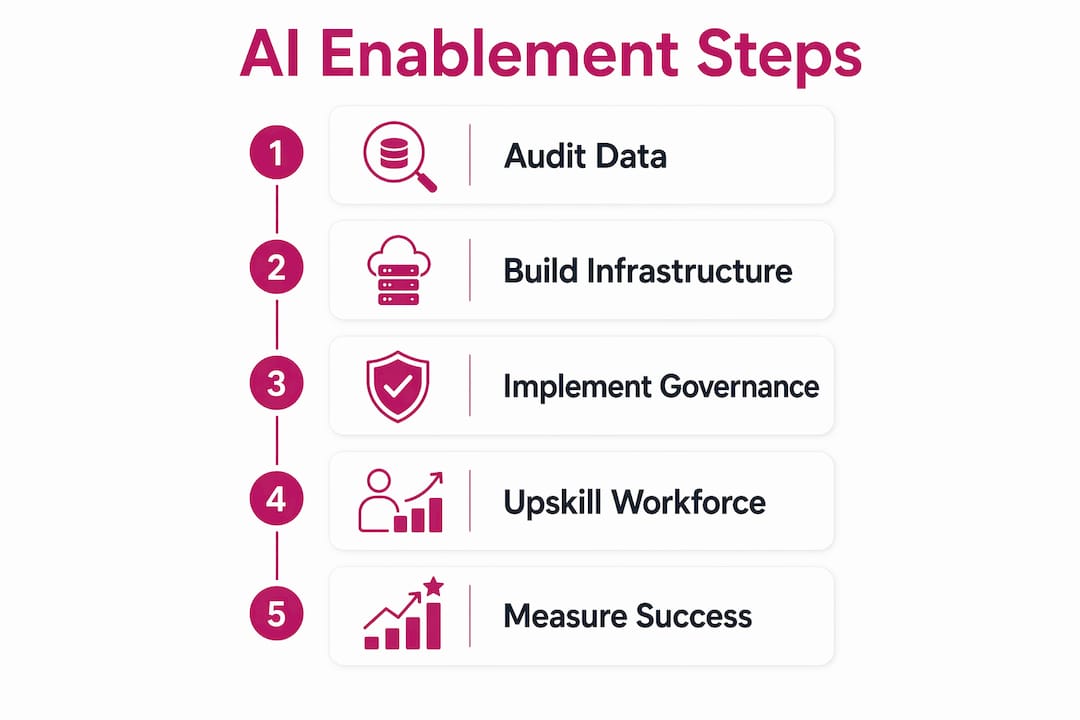
The critical insight is that enablement bridges adoption to transformation. Without it, organizations accumulate AI tools that underperform because the surrounding systems, skills, and governance were never built. Adoption without enablement produces shelfware. Transformation without enablement produces chaos.
What metrics and ROI models measure AI enablement success?
Measuring AI enablement success requires separating system-level ROI from single-model ROI. Single-model ROI tracks whether a specific AI application delivers value. System-level ROI tracks whether the entire enablement program is building durable organizational capability.
A mature measurement framework uses formal checkpoint reviews at baseline, then at 30, 90, 180, and 360 days. Each checkpoint has explicit ownership so accountability is clear. The framework divides metrics into two categories:
- Leading indicators (early signals): AI literacy rates across teams, data quality scores, adoption rates by department, and the number of use cases moved from pilot to production.
- Lagging indicators (business outcomes): Process cost reduction, error rate changes, revenue impact from AI-assisted workflows, and model degradation rates over time.
- Governance health metrics: Audit trail completeness, policy compliance rates, and the frequency of escalations required outside automated controls.
- Adoption depth metrics: Active usage rates for tools like Claude and Codex, broken down by team and role, not just license counts.
- Infrastructure metrics: Data pipeline reliability, API uptime, and the time required to deploy a new use case from scratch.
A survey of 755 respondents found 49.5% can demonstrate measurable AI ROI. That means just over half of organizations investing in AI can actually prove it is working. Governance maturity is the primary factor separating those who can from those who cannot.
Pro Tip: Assign named owners to both leading and lagging indicators before launch. Programs with shared ownership of metrics consistently produce weaker accountability than those with single, named owners per metric category.
Tracking these metrics manually across large organizations is impractical. Platforms like Tekkr’s Configurato automate this by tracking AI adoption metrics across tools, teams, and spend in one place.
What are the cultural and organizational challenges in AI enablement programs?
Culture is the most underestimated component of any AI enablement strategy. Technology and governance frameworks can be built in weeks. Changing how thousands of employees think about their work takes months of deliberate effort.
An AI-first culture is built through repeated behaviors and permission structures that encourage employees to reflexively ask how AI can support their work. This is not a memo or a mandate. It requires sustained practice, visible leadership behavior, and formal AI champions programs that keep adoption alive between training cycles.
The most common cultural failures in AI enablement programs include:
- Training without governance: Upskilled employees return to unchanged workflows and revert to old habits within weeks. Training alone does not produce performance improvements without structural support.
- No safe experimentation space: Teams that fear punishment for failed AI experiments stop experimenting. Enablement programs need explicit permission structures that protect people who try and fail.
- Missing AI champions: Without designated champions in each department, adoption momentum dies when formal training ends. Champions sustain practice and surface use-case intelligence that program managers never see.
- Governance as a barrier: When compliance requirements are presented as obstacles rather than background controls, teams route around them. Governance embedded into workflows reduces this friction.
The solution is integrating culture-building with governance and measurement from day one, not treating it as a separate workstream.
How can enterprises implement and scale AI enablement programs?
Scaling AI from pilots to production fails most often because of missing environmental foundations: shared data lineage, consistent platforms, and repeatable deployment paths. Each new use case ends up rebuilding the same infrastructure from scratch, causing delays and burning team capacity. A structured implementation approach prevents this.
- Conduct a readiness assessment. Evaluate data maturity, infrastructure gaps, talent needs, and governance deficits before committing to use cases. This assessment shapes the entire program design.
- Prioritize use cases by impact and readiness. Choose the first three to five use cases based on organizational capacity and anticipated business impact, not aspiration. Early wins build credibility for the program.
- Build shared infrastructure first. Shared data platforms, APIs, and deployment pipelines mean every subsequent use case costs less to launch. This is the compounding return on infrastructure investment.
- Embed governance as day-2 operations. Encoding decision boundaries and auditability into workflows means teams operate with minimal friction while maintaining oversight. Governance that requires constant escalation will be ignored.
- Establish review cadences with named owners. Quarterly reviews with defined thresholds and explicit ownership keep the program accountable. Without this, programs drift and metrics go unmeasured.
- Use enablement platforms to track and drive adoption. Tools that measure who is using AI, how much it costs by team, and where adoption is lagging give program managers the visibility to intervene before problems compound.
| Implementation stage | Primary focus | Key output |
|---|---|---|
| Readiness assessment | Data, skills, governance gaps | Prioritized enablement roadmap |
| Foundation build | Shared infrastructure, governance design | Repeatable deployment pipeline |
| Pilot and prioritize | High-impact use cases | Proven ROI on 3–5 use cases |
| Scale and measure | Adoption tracking, review cadences | Program-level ROI dashboard |
For a deeper look at scalable enterprise AI frameworks, Tekkr’s resource library covers the infrastructure and governance layers in detail.
Key takeaways
An AI enablement program succeeds when infrastructure, governance, workforce skills, and measurement are built together as a system, not deployed as separate initiatives.
| Point | Details |
|---|---|
| Definition clarity | AI enablement is a capability-building system, not a training event or tool rollout. |
| Three core pillars | Infrastructure readiness, process governance, and strategy alignment must all be present. |
| Measurement discipline | Separate system-level ROI from single-model ROI and assign named owners to each metric. |
| Culture requires structure | Training without governance produces upskilled employees in unchanged workflows. |
| Scale requires foundations | Shared data platforms and repeatable deployment paths prevent rebuilding work for every new use case. |
The part most executives get wrong about AI enablement
The most common mistake I see is treating AI enablement as a project with a finish line. Leaders approve a training program, roll out a few tools, and declare the initiative complete. Six months later, adoption has stalled, ROI is unclear, and the tools are underused.
AI enablement is an operating model, not a project. The organizations that get the most from AI are the ones that build governance, measurement, and culture as permanent infrastructure. They assign named owners to metrics. They run quarterly reviews. They maintain AI champions programs that keep momentum alive between formal training cycles.
The second mistake is underinvesting in governance because it feels like overhead. Governance embedded into workflows as background controls, with automated audit trails and defined decision boundaries, actually speeds teams up. It removes the need for constant escalations. The organizations that treat governance as a barrier end up with shadow AI use that creates compliance risk and produces no measurable value.
The third mistake is measuring the wrong things. License counts and training completion rates are not AI enablement metrics. Process cost reduction, error rates, and adoption depth by team are. If you cannot answer “what did AI save us this quarter,” your measurement framework needs rebuilding.
AI capability is becoming a core organizational asset, the same way data infrastructure became one a decade ago. The executives who build it deliberately now will have a compounding advantage over those who treat it as a series of one-off tool purchases.
— TekkrTools
Tekkr’s approach to AI enablement at scale
Tekkr built Configurato specifically for the gap between buying AI tools and proving they work. The platform tracks real usage of tools like Claude and Codex across every team, breaks down AI spend by department, and surfaces the use-case intelligence program managers need to drive adoption higher.
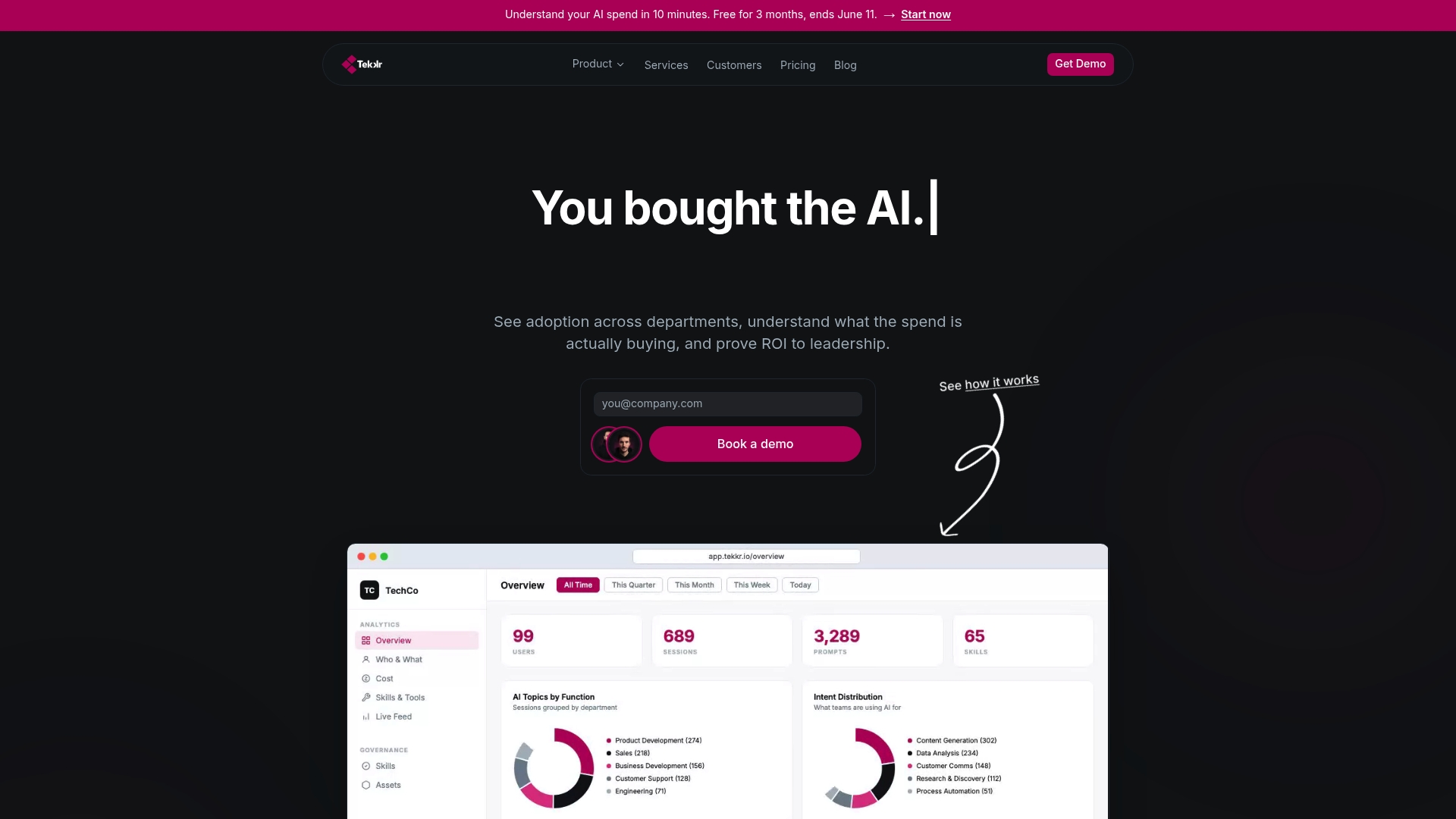
Configurato runs on a privacy-first architecture that is end-to-end encrypted, GDPR-compliant, and strips PII from prompts automatically. No browser extensions required. Setup takes about 10 minutes. For enterprises ready to move from AI investment to measurable results, Tekkr’s AI adoption solutions include both the Configurato platform and consulting support to build the governance and measurement frameworks your program needs. A free tier is available with no credit card required.
FAQ
What is an AI enablement program?
An AI enablement program is a structured organizational initiative that builds the infrastructure, governance, workforce skills, and measurement systems needed to deploy and scale AI reliably. It goes beyond tool adoption to create repeatable, governed AI capability across business functions.
How does AI enablement differ from AI adoption?
AI adoption refers to deploying and using AI tools. AI enablement is the broader capability-building program that makes adoption sustainable at scale, covering governance, training, infrastructure, and ROI measurement.
What metrics should executives track for AI enablement ROI?
Track both leading indicators like AI literacy rates and data quality scores, and lagging indicators like process cost reduction and error rates. Formal checkpoint reviews at 30, 90, 180, and 360 days with named metric owners produce the most reliable accountability.
Why do AI enablement programs fail?
The most common failure is training employees without changing the governance, workflows, or measurement systems around them. Upskilled individuals in unchanged processes produce limited gains, regardless of how good the training was.
How long does it take to implement an AI enablement program?
The timeline depends on organizational readiness, but most enterprises complete a readiness assessment and initial foundation build within 60–90 days. Full program maturity, including governance integration and measurable ROI, typically takes 6–12 months.