
An AI Center of Excellence is defined as a specialized, cross-functional unit that centralizes AI strategy, governance, and capability development to scale AI projects into enterprise-grade solutions. Most organizations buy AI tools and then watch adoption stall, costs balloon, and teams duplicate effort across departments. An AI CoE solves that problem at the structural level. It creates a single source of truth for how AI gets deployed, governed, and measured across the entire organization. For executives asking what is an AI center of excellence and whether they need one, the short answer is: if you have more than one AI tool running in production, you already need it.
What are the key functions of an AI Center of Excellence?
An AI CoE operates across five core pillars, and each one addresses a specific failure mode that organizations hit when AI adoption is left uncoordinated.
Strategy and governance is the foundation. The CoE sets the AI vision, defines roadmaps, and establishes policy standards that every team follows. Without this, different departments build toward different goals and the organization ends up with a collection of disconnected pilots instead of a coherent AI program.

Capability development closes the skills gap. An AI CoE pools knowledge from diverse business units and re-disperses expertise back into teams. Data scientists, business analysts, and IT professionals work together inside the CoE, then carry that knowledge into their home departments.
Enablement and training turns policy into practice. The CoE builds training programs, AI playbooks, and onboarding resources so that frontline teams can actually use AI tools well. Governance documents that sit in a shared drive do nothing. Embedded training programs change behavior.
Standards and best practices prevent duplication. The CoE defines reusable frameworks, approved model libraries, and code standards that every team draws from. This cuts the time it takes to move a new AI use case from idea to production.
Innovation and research keeps the organization ahead. The CoE runs experiments, evaluates emerging models, and identifies use cases that business units have not yet considered.
Pro Tip: Assign a dedicated CoE lead with both technical credibility and business authority. A CoE led only by engineers gets ignored by finance. A CoE led only by business leaders gets ignored by engineering.
How does an AI CoE operating model evolve over time?
The operating model of an AI CoE is not static. Early-stage CoEs centralize knowledge to ensure consistent practices and tight control. Mature organizations shift toward decentralized enablement models where product teams own AI use under CoE guardrails.
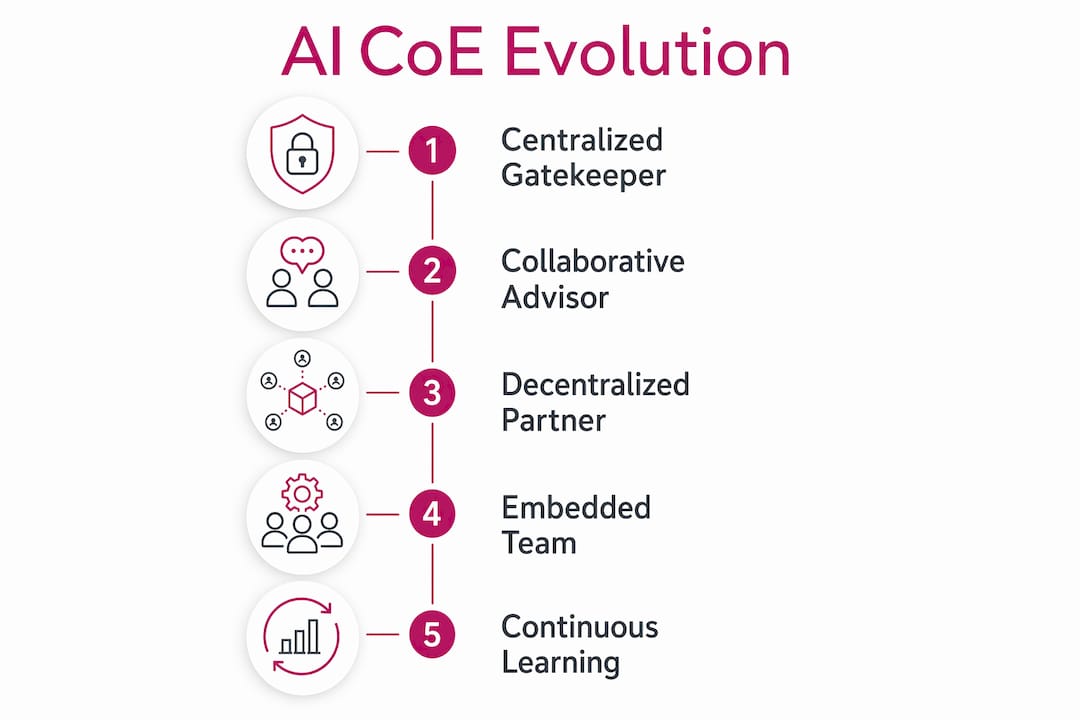
This progression matters because the wrong model at the wrong stage creates real problems. A centralized gatekeeper model in a mature organization becomes a bottleneck. Every new AI use case requires CoE approval, and innovation slows to a crawl. A decentralized advisory model in an early-stage organization creates chaos. Teams build without standards, and the organization ends up with the exact fragmentation the CoE was meant to prevent.
The transition from gatekeeper to advisor is what the Microsoft Cloud Adoption Framework calls the “day two” shift. It requires embedding governance into platform operations rather than relying on manual review processes. Automated policy enforcement replaces approval queues. Product teams gain autonomy within defined guardrails.
| Stage | Operating model | Primary focus | Key signal to evolve |
|---|---|---|---|
| Early | Centralized gatekeeper | Control and consistency | Teams waiting weeks for CoE approval |
| Developing | Hybrid oversight | Shared ownership | CoE capacity becomes the bottleneck |
| Mature | Advisory and enablement | Distributed innovation | Product teams own AI use cases end to end |
The signal that an organization is ready to shift is straightforward. When the CoE’s approval queue becomes the primary obstacle to AI delivery, the model needs to change.
What are the business benefits of establishing an AI CoE?
Organizations with mature AI governance frameworks supported by CoEs see measurable increases in returns on invested capital and faster AI time-to-value. That is the headline benefit. The mechanism behind it is worth understanding.
A CoE aligns AI initiatives with business objectives before resources get committed. That alignment prevents the most common form of AI waste: technically successful projects that solve problems nobody prioritized. When finance, legal, and business unit leaders sit inside the CoE alongside data scientists, the use cases that get funded are the ones that move the business.
The operational benefits compound over time:
- Reduced duplication. Centralized oversight eliminates overlapping tools and redundant model development across departments.
- Faster time-to-value. Reusable frameworks and pre-approved model libraries cut the time from use-case identification to production deployment.
- Lower risk exposure. Unified governance standards reduce the likelihood of regulatory violations, data breaches, and model failures reaching customers.
- Stronger cross-functional collaboration. A CoE creates a shared language for AI across technical and business teams, which reduces the friction that kills most AI projects at the handoff stage.
- Ethical AI compliance. Legal and ethics representation inside the CoE means responsible AI standards get built into projects from the start, not bolted on at the end.
An effective AI CoE also bridges the CIO’s technical standards and the CFO’s budget goals through cross-functional collaboration. That bridge turns prototypes into revenue-driving solutions instead of perpetual pilots.
How can executives build and sustain an effective AI CoE?
Building an AI CoE that actually works requires more than assembling a team and writing a charter. The following steps reflect what separates CoEs that deliver from those that become expensive overhead.
-
Secure executive sponsorship with real authority. The CoE needs a sponsor who controls budget and can resolve cross-departmental conflicts. A CoE with advisory status but no decision-making power gets overruled the moment it inconveniences a business unit.
-
Staff for breadth, not just depth. A successful AI CoE requires cross-functional staffing beyond technologists. Finance tracks ROI. Legal manages ethics and compliance. Business leaders align use cases with revenue goals. Without these roles, the CoE becomes an ivory tower that produces technically sound work nobody adopts.
-
Define success metrics before you start. Establish what the CoE is accountable for: AI adoption rates by department, cost per AI use case, time from prototype to production, or reduction in duplicated tooling spend. Metrics without baselines are meaningless.
-
Build governance that scales automatically. Embedding AI governance as a continuous automated capability rather than a periodic review process is the difference between governance that works and governance that gets bypassed. Automated runtime policy enforcement gives the CoE real-time oversight without creating approval bottlenecks.
-
Plan the operating model transition from day one. Design the CoE with the advisory model as the end state. Build documentation, playbooks, and platform guardrails that will eventually allow product teams to operate independently. Organizations that treat the centralized model as permanent end up dismantling their CoE when it stops scaling.
-
Avoid the common pitfalls. The primary failure point for AI CoEs is treating them as vanity projects rather than strategic capabilities aligned with core business decisions. A CoE that publishes frameworks but does not influence actual project funding or team behavior has no real impact.
Pro Tip: Publish a quarterly CoE impact report that shows business outcomes, not activity metrics. “We ran 12 training sessions” is activity. “AI adoption in the sales team increased by 40% and reduced proposal time by 3 hours per rep” is impact. Executives fund impact.
For a deeper look at how AI CoEs support cross-team AI adoption, the collaboration dynamics between technical and business leaders deserve particular attention. Getting that relationship right determines whether the CoE produces results or produces reports.
Key Takeaways
An AI Center of Excellence succeeds when it functions as a business capability, not a technical project, combining governance, cross-functional staffing, and an operating model that evolves with organizational maturity.
| Point | Details |
|---|---|
| Definition and purpose | An AI CoE centralizes AI strategy, governance, and capability development to prevent fragmented adoption. |
| Five core pillars | Strategy, capability development, enablement, standards, and innovation each address a specific failure mode. |
| Operating model evolution | CoEs start as centralized gatekeepers and mature into advisory models that empower distributed teams. |
| Business benefits | Mature CoEs drive higher returns on invested capital, faster time-to-value, and lower risk exposure. |
| Building for success | Cross-functional staffing, automated governance, and clear success metrics separate effective CoEs from expensive overhead. |
The part most executives miss about AI CoEs
The research is clear that AI projects succeed 70% based on people, processes, and culture, and only 30% based on models and technical infrastructure. That ratio should change how executives think about building a CoE. Most CoE charters I have seen spend the majority of their pages on technology selection, model governance, and infrastructure architecture. The organizational change management section is usually two paragraphs at the end.
That is backwards. The CoE’s hardest job is not picking the right models. It is convincing a sales director that AI-generated proposals need human review, or persuading a finance team to trust an AI-driven forecasting tool they did not ask for. Culture change is slower and messier than technology deployment, and it does not show up in a Gantt chart.
The CoEs that actually move the needle treat AI enablement as an ongoing organizational practice, not a one-time rollout. They measure adoption by department, surface where teams are stuck, and adjust training and tooling based on real usage data. They also accept that the CoE itself will need to change as the organization matures. A CoE that looks the same in year three as it did in year one has probably stopped learning.
The executives who get this right stop asking “what is our AI strategy?” and start asking “who is actually using AI, where, and what is it producing?” That shift from strategy to measurement is where CoEs either prove their value or fade into irrelevance.
— TekkrTools
How Tekkr helps organizations build and scale AI CoEs
Knowing what an AI CoE should do and knowing whether yours is actually doing it are two different problems. Tekkr’s platform, Configurato, gives CoE leaders the visibility they need to answer the second question.
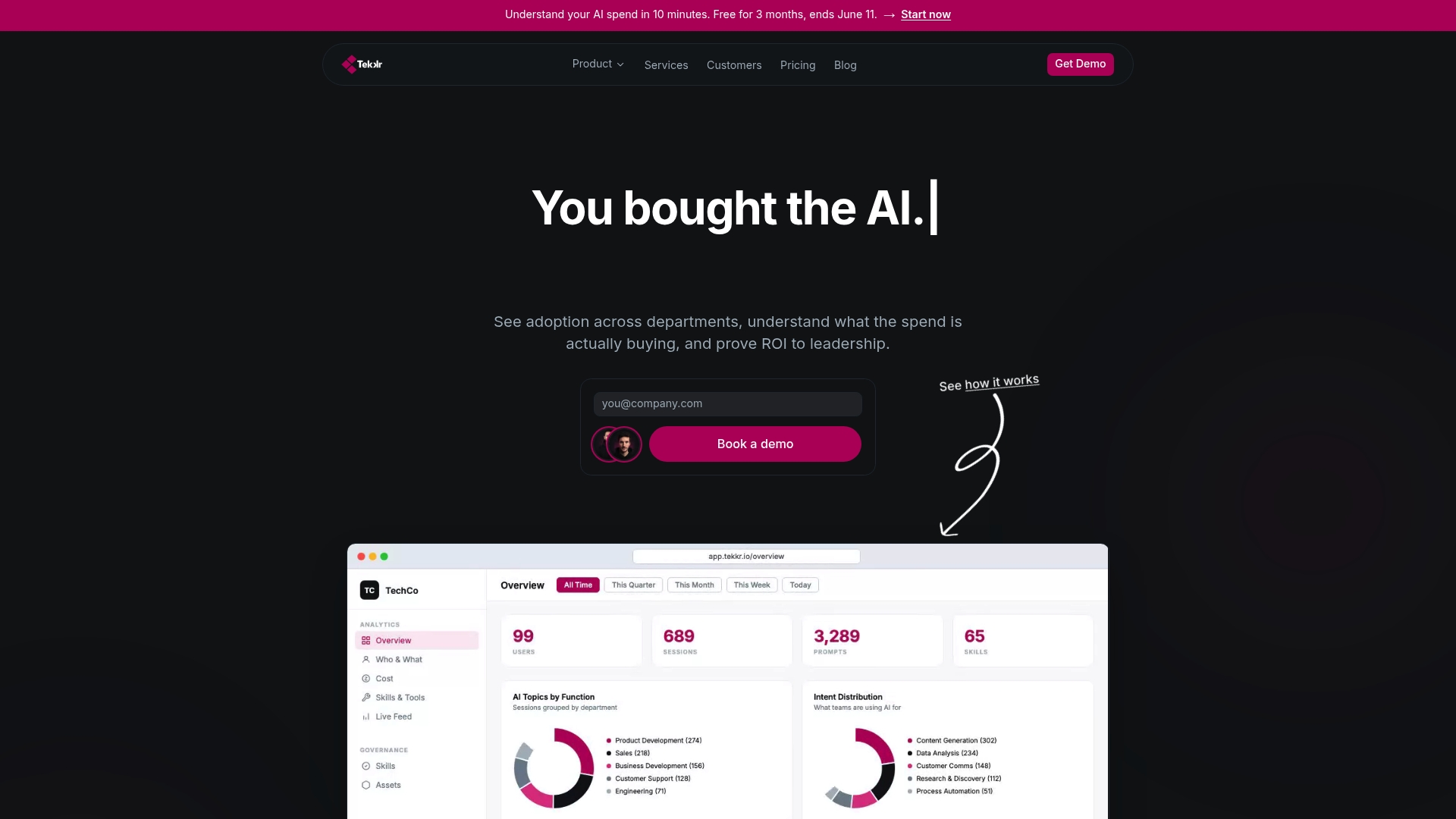
Configurato tracks AI adoption by team, breaks down tool costs by department, and surfaces which use cases are generating real productivity gains. That data is exactly what a CoE needs to report impact, justify budget, and identify where enablement efforts should focus next. The platform runs on a privacy-first architecture with end-to-end encryption, automatic PII stripping, and GDPR compliance, so governance requirements are covered from day one. Setup takes about 10 minutes, and a free tier is available with no credit card required. For CoE leaders who need to prove AI is working, Tekkr’s AI adoption solutions are built for exactly that purpose.
FAQ
What is an AI Center of Excellence?
An AI Center of Excellence is a cross-functional organizational unit that centralizes AI strategy, governance, capability development, and standards to scale AI initiatives across an enterprise. It prevents fragmented adoption and aligns AI projects with business objectives.
What does an AI CoE actually do day to day?
An AI CoE sets AI policy, trains teams, reviews use cases for feasibility and risk, maintains reusable frameworks, and tracks adoption and outcomes across departments. In mature organizations, it shifts from approving projects to advising product teams that own their own AI use cases.
How many people does an AI CoE need?
CoE size depends on organizational scale, but effective CoEs include representatives from data science, IT, finance, legal, and at least two or three business units from the start. A CoE staffed only with engineers consistently fails to drive business adoption.
How long does it take to see results from an AI CoE?
Most organizations see early governance and standardization benefits within the first six months. Measurable business outcomes, such as reduced AI spend duplication or faster time-to-production for new use cases, typically appear within 12–18 months of CoE launch.
What is the biggest risk when building an AI CoE?
The biggest risk is treating the CoE as a prestige project rather than a business capability. CoEs that lack executive authority, cross-functional staffing, and clear success metrics produce frameworks that nobody follows and get defunded within two years.