
An AI adoption incentive is a deliberate reward mechanism that links employee behavior to measurable business outcomes when integrating AI into daily workflows. Most organizations buy AI tools and stop there. The gap between purchase and productive use is where ROI disappears. ROI scales directly with adoption: 80% adoption delivers roughly 4x the value of 20% adoption with the same technology. That single fact reframes the entire conversation. Incentives are not perks. They are the mechanism that closes the gap between deployment and value. Tekkr’s Configurato platform is built precisely to measure and drive that gap closed.
What is an AI adoption incentive, and why does it matter?
An AI adoption incentive is any structured reward that motivates employees to integrate AI tools into real, high-frequency workflows rather than treating them as optional extras. The industry term for the broader discipline is “AI adoption enablement,” and incentives are its behavioral engine.
The distinction between deployment and adoption is the most important concept executives need to internalize. Deployment means the tool is available. Adoption means employees use it consistently, correctly, and in ways that improve outcomes. Only about 2% of companies have formally incorporated AI-specific metrics into executive incentive plans. That gap explains why so many AI investments underperform.

Incentives work because they address the behavioral dimension of change. Employees do not resist AI because they lack access. They resist it because their existing reward systems do not account for AI use. Fixing that misalignment is the core function of an AI adoption incentive program.
Why are AI adoption incentives critical for enterprise success?
The ROI case is direct. Adoption at 80% recovers roughly 80% of potential value, while adoption at 20% recovers only a fraction of that, despite identical technology costs. Every percentage point of adoption left on the table is money already spent with no return.
Behavioral resistance is the primary obstacle. Employees default to familiar workflows because those workflows are tied to their performance reviews, their team norms, and their sense of competence. AI tools disrupt all three. Without an incentive structure that addresses personal benefit, adoption stalls regardless of how good the technology is. The CHRO Association identifies this as a talent and rewards challenge, not a technical one.
Two failure modes appear repeatedly in organizations that skip incentive design. The first is “pilot purgatory,” where AI use cases never scale beyond a small test group. The second is “progress theater,” where teams report AI usage without any measurable improvement in outcomes. Both are symptoms of incentive systems that reward activity rather than results. Executives who recognize these patterns early can redirect investment before it compounds into a larger problem.
Pro Tip: Track adoption rates by team before launching any incentive program. Baseline data from a tool like Tekkr’s Configurato reveals where resistance is highest and lets you target incentives where they will have the most impact.
What effective incentive models and strategies drive AI adoption?
The most effective incentive programs use a tiered reward structure that matches reward size to the level of behavior change required. Micro-rewards of $5–$10 reinforce early adoption behaviors like completing training or using an AI tool for the first time. Efficiency dividends of $50–$100 reward measurable time savings or quality improvements. Innovation bounties of $100 or more recognize employees who develop new AI-enabled workflows or contribute to company-wide AI playbooks.
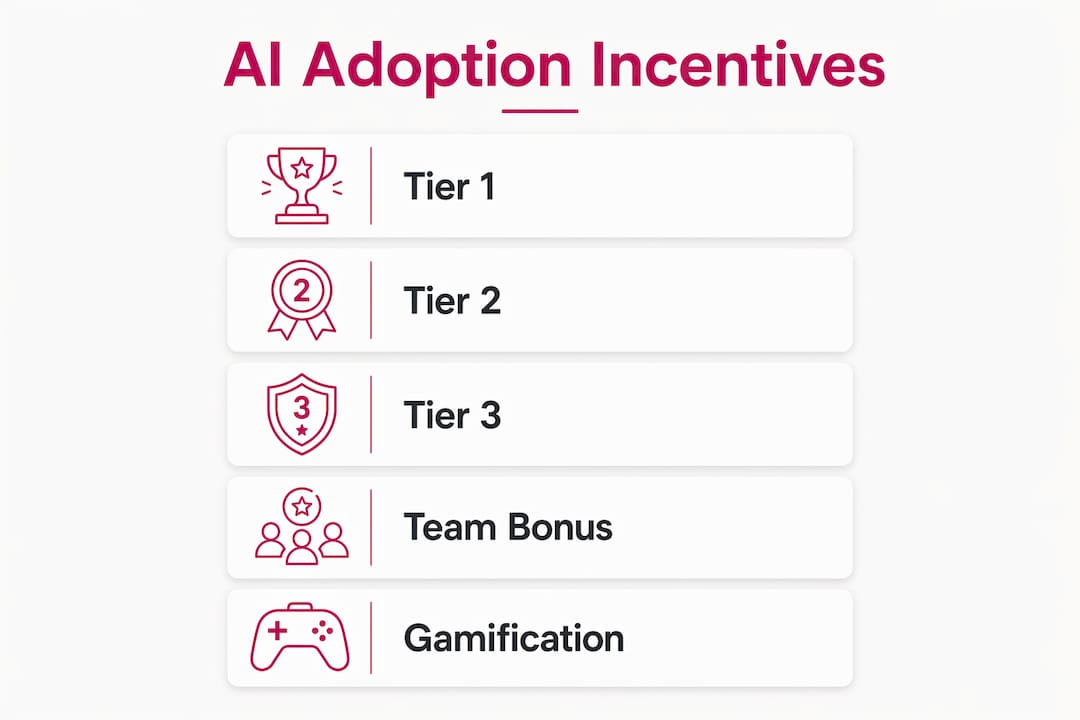
The shift from rewarding usage to rewarding outcomes is where programs mature. Team-based bonuses tied to revenue, productivity, or customer experience improvements produce higher engagement and better ROI than individual usage metrics. This matters because AI’s biggest gains come from workflow redesign, not from individual tool use.
Digital gift cards outperform cash bonuses for adoption incentives because they deliver immediacy and visible recognition. The action-reward loop closes faster, which reinforces the behavior more effectively. Speed of reward delivery is a design variable, not an afterthought.
Best practices for incentive design:
- Tie every reward to a specific, measurable behavior or outcome, not to tool access or login frequency.
- Use team-level rewards alongside individual ones to build social norms around AI use.
- Set reward thresholds that are achievable within 30 days to maintain early momentum.
- Publish a company-wide AI playbook so employees know exactly which behaviors qualify for rewards.
- Review and update reward tiers quarterly as adoption matures and baseline behaviors shift.
Pro Tip: Gamified rollouts, where employees earn points or badges for completing AI use-case milestones, create social visibility around adoption. Tekkr’s Configurato supports this approach natively, surfacing use-case intelligence across teams.
How do organizations align incentives with measurable AI-driven business results?
Aligning incentives with outcomes requires moving beyond activity volume. Incentive systems that reward tool activity produce superficial progress, while those that reward behavior quality produce durable adoption with real results. The practical difference is in how you define the KPI.
Effective AI incentive systems use a four-layer architecture that integrates goals and KPIs, recognition, development, and operating layers. Each layer reinforces the others. Goals define what success looks like. Recognition makes success visible. Development ties AI proficiency to career growth. Operating support removes friction from daily AI use.
| KPI Category | Example Metric | Balancing Metric |
|---|---|---|
| Decision quality | Reduction in escalations per team | Customer satisfaction score |
| Process improvement | Time saved per task (hours/week) | Output error rate |
| Innovation | New AI workflows submitted | Workflow adoption rate |
| Cost efficiency | AI spend per outcome unit | Budget variance |
| Learning velocity | Training completions per quarter | Skill assessment scores |
Managerial accountability is the missing layer in most programs. Compensation committees are increasingly evaluating AI capabilities as factors in leadership performance assessments. Executives who embed AI adoption metrics into their direct reports’ performance reviews create a cascade of accountability that no top-down mandate can replicate.
Pro Tip: Pair each KPI with a balancing metric to prevent gaming. If you reward time saved, also track output quality. If you reward AI tool use, also track decision accuracy. Single-metric incentives always produce unintended behavior.
What common challenges and pitfalls should executives avoid in AI incentive programs?
The most common failure is rewarding usage volume. When employees earn rewards for logging into an AI tool or submitting a set number of AI-generated outputs, they optimize for the metric rather than the outcome. Metrics focused on decision quality, escalation protocols, and team learning prevent this quality erosion and build genuine trust in AI outputs.
Vague goals are the second major pitfall. Setting goals like “use AI in department X” produces stalled projects because employees have no clear before-and-after measure to work toward. Specific workflows with defined success criteria are the minimum requirement for any incentive to function.
The following risks appear most often in programs that fail within the first six months:
- Incentives disconnected from daily workflows, making reward-earning feel like extra work.
- Reward cycles that are too long, breaking the action-reward loop and reducing motivation.
- No visible leadership participation, signaling that AI adoption is optional for senior staff.
- Incentive programs that never evolve past the launch phase, causing engagement to drop as novelty fades.
- Absence of AI quality standards that define what “good” AI use looks like, leaving employees to guess.
Treating AI adoption as a talent and behavior change strategy, rather than a technology rollout, is the frame that separates programs that sustain from those that stall. The reasons AI tools go unused are almost always behavioral, not technical.
How can executives implement AI adoption incentives for maximum ROI?
The 90-day adoption window is the most critical period in any AI rollout. Adoption efforts that begin before solid governance and baseline measurement exist lead to fragmented results and lost momentum. Executives must complete three foundational steps before launching any incentive program.
- Establish governance. Assign clear ownership for each AI use case. Define who is accountable for adoption rates, spend, and outcomes at the team level.
- Measure the baseline. Capture current productivity, error rates, and time-on-task for the workflows you plan to improve. Without a baseline, you cannot demonstrate ROI or calibrate reward thresholds.
- Define specific workflows. Embedding AI use in real, high-frequency workflows where employees experience early concrete wins is the fastest path to sustained adoption. Generic tool demos do not produce behavior change.
- Launch tiered incentives. Start with micro-rewards for early behaviors, then introduce efficiency dividends and innovation bounties as adoption matures. Align reward tiers with the four-layer architecture: goals, recognition, development, and operations.
- Evaluate and adapt every 30 days. Review adoption rates by team, identify where incentives are not producing behavior change, and adjust reward thresholds or KPIs accordingly. Programs that do not evolve lose relevance within a quarter.
Senior leadership visibility accelerates every step. When executives publicly participate in AI adoption programs and tie their own performance objectives to AI outcomes, the signal reaches every level of the organization. Measuring AI ROI at the executive level sets the standard for the rest of the organization.
Pro Tip: Use the first 30 days of your incentive program exclusively for workflow anchoring. Reward employees for completing specific AI-assisted tasks in their actual job, not for attending training sessions. Behavior change happens in the workflow, not the classroom.
Key Takeaways
AI adoption incentives are the primary mechanism for converting AI spend into measurable business value, and programs that reward behavior quality rather than activity volume consistently outperform those that do not.
| Point | Details |
|---|---|
| Adoption drives ROI directly | 80% adoption delivers roughly 4x the value of 20% adoption with identical technology costs. |
| Reward outcomes, not activity | Incentives tied to decision quality and process improvement prevent superficial adoption and quality erosion. |
| Use tiered reward structures | Micro-rewards, efficiency dividends, and innovation bounties match reward size to the level of behavior change required. |
| Start with governance and baselines | Launch incentive programs only after establishing clear ownership and baseline measurements to avoid fragmented results. |
| Embed AI in real workflows | Adoption anchored to high-frequency daily tasks produces faster and more durable behavior change than generic training. |
Why most AI incentive programs fail before they start
The uncomfortable pattern I see repeatedly is this: organizations design incentive programs around the tools they bought, not the behaviors they need. A team gets access to a coding assistant, and the incentive is “use it 10 times this week.” The behavior that follows is predictable. Employees generate outputs to hit the count, quality drops, and leadership concludes that AI is not delivering value. The incentive was the problem, not the technology.
The programs that work treat AI adoption as a talent strategy first. They ask what behavior change is required, what personal benefit the employee receives, and how the reward connects to something the employee already cares about. Career development, team recognition, and financial rewards all work, but only when they are tied to a specific, observable behavior in a real workflow.
The four-layer architecture is not a framework I would describe as optional. Organizations that skip the development and operating layers, focusing only on goals and recognition, consistently see adoption plateau after the first 90 days. The development layer, which ties AI proficiency to career progression, is what converts early adopters into long-term practitioners. That conversion is where the real ROI lives.
Leaders who treat AI incentives as a one-time launch event will always be disappointed. The programs that sustain are the ones that evolve quarterly, retire rewards that have done their job, and introduce new ones that push behavior to the next level. That requires measurement infrastructure, not just good intentions.
— TekkrTools
Tekkr’s approach to AI adoption and measurable returns
Buying AI tools is the easy part. Proving they work is where most organizations get stuck.
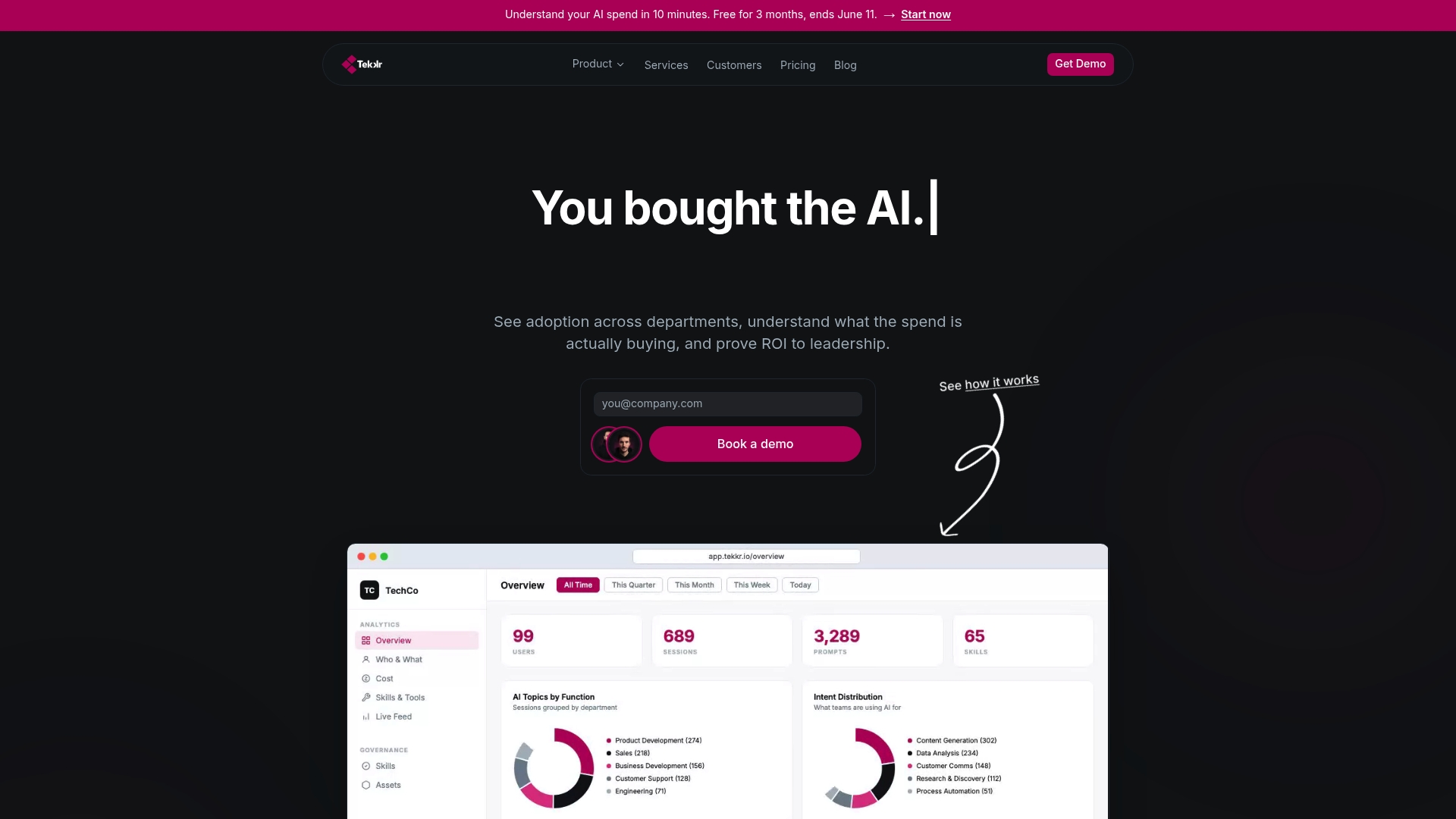
Tekkr’s Configurato platform tracks who is actually using tools like Claude and Codex, breaks down AI spend by team, and surfaces use-case intelligence across the organization. It then drives adoption higher through gamified rollouts and company-wide AI playbooks that give employees a clear path from first use to measurable impact. Setup takes about 10 minutes, there is a free tier, and no credit card is required. For organizations that need expert support designing incentive programs aligned to specific business outcomes, Tekkr’s consulting services provide structured guidance from baseline measurement through full-scale rollout. Executives who want visibility into adoption and a practical way to lift productivity across every department can explore Tekkr’s adoption platform and start measuring what their AI investment is actually delivering.
FAQ
What is an AI adoption incentive?
An AI adoption incentive is a structured reward that motivates employees to integrate AI tools into their daily workflows in ways that produce measurable business outcomes. Effective incentives link specific behaviors to rewards rather than rewarding tool access or login frequency.
How do AI adoption incentives improve ROI?
ROI from AI scales directly with adoption rates. 80% adoption delivers roughly 4x the value of 20% adoption with the same technology, so incentives that raise adoption rates produce proportional gains in business returns.
What types of rewards work best for AI adoption?
Tiered reward structures work best, combining micro-rewards of $5–$10 for early behaviors, efficiency dividends of $50–$100 for measurable improvements, and innovation bounties of $100 or more for new AI-enabled workflows. Digital gift cards outperform cash bonuses because they deliver immediate, visible recognition.
What is the biggest mistake in AI incentive program design?
Rewarding usage volume rather than outcome quality is the most common failure. Programs that count logins or outputs without measuring decision quality or process improvement produce superficial adoption and erode trust in AI tools over time.
When should an organization launch an AI incentive program?
Organizations should launch incentive programs only after establishing governance, assigning use-case ownership, and capturing baseline measurements. The critical 90-day adoption window produces the best results when these foundations are in place before incentives go live.