
AI value realization is the discipline of converting AI initiatives into measurable business outcomes by linking every AI project to clear objectives, defined KPIs, accountable owners, and ongoing value management. The term is sometimes called “AI benefits realization” in formal program management circles, but the concept is the same: you do not get value from AI by deploying it. You get value by measuring it, managing it, and adjusting until the numbers move. For executives asking what is AI value realization and why it matters in 2026, the short answer is this: without it, AI spend is an act of faith, not a business decision.
What is AI value realization, and why does it matter now?
AI value realization is the structured process of turning AI activity into verified business impact. It requires three things working together: a baseline that shows where you started, KPIs that show where you are going, and governance that keeps someone accountable for the gap between the two.
The urgency is real. 90% of companies are increasing AI budgets in 2026, yet 40% measuring AI cost savings report less than 10% savings against targets of 11–20%. That gap is not a technology failure. It is a value management failure.

AI value realization also requires a longer time horizon than most IT investments. ROI typically emerges over 2–4 years, unlike traditional IT projects that expect payback in 7–12 months. Executives who treat AI like a standard software rollout will consistently misread their results and cut programs that were actually working.
What are the key components of AI value realization?
Four components determine whether an organization captures AI value or watches it evaporate.
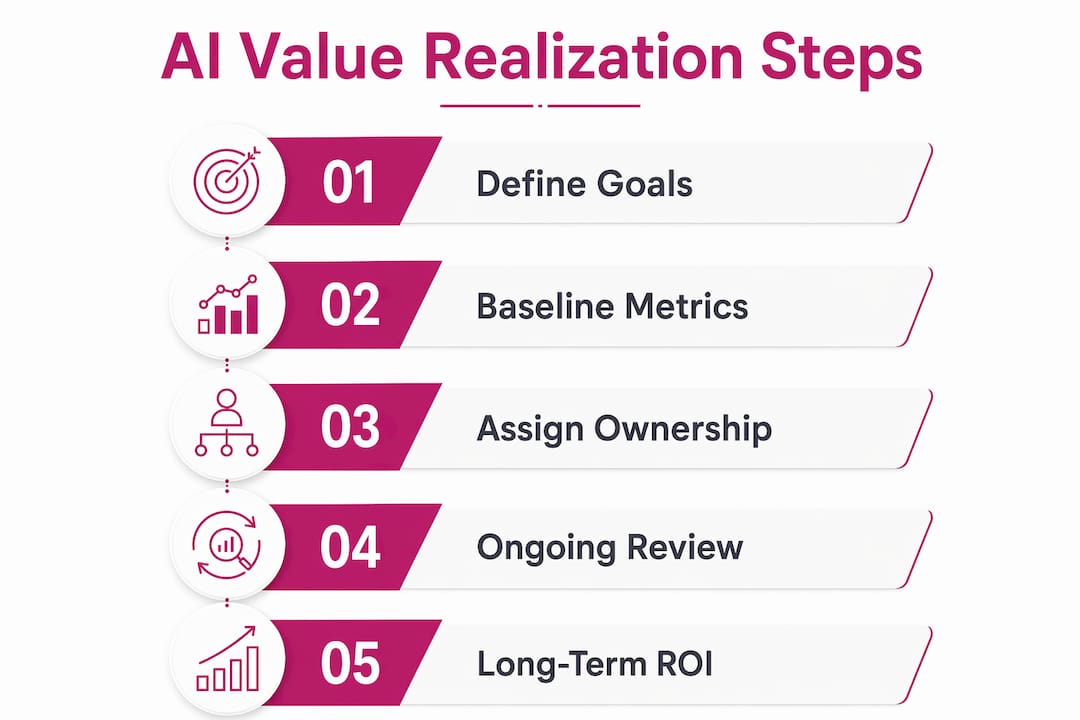
Objectives tied to business outcomes. Every AI project needs a stated business goal, not a technology goal. “Deploy a generative AI assistant” is a technology goal. “Reduce analyst report preparation time by 30%” is a business goal. The distinction determines whether you can ever declare success.
Baselines before deployment. Most organizations lack pre-deployment baselines to calculate defensible AI ROI, making measurement unreliable after the fact. Measure process time, error rates, and cost before the AI goes live. Without that anchor, every post-deployment number is a guess.
Accountable ownership. Value does not manage itself. Each AI initiative needs a named owner who reports on progress against KPIs at a cadence that matches the business cycle, whether monthly or quarterly.
Comprehensive KPIs. The right AI performance metrics cover both direct and indirect value. Direct KPIs include cost savings, cycle time, and error reduction. Indirect KPIs include customer retention, decision throughput, and employee satisfaction. Focusing only on direct productivity metrics overlooks critical indirect measures like customer satisfaction, creativity scores, and ticket deflection rates. That blind spot causes executives to undervalue AI programs that are actually delivering.
- Money saved per process
- Cycle time improvement
- Error reduction rate
- Customer retention change
- Decision throughput per team
- Ticket deflection rate
- Employee time recovered per week
Pro Tip: Build your KPI list before you select an AI tool, not after. The tool should serve the metric, not the other way around.
How do organizations measure AI value and ROI effectively?
Measuring AI return on investment requires full cost accounting, not just license fees. Infrastructure, talent, integration work, and ongoing maintenance all belong in the denominator of your ROI calculation.
The three tiers of AI benefit
AI benefits fall into three tiers. The first tier is direct financial returns: cost reduction, revenue lift, and headcount efficiency. The second tier is operational improvement: faster cycle times, fewer errors, and higher throughput. The third tier is capability shift: the ability to execute tasks that were previously impractical or impossible. True AI value often lies in this third tier, not in speeding up existing workflows. Most measurement frameworks never reach it.
Four ROI formulas executives use
- Basic ROI: (Net Benefit / Total Cost) × 100. Simple and fast, but ignores time value of money.
- Payback period: Total Investment / Annual Net Benefit. Shows how long until you break even. Only 6% of organizations realize AI investment returns in under one year; the majority wait 2–4 years.
- Net Present Value (NPV): Discounts future cash flows to today’s value. Best for multi-year AI programs where benefits compound over time.
- Internal Rate of Return (IRR): Finds the discount rate at which NPV equals zero. Useful for comparing AI projects against other capital investments.
Generative AI users recover an average of 5.4% of weekly working hours, with frequent users recovering over 9 hours per week. That translates to roughly one full workday per week for power users, a number that compounds significantly across a large workforce.
Pro Tip: Run a 90-day pilot with a control group before scaling any AI tool. The delta between the two groups gives you a defensible baseline for your ROI model.
A practical AI ROI measurement framework also needs a review cadence. Set a 30-day check on adoption, a 90-day check on operational KPIs, and a 12-month check on financial outcomes. Each checkpoint answers a different question about whether the investment is on track.
What challenges and pitfalls hinder AI value realization?
The obstacles to AI value realization are mostly organizational, not technical.
Data access and integration is the single biggest barrier. 41% of organizations cite data integration as their top AI obstacle. High performers treat this as a board-level issue, not an IT ticket. When data is siloed, AI models train on incomplete information and produce unreliable outputs that erode trust across the organization.
Misaligned investment cases are the second major pitfall. Many AI business cases are built on cost-saving assumptions that do not survive contact with operational reality. The gap between a projected 15% cost reduction and an actual 8% reduction is rarely a technology problem. It is a scoping problem, a change management problem, or a measurement problem.
Organizations that focus exclusively on direct cost savings miss the compounding value of AI-enabled capabilities. A customer service AI that deflects 30% of tickets does not just save agent hours. It frees those agents to handle complex cases, which raises resolution quality, which improves retention. The full value chain is three steps long, but most ROI models only count the first step.
Operating model inertia is the most underestimated challenge. AI projects underperform when operating models and employee roles are not redesigned to use AI-enabled capabilities. Deploying a coding assistant to a team that still reviews code through a manual, sequential process will not produce the expected throughput gains. The workflow has to change, not just the tool.
Change management gaps compound every other problem. Employees who do not understand why AI is being introduced, or who feel threatened by it, will underuse it. Low adoption means low value, regardless of how good the technology is. You can explore the AI value gap in detail to see how adoption shortfalls translate directly into unrealized returns.
How can business leaders apply AI value realization to drive sustained growth?
Sustained AI value comes from a deliberate system, not from individual tool deployments.
-
Link every AI project to a named business objective. Before approving any AI initiative, require a one-page brief that states the business problem, the target KPI, the baseline, and the owner. This single practice eliminates most unfocused AI spending.
-
Establish executive accountability. Assign a C-suite sponsor to each major AI program. Value realization requires decisions about resourcing, process redesign, and organizational change that only executives can make. Delegating it entirely to IT or data science teams guarantees underperformance.
-
Prioritize workflows where data is already accessible. Automating repeatable workflows with already-accessible data yields the fastest path to value. One documented example: automating VAT regulatory updates reduced task time by 92%. Start with the use cases where the data is clean and the process is well-defined. Build confidence and measurement muscle before tackling complex, data-sparse problems.
-
Redesign roles alongside tool deployment. Do not hand employees a new AI tool without changing how their work is structured. Map the current workflow, identify where AI inserts, and redefine the human role around judgment, oversight, and exception handling. AI adoption strategies that include role redesign consistently outperform those that treat AI as a simple add-on.
-
Build organizational literacy about AI value forms. Train leaders and managers to recognize value that does not show up in traditional financial reports: time recovered, new capabilities unlocked, and improved customer engagement. Organizational literacy about these value forms is a prerequisite for capturing them.
-
Use AI to solve data problems proactively. Rather than waiting for clean data before deploying AI, use AI tools to accelerate data cleaning, integration, and enrichment. This turns the biggest barrier into an early win.
-
Commit to a multi-year measurement horizon. Set board-level expectations that AI ROI compounds over 2–4 years. Quarterly reviews should track leading indicators like adoption rates and cycle time improvements, not just lagging financial outcomes.
Pro Tip: Create a company-wide AI playbook that documents proven use cases, KPI benchmarks, and lessons learned. This prevents teams from reinventing the wheel and accelerates value realization across every department.
Key Takeaways
AI value realization requires baselines, KPIs, accountable ownership, and a multi-year measurement horizon to convert AI spending into verified business outcomes.
| Point | Details |
|---|---|
| Define before you deploy | Every AI project needs a stated business objective and a baseline before going live. |
| Measure three tiers of benefit | Track direct savings, operational improvements, and new capabilities to capture full AI impact. |
| Expect a 2–4 year ROI horizon | Only 6% of organizations see returns in under one year; plan and communicate accordingly. |
| Redesign roles, not just tools | AI underperforms when workflows and employee responsibilities are not updated to match new capabilities. |
| Track indirect KPIs | Metrics like ticket deflection, customer retention, and decision throughput reveal value that cost savings alone miss. |
The measurement gap nobody talks about
The most common mistake I see executives make is treating AI value realization as a finance exercise. They assign it to the CFO’s office, build a spreadsheet model, and wait for the numbers to confirm their thesis. That approach misses the point entirely.
The organizations that realize the most AI value are the ones that treat measurement as a cultural practice, not a reporting requirement. They train managers to notice when AI changes what is possible, not just what is faster. They celebrate a team that used AI to build a product feature that could not have existed before, even if that win does not show up cleanly in a cost-savings column.
The uncomfortable truth is that most AI ROI models are built to justify a decision already made, not to guide future ones. The executives who break that pattern are the ones who set baselines before deployment, track indirect KPIs alongside direct ones, and give their programs the 2–4 year runway the evidence says they need. That is not patience. That is discipline.
— TekkrTools
Tekkr helps you prove AI is working
You bought the AI. Now you need to show it is working. Tekkr’s platform, Configurato, tracks AI adoption, spending, and return across your entire organization. It shows which teams are actually using tools like Claude and Codex, breaks down costs by department, and surfaces the use-case intelligence you need to make better investment decisions.
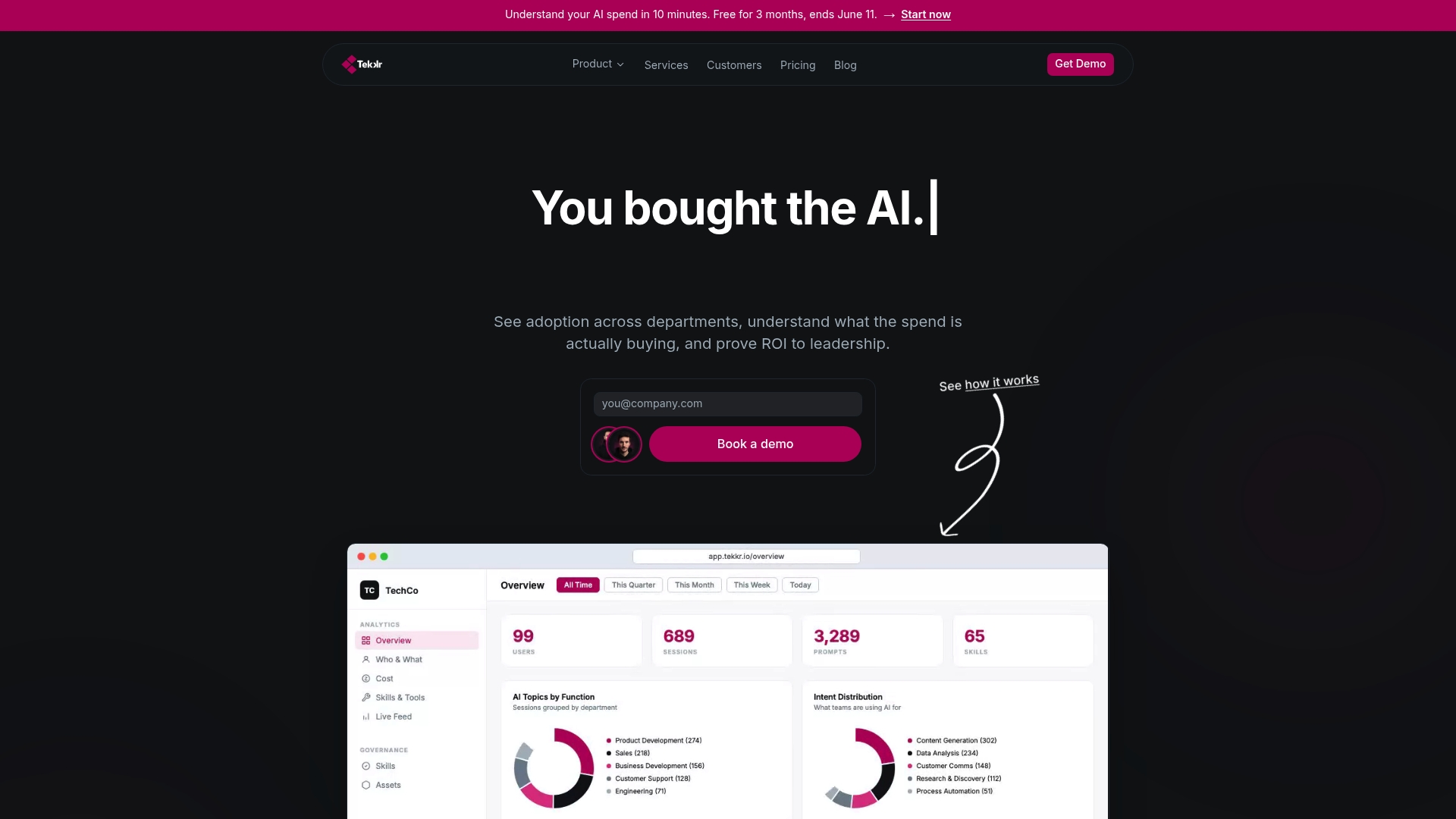
Tekkr also drives adoption higher through gamified rollouts and company-wide AI playbooks, so your investment does not stall at the deployment stage. Setup takes about 10 minutes, with a free tier and no credit card required. Explore Tekkr’s AI adoption solutions to see how organizations turn AI spend into measurable results.
FAQ
What is AI value realization in simple terms?
AI value realization is the process of turning AI investments into verified business outcomes by linking AI projects to clear objectives, KPIs, baselines, and accountable owners.
How long does it take to see ROI from AI?
Only 6% of organizations see AI returns in under one year. The typical payback period is 2–4 years, which is significantly longer than most traditional IT projects.
What KPIs should executives track for AI performance evaluation?
Track both direct KPIs like cost savings, cycle time, and error reduction, and indirect KPIs like customer retention, ticket deflection rates, and decision throughput to capture the full picture.
Why do so many AI projects fail to deliver expected returns?
The most common causes are missing pre-deployment baselines, misaligned business cases, poor data integration, and failure to redesign operating models and employee roles alongside the AI deployment.
How does AI value realization differ from standard IT ROI measurement?
AI ROI compounds over a longer horizon and includes capability shifts that traditional IT ROI models do not capture. Standard IT projects expect 7–12 month payback; AI value realization requires a 2–4 year measurement framework.