
AI usage intelligence is the automated process of capturing, measuring, and analyzing how AI tools are actually used within an organization to optimize adoption, control costs, and enforce governance. Most business leaders assume that buying licenses for tools like Claude or GitHub Copilot translates directly into productivity gains. It rarely does without measurement. This discipline fills that gap by replacing guesswork with real behavioral data, giving decision-makers a clear picture of where AI is working, where it is wasted, and where it needs to go next.
What is AI usage intelligence and why does it matter?
AI usage intelligence is the systematic collection and analysis of AI tool interaction data across an organization, covering who uses which tools, how often, for how long, and on which tasks. The industry also refers to this practice as AI utilization tracking or AI performance measurement, and the terms are used interchangeably depending on whether the focus is on adoption, cost, or governance.
The core problem it solves is visibility. When a company deploys 500 seats of an AI coding assistant, login data might show 480 active accounts. That number looks healthy. But login activity does not equal productive use. Login data overestimates seat utilization, and only deep usage audits reveal how many of those seats generate real output. Without that depth, budget decisions are built on false confidence.

Gartner recognizes a related discipline called AI Usage Control, which applies real-time, context-aware policies to how AI is used rather than simply who has access. That distinction matters. Access control tells you the door is open. Usage intelligence tells you whether anyone walked through it, what they did inside, and whether it was worth the cost.
Named entities driving this space include Agent Token Tracking (ATT), Gartner’s AI Usage Control framework, and platforms like Tekkr’s Configurato, which maps usage to teams, projects, and spend in real time.
How does AI usage intelligence differ from traditional tracking?
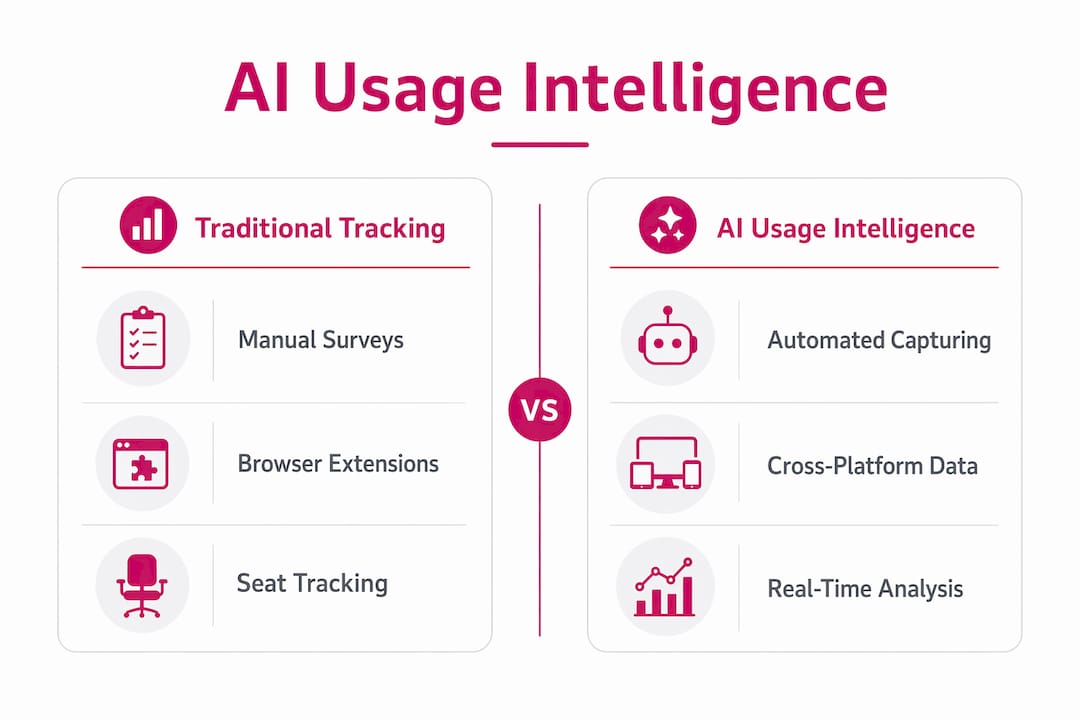
Traditional software tracking counts seats, logins, and session starts. AI usage intelligence captures a fundamentally different layer of behavior.
The core metrics in AI utilization tracking include:
- Tool usage time by individual, team, and department
- Feature engagement showing which AI capabilities are actually used versus ignored
- Task and project mapping connecting AI interactions to specific work outputs
- Prompt volume and token consumption reflecting actual computational demand
- Adoption velocity tracking how usage grows or stalls after rollout
The contrast with manual surveys is stark. 78% of employees underreport AI tool usage when asked to self-report, creating major blind spots in adoption data. That underreporting rate means a survey-based adoption report is structurally unreliable. You cannot make a sound investment decision on data that is wrong by design.
Browser extensions attempt to fill this gap but fall short. Browser extensions fail to capture AI usage in desktop-native and CLI applications, meaning tools like GitHub Copilot running inside VS Code or terminal-based AI agents go completely untracked. Agent Token Tracking (ATT) solves this by operating at the OS level, capturing AI interactions across desktop, browser, and CLI environments without requiring any user action or browser plugin.
Pro Tip: When evaluating any AI usage reporting tool, ask specifically whether it captures CLI and desktop-native app usage. If the answer is no, you are missing a significant share of developer and power-user activity.
How do consumption-based models change the cost equation?
The shift from per-seat licensing to consumption-based billing is the single biggest reason AI expense reporting has become a board-level concern. Traditional SaaS tools charge a flat monthly fee per user. AI tools charge based on tokens, API calls, and compute time, making costs variable and difficult to forecast without granular usage data.
The table below shows how the two models differ in practice:
| Dimension | Per-Seat Licensing | Consumption-Based AI Billing |
|---|---|---|
| Cost structure | Fixed monthly fee per user | Variable: tokens, API calls, compute |
| Budget predictability | High | Low without usage intelligence |
| Waste pattern | Unused seats | Idle licenses plus runaway usage spikes |
| Governance need | Access control | Real-time usage monitoring and caps |
| Optimization lever | Seat harvesting | User-Level Budgets and chargeback models |
A single power user running automated AI workflows can exhaust a shared credit pool in days. User-Level Budgets (ULBs) prevent this by capping individual AI credit consumption within enterprise accounts, restoring cost predictability without blocking legitimate use.
The right governance model for this environment is a hybrid of FinOps and Software Asset Management (SAM). Business leaders must adopt a hybrid FinOps-SAM approach for AI governance because consumption-based billing behaves more like cloud infrastructure spend than traditional software licensing. That means applying cloud cost management disciplines, including tagging, chargeback, and anomaly alerting, to AI tool spend.
Pro Tip: Map every AI tool in your stack to a billing model before your next budget cycle. Tools with consumption-based pricing need a usage dashboard and a spend cap. Tools on flat-rate seats need a seat audit. Treating both the same way guarantees waste on at least one side.
What technologies power effective AI usage intelligence?
Three layers of technology combine to deliver reliable AI usage intelligence at enterprise scale.
-
Agent Token Tracking (ATT) operates at the operating system level, capturing every AI interaction regardless of the application or interface. Unlike browser extensions, ATT provides non-bypassable OS-level tracking across desktop, browser, and CLI environments. This is the only method that gives a complete picture of how developers, analysts, and operations teams use AI tools in their actual workflows.
-
AI usage dashboards aggregate that raw data into structured views. Automated dashboards map usage to projects and clients without requiring manual tagging, showing who uses which AI tools, for how long, and on what work. Tekkr’s Configurato delivers this view broken down by team, role, and project, with cost attribution built in.
-
Runtime governance frameworks apply policy at the moment of use. Gartner’s AI Usage Control framework describes runtime policy enforcement based on data sensitivity, user intent, and usage context. This is a significant departure from static allowlists. Instead of approving a tool once and hoping it is used responsibly, runtime enforcement checks each interaction against current policy conditions.
The privacy architecture underneath all of this matters as much as the tracking capability. Effective AI usage intelligence collects behavioral signals without exposing sensitive content. Tekkr’s Configurato, for example, anonymizes prompts with automatic PII stripping and runs end-to-end encrypted, requiring no browser extensions and no access to prompt content. That architecture makes it deployable in regulated industries where data handling is non-negotiable.
You can explore how AI governance frameworks connect to usage intelligence in practice, particularly when building a compliance-ready tracking architecture.
How do you turn usage data into better AI adoption decisions?
AI usage intelligence becomes valuable only when it drives decisions. Here is how organizations apply it in practice:
- Audit and harvest unused licenses. Effective AI governance requires mapping usage intensity to actual user roles rather than relying on login data. A seat audit that compares login frequency against actual task output identifies licenses that can be downgraded or reclaimed, often recovering 15–30% of AI tool spend.
- Implement usage-based chargeback. Allocating AI costs back to the teams that generate them creates accountability. When a department sees its AI spend line in a budget review, usage behavior changes quickly.
- Adapt forecasts to real consumption patterns. Static annual budgets do not work for variable AI billing. Usage dashboards feed rolling forecasts that adjust as adoption grows or contracts by team.
- Enforce safe adoption with runtime controls. AI usage intelligence shifts organizations from approval-based models to real-time continuous monitoring, enabling leaders to catch policy violations, data exposure risks, and runaway spend before they become incidents.
- Drive adoption where it is lagging. Usage data identifies teams with low engagement. Targeted enablement, such as playbooks, training, or gamified rollouts, can then be directed precisely where the gap exists rather than applied organization-wide.
The AI financial dashboard view is particularly useful here. When cost, adoption rate, and productivity output appear in a single view, the conversation shifts from “are we using AI?” to “are we getting value from it?” That is the question that justifies or challenges the investment.
Pro Tip: Build your AI usage reporting cadence around billing cycles, not calendar quarters. Consumption-based tools generate cost signals weekly. Reviewing them quarterly means you are always reacting to problems that are already a month old.
Tekkr’s approach to AI governance trends in 2026 shows how leading organizations are connecting usage data to governance policy in real time.
Key takeaways
AI usage intelligence is the foundational discipline that separates organizations that own AI tools from those that actually benefit from them.
| Point | Details |
|---|---|
| Manual surveys are unreliable | 78% of employees underreport AI usage, making automated tracking the only accurate method. |
| Consumption billing demands visibility | Token and API-based pricing creates variable costs that require real-time usage dashboards to manage. |
| ATT outperforms browser extensions | Agent Token Tracking captures desktop, browser, and CLI usage that browser plugins miss entirely. |
| Runtime governance beats static access control | Context-aware policy enforcement at the moment of use prevents incidents that allowlists cannot catch. |
| Usage data must drive decisions | License audits, chargeback models, and targeted enablement only work when built on accurate usage intelligence. |
The shift nobody talks about
The conversation around AI adoption in most organizations is still stuck on access. Did we buy the licenses? Did we roll out the tool? Did we send the training email? Those questions measure procurement, not productivity.
What I have seen consistently is that the organizations making real gains from AI are the ones that treat usage intelligence as an operational discipline, not a reporting afterthought. They do not wait for a quarterly review to find out that 40% of their Copilot seats are dormant. They know by Tuesday.
The uncomfortable truth is that most AI governance frameworks are still built around the old software model: approve the tool, grant access, and trust that usage follows. That model was imperfect for SaaS. For consumption-based AI tools, it is genuinely dangerous. A single misconfigured agent or an enthusiastic power user can generate thousands of dollars in API costs before anyone notices.
The shift from access control to usage control is not a technical upgrade. It is a change in how leadership thinks about AI investment. Access is a gate. Usage intelligence is a continuous feedback loop. One tells you who can use the tool. The other tells you whether buying it was worth it.
Organizations that build this feedback loop early will have a compounding advantage. Their adoption data informs their governance. Their governance data informs their procurement. Their procurement decisions get sharper every cycle. The ones that skip this step will keep buying AI tools and wondering why the productivity numbers do not move.
— TekkrTools
See your AI investment clearly with Tekkr
Most organizations cannot answer a simple question: which teams are actually using the AI tools we paid for? Tekkr’s Configurato was built to answer that question and act on it.
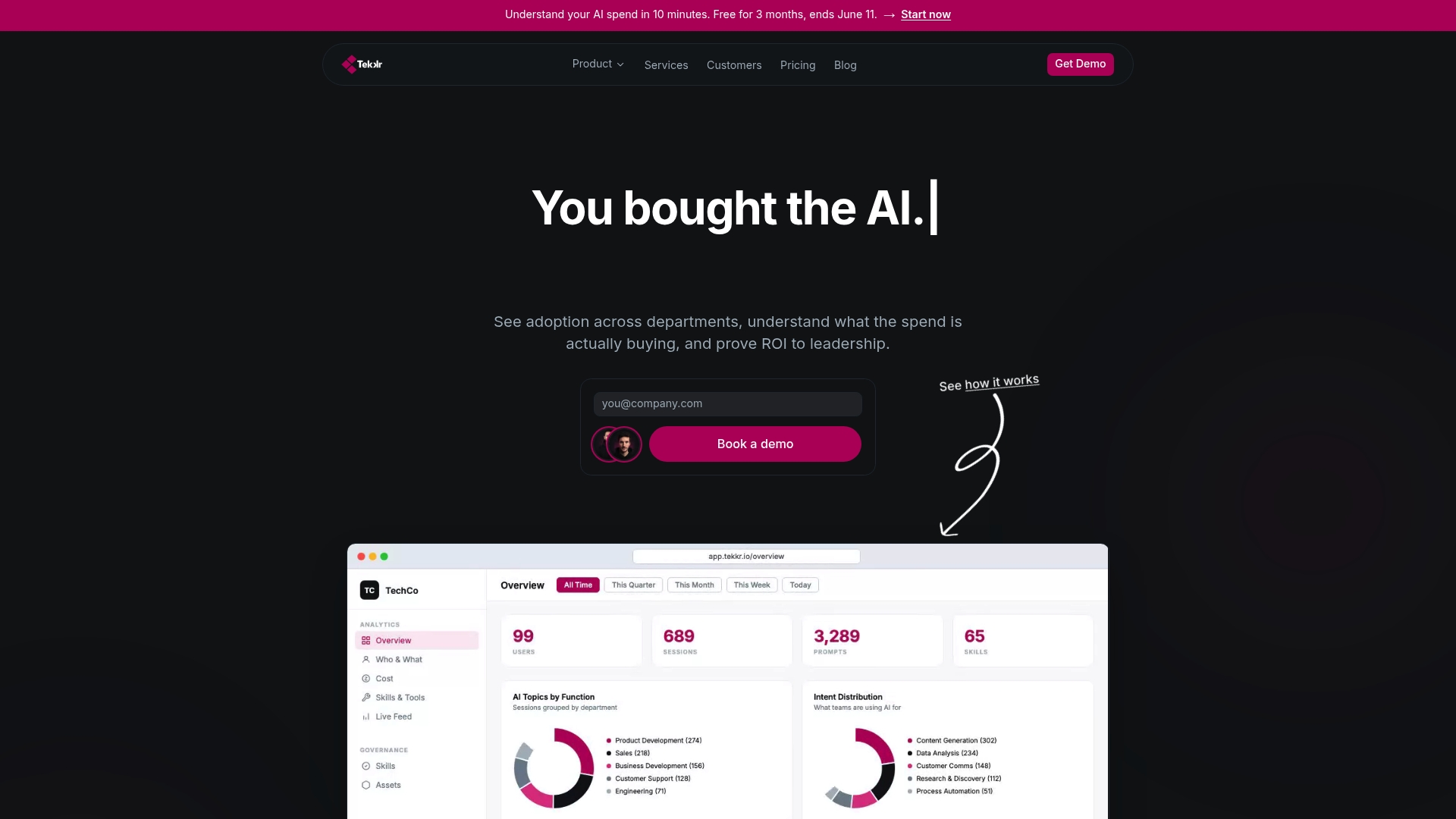
Configurato tracks AI adoption, spend, and return across your entire organization in real time. It maps usage to teams and projects, surfaces license waste, enforces governance policies, and drives adoption higher through gamified rollouts and AI playbooks. Setup takes about 10 minutes, there is a free tier, and no credit card is required. If you are ready to move from AI access to AI accountability, explore Tekkr’s AI adoption solutions or go deeper with the Configurato product page to see exactly what visibility looks like in practice.
FAQ
What is AI usage intelligence in simple terms?
AI usage intelligence is the automated measurement of how AI tools are used inside an organization, covering who uses them, how often, at what cost, and to what effect. It replaces manual surveys and login data with real behavioral tracking.
How is AI utilization tracking different from seat tracking?
Seat tracking counts who has access to a tool. AI utilization tracking measures actual interactions, task completion, token consumption, and feature engagement, giving a far more accurate picture of real adoption.
Why do manual surveys fail for AI usage reporting?
78% of employees underreport AI tool usage in manual surveys, making self-reported data structurally unreliable for any decision involving budget, governance, or adoption strategy.
What is a user-level budget in AI license management?
A User-Level Budget (ULB) caps how much AI credit an individual user can consume within a shared enterprise account, preventing a small number of heavy users from exhausting the organization’s credit pool.
How does AI usage intelligence support compliance?
Runtime governance frameworks apply context-aware policies at the moment of AI use, checking each interaction against data sensitivity rules and usage intent. This approach catches compliance risks that static access controls miss entirely.