
AI team analytics is defined as the practice of applying artificial intelligence to measure, analyze, and improve team productivity, collaboration quality, and the adoption of AI tools within organizational workflows. This discipline shifts performance measurement from tracking individuals to understanding how teams function as a unit, especially as AI absorbs more routine work. Gartner projects 80% of large software teams will transition to AI-augmented units by 2030. That shift makes team-level analytics not a nice-to-have but a core leadership capability. Business leaders who understand what AI team analytics measures, and how to act on it, will have a clear advantage in managing AI-augmented workforces.
What is AI team analytics and what does it actually measure?
AI team analytics is the structured use of AI-driven techniques to collect, process, and interpret data about how teams work, collaborate, and use AI tools. The standard industry term for this discipline is workforce intelligence, though AI team analytics has become the common shorthand in enterprise technology discussions. Both terms describe the same practice: using machine learning and behavioral data to surface patterns that human managers cannot see at scale.
The unit of analysis has shifted. Work analysis now centers on the team, not the individual, because AI absorbs routine tasks and human judgment concentrates in collaboration and decision-making. A single engineer’s output tells you less than it used to. How a team coordinates, delegates to AI, and resolves high-judgment problems tells you far more.
Tekkr’s Configurato platform reflects this shift directly. It tracks AI adoption across tools like Claude and Codex, breaks down costs by team, and surfaces use-case intelligence at the organizational level, giving leaders a real picture of where AI is working and where it is not.

What key metrics and data sources define AI team analytics?
AI team analytics draws from both quantitative and qualitative data sources to build a complete picture of team performance. No single metric tells the full story. The most reliable analytics programs triangulate across multiple independent data streams.
Quantitative metrics typically include:
- AI token usage per team member, tracked over rolling periods to detect adoption trends
- Task completion rates and cycle times, measuring how fast work moves through a pipeline
- Code commit frequency and pull request throughput in engineering contexts
- Collaboration frequency, including meeting cadence, async communication volume, and cross-team handoffs
- AI adoption thresholds, where low AI adoption is flagged if token usage drops below defined levels over four consecutive weeks
Qualitative inputs matter just as much. Manager assessments, peer feedback, and structured retrospectives capture judgment quality and team cohesion that automated data cannot. Engineering managers combine quantitative metrics weighted at 55% with qualitative assessments at 45% to produce composite performance scores. That balance prevents any single data point from distorting a review.
Pro Tip: Build your composite scoring model before you collect data. Deciding how much weight to give token usage versus manager assessment after the fact introduces bias that undermines the entire analytics program.
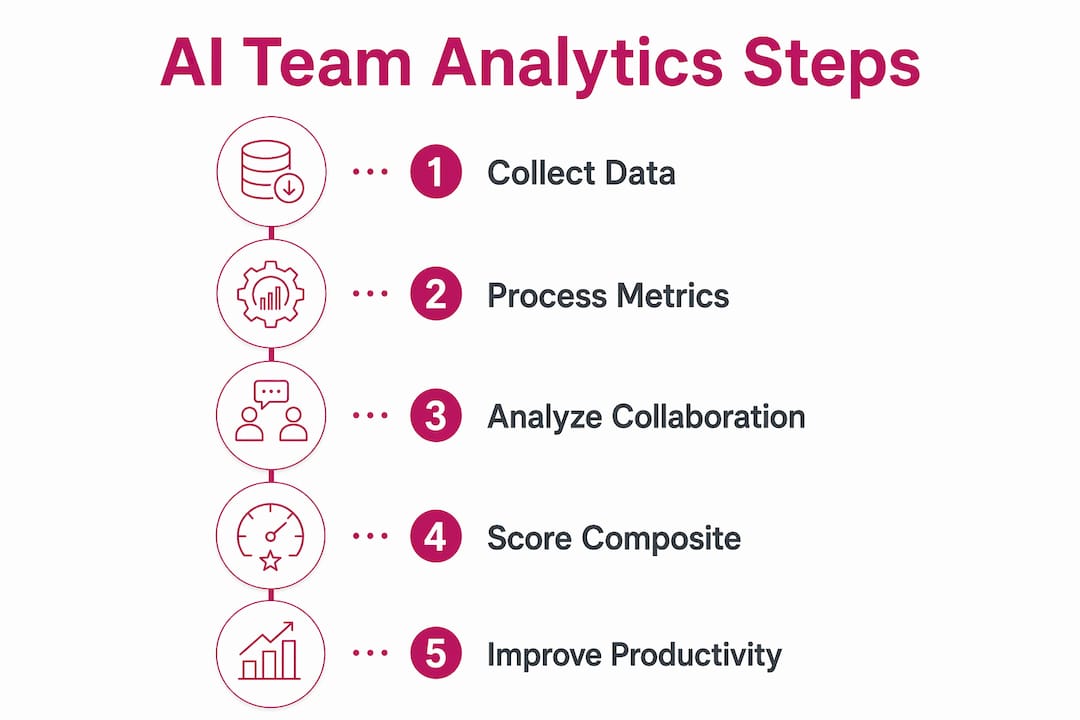
Multi-estimator validation reduces distortion in team performance analytics by requiring multiple independent evaluators to agree within a reasonable factor before a productivity multiplier is considered defensible. This approach protects against the single-source bias that plagues simpler measurement systems.
How does AI team analytics improve team productivity and collaboration?
AI team analytics improves productivity by making invisible inefficiencies visible. Teams often do not know where coordination breaks down, which workflows are bottlenecked, or which AI tools are being underused. Analytics surfaces those patterns so leaders can act on them rather than guess.
The productivity gains in AI-augmented teams are significant. Organizations using AI-augmented workflows report 40–50% faster delivery cycles, with AI generating up to 84% of code artifacts under human oversight. That is not a marginal improvement. It represents a fundamental change in how teams allocate effort.
Here is how analytics drives those gains in practice:
- Identifying bottlenecks in real time. Analytics flags when a team’s cycle time spikes or when AI adoption drops, prompting managers to investigate before a delay compounds.
- Guiding training decisions. When analytics shows that a team underuses a specific AI capability, leaders can target training precisely rather than running broad programs that miss the actual gap.
- Improving performance reviews. Composite scores built from behavioral data and manager input give reviewers concrete evidence rather than relying on recollection or recency bias.
- Compressing testing cycles. AI-augmented teams compress testing cycles and run parallel workstreams, reducing coordination overhead and accelerating delivery.
Collaboration benefits are equally concrete. When analytics tracks communication frequency and cross-team handoff patterns, managers can spot teams that are siloed or over-meeting. Both problems cost time. Fixing them based on data is faster and more credible than acting on gut instinct.
For a detailed breakdown of how AI integration improves delivery cycles, Tekkr’s step-by-step productivity guide covers the mechanics team by team.
What challenges arise when implementing AI team analytics?
AI team analytics produces bad decisions when the metrics are misread. The most common mistake is treating raw AI token usage as a direct measure of productivity. It is not. High token usage can reflect a team that is experimenting productively, or one that is struggling and retrying the same prompts repeatedly.
Raw AI token usage is a poor proxy for productivity. Metrics like retry pressure and sub-agent delegation frequency better indicate how AI is actually assisting a team. A spike in retries often reflects sub-agent spawning behavior in the underlying system, not a signal that a developer is failing. Misreading that pattern in a performance review causes real harm.
Common implementation pitfalls include:
- Over-relying on a single data source without triangulation across multiple estimators
- Ignoring context quality as a variable. Structured context treated as a first-class engineering artifact improves AI analytic speed and accuracy by up to 3X. Teams that feed their analytics agents curated, well-modeled data get far more reliable outputs.
- Skipping governance frameworks before collecting behavioral data, which creates legal and ethical exposure under regulations like GDPR
- Measuring activity instead of outcomes, which rewards busyness rather than results
Pro Tip: Before rolling out any AI analytics program, publish a clear policy explaining what data is collected, how it is used, and who can access it. Transparency reduces resistance and builds the trust that makes adoption data more accurate.
Governance is not optional. Human-AI collaboration maturity correlates directly with established ethical guidelines and defined success metrics. Organizations that skip this step find their analytics programs undermined by employee distrust and inconsistent data. Tekkr’s AI governance resource covers the policy frameworks leaders need to get this right.
How do organizations apply AI team analytics to drive strategic outcomes?
Applying AI team analytics at a strategic level requires connecting team-level data to business outcomes. Metrics that live only in an engineering dashboard do not change leadership decisions. Metrics tied to revenue, delivery speed, and workforce readiness do.
The table below maps the key dimensions of a practical AI team analytics program to the leadership actions they support.
| Analytics dimension | What it measures | Leadership action |
|---|---|---|
| AI adoption rate | Which teams use AI tools and how often | Target enablement programs at low-adoption teams |
| Delivery cycle time | Speed from task start to completion | Identify workflow bottlenecks and restructure handoffs |
| Composite performance score | Blended quantitative and qualitative output | Support fair, evidence-based performance reviews |
| Collaboration frequency | Cross-team communication and coordination patterns | Address silos or over-meeting before they compound |
| AI spend by team | Cost of AI tool usage per department | Reallocate budget toward highest-ROI use cases |
AI workforce readiness is foundational for successful AI transformation. Leaders who treat analytics as a one-time audit miss the point. The organizations that gain lasting advantage run continuous improvement cycles: measure adoption, identify gaps, run targeted training, measure again.
Role definition matters as much as measurement. Successful AI-augmented teams structure roles so that humans own architecture, governance, and high-judgment decisions while AI handles boilerplate and repetitive work. Analytics tells you whether that division of labor is actually happening or whether humans are still doing work AI should be doing.
For leaders building this capability from scratch, Tekkr’s enterprise AI adoption guide covers how to define roles, set KPIs, and structure governance across departments.
Key Takeaways
AI team analytics delivers measurable value only when organizations combine accurate metrics, multi-source triangulation, and governance frameworks that connect team data to business outcomes.
| Point | Details |
|---|---|
| Team is the unit of analysis | AI absorbs individual routine tasks, making team-level coordination the primary performance signal. |
| Triangulate metrics | Combine quantitative data and qualitative assessments to produce defensible, bias-resistant performance scores. |
| Avoid token usage as a sole metric | Retry frequency and sub-agent delegation reveal more about AI’s assistive effect than raw token counts. |
| Governance comes first | Publish data policies before collecting behavioral data to build trust and meet GDPR requirements. |
| Connect analytics to business KPIs | Team metrics only drive decisions when tied to delivery speed, revenue, and workforce readiness outcomes. |
The real competitive edge is not the data, it is what you do with it
Most organizations I work with have more AI usage data than they know what to do with. Token counts, commit logs, meeting transcripts. The data is not the problem. The problem is that nobody has defined what good looks like for an AI-augmented team in their specific context.
The leaders who get this right do one thing differently. They treat AI collaboration capability as a core competency, not a tool feature. That means building literacy programs, publishing governance policies, and reviewing AI adoption metrics in the same leadership meetings where they review revenue. When AI performance sits in a separate dashboard that only engineers see, it stays invisible to the decisions that matter.
The shift from AI consumer to AI orchestrator is real, and it is happening faster than most leadership teams are prepared for. Teams that used to need ten people to ship a feature now need four, but those four need to be genuinely skilled at directing AI, reviewing its outputs, and catching its failure modes. Analytics tells you whether your teams have made that transition or are still working the old way with new tools.
The long-term competitive advantage does not belong to the company with the most AI licenses. It belongs to the company that knows, with evidence, which teams are using AI well and has a system for spreading that capability across the organization. That is what AI team analytics, done properly, actually delivers.
— TekkrTools
Tekkr measures AI adoption so your analytics program has real data to work with
Knowing what AI team analytics requires is one thing. Having the infrastructure to run it is another. Tekkr’s Configurato platform tracks AI adoption, spend, and return across your entire organization, then actively drives adoption higher through gamified rollouts and company-wide AI playbooks.
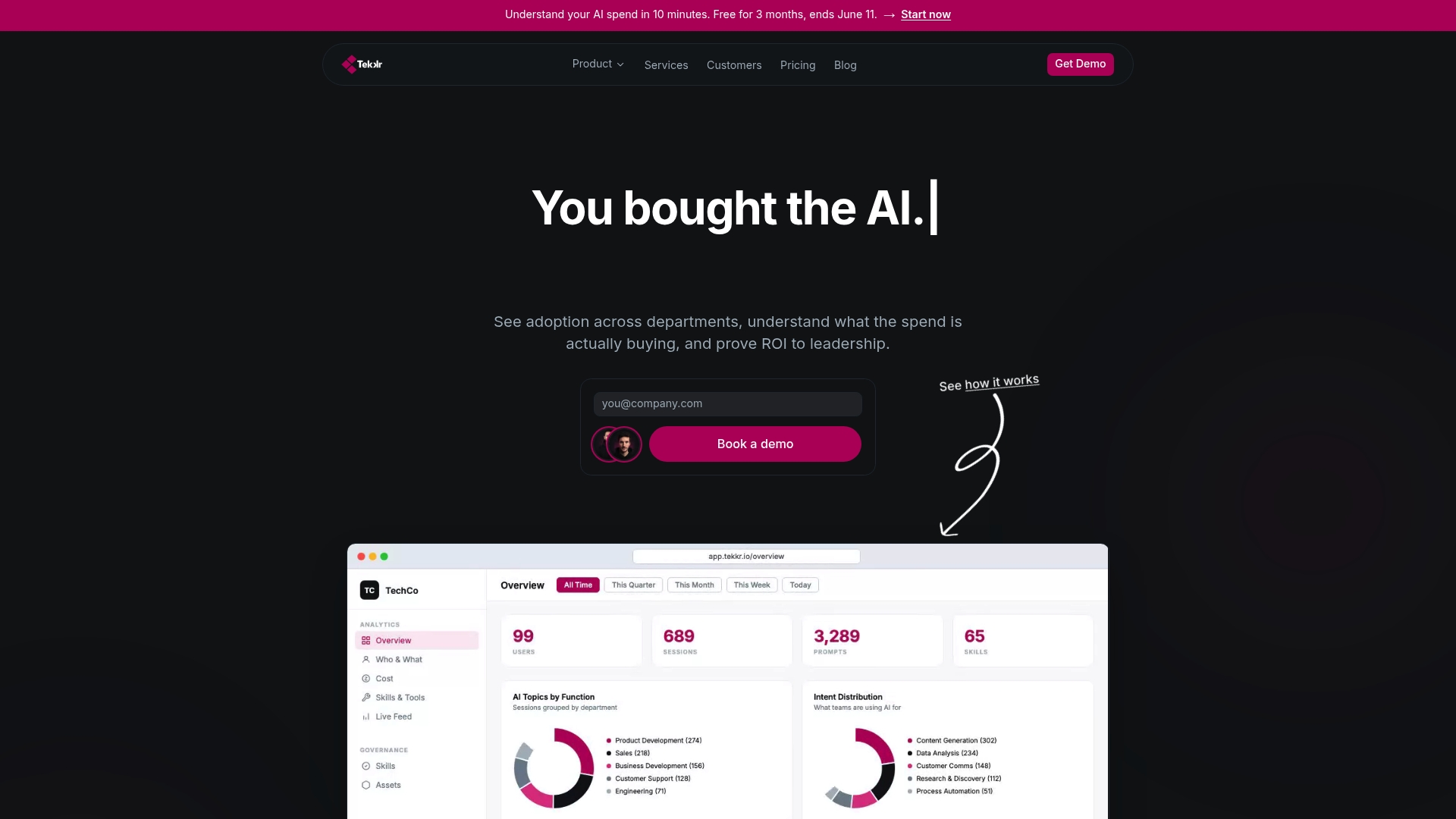
Configurato shows you who is actually using tools like Claude and Codex, breaks down costs by team, and surfaces use-case intelligence without requiring browser extensions or storing raw prompts. Setup takes about 10 minutes. The free tier requires no credit card. If you are ready to move from guessing about AI ROI to measuring it, explore Tekkr’s AI adoption solution and see what your teams are actually doing with the AI you have already paid for.
FAQ
What is AI team analytics in simple terms?
AI team analytics is the use of artificial intelligence to measure how teams work, collaborate, and use AI tools. It combines behavioral data, productivity metrics, and qualitative assessments to give leaders a clear picture of team performance.
How is AI team analytics different from traditional performance tracking?
Traditional tracking measures individual output. AI team analytics measures team-level coordination, AI adoption rates, and collaboration patterns, reflecting how work actually gets done in AI-augmented environments.
What metrics matter most in AI team analytics?
The most reliable programs combine AI adoption rates, task cycle times, collaboration frequency, and composite scores that blend quantitative data with manager assessments. Single-metric reliance risks bias and distorts performance reviews.
Can AI token usage alone measure team productivity?
No. Token usage is a poor proxy for productivity on its own. Retry frequency and sub-agent delegation patterns provide more accurate signals about how effectively a team is using AI assistance.
What governance steps should leaders take before deploying AI team analytics?
Leaders should publish a clear data policy, define what metrics are collected and why, and align the program with GDPR or applicable privacy regulations before collecting any behavioral data. Human-AI collaboration maturity depends on trust, and trust depends on transparency.