
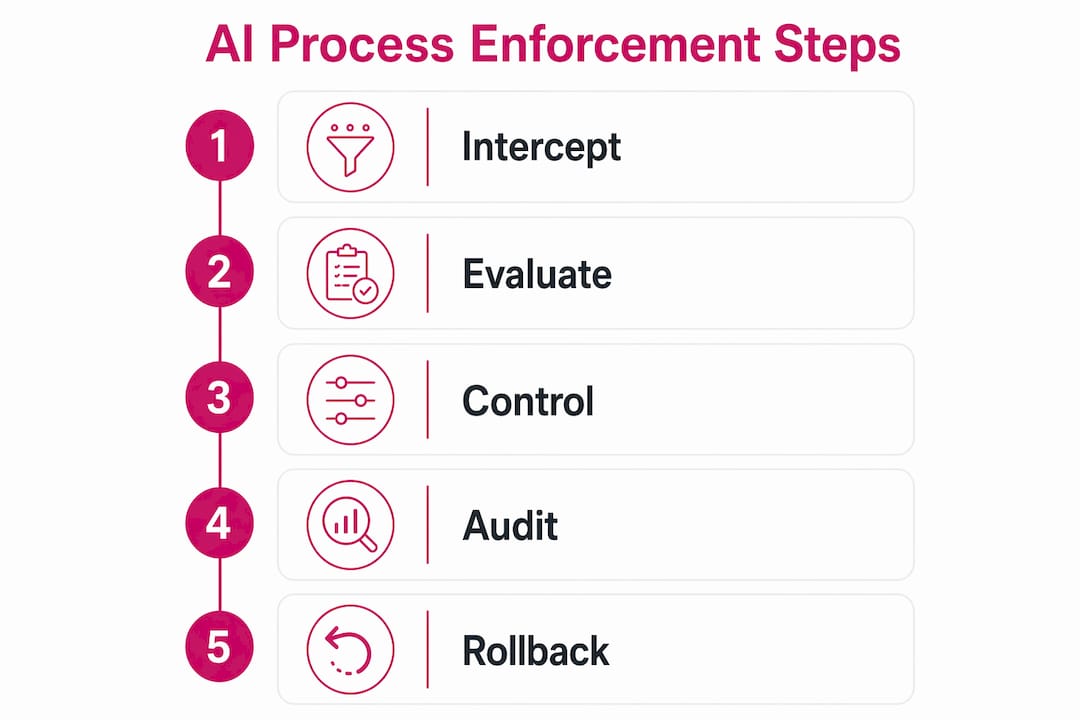
AI process enforcement is the runtime mechanism that intercepts, evaluates, and controls AI agent actions to guarantee compliance with your organization’s governance policies before outputs reach users or systems. Most business leaders treat AI governance as a prompt engineering problem. It is not. Prompt instructions degrade, context windows overflow, and models lose track of rules mid-task. The gap between “we told the AI what to do” and “the AI actually did it correctly every time” is exactly where AI process enforcement lives. Understanding this distinction is the difference between AI adoption that looks good on paper and AI integration that holds up under real operational pressure.
What is AI process enforcement and how does its architecture work?
AI process enforcement is built on a three-component architecture adapted from established enterprise security models, specifically XACML and ABAC frameworks applied to AI agent behavior. The three components are the Policy Enforcement Point (PEP), the Policy Decision Point (PDP), and the Policy Administration Point (PAP). Each plays a distinct role, and confusing them is one of the most common mistakes organizations make when designing AI governance systems.
The PEP and PDP separation is the architectural foundation of any credible AI enforcement system. The PEP sits on the critical path between the AI model and its output destination. It intercepts every request or output, forwards it to the PDP for evaluation, and then enforces whatever decision the PDP returns. Critically, the PEP contains no policy logic of its own. It does not decide what is allowed. It only acts on what it is told.

The PDP is where the actual governance logic lives. It receives a request from the PEP, evaluates it against a defined set of rules (covering tool access, data permissions, output content, and role-based controls), and returns a simple allow or deny verdict. This separation enables scalable governance across dozens of AI-powered services without duplicating policy logic in each one. One PDP can serve many PEPs across your organization.
The PAP is the management layer where your team defines, updates, and versions policies. Think of it as the control panel. Changes made in the PAP propagate to the PDP, which then informs every PEP in the system. This structure means a compliance update rolls out consistently across all AI touchpoints without manual reconfiguration.
Key roles in the enforcement architecture:
- PEP: Intercepts AI tool calls and outputs; enforces decisions without autonomous logic
- PDP: Evaluates requests against governance rules; returns allow or deny verdicts
- PAP: Management interface for defining, versioning, and distributing policies
- Audit layer: Records enforcement decisions with timestamps for compliance reporting
Pro Tip: Even if your initial deployment co-locates the PEP and PDP in a single service, maintain logical separation in your codebase from day one. This makes testing, scaling, and auditing dramatically easier as your AI footprint grows.
Why prompt-level rules are not enough for AI compliance
The most dangerous assumption in enterprise AI governance is that a well-written system prompt is sufficient to keep AI behavior within policy boundaries. It is not, and the failure mode is predictable. Claude agents drop compliance with instructions after approximately 15 tool calls. This is not a bug specific to Claude. It reflects how attention mechanisms work in large language models: as context grows, earlier instructions receive less weight relative to recent content.
This means your carefully crafted governance prompt is effectively invisible to the model by the time it reaches step 16 of a complex workflow. For a customer service agent handling a multi-step refund process, or a code generation assistant working through a long scaffolding task, this threshold arrives quickly. The compliance failure is silent. The model does not announce that it has stopped following the rules. It simply stops.
API-layer proxy enforcement solves this by moving policy validation outside the model context entirely. Rules are configured at the infrastructure level, validated pre- and post-request, and enforced deterministically regardless of how long the conversation has been running or how many tools have been called.
| Enforcement method | Reliability | Context dependency | Auditability |
|---|---|---|---|
| Prompt-level rules | Degrades after ~15 tool calls | High: fails as context grows | None: no enforcement log |
| API-layer / PEP enforcement | Deterministic | None: context-independent | Full: every decision logged |
Pro Tip: If you are running AI agents on multi-step workflows today without infrastructure-level enforcement, audit your logs for behavioral drift after step 10. You will likely find policy violations you did not know were happening.
How AI process enforcement works in practice
Understanding the architecture is one thing. Knowing how to deploy it is another. There are three common deployment patterns for AI process enforcement, each suited to different organizational scales and technical environments.
-
In-process SDK: The enforcement library runs inside the same application process as your AI agent. This is the lowest-latency option and works well for single-service deployments. The tradeoff is that policy updates require application redeployment.
-
Sidecar proxy container: The PEP runs as a separate container alongside your AI service, intercepting traffic at the network layer. This is the preferred pattern for Kubernetes-based environments. It decouples enforcement from application code and allows policy updates without touching the AI service itself.
-
API gateway plugin: Enforcement is embedded in your existing API gateway (such as Kong or AWS API Gateway). This works well when you want to apply governance across multiple AI services without deploying per-service infrastructure.
Regardless of deployment model, latency is a hard constraint. Runtime enforcement targets a median latency of 5ms or below, with p99 latency under 25ms and PDP evaluation completing in under 10ms at 1,000 concurrent requests. Exceeding these thresholds breaks AI agent execution loops, creating noticeable delays for end users and degrading the productivity gains you deployed AI to achieve.
Two additional operational requirements deserve attention. First, the fail-closed design: if the PDP becomes unreachable, the system denies all requests rather than allowing them through. This is the correct default for any security-sensitive deployment. Second, short-TTL decision caching allows the system to maintain availability during brief PDP outages without permanently compromising security posture.
Policy versioning and rollback are also non-negotiable in regulated environments. Every policy change should be versioned, timestamped, and reversible. Enforcement decisions should be logged with enough detail to reconstruct exactly what rule was applied, to which request, and what verdict was returned.
What are the benefits and risks of AI process enforcement?
The business case for AI process enforcement comes down to four outcomes: consistent compliance, reduced risk, full auditability, and sustainable AI scaling. Each of these matters more as your AI footprint grows.
Consistent compliance means that every AI action, across every tool, every user, and every workflow, is evaluated against the same policy set. There is no variance based on how a prompt was written or which model version is running. This is the foundation of regulatory readiness, particularly for organizations operating under frameworks like SOC 2, HIPAA, or the EU AI Act.
Risk reduction covers a specific set of failure modes that prompt-level governance cannot address: data exfiltration through unauthorized tool calls, privilege escalation by AI agents accessing resources beyond their role, and output policy violations that expose the organization to legal or reputational harm. Tools like AgentPEP intercept every tool call before execution using an OPA/Rego policy engine with a fail-closed design, providing role-based access controls and cryptographic audit trails. AEGIS extends this with real-time tool call classification, blocking of risky operations, and human-in-the-loop approval workflows for high-stakes actions.
Auditability is the benefit that most business leaders underestimate until they need it. Cryptographic audit trails with hash chaining provide tamper-evident records of every enforcement decision. In a regulatory investigation or internal incident review, this is the difference between being able to demonstrate what your AI did and having no credible answer.
The challenges are real too. Integration complexity is the most common friction point, particularly for organizations with heterogeneous AI tool stacks spanning Claude, GPT, Copilot, and Gemini. Latency trade-offs require careful architecture decisions. And policy management requires ongoing investment: rules that are not maintained become outdated and either too restrictive or too permissive.
Pro Tip: Start enforcement with your highest-risk AI workflows first, specifically those involving external data access, financial transactions, or customer-facing outputs. Get the architecture right there before rolling it out broadly.
Key takeaways
AI process enforcement is the only reliable mechanism for maintaining consistent, auditable control over AI agent behavior at enterprise scale.
| Point | Details |
|---|---|
| PEP and PDP separation | The PEP enforces decisions; the PDP makes them. Keep these logically separate from day one. |
| Prompt rules degrade | Models like Claude lose compliance after ~15 tool calls; infrastructure enforcement does not. |
| Latency is a hard constraint | Target p50 latency under 5ms to avoid breaking AI agent execution loops. |
| Fail-closed is the right default | If the PDP is unreachable, deny all requests rather than allowing unvalidated actions through. |
| Auditability enables compliance | Cryptographic audit trails are required for regulated industries and incident response. |
Why most organizations are solving AI governance in the wrong place
From working with companies on AI integration, the pattern is consistent: governance conversations start and end at the prompt layer. Teams spend weeks refining system prompts, adding rule after rule, and then wonder why their AI agents still produce non-compliant outputs in production. The building is not burning yet, so the structural problem gets deferred.
The uncomfortable truth is that prompt-level governance is a confidence problem, not a compliance solution. It makes teams feel like they have addressed the risk without actually doing so. Prompt-level rules cannot substitute mechanical enforcement because language model attention dilutes instructions over long conversations and multi-step tasks. This is not a model quality issue you can prompt your way out of.
The organizations that get this right treat AI governance the same way they treat API security: as an infrastructure problem with deterministic controls, not a content problem with probabilistic guardrails. They deploy enforcement at the layer where they can guarantee outcomes, not just influence them.
For business leaders, the practical recommendation is this: if your AI governance strategy today consists entirely of prompt instructions and model selection, you are one complex workflow away from a compliance failure you will not see coming. The fix is not complicated. It requires choosing an enforcement architecture, deploying it on your highest-risk workflows first, and building the audit trail that lets you demonstrate control when it matters.
— TekkrTools
How Tekkr helps you enforce AI process governance
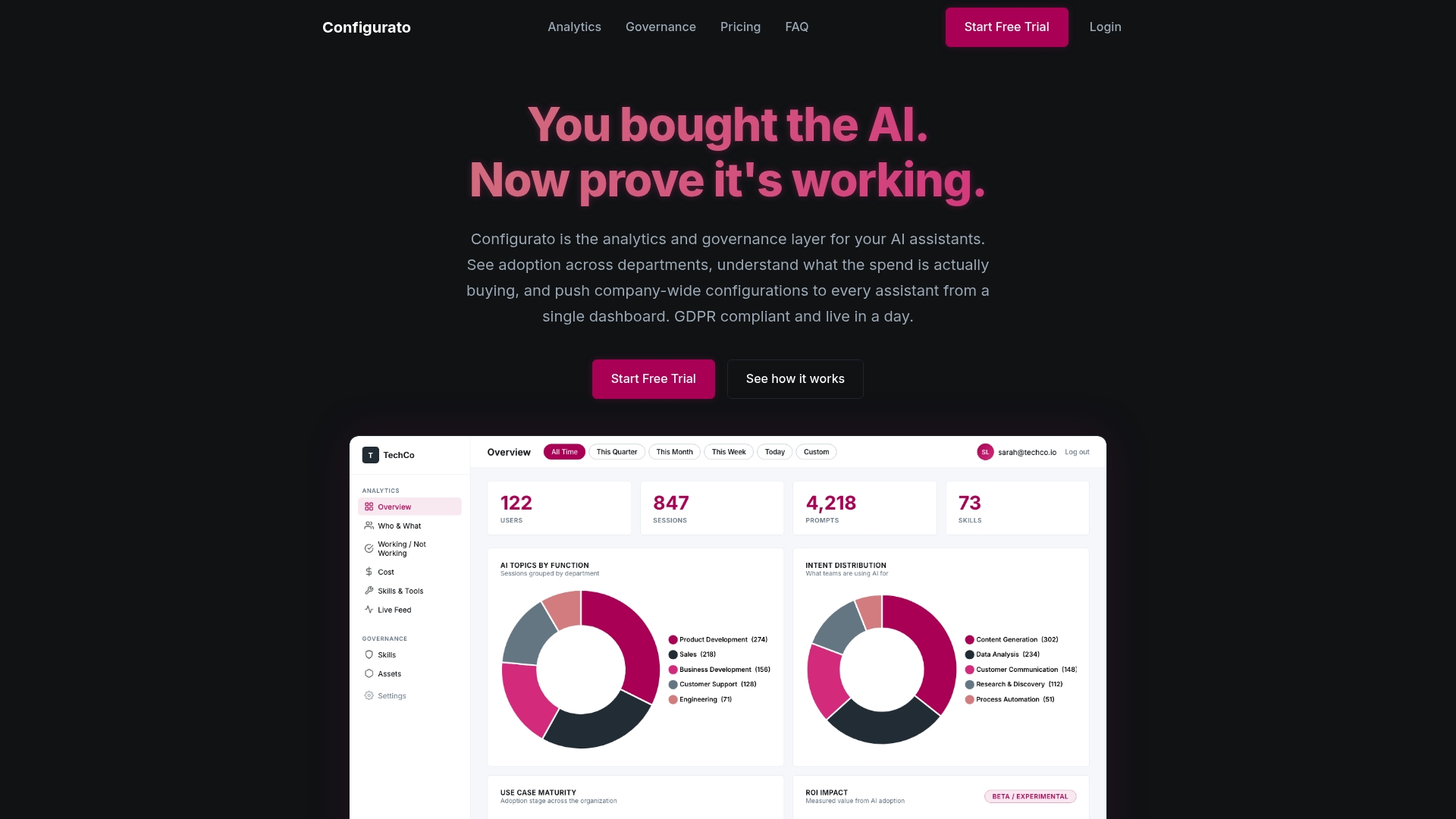
Tekkr’s Configurato platform brings AI process enforcement into your existing AI assistant workflows without requiring your team to change how they work. Configurato embeds your organization’s processes, quality standards, and governance rules directly into the AI tools your people already use, then enforces those rules agent-to-agent in the background. Visit Configurato to see how policy enforcement, audit logging, and real-time governance work together in a single platform built for enterprise AI adoption. No new tools for your team to learn. No rework on the back end. Just AI output that already reflects how your organization operates.
FAQ
What is AI process enforcement?
AI process enforcement is the runtime mechanism that intercepts AI agent requests and outputs, evaluates them against defined governance policies, and enforces allow or deny decisions before actions reach users or downstream systems. It is distinct from prompt-level rules because it operates at the infrastructure layer, independent of model context.
How does the PEP differ from the PDP?
The Policy Enforcement Point (PEP) intercepts requests and enforces decisions without containing any policy logic of its own. The Policy Decision Point (PDP) evaluates requests against governance rules and returns verdicts. The PEP enforces; the PDP decides, and keeping them separate is what makes enforcement scalable across distributed AI systems.
Why can’t prompt instructions handle AI compliance?
Prompt-level constraints degrade as context grows. Research shows that Claude agents stop complying with instructions after approximately 15 tool calls, a threshold reached quickly in multi-step workflows. API-layer enforcement validates rules outside the model context, making compliance deterministic rather than probabilistic.
What does fail-closed mean in AI enforcement?
Fail-closed means that if the Policy Decision Point is unavailable, the system denies all AI requests rather than allowing them through unevaluated. This is the correct default for security-sensitive deployments, and short-TTL caching can maintain availability during brief outages without permanently weakening the security posture.
What industries need AI process enforcement most urgently?
Any industry operating under data privacy, financial, or safety regulations, including healthcare, financial services, and legal, needs infrastructure-level AI enforcement. Cryptographic audit trails and human-in-the-loop approval workflows, as provided by tools like AEGIS, are specifically designed to meet the evidentiary and control requirements of regulated environments.