
AI return on investment (ROI) is defined as the measurable improvement in business outcomes directly attributable to AI deployment, tied to accountable decision units and verified against pre-AI baselines. Most organizations get this wrong. They track seat licenses, prompt counts, and user adoption rates, then wonder why the board remains skeptical. The real ways to measure AI ROI connect AI activity to workflow decisions, cost structures, and revenue outcomes. Frameworks like layered ROI models, CFO-aligned balanced scorecards, and Atlassian’s maturity ladder give you the structure to do this credibly. This article walks you through each method, in order of execution.
1. Ways to measure AI ROI start with defining your value unit
The single most common reason AI ROI measurement fails is that no one defines what they are actually measuring before the pilot begins. AI ROI failures often stem from measuring adoption instead of business outcomes, confusing technical success with real value.

Your first step is to define an explicit unit of value tied to a single accountable owner. That unit might be “contract review cycle time owned by the legal ops lead” or “support ticket resolution rate owned by the CX director.” Vague units produce gamed metrics. Specific units produce credible ones.
From there, establish a pre-AI baseline for that unit. Measure it for 30 to 90 days before any AI tool goes live. Forbes recommends a 90-day pilot to pick the unit, register baseline metrics and what isn’t counted, then observe workflow decision change, not just usage. That last point matters: you are measuring whether decisions improve, not whether people opened the tool.
- Define one unit of value per pilot, with a named owner
- Capture baseline workflow metrics for 30 to 90 days before deployment
- Observe behavioral changes in workflow decisions, not artifact generation or login counts
- Pre-register what does not count (e.g., time spent on AI prompting itself, rework cycles caused by bad output)
- Set a continuation criterion upfront: what improvement threshold justifies scaling?
Pro Tip: Register your exclusion criteria in writing before the pilot starts. This single act eliminates the most common source of inflated ROI claims and builds immediate credibility with your CFO.
2. Apply a four-layer ROI framework to structure your measurement
Once your baseline exists, you need a framework that connects AI activity to business impact without skipping steps. A four-layer ROI stack covering utilization, productivity, business outcomes, and strategic value provides structured, credible AI ROI measurement when combined with controlled experiments.
Here is how each layer works in practice:
- Layer 1, Utilization: Measure usage frequency, active user rates, and Shadow AI prevalence. This tells you whether the tool is being used at all. Track weekly.
- Layer 2, Productivity: Measure time saved per task, error reduction rates, and throughput increases. This tells you whether individual work is faster or better. Track weekly.
- Layer 3, Business outcomes: Measure revenue impact, cost savings, and risk mitigation. This tells you whether the business is better off. Track monthly, using A/B testing or holdout groups for attribution.
- Layer 4, Strategic value: Measure innovation pipeline contributions, market expansion signals, and data asset growth. This tells you whether AI is building long-term competitive position. Track quarterly.
Attribution is the hard part at Layers 3 and 4. Without a control group or holdout cohort, you cannot separate AI impact from market conditions, headcount changes, or process improvements that happened simultaneously. Controlled experiments are not optional at this level. They are the difference between a credible ROI case and a story.
Pro Tip: Pick one to three high-impact use cases for your first measurement cycle. Clean measurement on a narrow scope beats noisy measurement across ten use cases every time.
3. Use a CFO-style balanced scorecard beyond labor savings
Labor cost savings are the easiest AI ROI metric to calculate and the least convincing to a sophisticated CFO. Balanced scorecards that merge efficiency, speed, quality, and decision impact reduce skepticism among CFOs and boards far more effectively than a single savings number.
A CFO-aligned scorecard for AI ROI covers five categories:
- Efficiency: Hours saved per role per week, with a dollar value attached using fully loaded labor costs
- Speed: Cycle time reduction for key processes (e.g., invoice processing from 5 days to 1.5 days)
- Quality: Error rate before and after AI deployment, measured on the same task type
- Capacity: How much time was reallocated to higher-value work, not just freed up and absorbed
- Business impact: Improvements in decision quality, such as forecast accuracy gains or faster escalation resolution
The capacity metric is frequently ignored and frequently the most valuable. If AI saves a financial analyst 6 hours per week but those hours go to more meetings, the business impact is zero. You need to track where the time went, not just that it was saved.
Linking scorecard improvements to management decision impact gives you board-level clarity. A 15% improvement in forecast accuracy, for example, translates directly into better capital allocation decisions. That framing resonates with leadership in a way that “hours saved” never will.
Pro Tip: Present your balanced scorecard with baselines and targets side by side. CFOs are trained to distrust single-point metrics. Showing trajectory over time converts skeptics faster than any single impressive number.
4. Apply agent-specific metrics when measuring agentic AI
Standard productivity metrics break down when the AI is autonomous. Agentic AI systems, such as those built on Claude, GPT-4o, or Copilot agents, complete multi-step tasks without human intervention. The ROI calculation requires a different set of inputs.
Start by establishing human baseline metrics before deployment: process completion times, error rates, and cost per completed task when a human does the work. Then measure the agent against those same benchmarks.
Key metrics for agentic AI ROI:
- Agent Value Multiple (AVM): The ratio of value delivered by the agent to the fully loaded cost of running it, including token costs, infrastructure, and oversight
- Agent Cost per Completed Task (ACCT): Total cost divided by successfully completed tasks, normalized for success rate
- Outcome Rate: The percentage of initiated tasks that reach a successful, usable outcome. Outcome Rate outperforms simple completion or adoption rates as the best single indicator of agent value
- Token and context efficiency: Cost per token relative to task complexity, tracked to identify runaway cost patterns
- Human override rate: How often a human must intervene to correct or complete an agent task
| Metric | What it measures | Measurement cadence |
|---|---|---|
| Agent Value Multiple | Value delivered vs. total cost | Monthly |
| Agent Cost per Completed Task | Cost efficiency per successful task | Weekly |
| Outcome Rate | True task success, not just completion | Monthly |
| Human override rate | Autonomy reliability | Weekly |
| Token efficiency | Cost per unit of task complexity | Weekly |
Agentic AI ROI depends heavily on cost-per-success normalization, human override rates, and continuous tuning to balance autonomy versus cost. Partnering with your FinOps team to model token cost trajectories before scaling is not optional. It is how you avoid a situation where agent adoption grows but unit economics deteriorate.
5. Align your metrics to your AI maturity stage
Demanding revenue attribution from a team that deployed its first AI tool three months ago is a measurement failure, not a business failure. Aligning ROI metrics to an organization’s AI maturity stage avoids unrealistic expectations and focuses resources effectively.
Atlassian’s four-stage maturity ladder gives you a practical framework for this:
- Exploring stage: Focus on adoption metrics. Are people using the tools? What percentage of eligible workflows have AI touchpoints? Signal: adoption rate above 60% within the target team.
- Optimizing stage: Focus on efficiency metrics. Are workflows faster? Are error rates dropping? Signal: measurable cycle time reduction and cost avoidance on specific processes.
- Enhancing stage: Focus on quality metrics. Is output quality improving? Are customer satisfaction scores moving? Signal: CSAT delta, rework rate reduction, and decision accuracy improvements.
- Transforming stage: Focus on innovation metrics. Is AI enabling net-new products, markets, or business models? Signal: revenue from AI-enabled offerings, new market entries, or data asset monetization.
The practical implication is straightforward. If your organization is in the Exploring stage, a board presentation demanding revenue attribution will produce fabricated numbers or demoralized teams. Stage-appropriate metrics produce honest data and build the measurement discipline you need to reach the Transforming stage.
Use this ladder as a shared language across your leadership team. When the CFO asks for revenue impact and you are in the Optimizing stage, you can point to the framework and explain what credible measurement looks like at your current position. That conversation is far more productive than defending a number you cannot fully support.
Key takeaways
Measuring AI ROI credibly requires defined value units, layered metrics, and stage-appropriate expectations. Skipping any of these three elements produces either inflated claims or board-level skepticism.
| Point | Details |
|---|---|
| Define before you deploy | Establish a baseline unit of value with a named owner before any AI tool goes live. |
| Use a four-layer framework | Track utilization and productivity weekly; measure business outcomes and strategic value monthly with controlled experiments. |
| Go beyond labor savings | CFO-aligned balanced scorecards covering efficiency, speed, quality, capacity, and business impact build more credibility than single-metric reporting. |
| Agentic AI needs its own metrics | Agent Value Multiple, Outcome Rate, and human override rate replace standard productivity metrics for autonomous AI systems. |
| Match metrics to maturity | Atlassian’s four-stage ladder prevents premature revenue attribution demands and keeps measurement honest. |
What most measurement frameworks get wrong
Here is what I have seen repeatedly: organizations build a measurement framework, run a pilot, and then selectively report the metrics that look good. The exclusion criteria never got written down. The holdout group never got created. The CFO gets a slide with a big number, asks two follow-up questions, and the whole case falls apart.
The discipline that separates credible AI ROI measurement from performance theater is pre-registration. Before you start, write down what you will measure, what you will not count, and what threshold triggers a scale or stop decision. This is not bureaucracy. It is the same rigor that makes clinical trials trustworthy. Your AI investment deserves the same standard.
The other failure I see consistently is treating the measurement problem as a data problem. Leaders invest in dashboards and analytics tools before they have defined what they are trying to prove. The tool cannot save you if the question is wrong. Start with the question: “What specific business decision will improve if this AI works?” Then build the measurement backward from that answer.
One more thing worth saying directly: modest early ROI is not a failure signal. It is a calibration signal. The organizations that win with AI are the ones that track improvement trajectory, not just point-in-time returns. A use case that delivers 12% efficiency gain in month three and 31% in month nine is a success story. You just have to be measuring consistently enough to tell it.
— TekkrTools
See exactly where your AI is and isn’t delivering
If you have read this far, you already know that measurement discipline is what separates AI programs that compound in value from ones that stall. Tekkr’s Configurato platform gives you the governance and analytics layer to track the metrics covered in this article, including agent value multiples, cost per completed task, workflow error rates, and adoption signals across Claude, GPT, Copilot, and Gemini.
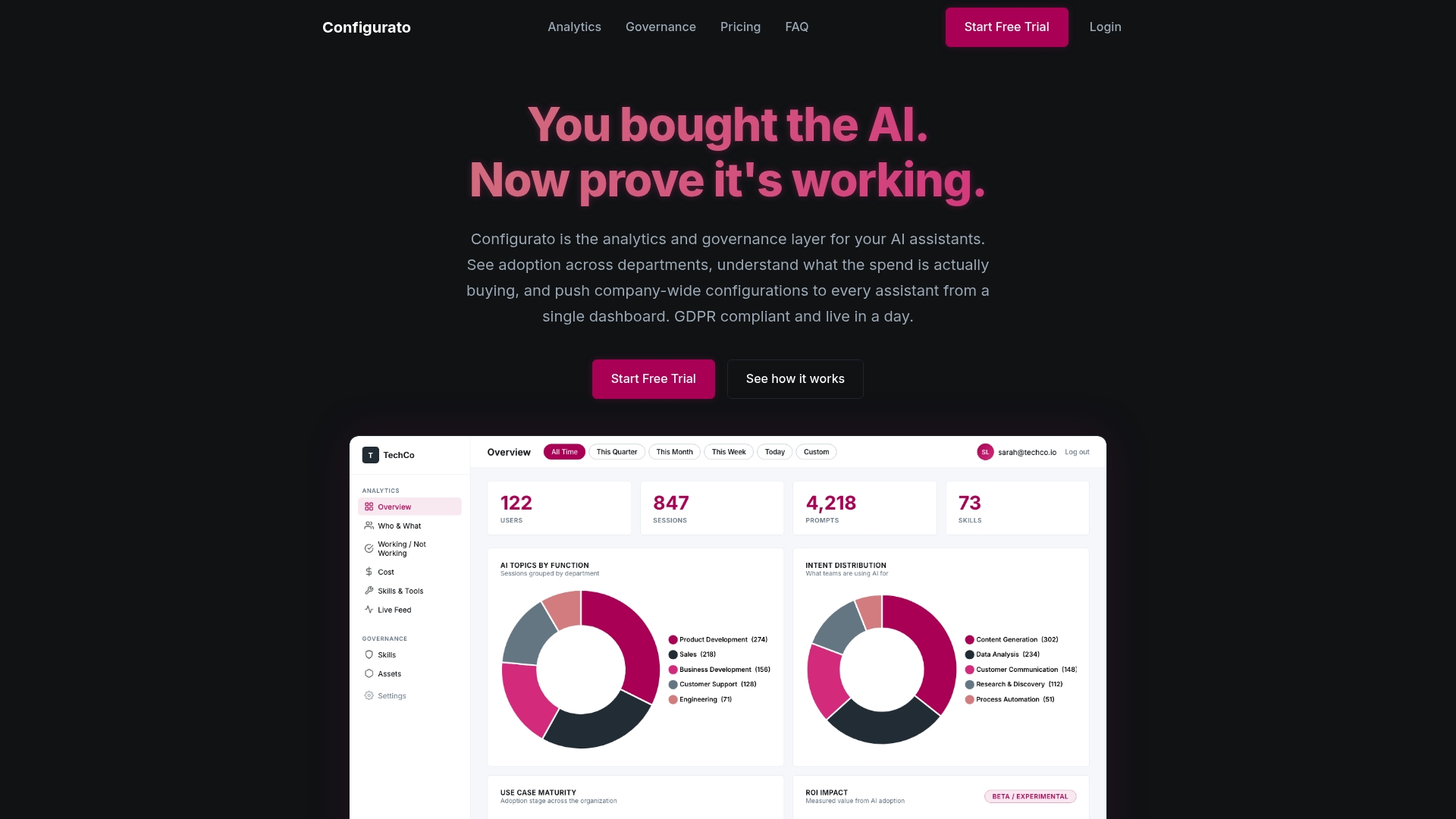
You do not need to build a custom analytics stack to get this visibility. Configurato embeds directly into your existing AI assistant workflows and surfaces the data your leadership team needs to make scale or stop decisions with confidence. For teams working through real-world AI efficiency gains, having a single source of truth for ROI data changes the board conversation entirely.
FAQ
What is the best single metric for AI ROI?
Outcome Rate is the most reliable single indicator for agentic AI, measuring the percentage of initiated tasks that reach a successful, usable result. For non-agentic AI, cycle time reduction on a specific workflow tied to a named business owner is the most credible starting point.
How long should an AI ROI pilot run before drawing conclusions?
Forbes recommends a 90-day pilot window to capture meaningful baseline data and observe genuine workflow behavior changes. Shorter windows produce noise; longer windows delay decisions that affect competitive position.
Why do CFOs distrust most AI ROI reports?
CFOs distrust AI ROI reports that rely on a single metric, lack baselines, or cannot separate AI impact from other simultaneous changes. A balanced scorecard covering efficiency, speed, quality, capacity, and business impact addresses all three objections.
How do you measure AI ROI for autonomous agents specifically?
Agentic AI requires metrics like Agent Value Multiple, Agent Cost per Completed Task normalized for success rate, and human override rate. Standard productivity metrics undercount costs and overcount value when the AI operates autonomously across multi-step tasks.
When should you stop measuring adoption and start measuring outcomes?
Once adoption exceeds 60% within the target team, shift measurement focus to efficiency and quality metrics. Continuing to report adoption rates past that threshold signals that the program lacks a credible outcome measurement plan.