
Most enterprises have already invested in AI tools. Some have deployed a dozen of them. Yet the productivity leap that seemed so inevitable on the roadmap remains stubbornly out of reach. The reason is not that the tools are bad. It is that deploying AI and actually integrating it into how your business operates are two completely different problems. AI adoption research shows productivity gains of 2.4 to 5x are real, but so is an 80% project failure rate, with change management alone costing three times more than model development. That gap between promise and reality is exactly what this guide is built to close.
Table of Contents
- The evolving landscape: How AI is reshaping business operations
- Key challenges in AI adoption for operations
- AI implementation roadmap: From pilot to scale
- Success and failure: Lessons from real AI project outcomes
- Why most AI integration playbooks miss the mark
- Take the next step: Align AI with your enterprise workflow
- Frequently asked questions
Key Takeaways
| Point | Details |
|---|---|
| Alignment over technology | Success with AI depends on workflow alignment, not just technical capabilities. |
| Start small, scale smart | Piloting focused projects and measuring KPIs is essential before scaling AI. |
| Data quality is foundational | Investing in high-quality, well-prepared data enables effective AI outcomes. |
| Change management matters | Cross-functional stakeholder engagement can make or break AI initiatives. |
| Continuous measurement | Ongoing analytics and governance are key for operationalizing and optimizing AI at scale. |
The evolving landscape: How AI is reshaping business operations
With the reality check set, let us examine where AI is making its mark today and how the landscape is evolving for enterprise leaders.
The conversation around AI in operations has shifted significantly. A few years ago, automation was the main story. Replace repetitive tasks, cut headcount in manual processes, and call it a win. Today, the most sophisticated enterprises are thinking about augmentation and workflow orchestration. AI is not just replacing steps in a process; it is becoming the connective tissue between systems, decisions, and teams.
The benefits of integrating AI into operations span several high-impact use cases that executives are actively prioritizing:
- Predictive analytics that flag supply chain disruptions before they escalate
- Intelligent document processing that reduces contract review cycles from days to hours
- Decision support tools that surface relevant data during real-time business decisions
- AI-driven scheduling and resource allocation that reduce operational waste
- Natural language interfaces that let non-technical staff query complex data systems directly
These are not experimental applications. They are live in organizations right now, and they are delivering results when implemented with the right foundation. The key word is foundation.
According to a structured implementation roadmap framework, the organizations seeing real gains follow a disciplined path: identify the KPIs that matter, map the bottlenecks those KPIs expose, define the problem with precise metrics, run a contained pilot, then scale only after validating results. That sequence sounds simple. Most organizations skip at least two of those steps.
The productivity and cost impact is not theoretical. When AI is genuinely embedded into operations rather than bolted on as a reporting layer, it reduces cycle times, cuts error rates, and frees up cognitive capacity for higher-value work. Understanding AI for business model strategy helps executives frame these gains not as IT wins but as strategic advantages that compound over time.
Key challenges in AI adoption for operations
Understanding how AI shapes operations sets the stage for a hard look at what regularly goes wrong and why so many projects struggle to deliver results.
The failure rate is not a mystery. The causes are well-documented and almost always predictable in hindsight. What makes them dangerous is that they are easy to underestimate when you are standing at the beginning of an AI initiative with executive sponsorship and budget in hand.
The challenges fall into two buckets: technical and organizational. Both are serious. Neither is insurmountable. But you have to go in with eyes open.
On the technical side, common AI challenges include data quality issues, system integration complexity, regulatory compliance demands, and ethical considerations around AI-driven decisions. These are not abstract concerns. Bad data produces confident but wrong AI outputs. Legacy system incompatibility means your AI initiative stalls at the integration layer. And compliance in regulated industries like finance, healthcare, and manufacturing adds a layer of governance overhead that many roadmaps simply do not account for.

Data quality best practices are the starting point for any serious AI initiative. You cannot train or deploy an AI system that will behave reliably in production without clean, well-structured, consistently formatted data. Most enterprises discover mid-project that their data estate is messier than anyone admitted in the planning phase. Understanding AI data preprocessing is not optional. It is the foundation.
On the organizational side, the picture is just as challenging:
“AI tools can process vast amounts of data and identify patterns, but they still lack the organizational context needed to make judgment calls that reflect company values, culture, and strategy.”
That observation captures something executives often miss. You can deploy a technically sophisticated AI system and still see it produce outputs that are contextually wrong because it does not understand how your organization actually operates. Skills gaps compound this. Teams that have not worked with AI before make poor prompt decisions, misinterpret outputs, and gradually lose trust in the tools. Change management then becomes a firefighting exercise instead of a proactive enablement program.
Ethical risk is the challenge that surfaces latest but costs the most when ignored. AI systems that make or influence hiring, lending, or operational decisions carry real accountability exposure. That accountability sits with your organization, not with the tool vendor.
AI implementation roadmap: From pilot to scale
Given these challenges, a structured roadmap can transform AI from aspirational technology into operational reality.
A successful AI implementation does not happen because you picked the right vendor or hired a data science team. It happens because you followed a process that kept business outcomes at the center at every stage. Here is how that process looks in practice, following the evidence-backed implementation roadmap that separates successful deployments from the 80% that stall.
- Identify the business area with the highest bottleneck density. Look for workflows where delays, errors, or manual handoffs are causing measurable drag on productivity or revenue.
- Clarify the desired outcome in specific terms. Not “improve efficiency” but “reduce invoice processing time from 5 days to 1 day with error rate below 2%.”
- Map the KPIs that will tell you whether you are succeeding. Establish a baseline before you touch anything so you have a clean comparison point.
- Choose the right AI approach for the problem. Predictive analytics, generative AI, computer vision, and robotic process automation are not interchangeable. Match the tool to the problem.
- Run a contained pilot with a real team, real data, and real stakes. Sandbox experiments do not reveal integration friction or adoption resistance.
- Iterate based on what the pilot reveals. Most pilots surface at least one assumption that needs revisiting.
- Scale only after confirming the pilot’s value against your predefined KPIs, with AI governance analytics in place to maintain oversight as complexity grows.
| Pilot success factors | Common pitfalls |
|---|---|
| Clear KPIs defined before launch | Vague success criteria set after deployment |
| Strong data quality in the target workflow | Assuming data is clean without auditing it |
| Change-ready team with executive sponsorship | Rolling out AI to resistant or unprepared teams |
| Narrow, well-scoped problem | Trying to solve too many problems at once |
| Iterative feedback loop built in | Treating the pilot as a one-shot evaluation |
| Integration with existing systems validated | Discovering integration blockers mid-pilot |
Building scalable AI solutions requires making deliberate architecture decisions early. Choices made at the pilot stage about data pipelines, API design, and model monitoring become much harder to change at enterprise scale.
Pro Tip: Choose your first pilot in a business unit where the team lead is genuinely enthusiastic about AI, the underlying data is reasonably clean, and there is a measurable outcome you can report to the board within 90 days. Winning early creates organizational momentum that makes every subsequent rollout easier.
Success and failure: Lessons from real AI project outcomes
A clear adoption roadmap is vital, but what does real-world data reveal about the journey from pilot to results?
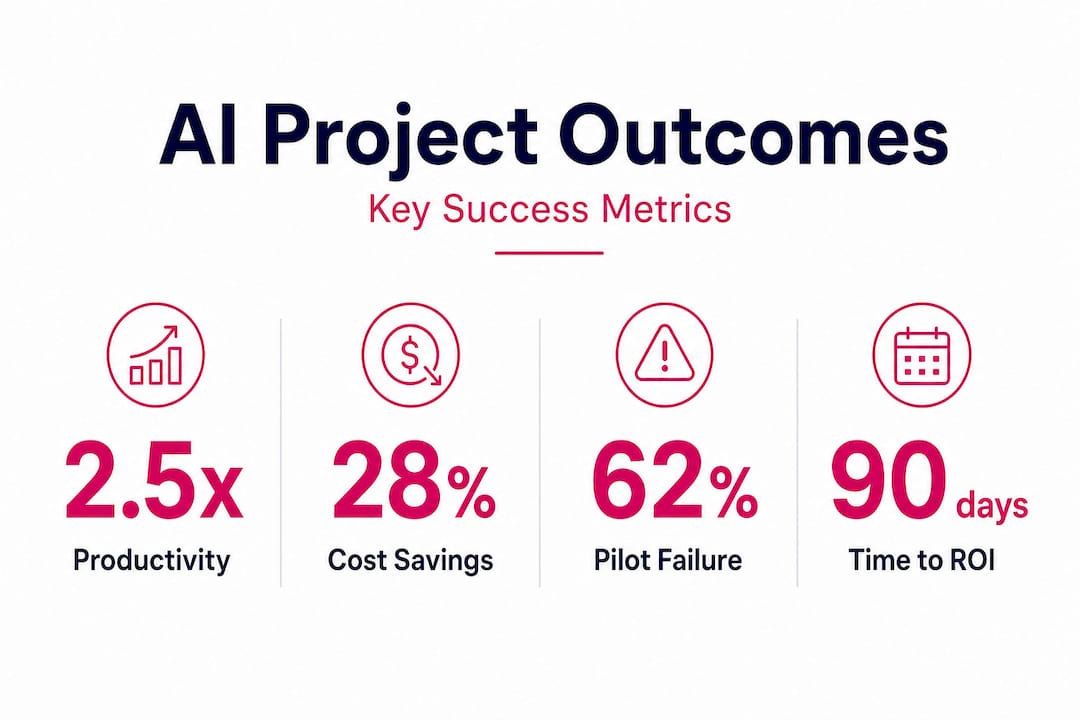
The data on AI project outcomes is both encouraging and sobering. On one side, organizations that execute well report productivity gains of 2.4 to 5x in the workflows they target. That is a material return on investment. On the other side, the same research confirms that 80% of AI projects fail to reach intended scale, and the cost of change management routinely runs three times the cost of model development. The math only works if you plan for both sides of that equation.
| Metric | Optimistic outcome | Realistic challenge |
|---|---|---|
| Productivity impact | 2.4x to 5x improvement | Gains confined to narrow workflows |
| Time to value | 3 to 6 months post-pilot | Often 12 to 18 months due to integration delays |
| Change management cost | Included in project plan | Frequently 3x model development cost |
| Project completion rate | Scaling across enterprise | 80% fail before full deployment |
| Employee adoption | High usage within 90 days | Gradual drop-off without enablement |
The gap between expectation and outcome almost always traces back to the same failure patterns. Leadership underestimates how much organizational behavior needs to change. Teams adopt the tool but not the workflow redesign it was meant to enable. AI outputs get second-guessed because employees do not trust them, so the efficiency gain evaporates in a manual verification layer that was never supposed to exist.
Understanding AI integration ROI means measuring outcomes at the workflow level, not just at the system level. A model that runs perfectly in production but is not actually informing decisions is not delivering ROI. The measurement has to follow the decision, not the deployment.
Pro Tip: Invest in cross-functional change management before your first pilot launches, not after it fails. Identify the skeptics on the team, address their concerns directly, and build advocates in every function that will be touched by the AI initiative. Technology without adoption is just expensive infrastructure.
Why most AI integration playbooks miss the mark
After examining statistics and common pitfalls, it is worth confronting what even the best frameworks sometimes overlook. This is where we will share what years of hands-on work with enterprises has actually taught us.
Most AI integration playbooks are technology-first documents. They map systems, vendors, APIs, and data flows. They describe governance structures and compliance checkpoints. They include project timelines and budget ranges. What they almost never address with sufficient depth is the organizational misfit problem.
The fundamental challenge is not whether your AI system can process the data. It is whether the AI output will be trusted and acted upon by the people whose workflows it is meant to improve. Organizational context in decisions is not a soft concern. It is the load-bearing wall of successful AI integration. Pull it out and the whole structure collapses.
Here is the shift we believe executives need to make: stop thinking tool-first and start thinking workflow-first. The question is not “which AI tool should we deploy?” It is “which workflow decision point, if made faster and more accurately, would change our business outcomes?” That reframe forces you to design AI integration around human judgment, not around software capability.
The playbooks also tend to underestimate governance. Not compliance governance, which most enterprises handle reasonably well, but operational governance: the ongoing process of ensuring that AI outputs remain aligned with how your organization actually operates as that organization evolves. Your processes change. Your quality standards change. Your strategy changes. A static AI configuration that does not evolve with those changes becomes a liability, not an asset.
What actually moves the needle is a data-driven alignment mechanism that continuously connects AI behavior to your real operating context. That is different from a rigid playbook or a one-time configuration. It is a living system that knows how your company works and passes that knowledge to every AI assistant your people use, without requiring them to change their workflow or learn a new tool. That is the gap most playbooks leave open.
AI governance insights are most valuable when they are actionable at the individual workflow level, not just at the compliance reporting level. The question executives should be asking is not just “are we compliant?” but “is our AI actually aligned with how we work, and is it getting better over time?”
Take the next step: Align AI with your enterprise workflow
Ready to move from roadmap to reality? Here is how you can align AI with your business operations, quickly and reliably.
The gap between AI deployment and AI value is a solvable problem. But it requires more than better tools. It requires embedding your company’s processes, standards, and domain knowledge directly into how AI behaves across every assistant your teams use.
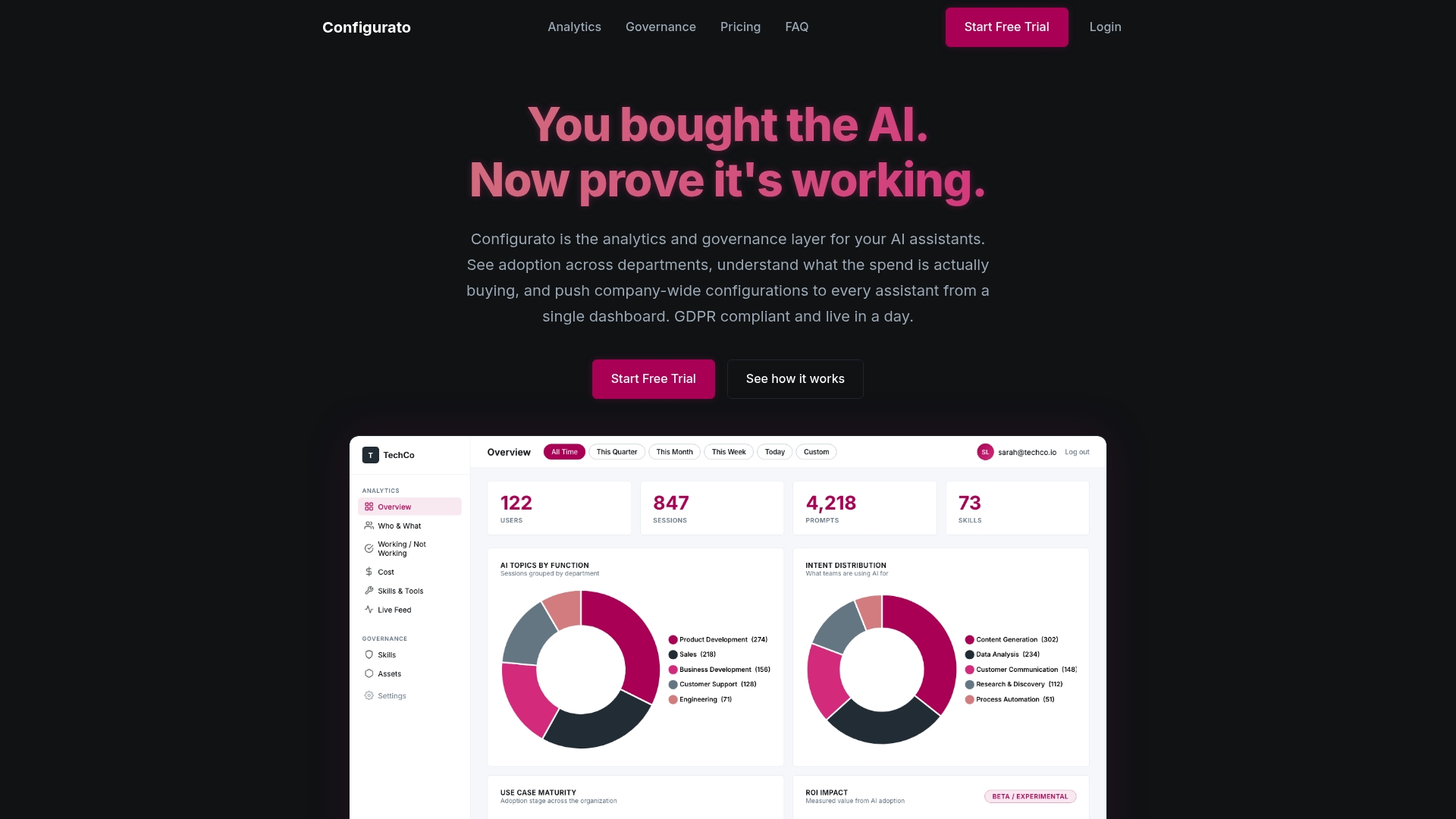
The Configurato analytics and governance platform by Tekkr is purpose-built for exactly this challenge. It codifies how great work looks at your company, distributes that context to any AI assistant your teams are already using, and traces where AI is actually accelerating work versus where adoption is stalling. No new tools for your employees to learn. No workflow disruption. Your AI simply starts operating like someone who already understands your business. If you are serious about turning your AI investment into a competitive advantage rather than a cost center, this is where that work begins.
Frequently asked questions
What is the most common reason AI projects fail in business operations?
The main reason is a lack of organizational context and failure to integrate AI with existing workflows, not technical shortcomings. Even technically sound AI systems fail when they are not aligned with how teams actually make decisions.
How can businesses measure ROI from AI integration?
Set clear KPIs before launching AI pilots and track them against baseline productivity metrics for tangible ROI. The implementation roadmap framework recommends defining measurable success criteria before any technology is deployed.
What are essential steps before scaling AI solutions enterprise-wide?
Pilot AI in one business unit, confirm value by tracking your predefined KPIs, then prepare integration and stakeholder alignment before expanding. Skipping the pilot-before-scaling step is one of the most consistent predictors of enterprise AI failure.
Why is data quality crucial for AI success in operations?
High-quality, well-structured data ensures AI models deliver accurate, actionable results that genuinely support business decisions. Data quality issues are among the most commonly cited blockers in enterprise AI initiatives, and they are almost always discovered later than they should be.