
AI productivity bottlenecks are defined as specific constraints that prevent organizations from realizing the full efficiency gains their AI investments are designed to deliver. Most leaders assume the problem is technology. The real problem is almost always people, processes, and organizational structure. 90% of AI initiatives fall short because organizations lack a value-first blueprint linking AI metrics to financial outcomes. That gap is not a technology failure. It is a systems failure. Understanding the distinct types of AI productivity bottlenecks is the first step toward fixing them.
What are the primary types of AI productivity bottlenecks?
AI workflow challenges fall into five broad categories. Each one is distinct, and each requires a different fix.
- Workforce skills and talent shortages. Teams lack the skills to use AI tools effectively, so tools sit underused.
- Fragmented AI tools and broken integrations. Disconnected subscriptions create manual work instead of eliminating it.
- Human verification and trust bottlenecks. AI speeds up drafting and coding, but human review and approval slow everything back down.
- Data silos and poor data governance. Scattered data across CRM, ERP, and legacy systems gives AI bad inputs and unreliable outputs.
- Lack of strategic alignment and organizational integration. Roles, incentives, and decision rights are not redesigned to match how AI actually works.
The sections below break each one down with evidence and practical implications for business leaders.
1. Workforce skill shortages as a barrier to AI implementation

Skill gaps are the most cited barrier to AI productivity, and the numbers are striking. 44% of federal agency leaders identify skilled workforce shortages as a critical barrier to AI modernization. A separate measure from the same survey shows 31% specifically lack tech-focused personnel to use AI for operational efficiency. These figures reflect a pattern seen across both public and private sectors.
The problem compounds quickly. When teams lack AI fluency, they default to old workflows even when better tools are available. Managers then measure activity rather than outcomes, which masks the real productivity gap. The result is an organization that pays for AI licenses but captures almost none of the value.
Closing this gap requires more than training sessions. It requires embedding AI skill development into role definitions, performance reviews, and hiring criteria. Leaders who treat AI literacy as a core competency rather than a nice-to-have see measurably faster adoption across their organizations.
Pro Tip: Map your current AI tool usage by team before investing in training. Tekkr’s Configurato platform tracks who is actually using tools like Claude and Codex, so you train the right people on the right gaps rather than running generic programs.
2. Fragmented AI tools and disconnected workflows
Fragmentation is the silent productivity killer in most AI rollouts. Disconnected AI tools without integration force manual work that cancels out the efficiency gains AI was supposed to create. A team might use one tool for drafting, another for summarizing, and a third for data analysis, with no automated handoff between them. The result is copy-paste workflows that are slower than the manual process they replaced.
The symptoms are easy to spot once you know what to look for:
- Employees manually transferring outputs from one AI tool into another system
- Duplicate data entry across platforms that do not share a common API
- Inconsistent outputs because each tool operates on different data snapshots
- No single view of what AI is producing, costing, or delivering across teams
Implementing AI without upfront process redesign risks automating and scaling existing inefficiencies. That is the core danger of fragmentation. You are not just failing to gain productivity. You are spending money to make broken processes run faster.
Connected workflows where AI tools communicate and trigger each other deliver compounded productivity gains compared to isolated subscriptions. The fix is integration architecture, not more tools. Map your end-to-end workflow before adding any new AI capability.
Pro Tip: Before buying another AI subscription, audit what your current tools can do when connected. Most enterprise platforms support API integrations that eliminate manual handoffs entirely. Check your AI integration strategies before adding to your stack.
3. Human verification and trust bottlenecks
AI shifts bottlenecks from production tasks to verification, trust, and judgment processes still performed by humans. This is the insight most leaders miss. AI does not remove bottlenecks. It moves them.
Think about what happens when a legal team deploys AI to draft contracts. Drafting time drops by 80%. But every draft still requires attorney review before it can be used. If the review process has not changed, the attorneys become the new bottleneck. Work-in-progress piles up faster than it can be cleared.
The same pattern appears across functions:
- Content production. AI generates 10x more drafts, but editorial review capacity stays flat.
- Software development. AI writes code faster, but QA testing and security review remain manual.
- Financial reporting. AI pulls and formats data quickly, but sign-off and compliance checks still require senior judgment.
- Customer support. AI drafts responses instantly, but agents still review before sending in regulated industries.
The solution is not to remove human judgment. It is to redesign the verification workflow so it scales alongside AI output. That means building quality assurance directly into the AI process, not as a downstream step. Leaders who treat AI integration as a workflow redesign problem rather than a technology problem solve this bottleneck faster.
4. Data silos and poor data governance
Bad data is a direct cause of bad AI outputs. Scattered data across CRM, ERP, and legacy applications creates silos that impede AI reliability. When an AI model pulls from incomplete or inconsistent data sources, its outputs require more human correction, which defeats the purpose of using AI at all.
Data governance is not just a technical problem. It is an organizational one. Departments often own their data independently, with no shared standards for formatting, updating, or sharing records. AI tools that cross departmental lines hit these inconsistencies immediately. The model produces outputs that look confident but are built on contradictory inputs.
The practical fix starts with a data audit before AI deployment, not after. Identify which systems hold the data your AI tools will need. Map the gaps, duplicates, and access restrictions. Build a governance policy that defines who owns each data set and how it gets updated. AI tools designed as integrated ecosystems that share data deliver far better results than tools bolted onto siloed systems.
5. Cognitive and organizational limits on AI adoption
Human cognitive constraints are a real and underappreciated AI bottleneck. Working memory capacity limits of 3–5 items and the time required to form new habits create fundamental constraints on how fast organizations can scale AI productivity. AI can process thousands of variables simultaneously. Humans cannot. That mismatch creates friction at every handoff point between AI output and human decision-making.
Habit formation takes weeks to months, and status quo bias pushes teams back toward familiar workflows even when new ones are demonstrably better. This is not resistance for its own sake. It is a predictable behavioral pattern that leaders must plan for explicitly.
The table below shows how cognitive and organizational limits map to specific AI bottleneck types and what each requires to resolve.
| Constraint | Bottleneck it creates | What resolves it |
|---|---|---|
| Working memory limits | Teams revert to manual steps when AI outputs are complex | Simplify AI outputs; use summaries and structured formats |
| Status quo bias | Employees avoid new AI workflows despite training | Incentive redesign and gamified adoption programs |
| Decision rights ambiguity | Teams wait for approval rather than acting on AI outputs | Clarify who owns AI-assisted decisions at each workflow stage |
| Incentive misalignment | Managers reward activity volume, not AI-driven outcomes | Tie performance metrics to AI productivity results |
Organizational barriers such as roles, incentives, and decision rights are the primary obstacles to sustained AI impact, not technology sophistication. That finding reframes the entire problem. The organizations that close the AI productivity gap fastest are the ones that redesign their operating model alongside their technology stack. Leaders who want to understand why AI tools go unused will find the answer almost always in organizational design, not the tools themselves.
Key takeaways
Resolving AI process inefficiencies requires addressing workforce skills, workflow integration, verification processes, data governance, and organizational design together, not as separate problems.
| Point | Details |
|---|---|
| Skills gaps block adoption | 44% of leaders cite workforce shortages as a critical barrier; treat AI literacy as a core competency. |
| Fragmentation creates hidden work | Disconnected tools force manual handoffs that cancel out AI efficiency gains. |
| AI moves bottlenecks, not removes them | Verification and approval become the new constraints after AI speeds up production tasks. |
| Data quality determines AI quality | Scattered data across siloed systems produces unreliable AI outputs that require more human correction. |
| Organizational design is the real fix | Roles, incentives, and decision rights must be redesigned alongside technology for AI to deliver lasting results. |
The bottleneck you are probably ignoring
Most AI productivity conversations focus on tool selection. Which model is best? Which platform has the most integrations? Those are the wrong questions to lead with.
The organizations I see struggle most with AI productivity are not the ones with bad tools. They are the ones with good tools and broken processes. They bought AI to speed up drafting, and now their review queues are three times longer. They deployed a data analysis platform, and now analysts spend half their time cleaning the outputs because the underlying data governance was never fixed.
Many organizations mistake increased AI tool usage for real business impact, neglecting the role and incentive redesign that actually drives results. That is the uncomfortable truth. Motion is not progress. A team generating twice as many AI-assisted documents is not more productive if those documents still require the same amount of human review time.
The leaders who get this right treat AI as a process redesign project first and a technology project second. They map their workflows before deploying tools. They redesign verification steps so they scale. They change how performance is measured so teams are rewarded for outcomes, not output volume. That sequence matters. Technology without process change is just expensive automation.
— TekkrTools
How Tekkr helps organizations fix AI productivity bottlenecks
Buying AI tools is the easy part. Proving they work is where most organizations get stuck.
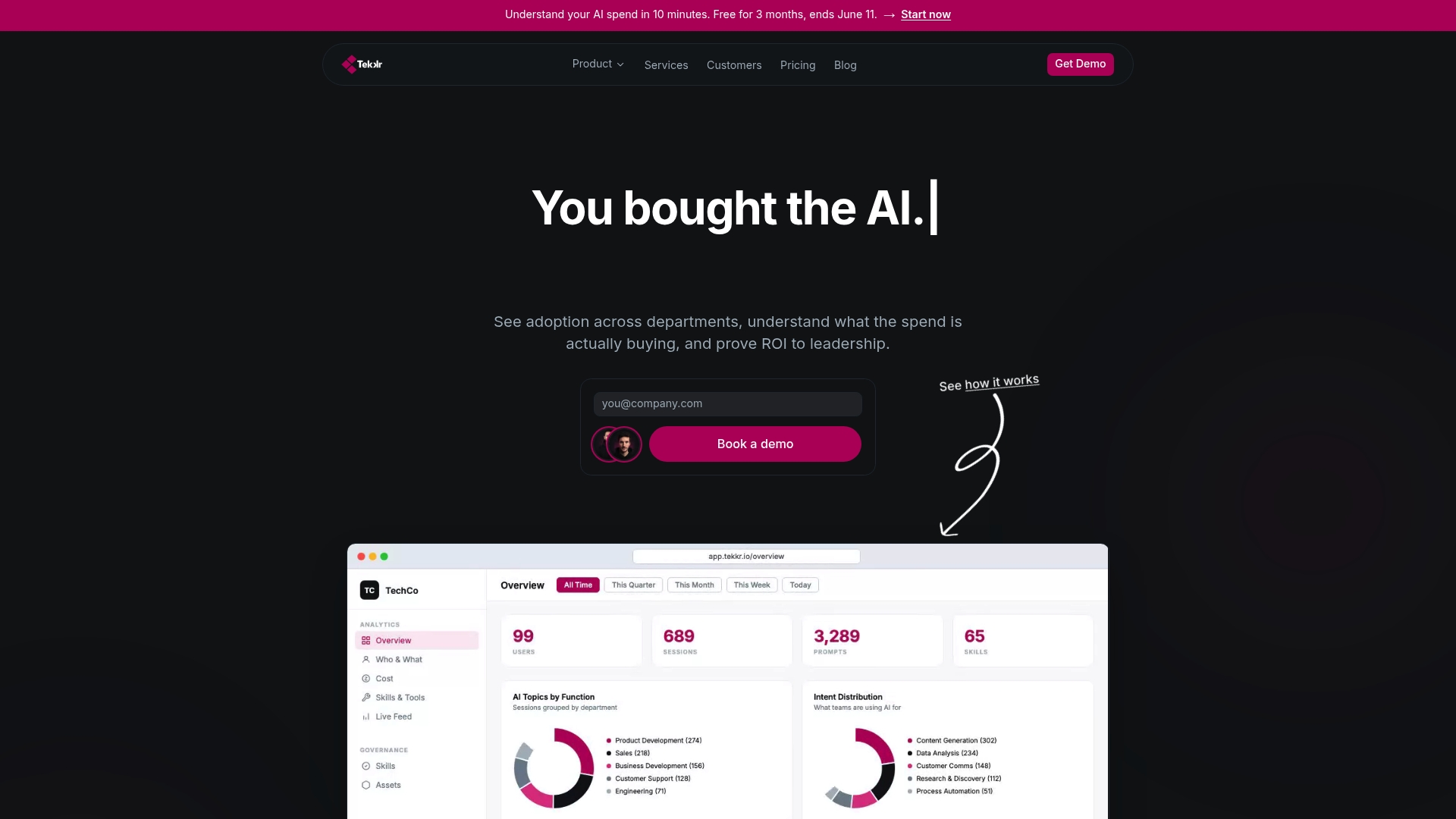
Tekkr’s Configurato platform gives business leaders the visibility they need to act. It tracks real AI adoption by team, breaks down costs by tool and department, and surfaces where usage is high but results are low. That combination tells you exactly where your bottlenecks are. Tekkr’s AI adoption consulting pairs that data with hands-on workflow redesign, so you are not just measuring the problem. You are fixing it. The Configurato product includes gamified rollouts and company-wide AI playbooks that drive adoption without requiring browser extensions or lengthy IT setup. A free tier is available with no credit card required.
FAQ
What are the most common types of AI productivity bottlenecks?
The most common types are workforce skill shortages, fragmented tool integrations, human verification delays, data silos, and misaligned organizational incentives. Each one limits AI effectiveness in a distinct way and requires a targeted fix.
Why do AI tools fail to improve productivity even when widely adopted?
90% of AI initiatives fall short because organizations focus on tool usage rather than redesigning roles, incentives, and workflows to match how AI actually operates.
How do data silos create AI workflow challenges?
Scattered data across CRM, ERP, and legacy systems gives AI tools inconsistent inputs, which produces unreliable outputs that require more human correction and slow down the entire process.
What is a verification bottleneck in AI workflows?
A verification bottleneck occurs when AI accelerates production tasks like drafting or coding but human review and approval steps remain unchanged, creating a backlog of work-in-progress that stalls overall throughput.
How can leaders start improving AI productivity in their organizations?
Start by tracking AI adoption metrics at the team level to identify where tools are underused or misaligned with workflows, then redesign those workflows before adding more AI capabilities.