
Choosing the wrong AI agent architecture is one of the most expensive mistakes a CTO can make right now. You roll out AI tools, adoption numbers look solid on dashboards, and then six months later you’re still waiting for the productivity lift to show up in the numbers. The problem usually isn’t the tool itself. It’s that the agent type deployed doesn’t match the complexity of the business process it was supposed to accelerate. Understanding how AI agent types differ, how they behave under real enterprise load, and how to match them to your workflows can be the difference between a transformative outcome and a very costly lesson.
Table of Contents
- How to evaluate AI agent types for enterprise needs
- The five core decision-behavior AI agents explained
- Complexity-based and advanced agent types
- Comparing agent types: Performance, reliability, and fit
- Why enterprise AI agent strategies must go beyond labels
- Get enterprise-ready: Analytics and governance for AI agent success
- Frequently asked questions
Key Takeaways
| Point | Details |
|---|---|
| Decision-behavior guides choice | Start with agent decision complexity, then add architecture to fit enterprise needs. |
| Advanced types boost scalability | Hierarchical and multi-agent designs enable robust automation for complex processes. |
| Learning is critical under load | Memory and experiential learning greatly improve performance as task complexity grows. |
| Governance and analytics matter | Operational success relies as much on monitoring and orchestration as on agent taxonomy. |
How to evaluate AI agent types for enterprise needs
Before you can choose the right agent, you need a reliable way to think about the options. The challenge is that “AI agent” means something different depending on who’s selling you something. Vendors use the term loosely. Research papers use it precisely. And your internal teams may use it in ways that blend both.
Enterprise-practical agent classification often differs from the theoretical five decision-behavior types because teams vary in whether they classify by architecture, orchestration complexity, or application role. That ambiguity is exactly where poor decisions get made. You end up evaluating agents on labels instead of on how they actually behave when embedded in your production environment.
The most reliable starting point is the Russell and Norvig decision-behavior framework, which organizes agents by how they process inputs and make decisions. This gives you five distinct categories:
- Simple reflex agents: Act on current input only, no memory
- Model-based reflex agents: Maintain internal state to make better decisions
- Goal-based agents: Plan multiple steps toward a defined objective
- Utility-based agents: Weigh trade-offs to optimize for the best outcome
- Learning agents: Improve over time based on feedback and experience
Beyond this foundational model, you also need to think about architectural patterns, specifically whether you’re deploying a single agent, a hierarchical structure, or a coordinated multi-agent system. Each pattern introduces different levels of orchestration complexity, which matters enormously when you’re managing compliance, data governance, and integration with legacy systems.
Building your evaluation criteria against decision-behavior first, then overlaying architecture and orchestration requirements, keeps you grounded in substance rather than marketing narratives. Use analytics and governance for AI assistants to track how deployed agents actually perform, not just how they were categorized at purchase.
Pro Tip: Always align evaluation criteria with your actual business processes and integration architecture before touching vendor documentation. The taxonomy should serve your workflow, not the other way around.
The five core decision-behavior AI agents explained
A commonly used classification for AI agent decision behavior follows the Russell and Norvig progression. Here’s what each type looks like in actual enterprise deployment, not in a textbook.
-
Simple reflex agents respond exclusively to their current input. No history. No context. If a condition is met, an action fires. These agents are useful for rule-based alerting, threshold monitoring, or basic intake routing. Think of a system that flags a support ticket as “urgent” the moment specific keywords appear. Fast and cheap to deploy, but brittle. They break the moment the input pattern changes.
-
Model-based reflex agents maintain an internal representation of the world, which means they can account for state. A workflow routing agent that tracks whether a previous step was completed before triggering the next one is operating in this category. These agents handle moderately complex automation without requiring explicit goal definition. They’re the workhorse of many enterprise operations today.
-
Goal-based agents go further by using defined objectives to guide multi-step decision-making. A ticket triage agent that researches the issue, identifies the right team, and drafts an initial response is goal-based. These agents are far more capable but require more careful design. You need to define what “success” looks like clearly, or the agent will optimize toward the wrong outcome.
-
Utility-based agents make trade-off decisions. Instead of just achieving a goal, they try to maximize a specific measure of value. Resource-aware scheduling is a strong example: an agent that balances meeting deadlines against compute costs against team capacity. These agents are powerful in dynamic environments, but they require well-designed utility functions. A poorly defined utility function produces outcomes that technically meet the criteria and completely miss the intent.
-
Learning agents improve through experience. They adapt based on feedback, new data, and updated requirements. Over time, a learning agent optimizing a document review workflow will get faster, more accurate, and more aligned with your team’s actual standards. These are the agents that create compounding value. They’re also the ones that require the most governance investment, because they can drift in ways that are hard to detect without monitoring.
The progression from simple reflex to learning agents represents increasing sophistication. For robust automation at scale, learning agents are not a luxury. They are a requirement.
The right agent for a given process depends on how dynamic that process is, how many steps it involves, and how much the definition of a good outcome changes over time. Mapping your processes against these five types before selecting tooling will save you significant rework downstream.
Complexity-based and advanced agent types
The five decision-behavior types describe how an agent thinks. But enterprise deployment also requires you to think about how agents are organized. Beyond the five decision-behavior types, some vendors propose complexity-based types that scale explicitly from single-function interactions to multi-agent collaboration.
The practical distinction breaks down into three structural patterns:
- Single-function agents: Handle one task, one input, one output. Fast, predictable, easy to govern.
- Hierarchical agents: An orchestrating agent coordinates subordinate agents, each handling a specific subtask. More powerful, but the orchestrator becomes a single point of failure.
- Multi-agent systems: Multiple agents operate in parallel or sequence, collaborating toward a shared goal. Highest potential output, highest orchestration risk.
Production agent designs are frequently implemented as orchestration loops, specifically a reason/plan phase, followed by act/tool calls, then observe, then repeat, with additional patterns like reflection and multi-agent coordination layered on top. This matters for enterprise teams because it means the architecture of your agent system determines its failure modes, not just its capabilities.
Here is a direct comparison across both frameworks:
| Dimension | Decision-behavior | Hierarchical | Multi-agent | Orchestration pattern | Business value | Example use case |
|---|---|---|---|---|---|---|
| Core logic | Reflex to learning | Delegation | Collaboration | ReAct, Reflection | Increases with complexity | Alert routing |
| State handling | Varies by type | Centralized | Distributed | Loop-based | Enables complex workflows | Document review |
| Governance surface | Minimal | Medium | High | Monitoring required | Risk scales up | Compliance automation |
| Failure mode | Input mismatch | Orchestrator failure | Coordination drift | Observability gaps | Depends on monitoring | Cross-team handoffs |
| Scaling path | Replace type | Add subordinates | Add agents | Extend loops | Compounding if governed | Enterprise ops |
| Integration complexity | Low to medium | Medium | High | Variable | Depends on architecture | API-connected workflows |
The governance and enterprise agent configuration and governance requirements scale sharply as you move toward multi-agent systems. The AI and cybersecurity impact conversation is directly relevant here: distributed agent systems expand your attack surface, introduce new data flow paths, and require explicit trust boundaries between agents.
Pro Tip: Multi-agent systems can unlock advanced automation and dramatically expand what’s possible. But they also introduce orchestration risk that basic monitoring setups are not equipped to catch. Invest in observability infrastructure before you scale agent count.
Comparing agent types: Performance, reliability, and fit
Now that the landscape is clear, the practical question is: which type fits which enterprise context? Empirical results suggest agent performance can degrade under multi-task load, and that memory and learning components can materially improve completion rates.

The CORPGEN research from Microsoft is striking. Learning-enabled systems achieved 3.5x better completion rates under multi-task load compared to basic agent designs. That’s not a marginal improvement. It’s the difference between an agent that helps at scale and one that becomes a bottleneck.
Here’s how the types stack up for enterprise deployment decisions:
| Agent type | Scalability | Reliability under load | Learning support | Best-fit scenario |
|---|---|---|---|---|
| Simple reflex | High | High (narrow inputs) | None | Alerting, static triggers |
| Model-based reflex | Medium-high | Medium | Minimal | Workflow routing, state-tracking |
| Goal-based | Medium | Medium (goal drift risk) | Limited | Ticket triage, multi-step tasks |
| Utility-based | Medium | Medium-high | Moderate | Resource scheduling, optimization |
| Learning | Medium (requires governance) | High (with monitoring) | Full | Complex, dynamic workflows |
| Multi-agent | Highest potential | Lower without observability | Full | Cross-functional automation |
Several key observations stand out from the research and from practical deployment patterns:
- Memory and state management are the most underinvested components in enterprise agent deployments. Teams choose the agent type but skip the architecture work that makes it reliable.
- Learning agents degrade without feedback loops. If you’re not capturing outcome data and feeding it back to the model, you’re running a static agent that happens to have a more expensive label.
- Orchestration patterns like ReAct (Reason and Act) and Reflection significantly improve agent adaptability in complex workflows, but they also require deliberate monitoring to catch runaway loops or reasoning errors.
- The highest-stakes workflows, compliance review, regulatory reporting, customer escalation, consistently need utility-based or learning agents because they involve dynamic trade-offs that reflex-based systems cannot handle.
The decision isn’t always “which type is most sophisticated.” It’s which type matches the actual variability, complexity, and stakes of the process you’re automating. Deploying a learning agent for a fixed-rule process is waste. Deploying a simple reflex agent for a dynamic compliance workflow is risk.
Why enterprise AI agent strategies must go beyond labels
Here’s the uncomfortable truth that most enterprise AI discussions avoid: the debate about agent types is mostly a distraction if you don’t have the architecture to back it up.
CTOs spend significant cycles deciding between agent taxonomies. Decision-behavior models versus application-role models versus complexity-based models. It sounds strategic. It usually delays the more important work. The organizations that are actually seeing returns from AI agents didn’t win because they picked the right label. They won because they built reliable memory layers, robust orchestration, and governance hooks into everything they deployed.
For CTOs and digital transformation leaders, a useful decision process starts with decision behavior: is this process reactive, stateful, goal-directed, utility-optimized, or learning-dependent? From there, you add enterprise-specific architecture requirements: what does memory need to look like, how will tools be orchestrated, what are the compliance and guardrail requirements? Application labels come last, if at all.
The next-level value in enterprise AI comes from building layered, composable systems. A single agent handling a narrow task is relatively easy to govern. A system where a learning orchestrator coordinates several goal-based subordinate agents, each with their own tool access and state management, is a fundamentally different operational challenge. Most enterprises are not ready for that challenge when they deploy it.
The teams that get this right share a common pattern: they treat monitoring and feedback infrastructure as a first-class deliverable, not a follow-on task. If your enterprise agent analytics and governance layer isn’t live before your agents go into production, you are flying blind. You won’t know if the agent is helping, drifting, or quietly creating downstream problems until it’s already expensive to fix.
Pro Tip: Invest as much in monitoring, analytics, and feedback mechanisms as you invest in selecting and deploying the agent itself. The architecture that surrounds the agent determines whether it compounds in value or compounds in technical debt.
The companies that outperform with AI agents are not the ones with the most sophisticated agent types on paper. They’re the ones that match agent complexity to process complexity, then govern the whole system rigorously. That’s the actual competitive lever.
Get enterprise-ready: Analytics and governance for AI agent success
Enterprise agent architectures demand more than smart selection. They require continuous analytics, real-time monitoring, and governance structures that scale as your agent footprint grows. Without visibility into how agents are actually performing across decision-behavior types and orchestration layers, you can’t optimize, you can’t audit, and you can’t course-correct before problems become expensive.
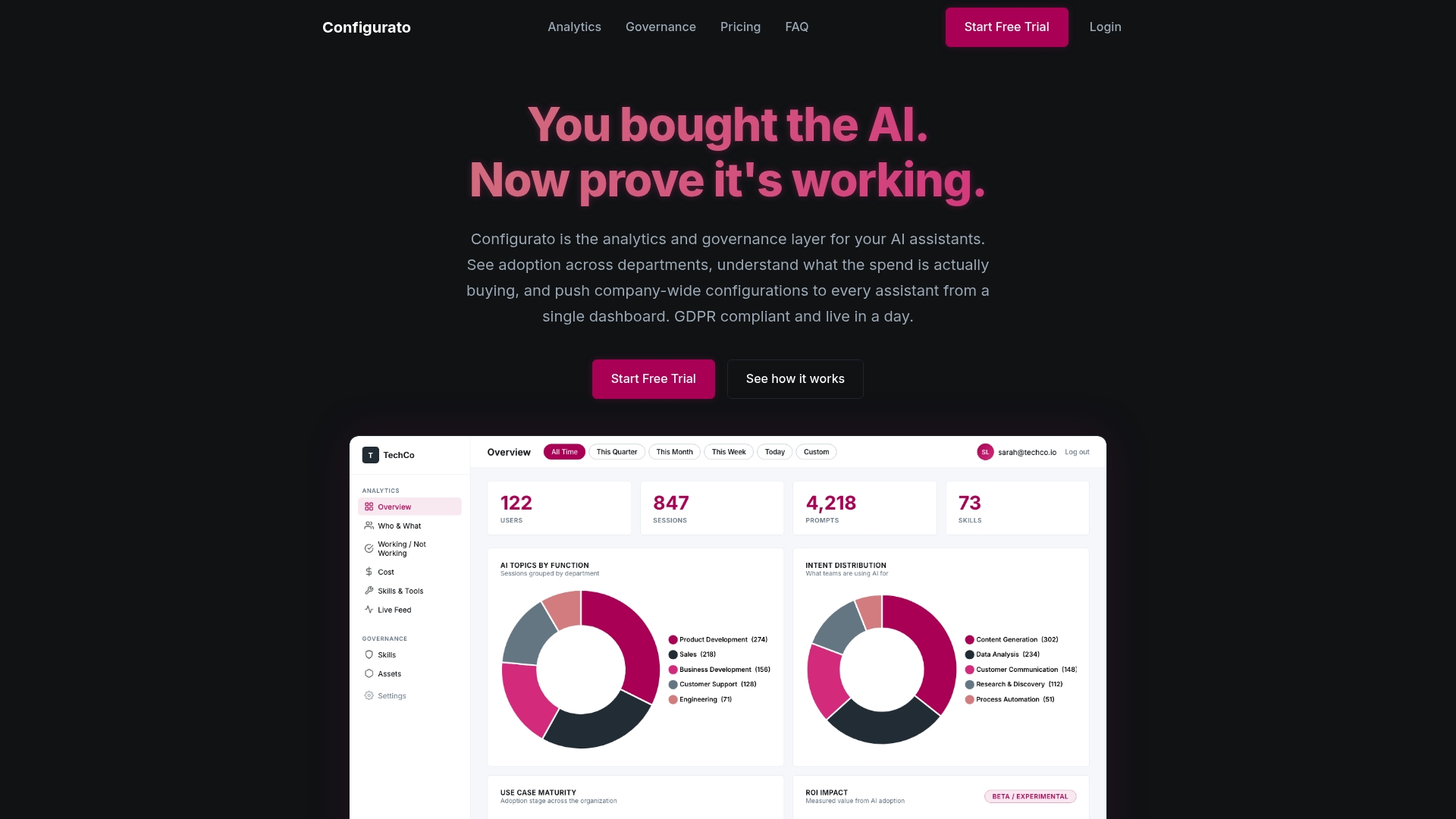
The Configurato platform is built for exactly this stage of the AI adoption journey. It gives digital transformation leaders the tools to trace where AI is accelerating work, where it isn’t, and what configuration changes will close the gap. Whether you’re managing simple reflex agents in operations or scaling toward multi-agent orchestration in complex workflows, Configurato provides the governance layer that keeps performance visible and aligned with your business standards. If you’re ready to move from deploying AI agents to actually getting results from them, this is where that work gets done.
Frequently asked questions
What is the most practical way to classify AI agent types for enterprises?
The best approach is to start with a decision-behavior framework (reactive, stateful, goal-based, utility-optimized, or learning), then layer in architecture and orchestration criteria specific to your context. Databricks recommends using this stable framework to avoid trend-driven taxonomies that shift with vendor marketing cycles.
Why does agent performance often decrease with added complexity?
Multi-task and multi-agent load can overwhelm basic designs that lack memory or learning components. Microsoft Research’s CORPGEN work showed that learning-enabled systems significantly outperformed basic agents under heavy multitasking conditions, achieving substantially better task completion rates.
How are orchestration patterns like ReAct and Reflection important for AI agents?
They help agents sequence reasoning and actions more reliably, improving adaptability and coordination in complex workflows. ReAct and Reflection are established design patterns for tool-using agents that need to handle multi-step tasks without losing coherence.
When should enterprises choose learning agents over simpler types?
Choose learning agents whenever your workflows are complex, dynamic, or require continuous improvement over time. Learning agents improve through experience and adapt to new data and requirements, which is essential for robust automation in any process where the definition of a good outcome shifts as the business evolves.