
Every executive has felt it: the pressure to move fast on AI while the landscape shifts weekly. New tools, new vendors, new promises. The real challenge isn’t finding an AI solution. It’s figuring out which use cases will actually move the needle for your organization, justify the investment, and scale beyond the pilot phase. This article cuts through the noise. You’ll get a practical evaluation framework, a deep look at the AI use cases enterprises are prioritizing in 2026, and a side-by-side comparison to help you make a confident, strategic decision.
Table of Contents
- How to evaluate and select AI use cases
- Customer service automation
- AI in predictive analytics and forecasting
- Smart process automation across business operations
- Comparing top AI use cases: Which delivers the most value?
- Our take: the companies that configure AI to their context will win
- Get more out of the AI you’ve already deployed
- Frequently asked questions
Key Takeaways
| Point | Details |
|---|---|
| Focus on business fit | Choose AI use cases that directly map to clear business objectives and pain points. |
| Leverage quick wins first | Start with use cases like customer service automation to show early results and build momentum. |
| Prioritize governance | Effective oversight and integration ensure AI deployments remain compliant and scalable. |
| Compare before you commit | A head-to-head analysis shows which AI investments align best with your strategic goals. |
How to evaluate and select AI use cases
Having framed the challenge, let’s start with how leaders can focus their AI investments effectively.
Most AI initiatives fail not because the technology is wrong, but because the selection process is. Teams chase what’s trending instead of what fits. They deploy a tool and then look for a problem to solve. That’s backward. The evaluation has to start with your business objectives.
The right framework asks four questions before any vendor conversation happens:
- Is there a clear, measurable business problem this AI use case solves?
- Do we have the data quality and volume to train or configure the model effectively?
- Can this solution scale across teams, regions, or business units without major rework?
- What are the governance, compliance, and risk implications if the AI produces an error?
These questions matter because they separate the use cases that deliver sustained value from the ones that look impressive in a demo and stall in production. ROI potential, data readiness, and scalability form the core evaluation axis. But risk management is just as important. Poorly governed AI in a regulated industry can create legal exposure that far outweighs any efficiency gain.
Cultural fit is the variable most organizations underestimate. A technically sound AI solution deployed into a team that doesn’t trust it, understand it, or want it will sit unused. Change management has to be built into the plan from day one, not bolted on after deployment. That means involving end users early, explaining how the tool changes their workflow, and demonstrating wins fast.
Pro Tip: Before scoring use cases on ROI, map them against your change management capacity. A high-ROI use case with low organizational readiness will underperform a moderate-ROI use case your teams are eager to adopt.
The governance dimension deserves specific attention. When you deploy AI at enterprise scale, you need clear policies on data handling, model updates, error remediation, and bias monitoring. Exploring AI governance strategies early in your planning prevents costly course corrections once systems are live. The organizations that move fastest on AI are often the ones that established governance guardrails before they started scaling.
Customer service automation
With criteria in mind, let’s dive into leading AI use cases executives prioritize, starting with customer experience transformation.
Customer service is the most mature AI use case in the enterprise, and for good reason. The economics are compelling, the technology is proven, and the impact is visible to customers in real time. Chatbots, virtual assistants, and AI-driven sentiment analysis have moved from experimental to standard operating infrastructure at most large organizations.
Here’s what modern customer service automation actually delivers:
- 24/7 availability without proportional headcount increases, resolving common queries instantly regardless of volume spikes
- Consistent, on-brand responses across every channel, eliminating the variance that occurs when dozens of agents interpret policy differently
- Faster resolution times, which directly improves Net Promoter Score (NPS) and customer retention
- Sentiment analysis that flags escalating customer frustration in real time, routing high-risk interactions to skilled human agents before they become complaints
- Significant cost reduction per interaction, typically ranging from 30 to 50 percent compared to fully human-staffed resolution
The real-world impact is substantial. Enterprises deploying AI-driven automation in customer support commonly report first-contact resolution rates improving by 20 to 30 percentage points within the first year. Response times that once took hours drop to seconds for tier-one queries.
“The goal isn’t to replace your support team. It’s to make sure your best human agents spend their time on the conversations that actually require human judgment, empathy, and expertise.”
That distinction is critical. The organizations seeing the best results aren’t the ones that automated everything. They’re the ones that mapped their query types carefully, automated the high-volume, lower-complexity interactions, and preserved human-in-the-loop handling for anything involving sensitive data, complex decision-making, or emotionally charged situations.
Pro Tip: Run a query classification exercise before deploying any customer service AI. Categorize your incoming contacts by complexity and frequency. The top 20 percent of query types typically account for 60 to 70 percent of volume. Automate those first, measure the impact, and expand from there.
AI in predictive analytics and forecasting
Beyond external-facing automation, AI drives transformation in enterprise analytics.

If customer service automation is the most visible AI use case, predictive analytics is often the most strategically valuable. This is where AI stops being a support tool and starts functioning as a competitive advantage embedded in how you make decisions.
The core applications include:
- Sales forecasting with accuracy rates significantly higher than traditional statistical models, reducing the revenue planning variance that creates misaligned resource allocation
- Inventory and supply chain optimization, where AI models analyze hundreds of variables simultaneously to reduce both overstock and stockout scenarios
- Customer churn prediction, enabling proactive retention outreach before customers have decided to leave
- Risk prediction in financial services, insurance, and healthcare, where early identification of adverse outcomes has direct financial and regulatory implications
- Workforce demand forecasting, helping HR and operations teams plan headcount and scheduling with greater precision
| Use case | Primary benefit | Typical accuracy improvement | Implementation complexity |
|---|---|---|---|
| Sales forecasting | Better revenue planning | 20 to 40 percent over baseline | Medium |
| Inventory optimization | Reduced waste and stockouts | 25 to 35 percent cycle improvement | Medium to High |
| Churn prediction | Improved retention spend | 15 to 30 percent lift in retention | Medium |
| Risk modeling | Faster, more accurate decisions | Varies by domain | High |
| Workforce planning | Optimized staffing levels | 10 to 20 percent efficiency gain | Low to Medium |
What makes AI models powerful in this context is their ability to detect patterns that are genuinely too complex for traditional analytics. A regression model might capture five or six variables when predicting churn. A machine learning model can process hundreds of behavioral signals simultaneously, weighing their interactions in ways no human analyst could replicate at scale.
The governance question matters here too. When AI predictions drive high-stakes decisions, such as credit approvals, clinical recommendations, or large procurement commitments, you need clear accountability for governing AI predictions and validating model outputs against real-world results. Models drift. Business conditions change. A forecasting model trained on pre-pandemic demand patterns will underperform without ongoing recalibration.
The enterprises getting the most value from predictive analytics treat model governance as a continuous process, not a one-time deployment task.
Smart process automation across business operations
AI’s internal impact extends further when automating multi-step and regulatory-compliant processes.
Back-office and operational processes represent one of the largest untapped AI opportunities in most enterprises. Document processing, employee onboarding, invoice management, contract review, compliance reporting: these are high-volume, rules-driven workflows that consume enormous amounts of skilled human time and introduce error risk at every manual handoff.
AI-enabled process automation approaches these challenges through a stepwise architecture:
- Detection. AI identifies the document type, transaction category, or workflow trigger, classifying the input correctly before any processing begins.
- Extraction. Relevant data fields are pulled from unstructured inputs, whether that’s a scanned invoice, a contract PDF, or an HR form submitted through a portal.
- Validation. The extracted data is checked against business rules, compliance requirements, and existing records to flag discrepancies before they move downstream.
- Execution. Approved transactions or decisions are pushed directly into ERP, HRIS, or other enterprise systems, eliminating manual data entry.
- Audit and logging. Every action is recorded with a traceable audit trail, which is essential for regulatory compliance in finance, healthcare, and other governed industries.
The benefits compound quickly. Error rates on manual data entry in finance processes average between 1 and 4 percent. That sounds small until you apply it to tens of thousands of invoices per month. Cycle times for invoice approval, which traditionally take 10 to 15 days in many enterprises, can compress to under 48 hours with well-configured AI automation. Compliance assurance improves because the AI applies rules consistently, every time, without the fatigue or distraction that affects human reviewers.
Connecting these workflows to a broader process optimization with AI strategy ensures that individual automations don’t become siloed tools. The goal is an interconnected set of automated processes that share data, respect governance rules, and produce an auditable record of every decision.
Pro Tip: Data privacy is a serious consideration when automating processes that handle employee records, financial data, or customer personally identifiable information. Before deployment, conduct a data classification audit and confirm that your AI tooling meets the relevant regulatory standards for your industry and geography.
Comparing top AI use cases: Which delivers the most value?
Having reviewed each use case individually, compare them to see which aligns best with your enterprise priorities.
The honest answer is that there is no single best AI use case. The right choice depends on your industry, your current data maturity, your organizational readiness, and where operational drag is costing you the most. That said, comparing the use cases side by side helps clarify the tradeoffs.
| AI use case | Business impact | Implementation complexity | Time to measurable ROI | Best fit |
|---|---|---|---|---|
| Customer service automation | High | Low to Medium | 3 to 6 months | B2C, high-volume support environments |
| Predictive analytics | Very High | Medium to High | 6 to 12 months | Data-rich industries: retail, finance, logistics |
| Process automation | High | Medium | 4 to 9 months | Ops-heavy organizations with manual back-office |
A few practical guidelines for choosing where to start:
- If your biggest pain point is customer experience and support costs, customer service automation offers the fastest path to visible ROI with relatively lower deployment risk.
- If you operate in a data-intensive industry and your competitive edge depends on faster, more accurate decisions, predictive analytics deserves priority investment even with the longer runway to results.
- If your operations are drowning in paper-based or manual processes, and your compliance burden is growing, process automation delivers efficiency and risk reduction simultaneously.
- If you’re unsure where to start, run a rapid discovery sprint: audit your top five operational bottlenecks, score them on data readiness and business impact, and let the data guide the first pilot.
Across all three categories, adoption rates for enterprise AI are rising sharply. Organizations that have moved past pilots and into production deployments consistently report that the barrier isn’t the technology. It’s the quality of implementation, the specificity of the configuration to their processes, and the rigor of their governance framework.
Our take: the companies that configure AI to their context will win
Most of the AI implementation conversation focuses on tool selection. Which model. Which vendor. Which platform. That’s understandable but mostly beside the point.
The real differentiator in 2026 is not which AI tool you choose. It’s how well you configure that tool to reflect how your organization actually works. Two companies can deploy the same AI assistant for product management. One will see generic output that needs heavy editing. The other will see first drafts that already follow their product development lifecycle, their quality gates, and their naming conventions. The difference isn’t the tool. It’s the context the tool has access to.
This is the problem most enterprises are sitting inside right now without quite naming it. Adoption metrics look fine. Usage is up. But the competitive advantage hasn’t materialized because employees are prompting AI generically, ignoring company context, and spending as much time reworking outputs as they saved generating them.
The organizations that will pull ahead are the ones that treat AI configuration as a strategic priority on par with tool selection. That means codifying what great work looks like in your organization and making that knowledge available to your AI systems at the point of execution, not just in a training deck that employees may or may not read. It means measuring where AI is actually accelerating work and where it isn’t, and using that data to improve continuously.
The companies that win with AI won’t be the ones that deployed the most tools. They’ll be the ones that taught their AI how they work.
Get more out of the AI you’ve already deployed
If your organization has rolled out AI tools but isn’t seeing the productivity leap you expected, you’re not alone. The gap between adoption and impact is real, and it’s solvable.
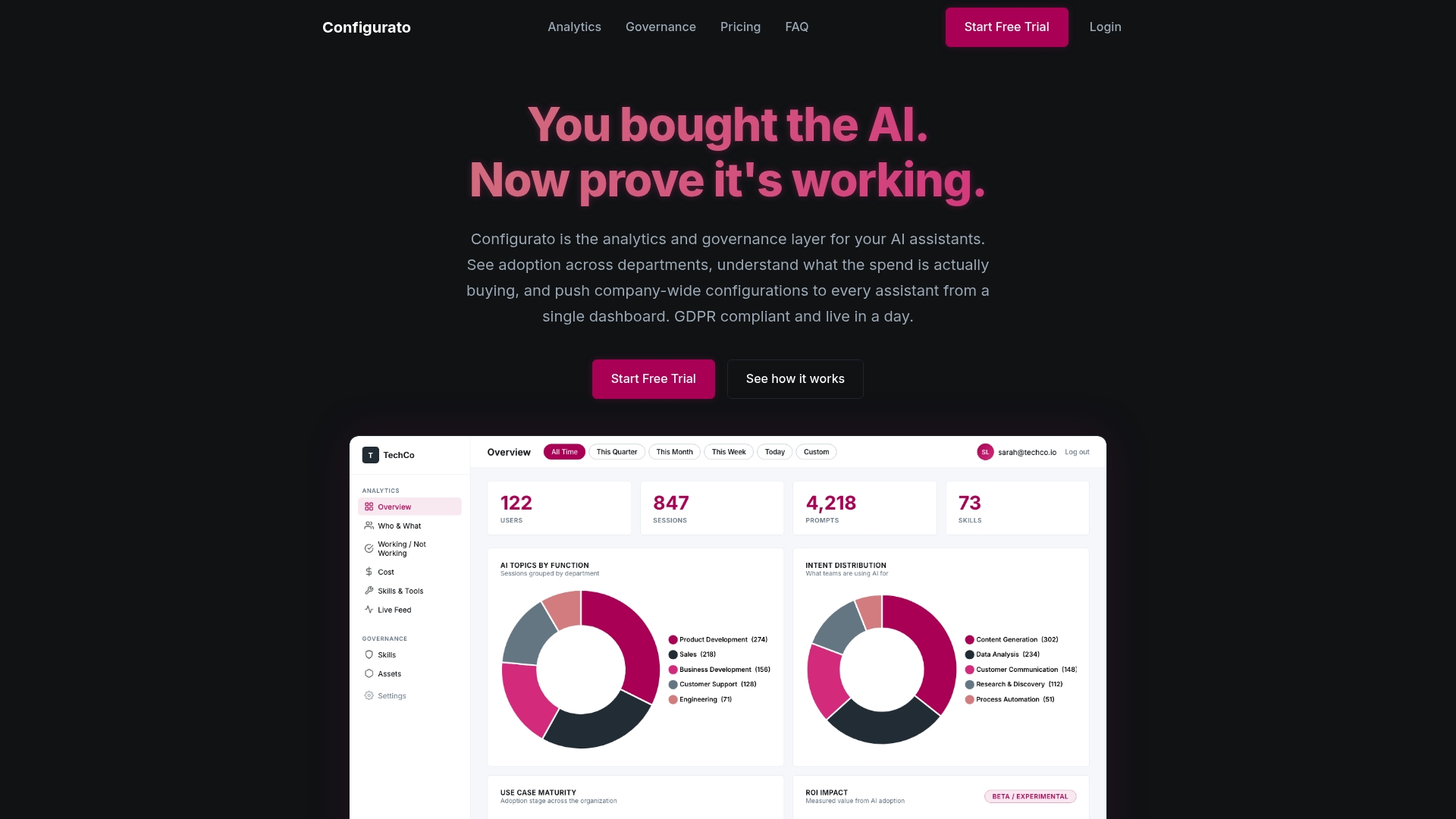
Tekkr Configurations embeds your company’s processes, quality standards, and domain knowledge directly into the AI assistants your people already use. No new tools. No retraining. Just AI that works like it already knows how your organization operates. When your product manager asks for a spec, the output reflects your PDLC. When your finance team processes invoices, the AI follows your approval rules. Visit Tekkr to see how leading enterprises are closing the gap between AI adoption and real competitive advantage.
Frequently asked questions
What is the fastest AI use case to implement in large enterprises?
Customer service automation via chatbots or virtual assistants is typically the fastest to deploy, with many enterprises seeing measurable ROI within three to six months of go-live.
How do I assess the ROI of an AI solution?
Start by establishing baseline metrics for the process you’re automating, project the efficiency gains based on comparable deployments, and factor in ongoing maintenance and governance costs to calculate your payback period accurately.
Are there regulatory risks when adopting AI for process automation?
Yes, particularly in finance, healthcare, and any industry handling personal data. Compliance and data privacy requirements must be addressed upfront through clearly defined governance frameworks before any automated process goes live.
Can AI solutions scale with business growth?
Modern cloud-based AI platforms are architected for elastic scaling, allowing organizations to expand from a focused pilot in one department to enterprise-wide deployment without rebuilding the underlying infrastructure.