
Leadership is the single most decisive factor in whether AI adoption delivers competitive advantage or stalls at the pilot stage. Most organizations have deployed AI tools. Few have deployed the leadership behaviors that make those tools produce real business value. The role of leadership in AI adoption goes far beyond approving budgets or naming an AI task force. It means owning the strategy, embedding governance, building trust, and connecting every AI initiative to a measurable outcome. This guide gives you the frameworks and behaviors to do exactly that, drawing on research from Bain and Company, the OECD.AI Governance Playbook, and the Center for Creative Leadership.
What are the key leadership strategies that drive effective AI adoption?

AI-enabled transformation starts and stops with the CEO. That is not a motivational claim. It is an operational reality. CEOs who dedicate 15 to 25% of their time to AI initiatives significantly improve adoption outcomes and business results. That level of personal investment signals organizational priority in a way that no memo or budget line can replicate.
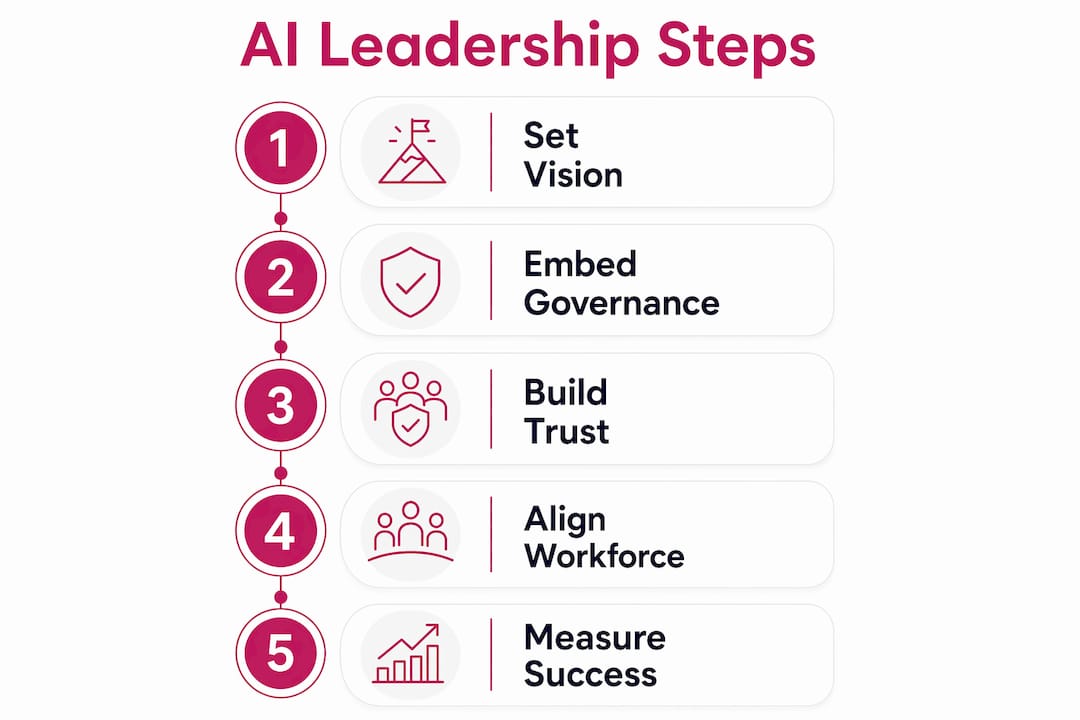
Effective AI integration leadership requires five concrete behaviors from the top:
-
Anchor every AI initiative in a specific business outcome. “We are deploying AI to reduce contract review time by 40%” is a strategy. “We are exploring AI” is not. Vague mandates produce vague results.
-
Create an AI-first mindset across the organization. This means modeling AI use yourself, asking for AI-assisted analysis in executive reviews, and rewarding teams that experiment rather than teams that play it safe.
-
Give explicit permission to experiment and fail. Most employees will not touch AI tools if they fear being judged for imperfect output. Your job is to remove that fear by naming it publicly and protecting people who try.
-
Remove structural barriers to scale. Fragmented budgets, siloed data, and unclear ownership are the three most common reasons AI pilots never expand. Scaling AI requires CEOs to actively centralize resources and bridge technical and cultural divides.
-
Measure and communicate progress. Pick three to five adoption metrics, report them at the leadership level, and treat AI performance the same way you treat revenue performance.
Pro Tip: Set a personal AI use goal for yourself before you set one for your organization. If you are not using AI tools in your own workflow, your credibility as an AI champion is limited from day one.
How does leadership embed AI governance into organizational strategy?
Governance is not a compliance checkbox. Embedding governance operationalizes responsible AI use and converts it into a strategic advantage. The OECD.AI Governance Playbook identifies four areas where governance must be embedded, not bolted on:
- Strategy: Define which AI use cases are approved, which are prohibited, and who has authority to expand the list.
- Risk and compliance: Map AI decisions to existing regulatory frameworks, including the EU AI Act and the NIST AI Risk Management Framework, and assign clear accountability for each risk category.
- Workforce readiness: Treat AI literacy as a governance requirement, not a training perk. Employees who do not understand how AI makes decisions cannot catch errors or escalate concerns.
- Operational management: Governance that scales is integrated into day-to-day decision-making, not treated as a separate audit cycle.
The table below shows how each governance area maps to a leadership action and a measurable indicator:
| Governance area | Leadership action | Measurable indicator |
|---|---|---|
| Strategy | Approve and publish AI use case registry | Number of approved use cases reviewed quarterly |
| Risk and compliance | Assign risk owners per AI system | Percentage of AI systems with named accountability |
| Workforce readiness | Mandate role-based AI literacy training | Completion rate and assessment scores by function |
| Operational management | Embed AI review into existing management cadences | Frequency of AI performance reviews in team meetings |
Executive sponsorship is what keeps governance alive between audits. Assign a named executive to each major AI deployment. That person is accountable for output quality, ethical risk, and course correction. Without a named owner, governance degrades into paperwork.
Why is trust critical in AI adoption, and how can leaders strengthen it?
Trust and AI transformation are intertwined. AI adoption tests the very trust foundations it depends on. Employees worry about job displacement, surveillance, and whether leadership is being straight with them. If you do not address those concerns directly, they will surface as passive resistance, low adoption rates, and quiet disengagement.
The Center for Creative Leadership identifies three trust dimensions that leaders must actively manage throughout AI adoption:
- Capability trust: Employees need to believe you know what you are doing. This means demonstrating your own AI learning, bringing in credible expertise, and being honest when you do not have all the answers yet.
- Communication trust: Transparency is not a one-time town hall. It is a continuous practice. Share what AI is being used for, what data it touches, and what decisions it influences, before employees hear it through the grapevine.
- Character trust: People need to believe your intentions are genuine. If AI is being deployed to reduce headcount, say so. Discovering that truth later destroys trust far more than the news itself would have.
Trust-building must be planned as a continuous operational process, not a one-time communication event. Involve employees in AI pilot design. Let them name the problems AI should solve in their workflows. Give them a formal channel to report concerns without fear of retaliation.
Pro Tip: Run a “trust audit” at the 90-day mark of any major AI deployment. Ask employees three questions: Do you understand how this AI tool works? Do you trust the output it produces? Do you believe leadership is being transparent about its purpose? The answers will tell you exactly where your trust gaps are.
How do leaders align AI deployment with workforce readiness?
Designing AI workflows around how employees actually operate is the difference between adoption that sticks and adoption that looks good in a dashboard. Generic AI training produces generic AI use. Role-based, functional training tied directly to intended outcomes produces measurable productivity gains.
The comparison below shows the difference between low-readiness and high-readiness AI deployment:
| Deployment approach | Low readiness | High readiness |
|---|---|---|
| Training design | Generic AI literacy course | Role-specific, workflow-integrated training |
| Use case definition | Broad (“use AI for productivity”) | Specific (“use AI to draft first-pass RFPs in under 20 minutes”) |
| Adoption measurement | Login rates and license usage | Repeat use, output quality, cycle time reduction |
| Employee feedback loop | Annual survey | Bi-weekly check-in tied to AI workflow changes |
Follow this sequence to build genuine workforce readiness:
- Map the actual workflow before you introduce AI. Understand where time is lost, where quality varies, and where employees feel the most friction.
- Define the specific AI use case for each role. A product manager’s AI use case is not the same as a finance analyst’s. Treat them differently.
- Train on outcomes, not tools. Teach employees what good AI output looks like for their specific work, not just how to open the interface.
- Track adoption signals and performance signals separately. Adoption signals tell you if people are using the tool. Performance signals tell you if it is working. You need both.
- Incorporate employee experience data. Burnout from poor AI integration is a real risk. If employees are spending more time correcting AI output than they saved using it, the workflow design is broken.
AI investments deliver value when tied to specific business outcomes and integrated into key workflows. That integration is a leadership design decision, not a technology decision.
What are common leadership pitfalls in AI adoption, and how can you avoid them?
Most AI adoption failures trace back to leadership behavior, not technology limitations. 78% of CEOs say AI could cost them their job and their company’s future, yet many still underinvest in the leadership behaviors that determine success. That gap is where transformations collapse.
The most common pitfalls are:
- Underestimating the required time commitment. A 15 to 25% CEO time investment is not optional. Delegating AI strategy entirely to a Chief AI Officer or CTO without active executive engagement produces orphaned initiatives.
- Neglecting governance until a crisis forces it. Ethical risk increases when automation outpaces leaders’ ability to maintain accountability. Governance built reactively is governance built under pressure, and it shows.
- Overlooking the emotional impact on your workforce. Employees are not neutral about AI. They have fears, questions, and opinions. Ignoring those responses does not make them go away. It makes them louder.
- Running fragmented AI initiatives without strategic coherence. When every department launches its own AI project with its own tools, standards, and metrics, you get activity without progress. The CEO’s job is to impose coherence.
- Failing to connect AI use to measurable business outcomes. Adoption metrics without performance metrics tell you nothing useful. If you cannot show the business impact, you cannot justify the investment or the organizational change it requires.
The fix for all five pitfalls is the same: treat AI adoption as a cross-functional initiative with CEO-level ownership, not a technology project with executive sponsorship in name only.
Key takeaways
Effective AI adoption is a leadership problem before it is a technology problem, and executives who own the strategy, governance, and trust dimensions of AI integration outperform those who delegate it.
| Point | Details |
|---|---|
| CEO time investment matters | Dedicating 15 to 25% of CEO time to AI initiatives measurably improves adoption outcomes. |
| Governance must be embedded | Assign named accountability per AI system and integrate oversight into existing management cadences. |
| Trust requires continuous effort | Plan trust-building as an ongoing operational process, not a single communication event. |
| Workforce readiness is role-specific | Generic AI training produces generic results; tie training directly to role-specific workflows and outcomes. |
| Pitfalls are leadership failures | Fragmented initiatives, neglected governance, and ignored employee concerns are executive decisions, not technology failures. |
What I have learned about leading AI transformation
The executives who get AI adoption right share one trait: they are genuinely curious, not just strategically committed. They use the tools themselves. They ask uncomfortable questions about what the AI is actually doing. They treat governance as a design challenge, not a legal obligation.
The ones who struggle tend to believe that naming an AI leader and approving a budget is sufficient ownership. It is not. AI transformation is a contact sport for the C-suite. The leadership influence on AI outcomes at any organization is directly proportional to how much senior leaders are personally engaged with the work, not just the results.
What I find most underappreciated is the trust dimension. Leaders consistently underestimate how much their workforce is watching them during AI rollouts. Every decision about transparency, every moment of visible accountability, and every instance of honest communication about uncertainty either builds or erodes the trust that makes transformation possible. You cannot separate the human leadership work from the AI strategy work. They are the same work.
The organizations that will win with AI are not the ones with the most tools or the biggest AI budgets. They are the ones where leadership has done the harder work of building the culture, governance, and trust infrastructure that lets AI actually perform. That is not a technology investment. It is a leadership investment.
— TekkrTools
How Tekkr helps leaders close the AI adoption gap
Most executives discover too late that their AI adoption numbers look healthy while the actual productivity gains are nowhere to be found. Employees are using the tools, but prompting generically, ignoring company context, and reworking output that should have been right the first time.
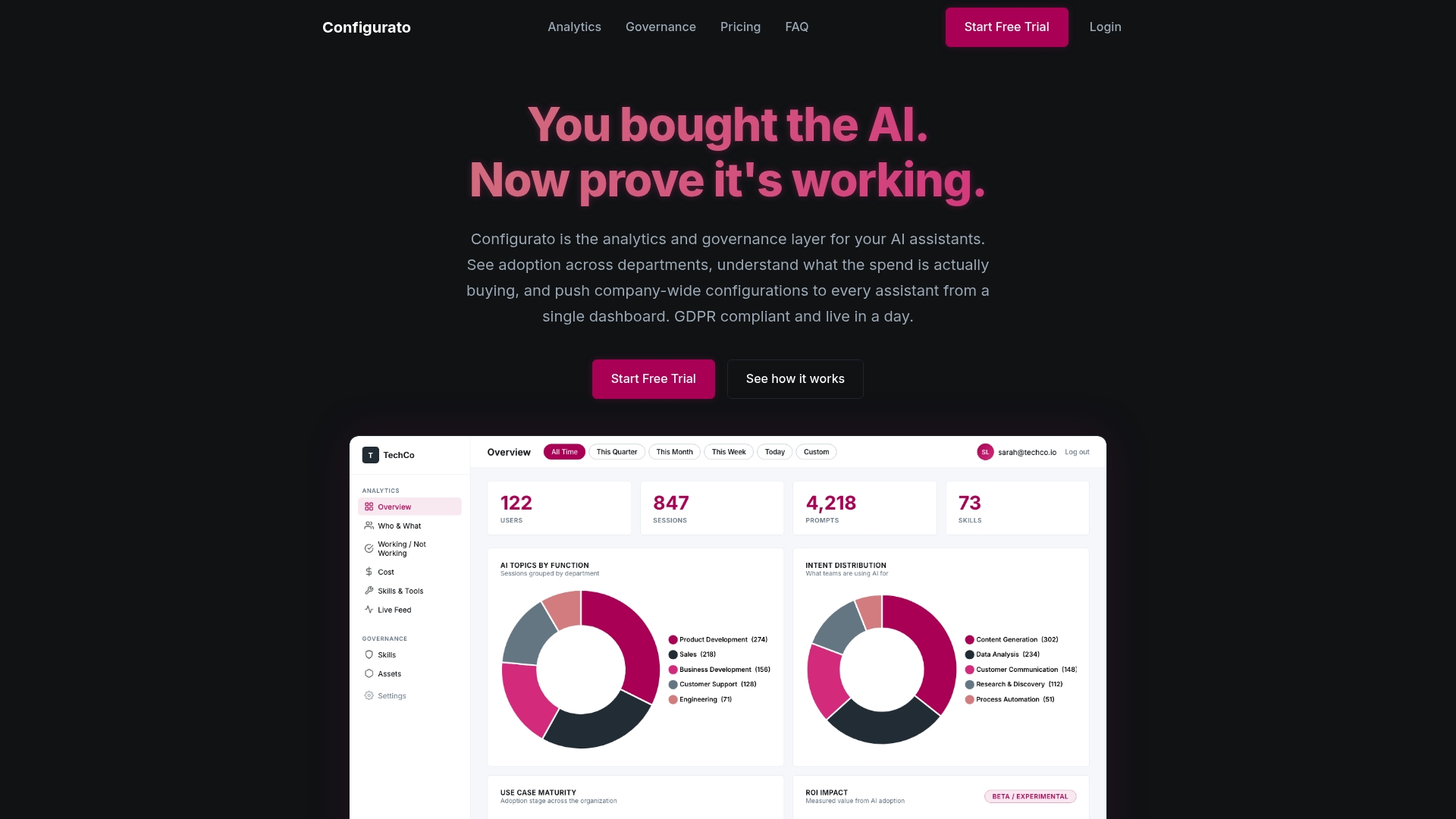
Tekkr’s AI governance and analytics platform gives you the visibility and control to change that. Tekkr embeds your company’s processes, quality standards, and domain knowledge directly into the AI assistants your teams already use, across Claude, GPT, Copilot, and Gemini. You can track where AI is genuinely accelerating work and where it is not, with the data infrastructure to benchmark your adoption against high-performing organizations. No new tools for your employees. No retraining. Just AI that already knows how your company operates.
FAQ
What is the role of leadership in AI adoption?
Leadership sets the strategy, governance, and culture that determine whether AI tools produce real business value or remain underused. CEOs who dedicate 15 to 25% of their time to AI initiatives significantly improve adoption outcomes and measurable results.
How does CEO ownership affect AI integration outcomes?
Active CEO ownership removes structural barriers, centralizes resources, and signals organizational priority in a way that delegated AI programs cannot replicate. Without it, AI initiatives remain fragmented and fail to scale beyond pilots.
Why does trust matter so much in AI transformation?
Trust is the infrastructure that enables employees to adopt, use, and honestly report on AI tools. Leadership behaviors around transparency, communication, and visible accountability either build or erode that trust throughout the adoption process.
How should leaders measure AI adoption success?
Track both adoption signals (repeat use, license utilization, workflow integration) and performance signals (cycle time reduction, output quality, rework rates). Adoption metrics alone tell you people are using the tool, not whether it is working.
What governance frameworks should executives use for AI?
The OECD.AI Governance Playbook and the NIST AI Risk Management Framework both provide structured approaches to embedding governance across strategy, risk, workforce readiness, and operations. Assign named executive accountability to each AI system rather than treating governance as a centralized audit function.