
Most business leaders know AI matters. Far fewer understand what it actually does in a digital transformation. The default assumption is that AI means automation: faster processes, fewer manual steps, reduced headcount. That framing misses most of the value. The real role of AI in digital transformation is reshaping how organizations compete, create, and grow. Getting that distinction right separates companies that see marginal efficiency gains from the ones building durable competitive advantage.
Table of Contents
- Key Takeaways
- AI maturity and what it means for transformation outcomes
- Operating model redesign: the thing leaders skip
- AI’s real impact on workforce productivity
- Practical AI use cases that actually drive transformation
- My take: automation is the floor, not the ceiling
- How Tekkr helps you close the transformation gap
- FAQ
Key Takeaways
| Point | Details |
|---|---|
| AI maturity determines ROI | Organizations at higher AI maturity levels outperform basic automation adopters across growth and financial KPIs. |
| Operating model redesign is non-negotiable | Data silos and inconsistent governance block AI scaling; redesigning your operating model unlocks real value. |
| Productivity gains take time | AI productivity improvements require complementary investments in skills and process change before they materialize fully. |
| Automation is not transformation | True AI-driven transformation includes new business models, revenue streams, and innovation. Not just cost reduction. |
| Governance enables scale | Without clear data controls, decision rights, and traceability, AI use cases pile up in a backlog and stall. |
AI maturity and what it means for transformation outcomes
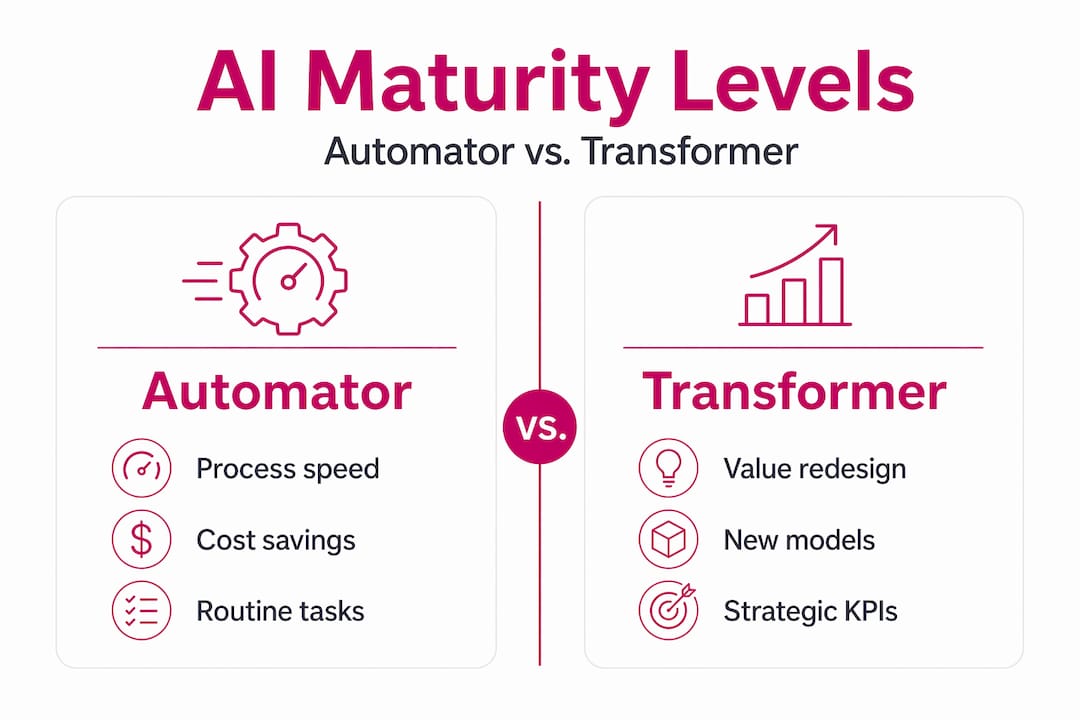
There is a meaningful difference between organizations that use AI and organizations that are transformed by it. Deloitte research segments these into two distinct personas: Automators and Transformers.
Automators deploy AI to replicate existing processes faster. Think document processing, customer service routing, and data entry. These are real efficiency wins. But they rarely change the competitive structure of a business.
Transformers operate differently. They use AI to redesign how value is created and delivered, across products, business models, and customer experiences. The results reflect that ambition. 72% of Transformers reported the highest AI and generative AI ROI, outperforming Automators by five percentage points. That gap compounds over time.

What separates these groups is not which AI tools they buy. It is how they invest around AI. Transformers invest broadly across cloud platforms, modern data environments, and connectivity infrastructure. They treat AI as one component of a broader technology ecosystem, not as a standalone solution.
The KPIs they track are also different:
- Automators measure cost reduction and efficiency ratios
- Transformers measure growth, new product revenue, customer lifetime value, and innovation velocity
If your AI dashboard only shows cost savings, you are operating as an Automator. That is fine as a starting point. It is a problem as an endpoint.
| Maturity Level | Primary Focus | KPIs Tracked | Typical Outcomes |
|---|---|---|---|
| Automator | Process efficiency | Cost reduction, cycle time | Marginal savings, limited scale |
| Transformer | Business model redesign | Growth, innovation, revenue | New markets, higher ROI |
Pro Tip: Before your next AI investment review, ask whether your KPIs measure what you are creating or only what you are saving. That one question will expose whether you are building a transformation or just cutting costs.
Operating model redesign: the thing leaders skip
Scaling AI is not a technology problem. It is an organizational one. Most companies discover this too late. They run successful AI pilots, generate real results in controlled environments, then watch adoption stall when they try to go broader.
The reason is almost always the same. Inconsistent platforms and governance create a backlog of AI use cases that cannot be prioritized or deployed safely. Data lives in silos. Decision rights are unclear. Controls are inconsistent across teams. The result is that AI sits at the edge of the organization rather than running through the middle of it.
Redesigning your operating model to support AI at scale requires changes across four dimensions:
- Data governance: Define who owns data, how it is classified, and how it flows across systems. AI is only as good as the data it works with. Garbage in, garbage out is not just a cliché.
- Decision rights: Clarify which decisions AI can make autonomously, which require human review, and which are off-limits for AI involvement entirely.
- Workflow integration: Redesign job roles and team processes so AI assistance is embedded in daily work, not bolted on as an afterthought.
- Control frameworks: Build audit trails, monitoring protocols, and escalation paths. Regulators and customers expect accountability.
The emergence of agentic AI makes this even more critical. AI increasingly performs routine actions while humans shift toward oversight and strategic judgment. That changes the nature of almost every knowledge worker role. Your operating model needs to reflect that shift or you will end up with AI systems and human processes that conflict rather than collaborate.
A useful starting point is mapping your current AI use cases against your governance capabilities. Where the gap is largest, that is where to redesign first.
Pro Tip: Treat operating model redesign as a prerequisite for AI scaling. If you try to scale AI on top of broken processes and siloed data, you are not accelerating transformation. You are accelerating the mess.
For organizations exploring scalable AI architecture, the platform consistency piece deserves particular attention early in the redesign.
AI’s real impact on workforce productivity
The productivity story around AI is more nuanced than the headlines suggest. Yes, people are saving time. But the mechanism matters for how you plan.
Global generative AI usage reached 17.8% of the working-age population in Q1 2026. Adoption is real and growing. And individual time savings are measurable. In Canada, for example, AI adoption quadrupled from 3% to 12% between 2022 and 2025. Among workers using AI, 57% reported saving one to two hours per day. Another 22% saved three to five hours. Doctors specifically saved three to four hours weekly on routine paperwork.
Those are significant numbers. But here is the catch:
Productivity gains from AI adoption require patience and organizational change. Focus on measurable workload savings and process integration over expecting immediate macro results.
Research from Statistics Canada found no statistically significant direct association between AI adoption alone and productivity at the firm level, once you control for complementary capabilities. The gains require skills investment, process redesign, and data enablement to fully materialize.
This is the diffusion lag problem. Organizations deploy AI tools and expect the productivity curve to shift immediately. When it does not, they conclude AI is overhyped. The more accurate conclusion is that they skipped the complementary work.
There is also a counterintuitive story happening in software development. Git pushes rose 78% year over year globally, and U.S. developer employment reached a record 2.2 million in 2025, up 8.5%. AI coding tools did not reduce developer headcount. They amplified developer output, which drove demand for more developers. That is AI and digital innovation working as it should: expanding what is possible, not just reducing what it costs.
The practical guidance for leaders is straightforward. Frame productivity goals in operational terms, not financial ones. Start by measuring workload changes: tasks completed per week, review cycles shortened, first-draft quality improved. Build the case internally before extrapolating to revenue impact.
Practical AI use cases that actually drive transformation
Understanding where AI creates the most leverage helps you prioritize. Not all use cases are equal, and the ones that look impressive in demos often underperform in production, while more unglamorous applications quietly compound value.
Here is how AI applications map across maturity levels:
| Use Case Category | Automator Application | Transformer Application |
|---|---|---|
| Customer experience | Chatbot for FAQ resolution | Personalized journey orchestration |
| Product development | Automated testing | AI-assisted spec generation and ideation |
| Operations | Invoice processing, data entry | Predictive supply chain optimization |
| Revenue growth | Cost-reduction modeling | New digital product and platform creation |
| Decision support | Reporting dashboards | Real-time scenario modeling |
74% of Transformers allocate 21 to 50% of their digital budget to monetization, pursuing new business models and platform strategies rather than just cost containment. That is the signal worth following.
A few principles that actually work when integrating AI into your strategy:
- Start with use cases that have clean data, clear ownership, and measurable outputs. Success here builds organizational confidence for harder problems.
- Treat AI as a co-creator in knowledge work, not just a processor. The value in writing, analysis, and planning workflows comes from AI generating first drafts that humans refine. That is faster than starting from scratch.
- Design for feedback loops. AI systems improve with data. Build workflows that capture output quality signals from day one. The real-world benefits of AI automation compound when organizations actively learn from output and adjust.
- Align AI investments to strategic goals explicitly. If your goal is to enter a new market segment, the relevant AI investment looks different than if your goal is to reduce operational costs by 20%.
Pro Tip: Pick one business goal with a clear owner and design an AI use case specifically to accelerate it. Generic AI deployment produces generic results. Specificity is what separates pilots that expand from pilots that stall.
My take: automation is the floor, not the ceiling
I have seen a lot of organizations get stuck at the automation stage and mistake it for transformation. The building is running more efficiently. Costs are down. Leadership declares success. But two years later, no meaningful competitive position has changed. No new revenue streams exist. And competitors who treated AI as a strategic redesign tool have moved.
The mistake is treating AI as a faster version of what you already do. In my experience, the organizations that actually transform are the ones that use AI to ask different questions, not just to answer the same questions faster. They redesign roles before deploying tools. They measure creation, not just efficiency. They build a culture where experimentation with AI is expected, not exceptional.
The hardest part is not the technology. It is convincing the organization that the operating model itself needs to change. Every leader I have worked with who got real AI value had to do organizational work that felt unrelated to AI. Governance meetings. Data ownership debates. Workflow redesigns that seemed bureaucratic. That is the invisible prerequisite that most transformation roadmaps skip.
The future of AI in business is not about which company deploys the most tools. It is about which company teaches AI to work the way they work. That is a governance and configuration problem, not a procurement problem.
— TekkrTools
How Tekkr helps you close the transformation gap
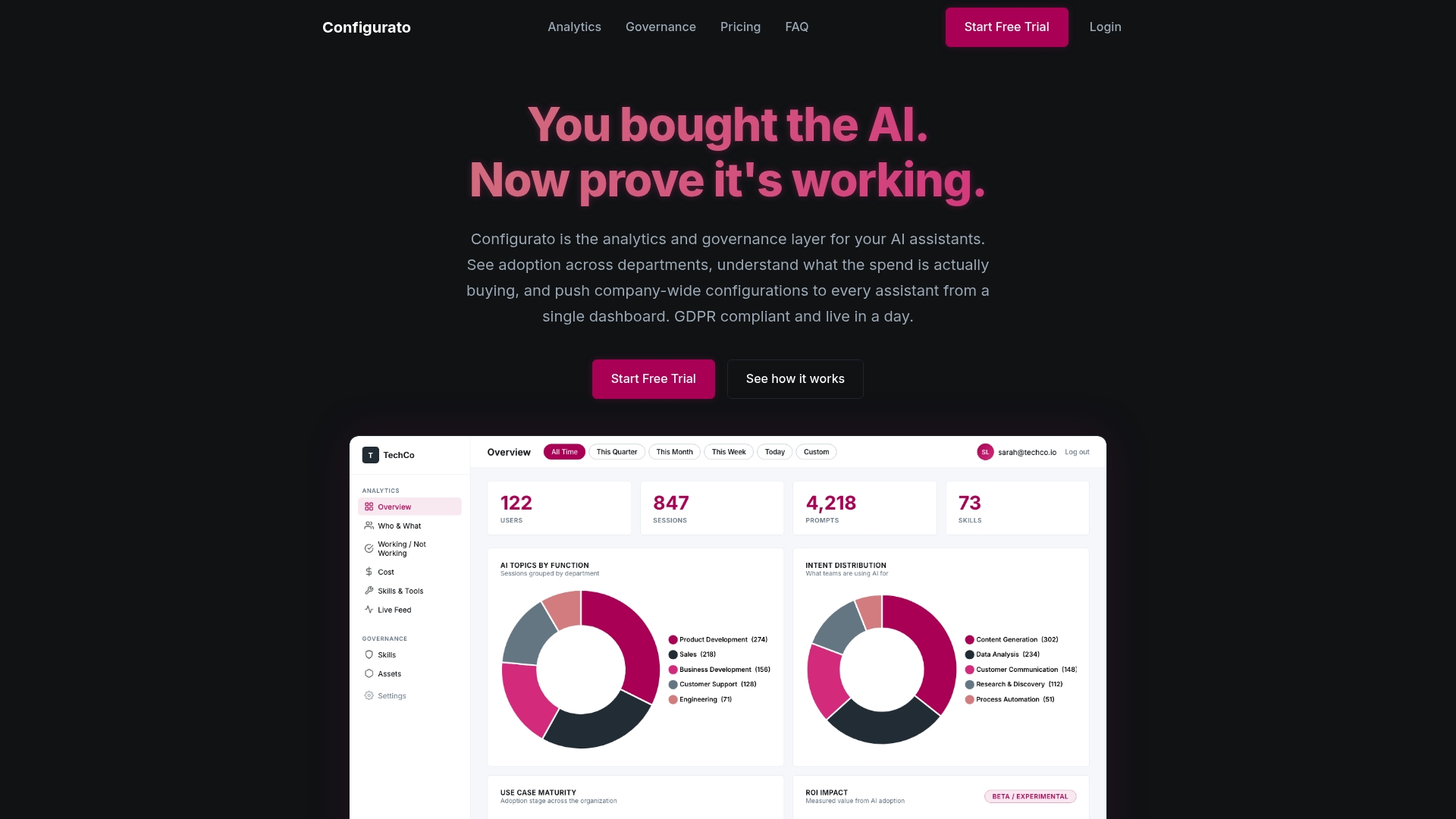
Most companies have AI adoption on paper and confusion in practice. Employees prompt AI tools generically, ignore company context, and produce output that needs heavy rework. The competitive advantage never materializes because the tools do not know how your organization operates.
Tekkr Configurato changes that. It embeds your processes, quality standards, and domain knowledge directly into whatever AI assistants your teams use. When a product manager asks Claude for a spec, the output already reflects your process. When an engineer prompts Copilot, it follows your architecture standards. No training. No lookup. No rework. Tekkr’s governance layer handles it agent-to-agent in the background.
If you want to move from AI adoption on paper to AI value in practice, see how Configurato works and what it takes to configure your AI for real organizational impact.
FAQ
What is the role of AI in digital transformation?
AI accelerates digital transformation by automating processes, enabling new business models, and improving decision quality. Its broadest role is redesigning how value is created, not just how work gets done faster.
Why do most AI transformations stall before scaling?
Inconsistent governance and data silos create backlogs of AI use cases that cannot be deployed safely or prioritized effectively. Scaling requires operating model redesign, not just more tools.
How long does it take to see productivity gains from AI?
Productivity gains from AI typically take time due to diffusion lags. Research confirms that gains depend on complementary investments in skills, process redesign, and data quality before they fully materialize.
What separates high-maturity AI organizations from basic adopters?
High-maturity organizations invest across cloud, data infrastructure, and connectivity alongside AI, and measure ROI across growth and innovation KPIs rather than cost savings alone.
How does agentic AI change workforce roles?
As AI handles routine actions, human roles shift toward oversight and strategic judgment. This requires organizations to redesign decision rights and workflows before deploying agentic AI at scale.