
AI is the core catalyst of digital transformation, reshaping business operations through autonomous decision-making, data-driven intelligence, and workflow redesign at a scale no prior technology has matched. The role of AI in digital transformation goes far beyond adding chatbots to a website or automating a single report. It means rebuilding how organizations work from the ground up. AI-first companies automate 30–50% of workflows, freeing millions of hours of human capacity and delivering measurable ROI within two years. Business leaders who understand this distinction stop treating AI as a feature and start treating it as an operating model.
How AI drives digital transformation through workflow redesign
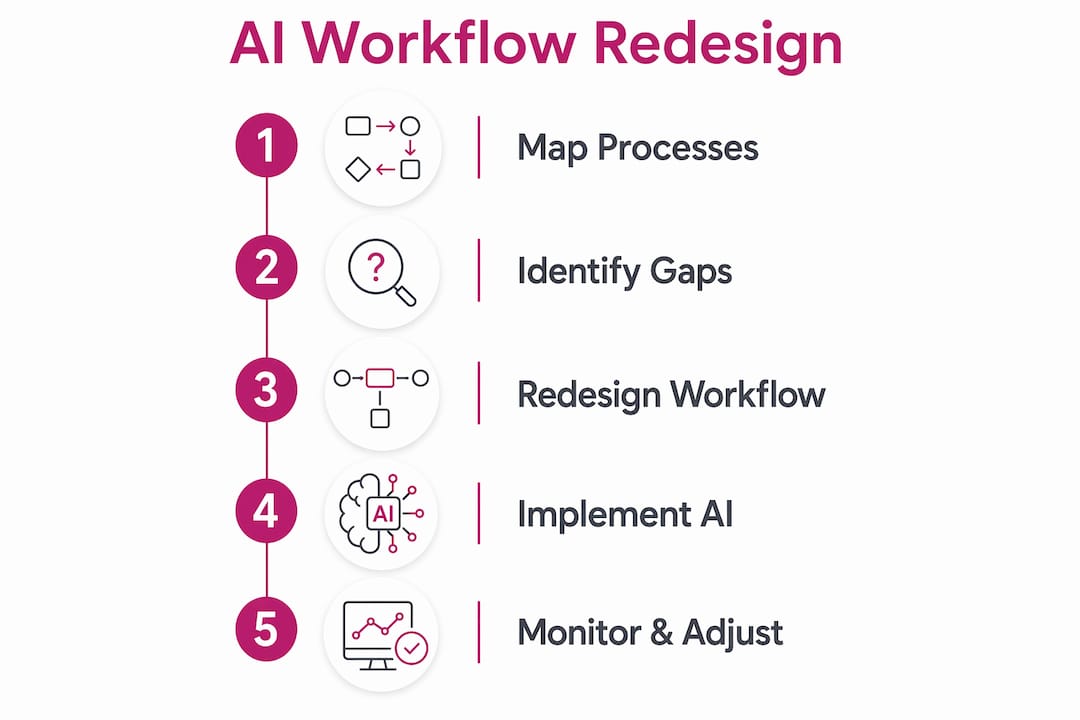
The biggest mistake organizations make is layering AI onto existing, broken processes. Layering AI on flawed workflows exposes every inefficiency that was already there, amplifying problems rather than solving them. The correct sequence is to redesign the workflow first, then embed AI as the engine that runs it.
AI-first workflow redesign produces results that legacy automation cannot match. A bank that rebuilt its operations around AI-driven workflows saved 3 million hours and achieved 150% ROI over five years. That outcome is not a product of better software. It is a product of a fundamentally different operating model.

The shift from rule-based automation to agentic AI is the defining change of 2026. Agentic workflows handle complex, multistep tasks such as ticket creation, invoice reconciliation, and lead routing, with defined permissions and human fallback mechanisms built in from the start. These systems do not just execute instructions. They make decisions within boundaries set by the organization.
Key differences between legacy automation and agentic AI workflows:
- Legacy automation follows fixed rules, breaks when inputs change, and requires human intervention for exceptions.
- Agentic AI adapts to context, handles exceptions autonomously within set permissions, and escalates to humans only when thresholds are crossed.
- Data dependency shifts from structured inputs to continuous learning from proprietary organizational data.
- Governance moves from a compliance checkbox to an embedded, real-time component of every workflow.
Pro Tip: Before deploying any AI tool, map the workflow it will touch and identify every manual workaround your team currently uses. Those workarounds are the signal that the process needs redesigning, not automating.
How do organizations restructure teams for AI integration?
Embedding AI deeply into operations requires more than new software licenses. It requires new team structures, new roles, and new governance frameworks. Cross-functional teams integrating humans and AI agents are now the standard model for high-performing organizations, replacing siloed department structures that prevent AI systems from sharing context.
Three roles have emerged as non-negotiable in AI-mature organizations:
- AI product owners translate business outcomes into AI workflow requirements, prioritize use cases, and own the performance metrics for each AI system.
- AI governance managers design logging mechanisms, set human review thresholds, and manage compliance with data privacy regulations such as GDPR.
- AI operations leads monitor model performance, detect drift, and coordinate retraining cycles to keep systems accurate over time.
These roles exist because AI transformation requires ongoing maintenance, including monitoring for model drift and embedding governance from Day 1 as an integral workflow component. Governance is not an afterthought. It is the architecture that makes autonomous AI safe to run at scale.
Balancing automation with human judgment is the practical challenge every leadership team faces. The answer is not a fixed ratio of human to AI decisions. It is a set of clearly defined escalation rules. When an AI agent encounters a case outside its confidence threshold, it routes to a human. When it operates within bounds, it acts. That boundary must be designed deliberately, not discovered after an incident.
Pro Tip: Build your AI governance framework before your first agentic workflow goes live. Retrofitting logging and fallback rules into a running system costs three to five times more than designing them upfront.
What is the role of an AI transformation lead?
The AI Transformation Lead is the role responsible for sequencing AI initiatives, proving ROI, and maintaining momentum across budget cycles. AI Transformation Leads prioritize workflows by their potential to deliver measurable outcomes within a single budget cycle, eliminating pilot fatigue and keeping funding secure.
This role sits at the intersection of artificial intelligence and digital strategy. The AI Transformation Lead does not manage individual AI tools. They manage a portfolio of AI initiatives, each with a defined business case, a measurable outcome, and a timeline tied to the organization’s annual planning cycle.
Practical priorities for an AI Transformation Lead include:
- Sequencing by impact. Start with workflows where AI can change cycle time, cost, or quality within 90 days. Early wins fund the next phase.
- Limiting the portfolio. Focusing on 3–5 high-impact workflows prevents the pilot fatigue that kills most AI programs before they reach scale.
- Proving ROI before the next budget review. Demonstrating measurable results before the annual planning cycle is the single most effective way to secure continued investment.
- Connecting AI initiatives to enterprise digital strategy. Each workflow improvement must map to a business metric the CFO or board already tracks.
Leaders who invest in proprietary intelligence through unique data, encoded workflows, and learning architectures build competitive advantages that compound faster than competitors can replicate. The AI Transformation Lead is the person who turns that principle into a funded, sequenced program. For a deeper look at how to structure this role within your organization, Tekkr’s AI transformation strategy guide covers the full mandate.
What are the biggest pitfalls in AI-driven transformation?
Pilot fatigue is the most common failure mode in AI transformation programs. Most organizations run many isolated experiments without moving key business metrics, burning budget and credibility without producing results. The fix is concentration, not expansion.
The second major pitfall is siloed AI systems that cannot communicate across functions. Designing AI architectures to resolve cross-functional coordination gaps is what separates high-performing organizations from those stuck in departmental experiments. When an AI system in finance cannot share context with an AI system in operations, the organization captures only a fraction of the available value.
| Common pitfall | Practical solution |
|---|---|
| Pilot fatigue from too many experiments | Limit active AI initiatives to 3–5 workflows with defined metrics |
| Siloed AI systems across departments | Design shared data layers and cross-functional AI architectures |
| Governance added after deployment | Embed logging, fallback rules, and review thresholds from Day 1 |
| Model drift degrading performance over time | Schedule regular monitoring cycles and retraining checkpoints |
| AI layered on broken processes | Redesign workflows before deploying any AI capability |
AI transformation is probabilistic and ongoing, requiring embedded monitoring for model accuracy and drift rather than static compliance processes. Organizations that treat AI deployment as a one-time project consistently underperform those that treat it as a continuous operating discipline. For practical guidance on building enterprise AI adoption programs that avoid these traps, the sequencing of initiatives matters as much as the technology selected.
Key Takeaways
AI-first organizations outperform competitors by redesigning workflows around AI capabilities, embedding governance from Day 1, and concentrating investment on 3–5 high-impact initiatives that deliver measurable ROI within a single budget cycle.
| Point | Details |
|---|---|
| Redesign before deploying | Fix broken workflows first; layering AI on flawed processes amplifies problems. |
| Agentic AI requires governance | Build logging, fallback rules, and human review thresholds before going live. |
| Limit your AI portfolio | Focus on 3–5 workflows with measurable outcomes to avoid pilot fatigue. |
| The AI Transformation Lead role matters | This role sequences initiatives and ties ROI proof points to budget cycles. |
| Cross-functional architecture unlocks value | AI systems that share context across departments deliver far greater business impact. |
Why most AI transformation programs stall before they scale
The organizations I see succeed at AI transformation share one habit: they treat workflow redesign as the primary deliverable, not the AI tool itself. The tool is the engine. The workflow is the vehicle. Most programs buy the engine and forget to build the vehicle.
The second pattern I consistently observe is that governance gets treated as a legal requirement rather than an operational one. Teams deploy AI agents, then scramble to add logging and oversight after something goes wrong. That sequence is backwards. Governance is what makes autonomous AI trustworthy enough to run without constant human supervision. Build it first, and your AI systems earn more autonomy over time. Skip it, and you spend more time managing exceptions than the AI saves you.
The third pattern is the hardest to fix: leadership that measures AI success by the number of tools deployed rather than the number of workflows transformed. Buying Claude, Codex, and a dozen other tools does not make an organization AI-first. Using them well, in redesigned workflows, with measurable outcomes, does. The organizations that figure this out early build compounding advantages. The ones that do not end up with expensive subscriptions and unchanged results.
— TekkrTools
Turning AI investment into measurable results with Tekkr
Most organizations know they need AI. The harder problem is knowing whether their AI investments are actually working.
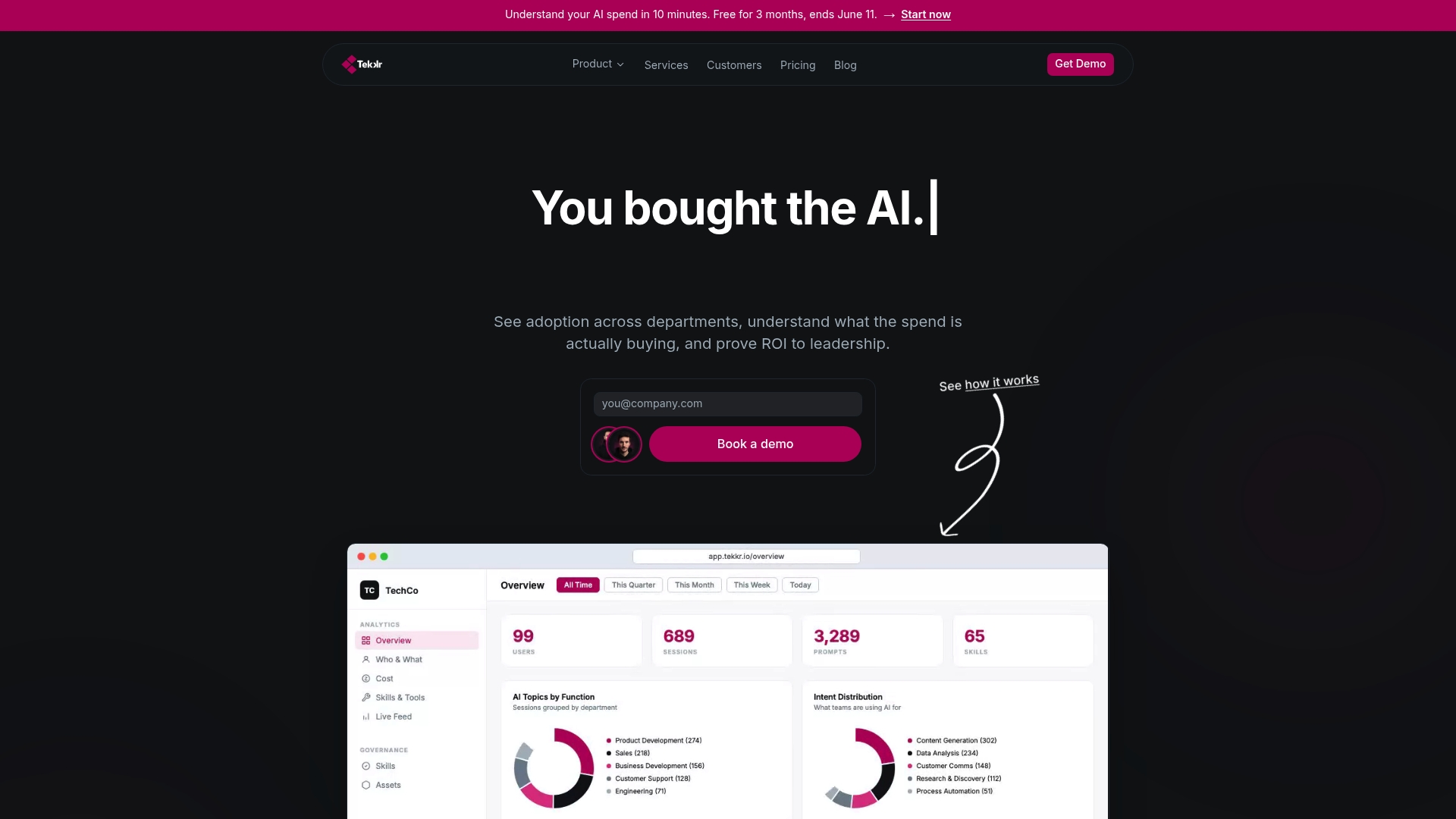
Tekkr’s flagship product, Configurato, tracks AI adoption, spending, and return across every team in your organization. It shows who is using tools like Claude and Codex, breaks down costs by department, and surfaces which use cases are generating real productivity gains. Tekkr then drives adoption higher through gamified rollouts and company-wide AI playbooks, so your teams do not just have access to AI. They use it well. Setup takes about 10 minutes, with a free tier and no credit card required. See how Tekkr’s AI adoption solutions turn AI spend into proof.
FAQ
What is the role of AI in digital transformation?
AI serves as the core driver of digital transformation by enabling autonomous workflows, data-driven decisions, and process redesign at scale. Organizations that embed AI into rebuilt workflows, rather than existing ones, achieve the strongest and most durable results.
What does an AI Transformation Lead do?
An AI Transformation Lead sequences AI initiatives, proves ROI within budget cycles, and limits the active portfolio to 3–5 high-impact workflows. This role connects artificial intelligence and digital strategy to ensure AI programs maintain funding and momentum.
How do organizations avoid pilot fatigue in AI programs?
Pilot fatigue is avoided by concentrating AI investment on a small number of workflows with clearly defined, measurable outcomes rather than running many isolated experiments simultaneously. Tying each initiative to a business metric the leadership team already tracks keeps programs funded and focused.
Why does AI governance need to be embedded from Day 1?
Retrofitting governance into a running AI system is significantly more costly and risky than designing it upfront. Logging, fallback rules, and human review thresholds must be built into agentic workflows before deployment to manage risk and maintain human oversight effectively.
How does AI transformation differ from traditional digital transformation?
Traditional digital transformation digitizes existing processes. AI transformation redesigns those processes around autonomous, learning systems that improve over time. The distinction is the difference between moving paper forms online and replacing the entire approval workflow with an AI agent that acts within defined permissions.