
A responsible AI policy is an enforceable operational program that translates ethical principles like fairness, transparency, and accountability into concrete engineering processes and organizational controls. The term “responsible AI” is the recognized industry standard for this discipline, while “ethical AI policy” is the broader aspirational framing that precedes it. Policy makers and business leaders who understand what is responsible AI policy gain a critical advantage: they can move their organizations from vague commitments to auditable, defensible practices. Regulatory frameworks like the EU AI Act, OECD Due Diligence Guidance, and IEEE 7000™ standards now demand exactly that shift. An operational responsible AI program covers the full AI lifecycle, requires continuous monitoring, maintains audit trails, and mandates human oversight for high-risk systems.
What is responsible AI policy, and why does it matter?
A responsible AI policy is the set of documented rules, processes, and controls that govern how an organization builds, deploys, and monitors AI systems. It is not a mission statement. It specifies who approves a model before it goes live, how bias is tested, what triggers an incident response, and which regulatory notifications are required. Without this specificity, ethical commitments remain aspirational and unenforceable.
The importance of AI accountability becomes clear when you consider the regulatory environment. The EU AI Act, in force since 2024, is the world’s first comprehensive AI regulation. It bans certain AI applications outright and requires conformity assessments, documentation, and human oversight for high-risk AI systems. Organizations that cannot demonstrate a functioning policy face legal exposure, not just reputational risk.

Responsible AI development also depends on data quality. Trustworthy AI requires trustworthy data: comprehensive documentation, quality assurance, and data management processes are foundational. An AI system trained on biased or poorly governed data cannot be made ethical through policy alone, which is why responsible data governance and responsible AI policy are inseparable disciplines.
What are the key components of a responsible AI policy?
The core components of a responsible AI policy translate values into verifiable actions. Each element below addresses a specific failure mode that organizations encounter when AI systems cause harm or produce unreliable outputs.
- Bias testing cadences. Policies must specify how often bias audits run, which fairness metrics apply, and what thresholds trigger remediation. A quarterly cadence is common for high-risk systems, but continuous monitoring is the emerging standard.
- Transparency artifacts. Model cards document a model’s intended use, performance characteristics, and known limitations. Datasheets for datasets record provenance, collection methods, and known gaps. Both are required artifacts under the EU AI Act for high-risk applications.
- Human-in-the-loop definitions. The policy must name which decisions require human review before AI output is acted upon, and assign a specific approver role. Vague language like “human oversight where appropriate” creates accountability gaps.
- Incident response workflow. A documented process must cover detection, containment, root cause analysis, and regulatory notification. The EU AI Act requires serious incident reporting within defined timeframes.
- Dedicated budget. Governance activities cost money. Bias audits, third-party assessments, and documentation tooling require line-item budget allocation. Policies that lack funding commitments rarely survive their first annual review.
High-risk AI applications require conformity assessments, documentation, and registration under current regulatory frameworks. That requirement makes the components above non-optional for any organization operating in regulated markets.
Pro Tip: Assign a named “approver of record” with explicit authority to halt a high-risk AI deployment. Without a named individual, accountability diffuses and unsafe systems ship.
How does responsible AI policy differ from AI ethics and AI governance?
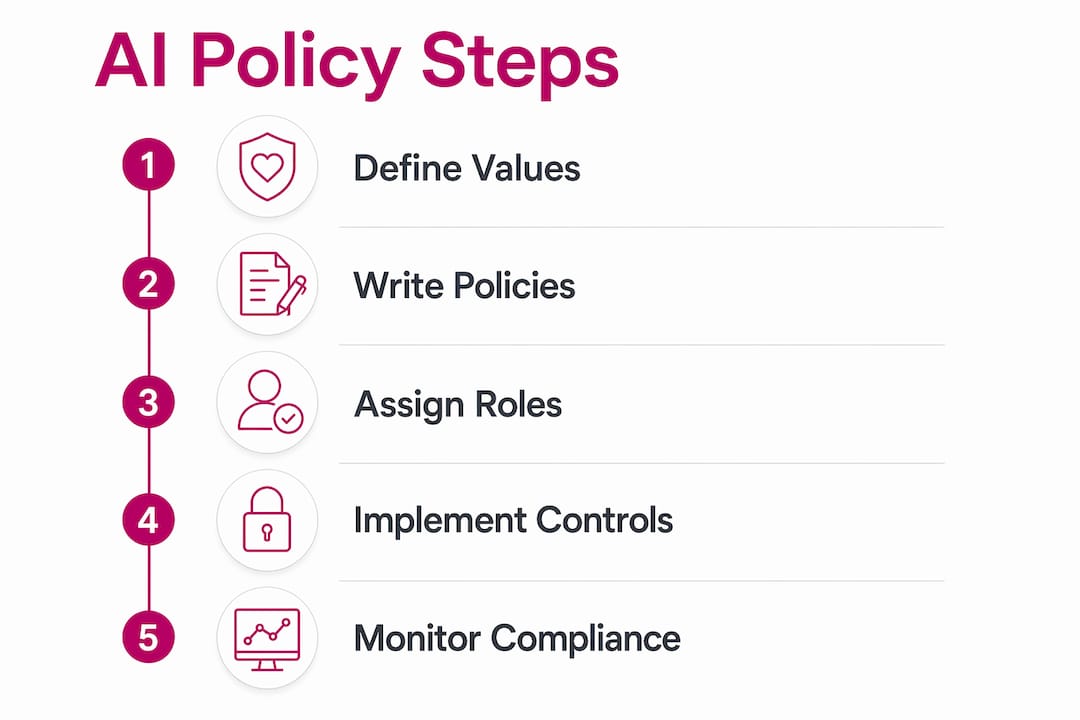
The biggest misconception in this field is treating AI ethics, responsible AI policy, and AI governance as interchangeable terms. They operate at different levels and serve different functions.
Ethics states the values; responsible AI enforces them via operational processes. AI governance then embeds those policies into organizational structures with real enforcement power. Confusing the three leads to organizations that publish ethical principles but deploy harmful systems because no one had the authority or the process to stop them.
| Layer | Definition | Example |
|---|---|---|
| AI ethics framework | Aspirational values and principles | “Our AI will be fair and transparent.” |
| Responsible AI policy | Enforceable processes and controls | Bias testing every 90 days, named approver required. |
| AI governance | Organizational structures that enforce policy | An AI review board with authority to block deployments. |
AI governance principles give the policy teeth. A governance body without enforcement authority is an advisory committee. Effective governance requires the power to block unsafe deployments and mandate remediation, not just the power to recommend. Organizations that skip this step produce documents that satisfy auditors on paper but fail in practice.
The practical implication is sequencing. Build the ethics framework first to align stakeholders on values. Write the responsible AI policy second to operationalize those values. Establish the governance structure third to enforce the policy with real consequences. Skipping any step produces a gap that regulators and incident investigators will find.
What regulatory frameworks shape responsible AI policies in 2026?
Three frameworks define the current compliance baseline for most organizations operating internationally.
The EU AI Act uses a risk-tiered approach. Unacceptable-risk AI is prohibited. High-risk AI, which includes systems used in hiring, credit scoring, critical infrastructure, and law enforcement, requires conformity assessments, technical documentation, human oversight, and registration in an EU database. The Act has been in force since 2024 and enforcement timelines are now active for most categories.
The OECD Due Diligence Guidance 2026 defines a six-step governance process that embeds responsible business conduct into daily operations. It requires organizations to build a living inventory of AI systems and assign clear roles for oversight. The OECD framework is not legally binding in most jurisdictions, but regulators in G20 countries treat it as the expected standard of care.
IEEE 7000™ standards provide technical guidance on embedding ethical values into system design from the earliest stages. IEEE standards are voluntary but widely referenced in procurement requirements and third-party audits.
| Framework | Jurisdiction | Binding? | Key requirement |
|---|---|---|---|
| EU AI Act | European Union | Yes | Risk-tiered conformity and registration |
| OECD Due Diligence Guidance | G20 countries | No | Six-step governance and living AI inventory |
| IEEE 7000™ | Global | No | Ethics-by-design in system engineering |
| NIST AI RMF | United States | No | Risk identification and management lifecycle |
| ISO/IEC 42001 | Global | No | AI management system certification |
Mapping internal policies to NIST AI RMF and ISO/IEC 42001 early saves significant time during audits and creates a defensible compliance baseline. Building a policy from scratch without referencing these frameworks risks gaps that only surface under regulatory scrutiny.
Pro Tip: Start your policy mapping with ISO/IEC 42001. Its structure mirrors the EU AI Act’s documentation requirements closely enough that a single documentation effort can satisfy both.
How can organizations implement and sustain responsible AI policies?
Effective implementation requires embedding AI governance into existing business operations rather than treating it as a separate compliance function. Siloed governance programs get deprioritized when business pressure mounts. Integrated programs survive because they share infrastructure with legal, risk, and finance functions that already have enforcement authority.
A practical implementation sequence follows five steps:
- Build a living AI inventory. Catalog every AI system in use, including third-party tools and embedded models. The OECD Due Diligence Guidance 2026 makes this the first governance step. You cannot govern what you have not documented.
- Assign named roles with enforcement authority. Every high-risk AI system needs a designated owner, a named approver of record, and a defined escalation path. Roles without authority are titles, not governance.
- Establish continuous monitoring. Successful programs require continuous monitoring for model drift and harmful outputs. Model performance degrades over time as real-world data shifts away from training distributions. Monitoring catches this before users or regulators do.
- Address advanced risks explicitly. Updated ERA Living Guidelines flag hidden prompts as a governance risk: AI instructions invisible to human reviewers can produce unmonitored outputs. Policies must explicitly cover prompt visibility and logging requirements for generative AI systems.
- Allocate a dedicated governance budget. Governance without funding is a wish list. Budget line items should cover bias auditing tools, third-party assessments, documentation maintenance, and staff training. Annual reviews should adjust the budget as the AI portfolio grows.
The leadership role in AI adoption is decisive here. Leaders who treat responsible AI policy as a compliance checkbox produce checkbox programs. Leaders who treat it as a risk management function produce programs that actually protect the organization. The difference shows up in incident rates, audit outcomes, and employee trust in AI tools.
Integrating AI governance into existing governance strategies for compliance also reduces duplication. Legal, privacy, and security teams already manage risk registers, incident response processes, and vendor assessments. Responsible AI policy can extend these existing workflows rather than duplicate them.
Key Takeaways
A responsible AI policy is only as effective as the enforcement mechanisms and named accountabilities behind it.
| Point | Details |
|---|---|
| Definition clarity | Responsible AI policy translates ethical values into enforceable engineering processes and organizational controls. |
| Core components | Policies must include bias testing cadences, transparency artifacts, named approvers, incident response workflows, and dedicated budgets. |
| Framework alignment | Mapping policies to NIST AI RMF and ISO/IEC 42001 early creates a defensible compliance baseline and simplifies audits. |
| Enforcement authority | Governance bodies without the power to block deployments cannot enforce responsible AI policy in practice. |
| Continuous monitoring | Model drift and hidden prompt risks require ongoing monitoring, not one-time assessments at deployment. |
Why most responsible AI programs fail before they start
The pattern I see most often is organizations that invest heavily in writing ethical AI principles and almost nothing in operationalizing them. The principles document gets published, leadership signs off, and then nothing changes in the engineering process. Six months later, a biased model ships because no one had the authority or the process to stop it.
The uncomfortable truth is that a responsible AI policy without a named approver of record is not a policy. It is a document. The distinction matters enormously when something goes wrong and regulators ask who was responsible for the decision to deploy.
The second failure mode is treating data privacy in AI as a separate workstream from responsible AI policy. They are the same problem. An AI system is only as trustworthy as its training data, and a policy that governs model behavior but ignores data provenance has a structural gap.
The organizations that get this right share one characteristic: their AI governance body has real authority, not advisory status. That means the ability to delay a product launch, require a third-party audit, or mandate a model rollback. Without that authority, the governance program becomes theater. With it, responsible AI policy becomes a genuine competitive advantage because it builds the kind of trust that accelerates adoption rather than slowing it down.
— TekkrTools
Tekkr’s approach to responsible AI adoption
Organizations that want to move from policy documents to measurable AI governance need more than frameworks. They need visibility into which AI tools are actually in use, how they are being used, and whether usage aligns with policy requirements.

Tekkr’s platform, Configurato, gives policy makers and business leaders exactly that visibility. It tracks AI adoption across every team, breaks down costs by department, and surfaces use-case intelligence that informs governance decisions. Its privacy-first architecture is end-to-end encrypted, GDPR-compliant, and anonymizes prompts with automatic PII stripping, making it compatible with responsible AI policy requirements from day one. For organizations building or scaling their AI adoption program, Tekkr provides both the measurement infrastructure and the consulting support to make governance real rather than aspirational. Setup takes about 10 minutes, with a free tier and no credit card required.
FAQ
What is responsible AI policy in simple terms?
A responsible AI policy is a documented set of rules and processes that govern how an organization builds, deploys, and monitors AI systems to ensure they are fair, transparent, and accountable. It translates ethical values into specific engineering requirements and organizational controls.
How does responsible AI policy differ from AI ethics?
AI ethics defines the values an organization wants its AI to reflect, while a responsible AI policy specifies the enforceable processes that make those values real. Without the policy layer, ethical commitments remain aspirational and unverifiable.
What are the best practices for AI policy implementation?
Best practices include assigning named approvers with enforcement authority, building a living AI inventory, establishing continuous monitoring for model drift, mapping policies to NIST AI RMF or ISO/IEC 42001, and allocating a dedicated governance budget.
Which regulations require a responsible AI policy in 2026?
The EU AI Act requires conformity assessments, documentation, and human oversight for high-risk AI systems. The OECD Due Diligence Guidance 2026 sets a six-step governance standard that G20 regulators treat as expected practice, even where it is not legally binding.
What is the role of AI governance in responsible AI?
AI governance provides the organizational structure and enforcement authority that makes responsible AI policy effective. A governance body with the power to block unsafe deployments and mandate remediation turns policy documents into operational controls.