The recommended approach to prompt PII detection is a layered pipeline: deterministic rules catch structured identifiers instantly, an ML layer catches unstructured PII with context, and a reversible pseudonymization step lets you scrub sensitive values before a prompt leaves your infrastructure and restore them after the model responds. Run as much of this as possible inside your own enterprise boundary rather than shipping raw text to a third-party detection API.
Three building blocks make this work:
- Deterministic layer: regex and checksum validators (Luhn, IBAN, SSN patterns) for structured identifiers, with near-zero added latency.
- ML/NER layer: transformer-based or spaCy-style named entity recognition for names, informal addresses, and other context-dependent PII.
- Reversible pseudonymization: a scrub-map-restore flow that swaps real values for consistent placeholders, then rehydrates them in the final output.
Keep detection and the placeholder map inside enterprise-controlled infrastructure whenever the data is sensitive enough to matter. That single decision shapes almost every architecture choice that follows.
Key Takeaways
The most reliable prompt PII detection systems combine deterministic pattern matching, context-aware ML, and reversible pseudonymization inside a boundary the enterprise controls.
| Point | Details |
|---|---|
| Layer your detectors | Combine regex/checksum validators with NER models rather than relying on either approach alone. |
| Use reversible pseudonymization | Scrub-map-restore preserves conversational context that flat redaction destroys. |
| Start narrow, expand with data | Begin with high-risk categories like SSNs and credit cards, then widen scope after monitoring false positives. |
| Keep raw values inside your boundary | Gateway and client-side deployments carry far less privacy risk than third-party detection APIs. |
| Test multilingual and indirect PII separately | English-language accuracy figures rarely hold for other languages or context-dependent identifiers. |
Table of Contents
- What’s The Difference Between Deterministic And ML-Based PII Detection?
- How Do You Build A Layered Detection Pipeline?
- Why Reversible Pseudonymization Beats Simple Redaction
- Which Tools And Libraries Actually Cover This Well?
- How Do You Test And Tune A PII Detector?
- Where Should You Actually Run Detection?
- What Belongs On Your Implementation Checklist?
- How Does Tekkr’s Configurato Handle Prompt Anonymization?
- How Do You Detect PII Across Multiple Languages?
- How Do You Catch PII That Isn’t Explicitly Labeled?
- How Should You Annotate Data To Train A Prompt Detector?
- What Compliance Standards Apply To Prompt-Level Detection?
- What Goes Wrong When Teams Deploy This Badly?
- Ready To Pair Detection With Adoption Visibility?
- Where To Read More On PII Detection Standards
- What Should Engineers Actually Prioritize First?
- Sources
What’s The Difference Between Deterministic And ML-Based PII Detection?
Deterministic detectors and machine learning detectors solve different halves of the problem, and confusing the two is the most common design mistake in prompt PII detection.
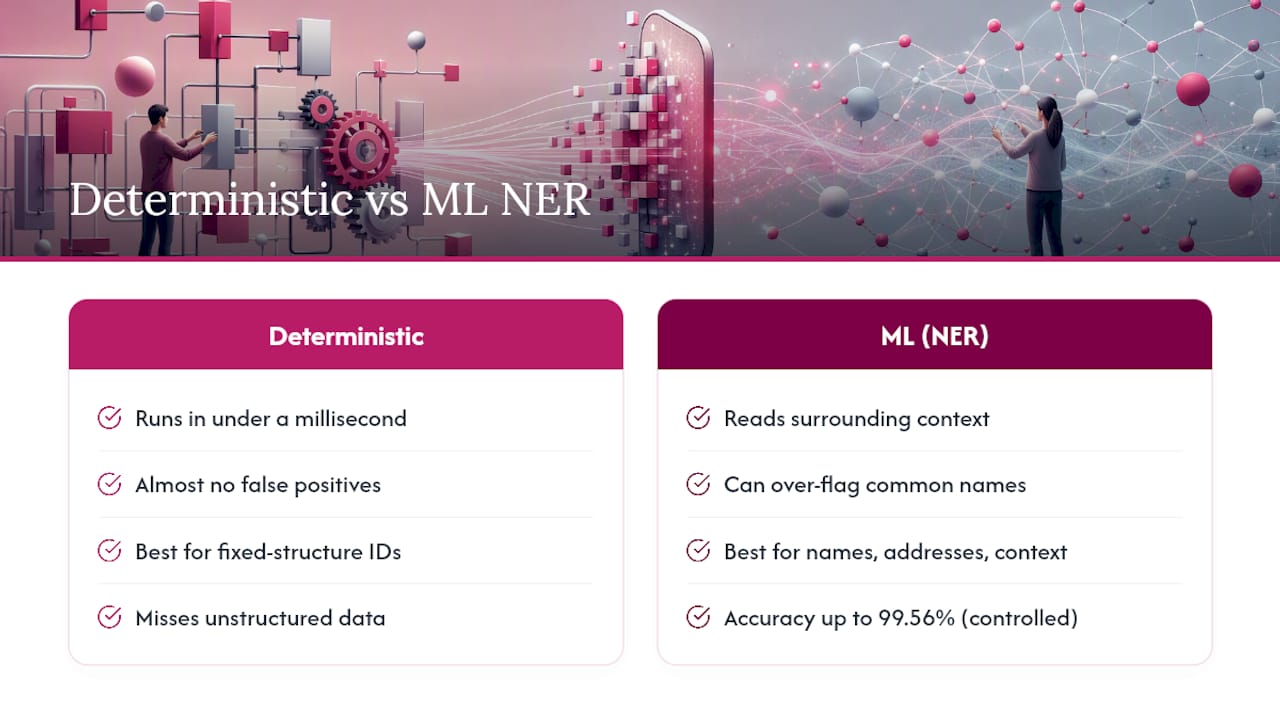
Regex and checksum validators handle anything with a fixed structure: credit card numbers, Social Security numbers, API keys, email addresses, phone numbers in standard formats. A Luhn check on a 16-digit string, an IBAN format validator, a pattern match against \d{3}-\d{2}-\d{4} for an SSN. These run in under a millisecond and produce almost no false positives, because the structure itself is the signal. Cloudflare’s documentation on PII detection treats regex as the default for exactly this class of identifier, reserving fuzzy detection for everything regex can’t reliably parse.
Names, informal addresses, and context-dependent references need something smarter. Named entity recognition (NER) models and transformer-based classifiers read surrounding context to decide whether “Jordan” is a person’s name or a brand. Combining NER with a deterministic base layer has been shown to lift address recall from roughly 19% to 82% in one evaluation of reversible scrubbing tools, because addresses rarely follow a fixed pattern the way a credit card number does. Some transformer-based NER systems report accuracy as high as 99.56% in controlled testing, though that number drops on messy, conversational prompt text where informal phrasing and typos are the norm.
The failure modes cut in opposite directions. Deterministic rules miss anything unstructured. ML detectors over-flag common names (“Amazon” as a person, “Paris” as a location versus a name) and can shred a prompt’s usable context if you redact too aggressively. The fix for both is layering, not picking a winner.
How Do You Build A Layered Detection Pipeline?
A production-grade pipeline runs three layers in sequence, each catching what the previous one missed, before anything leaves your environment.
- Deterministic filter first. Regex and checksum validators scan the raw prompt for structured tokens. This layer is fast enough to run synchronously on every request without a user noticing.
- Fuzzy/ML pass second. A NER or transformer model scores the remaining text for names, addresses, and informal identifiers, attaching a confidence score to each match rather than a binary flag.
- Local LLM adjudication, optional. For low-confidence matches, a small local model can adjudicate edge cases, such as deciding whether “Jordan called about the invoice” contains a person’s name or a company reference.
Where you place this pipeline matters as much as what’s in it. Client-side placement (browser extension or local agent) keeps raw text off any network entirely, but it’s constrained by local compute and can’t easily share detection logic across a fleet of devices. A gateway or proxy sitting between your users and the LLM provider gives you central policy control, shared logging, and the ability to apply the same rules across every application that calls the model. Hugging Face’s LLM gateway cookbook documents this pattern directly: a wrapper object intercepts the outbound call, scrubs it, and holds the mapping needed to restore values later. Server-side batch processing works for offline pipelines (log scrubbing, dataset preparation) where latency doesn’t matter but throughput does.
Streaming responses complicate rehydration. If a model streams tokens back and a placeholder spans multiple chunks, your gateway needs to buffer just enough to detect and replace the full placeholder before forwarding it to the user, not letter by letter.

Pro Tip: Build the rehydration buffer to hold a small trailing window of tokens, not the whole response. Waiting for the full stream to check for placeholders kills the point of streaming in the first place.
Why Reversible Pseudonymization Beats Simple Redaction
Replacing every sensitive value with a generic [REDACTED] tag looks safe on paper but quietly breaks the thing you’re trying to protect: the model’s ability to reason about the conversation. If three different names all become [REDACTED], the model can no longer track who did what, and your output quality collapses along with your privacy protections.
Consistent placeholdering solves this. Instead of blanking a value, you substitute a stable token, like PERSON_1 or ADDRESS_2, and reuse that same token every time the value reappears in the conversation. The model reasons about PERSON_1 calling PERSON_2 just as coherently as it would about the real names, and your gateway swaps the real values back in once the response comes home. Open-source projects like preserve-pii implement exactly this scrub-map-restore flow, and GitHub-hosted tools such as llm-pii-firewall build the mapping and rehydration logic around ephemeral storage with strict expiration.
Three design details separate a solid placeholder map from a liability:
- Ephemeral storage with a short TTL. The map should expire minutes after the response returns, not persist indefinitely.
- Encryption at rest, even briefly. A map that lives for ninety seconds in memory is still worth encrypting if it touches disk or a cache layer.
- Audit-only logging. Log that a rehydration happened and when, never the raw value that was restored.
The real threat model question isn’t “can we detect PII?” It’s “who can rehydrate it, under what conditions, and can we prove that after the fact?” A detection layer without an answer to that question is a compliance gap wearing a security feature’s clothes.
Raw values should never persist longer than the single request-response cycle requires. If your map still has entries an hour after the conversation ended, something in your TTL logic is broken.
Which Tools And Libraries Actually Cover This Well?
You don’t need to build every layer from scratch. Open-source libraries and cloud APIs already cover most of the deterministic and ML work; the engineering effort is mostly in wiring them together correctly.
For the deterministic layer, standard checksum validators exist for most structured identifiers worth checking: Luhn for credit cards, MOD-97 for IBAN numbers, and country-specific formats for national ID numbers and passport strings. These are a few dozen lines of code each and rarely need updating once written.
For the fuzzy layer, a few names come up repeatedly:
- Microsoft Presidio ships pre-built recognizers for common PII categories and lets you plug in custom ones for industry-specific identifiers.
- spaCy provides solid general-purpose NER out of the box and is fast enough for real-time scanning on modest hardware.
- Transformer fine-tunes (BERT-based or similar) trained specifically on your domain’s entity types outperform general NER when your prompts use unusual naming conventions or industry jargon.
- Local LLMs handle the genuinely ambiguous cases, like adjudicating whether a string is a person’s name or a fictional character.
Microsoft’s own Azure Language service documentation is worth reading even if you’re not using Azure, because it maps out distinct feature types, Text PII, Conversation PII, Document PII, that map neatly onto real integration decisions: a single synchronous prompt needs different handling than a multi-turn chat log or a batch of uploaded documents.
Integration typically happens at one of three points: a gateway wrapper that intercepts every outbound call (the most common enterprise pattern), a CI pre-commit hook that scans code and config files for hardcoded secrets and test PII, or an SDK-level proxy that wraps streaming API calls so detection happens transparently to the calling application.
How Do You Test And Tune A PII Detector?
Treat your detector like any other model in production: measure it against a labeled dataset before you trust it, and keep measuring after deployment.
The core metrics are precision, recall, F1 score, latency per request, and a running count of false-negative incidents caught after the fact (usually through user reports or downstream audits). A hybrid rule-based plus ML approach tested on financial documents showed that combining both layers produces stronger precision and recall than either alone, but only when the training and validation data reflected the real document types the system would see in production.
- Build a synthetic corpus covering every PII category you care about, generated with realistic formatting variance, not just clean textbook examples.
- Collect a smaller sample of real, labeled prompts (with consent and proper handling) to validate against actual usage patterns.
- Run stratified k-fold validation so no single PII category is over- or under-represented in your test splits.
- Deploy with conservative thresholds, then tune using production feedback loops.
| Metric | What It Tells You |
|---|---|
| Precision | How often a flagged item is actually PII, low precision means excess redaction and broken context |
| Recall | How much real PII you’re catching, low recall means silent leaks |
| F1 score | Balanced view of precision and recall together |
| Latency (p95) | Whether the detector is fast enough for synchronous, real-time use |
Start narrow. Cloudflare’s guidance recommends beginning with a small set of high-risk categories, credit cards and government IDs, then expanding coverage only after monitoring shows the false-positive rate is manageable. Widening scope before you’ve measured the narrow case almost always produces alert fatigue that gets the whole system disabled.
Where Should You Actually Run Detection?
The deployment location determines your privacy exposure more than any algorithm choice you make inside the pipeline.
- Client-side detection offers the strongest privacy guarantee, since raw text never leaves the device, and fits browser-based agents or local desktop tools well. The tradeoff is limited compute for heavier ML models and no centralized policy control across a team.
- Gateway or proxy detection sits between your application and the LLM provider, giving you one place to enforce policy, log activity, and support streaming rehydration across every app that calls the model. This is the most common pattern for mid-size and large engineering teams, and it’s the pattern Hugging Face’s gateway cookbook documents in detail.
- Third-party detection APIs require the least engineering effort but mean sending prompt text to another vendor before you’ve even scrubbed it, which is often the highest-risk option from a compliance standpoint. Use this pattern only when your contracts and data processing agreements explicitly cover that transfer.
Self-hosting the detection layer, whether client-side or gateway-based, keeps privacy risk assessment squarely under your own control instead of a vendor’s terms of service.
What Belongs On Your Implementation Checklist?
Turn the architecture above into a sprint plan with five categories of work.
- Set policy first. Define sensitivity levels, decide which PII categories are in scope for this release, and set retention limits on any placeholder maps before writing code.
- Instrument detection. Wire the deterministic layer into your gateway or client, add the ML layer, and log detection events (not raw values) from day one.
- Gate in CI. Add automated scans that block commits or deployments containing test PII, hardcoded credentials, or sample data that slipped past review.
- Scope your endpoints. Decide which API endpoints need synchronous detection versus which can run batch scans overnight.
- Plan for streaming. Build and test the token-buffering logic for rehydration before you ship any streaming-enabled feature.
- Build operational readiness. Set up monitoring dashboards, an incident response runbook for detected leaks, audit logs for every rehydration event, and a retraining cadence for your ML models.
Skipping the policy step is the most common mistake. Teams that jump straight to instrumentation end up rebuilding half the pipeline once legal or compliance defines the actual retention rules six weeks later.
How Does Tekkr’s Configurato Handle Prompt Anonymization?
Tekkr’s Configurato platform anonymizes prompts automatically as part of its usage-tracking layer, stripping PII before any telemetry data is stored or analyzed. The architecture runs end-to-end encrypted and is built to comply with GDPR by design, not as an afterthought bolted onto an existing tracking system.
For teams that already run an internal detection stack, Configurato works as a complementary layer rather than a replacement:
- It handles the adoption and spend visibility layer (who’s using Claude, Codex, or other AI tools, and how much it costs by team) with anonymization built into the telemetry pipeline itself.
- Internal detection stacks can still own the raw-prompt scrubbing for application traffic, while Configurato covers usage analytics without ever storing identifiable prompt content.
- Setup takes about 10 minutes, with a free tier available and no credit card required for the pilot.
Pro Tip: If you’re piloting a detection stack alongside an adoption analytics tool, scope the pilot to one department first. It’s far easier to validate anonymization behavior against a small, known dataset than against your entire org’s prompt traffic on day one.
How Do You Detect PII Across Multiple Languages?
Regex patterns built for American phone numbers and Social Security numbers don’t transfer to a French carte vitale number or a German steuer-ID, and this is where a lot of prompt PII detection systems quietly fail once they scale past one market.
Structured identifiers need country-specific validators, not a single universal pattern. National ID formats, postal codes, and phone number structures vary enough that a regex library built for United States formats will silently miss or misfire on international equivalents. IBAN validation is one of the few formats with a genuinely international checksum standard (MOD-97) that works the same way across countries, which makes it a rare easy win.
Named entity recognition has its own multilingual gap. A NER model trained primarily on English text often underperforms on names from other naming conventions, particularly patronymic or compound-surname structures common outside English-speaking countries. Multilingual transformer models exist and help close this gap, but they generally need language-specific fine-tuning or a curated gazetteer to catch names reliably outside their training distribution.
The practical fix is a tiered fallback: run language detection first, route text to the appropriate regional regex set, and use a multilingual NER model as the fuzzy layer rather than an English-only one. Teams supporting global users should budget real testing time against non-English prompt samples specifically, since most published detector accuracy figures, including the ones cited earlier in this piece, come from English-language benchmarks and won’t hold at the same rate elsewhere.
How Do You Catch PII That Isn’t Explicitly Labeled?
The hardest PII to catch isn’t the Social Security number sitting in plain text. It’s the sentence that reveals someone’s identity without naming them directly, and pattern matching alone will never catch it.
Consider a prompt like “my manager, the only VP at our 40-person startup who went to Stanford, wants a performance review template.” No name, no email, no phone number, yet the description likely identifies one specific person to anyone with basic company knowledge. This is context-dependent, or indirect, PII, and it requires reasoning about combinations of facts rather than matching a single token.
A few techniques help close this gap, though none solve it completely:
- Quasi-identifier scoring. Flag combinations of otherwise-innocuous details (job title, company size, location, alma mater) that together narrow down to a small population of possible individuals.
- Local LLM adjudication. A capable local model can read a full sentence and flag “this describes a specific, identifiable person” even when no named entity appears, which is exactly the adjudication role described in layered pipeline designs.
- Adaptive sensitivity scoring. Framing risk by use case and jurisdiction, rather than applying one static rule everywhere, lets you flag high-risk combinations more aggressively in regulated contexts, an approach described in research on adaptive PII mitigation frameworks for LLMs.
None of this runs at regex speed. Budget for the added latency, and reserve it for prompts flagged as higher-risk by earlier layers rather than running it on every single request.
How Should You Annotate Data To Train A Prompt Detector?
A detector trained on clean, formal text will underperform badly on the messy, half-punctuated way people actually write prompts, so your annotation process needs to reflect that reality from the start.
Label prompt data at the span level, marking exact character offsets for each PII entity rather than tagging whole sentences, since span-level labels let you train and evaluate NER models precisely. Include negative examples deliberately: common names that aren’t PII in context (“Amazon,” “Paris,” a product called “Jordan”), so the model learns to use surrounding context rather than pattern-matching on capitalized words.
Cover realistic prompt noise on purpose. Real prompts include typos, inconsistent capitalization, copy-pasted email signatures, and code snippets with placeholder variables that look like real data. A training set built only from clean, textbook-formatted examples will pass every internal test and then fail in production the first week.
Stratify your annotation effort across PII categories so rare-but-critical types (SSNs, medical record numbers) get proportionally more labeled examples than their natural frequency in a corpus, since a model trained on a corpus that’s 90% email addresses will learn to catch emails well and everything else poorly. Multiple annotators reviewing the same sample and reconciling disagreements catches ambiguous cases, like whether “the CEO’s daughter” counts as identifying information, that a single annotator’s judgment call would otherwise bake into the dataset inconsistently.
What Compliance Standards Apply To Prompt-Level Detection?
GDPR and HIPAA don’t specify exact detection thresholds or model architectures, but they do set clear expectations that shape how a prompt detection system needs to behave.
Under GDPR, personal data processing requires a lawful basis, and “we ran it through an AI model” isn’t automatically one. If prompts contain EU residents’ personal data, your detection and anonymization layer becomes part of your data minimization obligation, not just a nice-to-have security feature. Pseudonymization, which GDPR explicitly recognizes as a risk-reduction technique, is exactly what the scrub-map-restore pattern in this guide implements.
HIPAA’s requirements are stricter for anything touching protected health information: the eighteen HIPAA identifiers (names, dates, medical record numbers, and others) need to be stripped or properly de-identified before health-related prompt data touches a system outside your covered entity’s compliance boundary. A detection system that catches 95% of structured identifiers but misses informal references to a patient’s condition doesn’t meet that bar.
Both frameworks converge on the same architectural answer: keep raw sensitive data inside your compliance boundary whenever possible, log who accessed rehydrated values and when, and set retention limits that match your actual legal obligation rather than defaulting to “keep everything.” Reviewing your organization’s data privacy governance practices alongside your technical detection stack catches gaps that a purely engineering-focused review misses, since compliance failures are often policy gaps, not code bugs.
What Goes Wrong When Teams Deploy This Badly?
The most common failure pattern isn’t a missed detection. It’s over-redaction that breaks the product, followed by a rushed rollback that removes protection entirely.
One recurring pattern: a team deploys a broad regex and NER layer across all prompt traffic on day one, without narrowing scope first. Common names get flagged constantly, addresses inside legitimate business context get redacted mid-sentence, and support tickets pile up about garbled AI responses. The team’s response is often to disable detection entirely rather than tune it, which leaves the product with zero protection until someone rebuilds the system properly months later. This is exactly the failure mode Cloudflare’s guidance on starting narrow and expanding gradually is designed to prevent.
A second pattern shows up in streaming implementations: a placeholder token gets split across two response chunks, the rehydration logic checks each chunk independently, and the user sees a half-restored placeholder like “PERSON_” instead of a name. This is purely an engineering bug, not a detection failure, but it erodes trust in the whole system just as fast.
A third pattern is scope creep in the placeholder map itself. A team builds a solid TTL-based ephemeral map, then someone adds a “just log everything for debugging” flag during an incident, and raw values end up sitting in a debug log for weeks. The lesson across all three: the algorithm choice rarely causes the outage. The rollout discipline around it does.
Ready To Pair Detection With Adoption Visibility?
Building a detection pipeline solves half the problem. Knowing whether your organization is actually using AI tools safely and effectively, and proving that investment is paying off, is the other half. Tekkr’s Configurato platform gives finance and AI transformation leaders visibility into tool usage, spend by department, and adoption trends, all built on a privacy-first architecture with automatic prompt anonymization baked in.
Pairing an internal PII detection stack with Configurato’s adoption and enablement tracking means you get both sides covered: your own detection logic for application-level prompt traffic, and enterprise-grade visibility into how your teams are actually using tools like Claude and Codex, without either system exposing raw sensitive data. The free tier requires no credit card and setup takes about 10 minutes, so a pilot scoped to a single department is a realistic first step rather than a multi-quarter project.
Where To Read More On PII Detection Standards
A few primary sources are worth bookmarking for implementation reference rather than relying on secondhand summaries.
- Cloudflare’s PII detection documentation covers practical rule construction for combining regex and fuzzy detection in a WAF context.
- Microsoft’s Azure Language service PII documentation maps out feature types for text, conversation, and document PII detection.
- The MDPI paper on NLP-based PII detection details transformer and NER accuracy benchmarks under controlled conditions.
- The preserve-pii project and llm-pii-firewall offer open-source reference implementations of the scrub-map-restore pattern.
- Research on adaptive PII mitigation frameworks explores context-sensitive masking policies beyond static rules.
What Should Engineers Actually Prioritize First?
Most guidance on prompt PII detection treats it as a pure detection problem: pick the right regex, tune the right NER model, ship it. That framing misses the part that actually determines whether the system survives contact with production, which is the restore half of the pipeline, not the detect half.
Teams spend most of their engineering time on catching PII and almost none on the map storage, TTL enforcement, and audit logging that determine whether the system is actually defensible in an incident review. A detector with 99% recall and a placeholder map that never expires is a worse security posture than a detector with 85% recall and airtight ephemeral storage, because the second system fails safely and the first one doesn’t.
The overrated piece of conventional advice is chasing maximum recall from day one. Broad detection scope without monitoring produces false positives fast enough that teams disable the whole system within weeks, which is a worse outcome than a narrower detector that stays on. Start with the highest-risk categories, prove the rehydration and audit logic works under real load, and expand coverage only once you have production data showing where the gaps actually are, not where you assumed they’d be.
— TekkrTools
Sources
- Detecting Personally Identifiable Information Through Natural Language Processing: A Step Forward — MDPI (2025-04-18)
- PII detection — Cloudflare docs (2026-08-19)
- PII detection — Microsoft Azure Language service docs (2026-07-22)
- preserve-pii project (PyPI) — privacy-preserving PII scrubbing and reversible maps