
Most AI adoption programs stall not because the technology fails, but because the organization isn’t ready to absorb it. 80% of AI pilots fail to scale due to unique organizational challenges, leaving executives with impressive dashboards and underwhelming results. The gap between a promising pilot and real competitive advantage isn’t a tool problem. It’s a process problem. This guide walks you through a structured, five-phase approach to AI adoption that moves from diagnosing readiness all the way through scaling AI into your daily workflows, with practical steps you can act on immediately.
Table of Contents
- Diagnose readiness and set the foundation
- Design high-impact AI pilots
- Experiment and evaluate pilots
- Scale and integrate AI into workflows
- Why transformation beats technology-first AI adoption
- Accelerate your AI journey with analytics and governance
- Frequently asked questions
Key Takeaways
| Point | Details |
|---|---|
| Assess readiness first | Evaluate organizational culture, leadership alignment, and data quality before launching AI initiatives. |
| Pilot for quick wins | Start with high-impact, low-risk pilots to build momentum and mitigate adoption barriers. |
| Measure and iterate | Track ROI, risks, and performance during pilots to refine strategies and avoid scaling failures. |
| Embed governance at scale | Integrate AI governance and ethics frameworks throughout scaling for sustainable, secure adoption. |
Diagnose readiness and set the foundation
Before you deploy a single AI assistant, you need an honest picture of where your organization actually stands. Skipping this phase is how you end up six months into a pilot with no clear owner, inconsistent data, and a frustrated team. Organizational AI adoption typically begins with a structured assessment of readiness and culture, and for good reason.
Readiness isn’t just about whether you have the right software licenses. It covers four critical dimensions:
- Culture: Are teams willing to experiment, fail fast, and adapt? Resistance to change is one of the top reasons AI initiatives stall.
- Leadership alignment: Do executives and department heads share a common vision for what AI should accomplish? Misaligned priorities create competing priorities downstream.
- Data quality: AI output is only as good as the data feeding it. Fragmented, inconsistent, or siloed data is a structural blocker.
- Infrastructure and governance: Do you have the technical foundation and oversight mechanisms to support AI at scale?
Beyond culture and data, you need to map your workflows. Not every process is a good candidate for AI augmentation. The best starting points are high-volume, repetitive tasks with clear inputs and measurable outputs. Think document review, report generation, or first-draft content creation. Workflows that require nuanced judgment, deep relationship context, or regulatory sign-off need more careful design before AI touches them.
The Stanford AI adoption insights point to leadership alignment as a non-negotiable prerequisite. When executives are not visibly committed, middle management hedges, and adoption stalls at the team level.
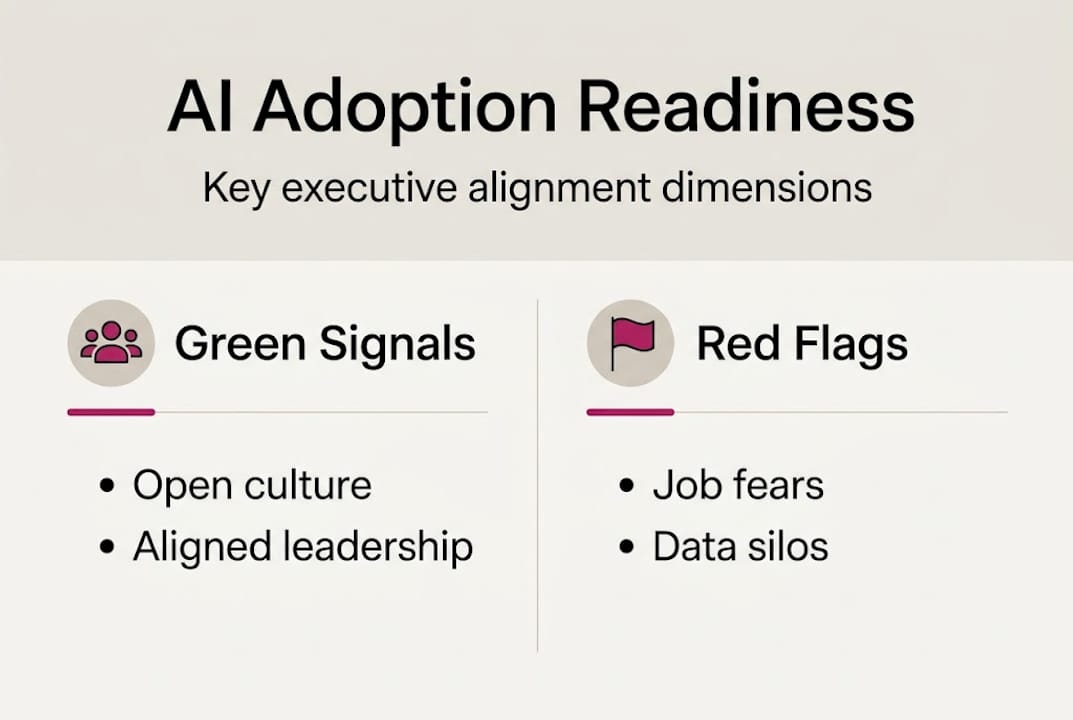
| Readiness dimension | Green signal | Red flag |
|---|---|---|
| Culture | Teams experiment openly | Fear of job loss dominates |
| Leadership | Unified AI vision | Competing departmental agendas |
| Data quality | Centralized, clean datasets | Siloed, inconsistent records |
| Governance | Policies in draft or live | No oversight structure exists |
Pro Tip: Use a standardized readiness assessment tool rather than relying on informal conversations. A structured scorecard surfaces blind spots that anecdotal feedback misses, and it gives you a baseline to measure progress against.
Once you have a clear readiness picture, you can prioritize where to focus first, rather than trying to boil the ocean.
Design high-impact AI pilots
Readiness assessed, now you need to choose where to start. The temptation is to pick the most ambitious use case to demonstrate transformational value. Resist it. The goal of an early pilot is to generate credible evidence, build internal confidence, and surface integration challenges in a controlled environment.

People-first change management, workflow redesign around AI agents, executive sponsorship, and iterative pilots are the methodologies that separate successful programs from expensive experiments. That framing matters. Your pilot isn’t just a technology test. It’s a change management exercise.
When selecting use cases, apply two filters: impact potential and implementation risk. High-impact, low-risk use cases are your starting point. Here’s how the two main pilot approaches compare:
| Pilot type | Best for | Risk level | Time to value |
|---|---|---|---|
| Quick-win pilot | Proving ROI fast, building buy-in | Low | 6-12 weeks |
| End-to-end transformation | Redesigning a full workflow | High | 6-12 months |
For most organizations, quick-win pilots are the right entry point. They generate momentum without requiring a full organizational redesign upfront.
Here’s a practical sequence for designing your pilot:
- Identify three to five candidate workflows with measurable outputs and willing team leads.
- Score each workflow on impact potential, data readiness, and change complexity.
- Select the top one or two and define clear success metrics before you start, not after.
- Design the workflow for augmentation, not full automation. AI should handle the repetitive, low-judgment steps while humans retain decision authority.
- Assign an executive sponsor who will actively remove blockers, not just attend status meetings.
The AI adoption process overview at Tekkr shows that the organizations seeing the fastest time to value are those that treat pilot design as a cross-functional initiative, not an IT project.
Pro Tip: Involve department heads in pilot selection from day one. When they co-own the use case, they advocate for it internally. When IT or a central AI team picks it for them, adoption resistance is almost guaranteed.
Experiment and evaluate pilots
With your pilot designed, execution is where theory meets reality. The biggest mistake organizations make here is running pilots too loosely, with no governance, no structured feedback loops, and no clear criteria for what “success” looks like.
Agile delivery principles apply directly to AI pilots. Run in short sprints, review outputs frequently, and iterate based on what you learn. This isn’t a waterfall project. You should expect to adjust your workflow design, your prompts, and your measurement approach as you go.
When evaluating pilot outcomes, focus on four dimensions:
- Effectiveness: Is the AI output actually usable, or does it require heavy rework? Track the ratio of accepted outputs to total outputs.
- Risk: Are there accuracy issues, compliance gaps, or data exposure concerns surfacing?
- Scalability: Does the workflow hold up at higher volumes, or does it break under load?
- User adoption: Are the people in the pilot actually using the tool, or reverting to old habits?
The barriers that derail pilots are predictable. Data silos, talent gaps, resistance to change, governance gaps, and overestimation of AI autonomy account for the majority of pilot failures. Naming these risks upfront and assigning owners to each one is not pessimism. It’s good program management.
“73% of security breaches during AI scaling are linked to poor protocols established during the pilot phase. What you permit in a pilot becomes the template for scale.”
The analytics for AI pilots you build during this phase become your evidence base for the scaling decision. Document everything, including what didn’t work. Organizations that treat failed pilots as learning assets move faster than those that bury the results. Review AI failure reasons from across the industry to pressure-test your own assumptions before you declare a pilot ready to scale.
Scale and integrate AI into workflows
A successful pilot is not a green light to flip a switch and roll out company-wide. Scaling requires deliberate infrastructure investment, governance frameworks, and a plan for continuous improvement. This is where many organizations stumble, moving too fast and discovering at scale the problems they missed in the pilot.
Phased scaling into workflows is the standard approach for a reason. It lets you manage risk, build organizational capability, and adjust before problems compound. And with 73% of security breaches in AI scaling linked to poor protocols, governance cannot be an afterthought.
Key priorities for the scaling phase:
- Embed governance and ethics frameworks before you expand access. Define who can use AI for what, how outputs are reviewed, and how incidents are reported.
- Address infrastructure gaps proactively. Scaling AI workloads puts pressure on data pipelines, API rate limits, and security architecture.
- Build a center of excellence (CoE) to own ongoing AI optimization. This team defines best practices, monitors performance, and transfers knowledge across departments.
- Measure innovation, not just cost savings. Track metrics like time-to-first-draft, decision cycle time, and employee confidence with AI tools, not just headcount ratios.
The continuous measurement strategies recommended by Stanford emphasize that organizations which measure only efficiency gains miss the broader value AI creates in speed, quality, and organizational learning.
| Phase | Key action | Success indicator |
|---|---|---|
| Diagnose | Readiness assessment complete | Gaps identified and prioritized |
| Design | Use cases selected, sponsors assigned | Pilot scope documented |
| Experiment | Agile sprints running | Output quality metrics tracked |
| Scale | Governance framework live | CoE operational |
| Integrate | AI embedded in standard workflows | Adoption rate above 70% |
The AI governance at scale layer is what separates organizations that sustain AI value from those that see it erode after the initial excitement fades.
Why transformation beats technology-first AI adoption
Here’s the uncomfortable truth most AI vendors won’t tell you: the technology is the easy part. You can deploy GPT-4, Copilot, or Claude across your entire organization in a matter of weeks. What takes longer, and what actually determines whether you win, is the organizational redesign that makes AI output usable.
Enterprise AI success is 70% people and organizational change, and only 30% technology. That ratio should reframe how you allocate your budget and your attention. If you’re spending 80% of your AI investment on tool procurement and 20% on change management, you have the ratio inverted.
The organizations we see getting real traction with organizational transformation with AI are not the ones with the most sophisticated tools. They’re the ones that have codified how great work gets done and embedded that knowledge into their AI workflows. Their AI outputs don’t need heavy rework because the AI already knows the company’s standards. That’s not a technology advantage. It’s an organizational one. And it compounds over time in ways that tool procurement never will.
Accelerate your AI journey with analytics and governance
You’ve mapped the process. Now the question is execution speed. Most organizations know what they need to do. The gap is having the infrastructure to do it consistently, across every team, every AI assistant, and every workflow.
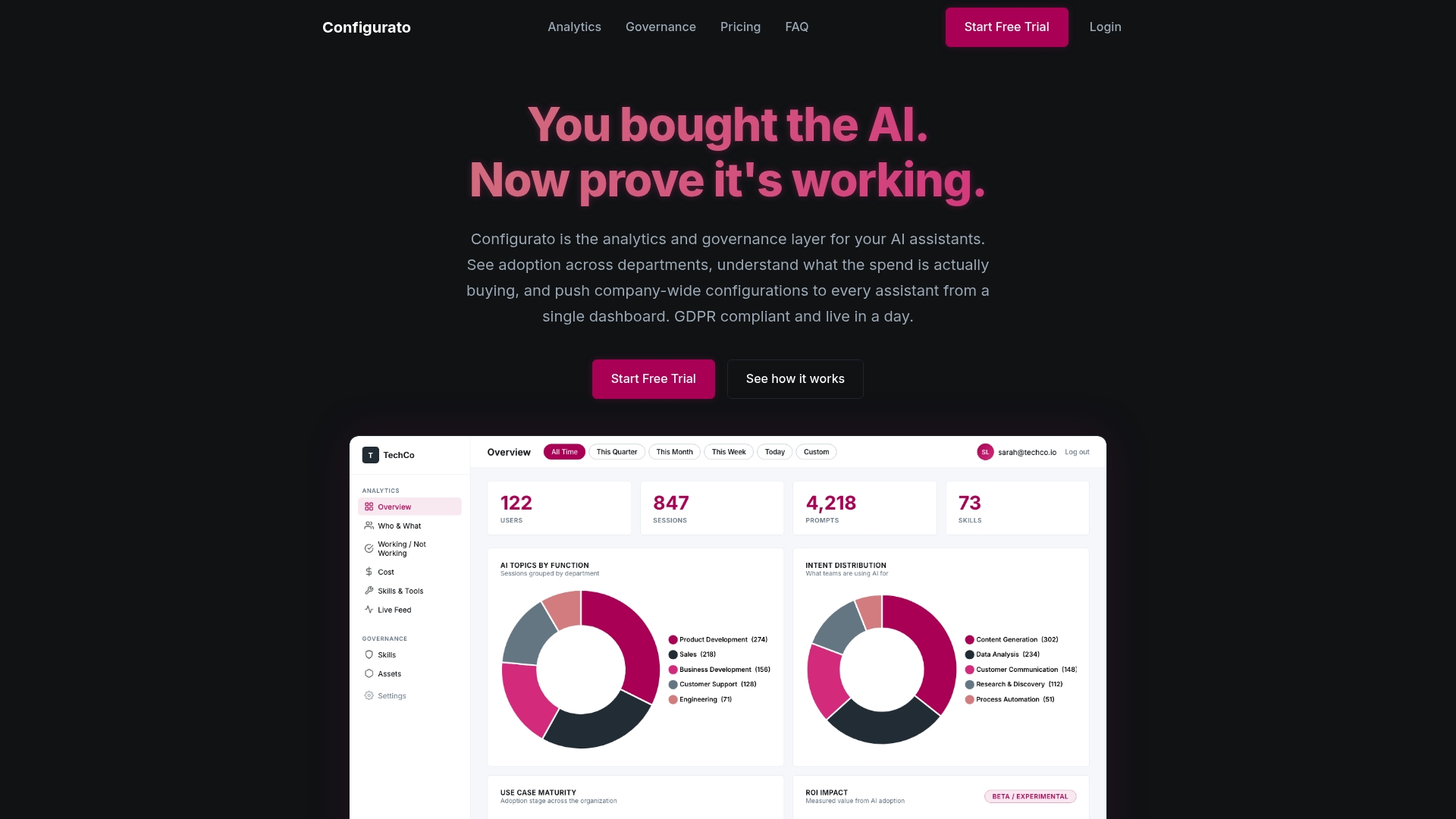
Tekkr’s AI analytics and governance platform is built for exactly this challenge. We embed your company’s processes, quality standards, and domain knowledge directly into the AI assistants your teams already use. No retraining. No new tools. Your people get AI output that already reflects how your organization works, from the first draft. If you’re serious about moving from pilot to scale without losing control of quality or governance, this is where to start.
Frequently asked questions
What is the typical timeline for organizational AI adoption?
Most organizations progress through five to six phases, with initial pilots lasting 3 to 6 months and full scaling taking up to 18 months depending on organizational complexity and readiness.
Why do most AI pilot projects fail to scale?
80% of pilots fail primarily due to data silos, talent gaps, resistance to change, and governance structures that were never built to handle scale.
How can executives ensure successful AI integration into workflows?
The most reliable path combines workflow redesign and governance with strong executive sponsorship, ongoing AI literacy programs, and measurement frameworks that track quality and adoption, not just cost reduction.
Should organizations choose augmentation or full automation with AI?
Augmentation is the right default for most organizations. Integrating AI to enhance human decision-making rather than replacing it entirely reduces risk, maintains accountability, and drives higher adoption among the teams who need to trust the output.