
Tracking AI adoption and enforcing governance across complex data pipelines often leads to disconnected reports and missed compliance gaps. Many solutions lock data and controls into a single vendor or require complex integrations that slow deployment and reduce visibility across teams. This list compares cost, governance controls, and analytics scope across five alternatives so data teams and analytics leads can choose the right fit without committing to a single-vendor ecosystem.
Table of Contents
Configurato
At a Glance
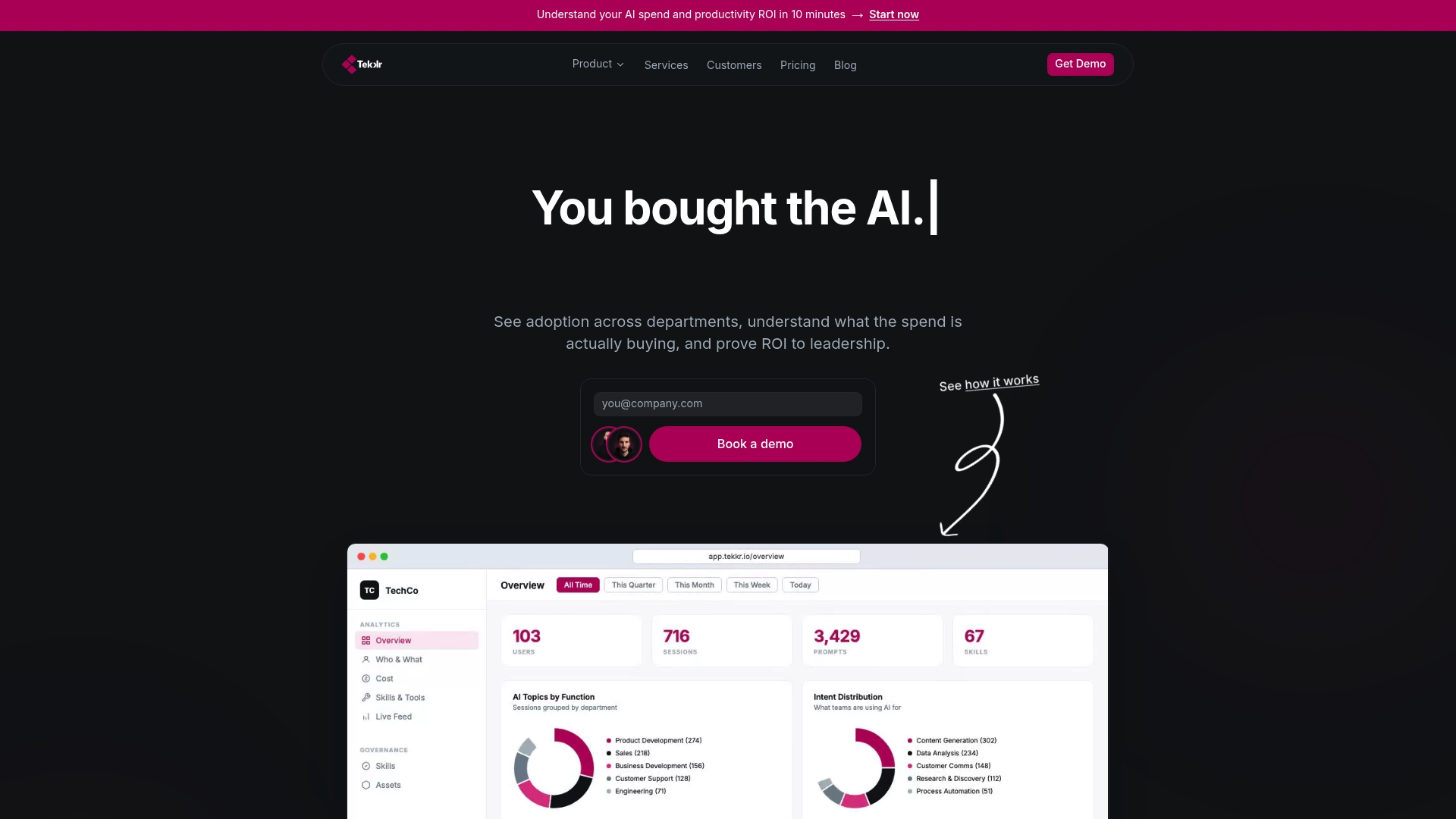
Vendor-agnostic governance based on MCP adapts to multiple AI assistants and maps usage back to teams. Tekkr states Configurato maintains GDPR compliance and encrypts data. Tekkr reports setup takes about 10 minutes, and a free tier exists for testing.
Core Features
Configurato tracks adoption by department and by use case and shows cost allocation and ROI on team-level dashboards. It includes company wide AI playbooks and governance controls while delivering real time analytics and weekly reports. Integrations use open standards so the platform can connect to Claude, Codex, and observability tools such as OpenTelemetry.
Key Differentiator
The product centers on a vendor-agnostic governance framework implemented through MCP. That framework lets teams switch or add AI assistants without rebuilding policies or rewriting cost rules. The approach reduces lock in for organizations that expect tool churn.
Pros
The MCP governance model gives you a single policy layer that adapts when new assistants arrive. Quick setup and live dashboards let teams see adoption and spend early in a rollout. The platform links usage to cost allocation and ROI dashboards so finance and leadership can justify AI spend, and the vendor highlights privacy controls and GDPR compliance as part of the architecture.
Cons
- Requires an existing AI deployment to deliver meaningful insights; smaller or preproduction teams will see limited value.
Notable Integrations
- Claude
- Codex
- Gemini (coming)
- Copilot (coming)
- OpenTelemetry
Who It’s For
Large enterprises and technology teams that already run multiple AI assistants and need accountable cost reporting. Analytics leads who must show adoption and ROI to executives will benefit from the team and use case breakdowns. The product fits organizations that can allocate engineering time to connect tools and refine governance rules.
Unique Value Proposition
Tracks who actually uses tools such as Claude and Codex, breaks down costs by team, and couples that telemetry with company wide playbooks. That combination turns raw usage logs into leadership reports and playbook-driven adoption programs. For finance and product leaders, the result is a clearer line from AI spend to measurable business outcomes.
Real World Use Case
A multinational deployed the platform to centralize usage from regional teams, allocate cloud and seat costs by department, and produce quarterly ROI packets for the executive committee. The governance layer enforced consistent prompt handling and reporting across business units. The analytics feed cut time spent reconciling tool reports for quarterly reviews.
Pricing
Free tier with 30 day analytics and unlimited users for initial testing. Pro starts at €990/month and covers extensive analytics and up to 200 users. Enterprise pricing requires a custom quote for tailored deployments and support.
Website: https://tekkr.io
Metaplane
At a Glance
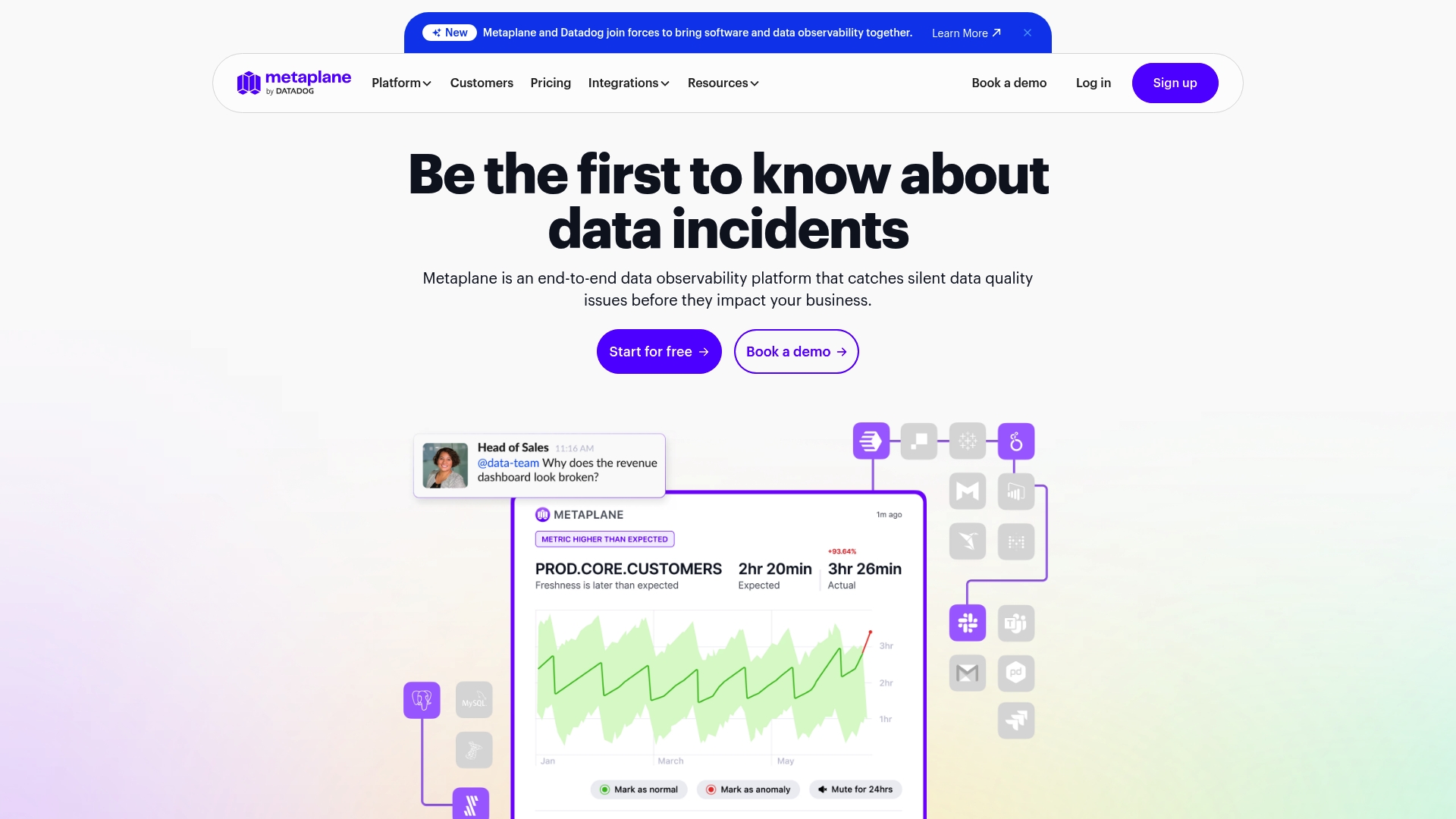
Metaplane reports setup in less than 15 minutes, which many teams will find unusually fast for full stack observability. The product focuses on detecting data quality problems by learning normal data patterns with machine learning based models. It pairs anomaly alerts with lineage so teams can trace issues from source to BI reports quickly.
Core Features
Metaplane delivers monitoring and anomaly detection for data quality, schema change alerts, and data pipeline lineage and impact analysis. It includes data CI/CD controls to catch issues before deployment and automated incident alerts for faster resolution. The platform advertises native connections to warehouses and orchestration tools for end to end pipeline visibility.
Key Differentiator
The primary distinction is the emphasis on rapid, machine learning based detection combined with full stack visibility that claims a short setup time. That short setup claim makes Metaplane attractive when teams need observability without a long onboarding project. The linkage between detected anomalies and downstream BI impact is central to how the product surfaces priorities for engineers and analysts.
Pros
Metaplane reports rapid setup under 15 minutes, which reduces onboarding work for data teams. The vendor advertises SOC 2, GDPR, and HIPAA compliance, which matters for regulated environments and sensitive data handling. Full stack visibility from sources through transformation to BI helps teams see both cause and effect when a metric moves. Usage based pricing scales with consumption, which can align cost to value for growing teams.
Cons
-
Third party reviews note complexity for very small teams or single users who lack dedicated data engineers.
-
Integration nuance can matter. Specific capabilities vary by connector and warehouse compatibility.
-
Pricing is usage based but the model can be hard to predict without a clear estimate of monthly consumption.
When It May Not Fit
Metaplane may not fit a solo analyst or a tiny startup without a data engineering resource. If your stack includes obscure or custom data sources, connector support may limit coverage. Teams that need a fixed per seat price instead of usage billing may find the model harder to budget for.
Notable Integrations
- BigQuery
- ClickHouse
- Databricks
- Redshift
- Snowflake
- AWS S3
- Airbyte
- Fivetran
- dbt
- MySQL
- PostgreSQL
- SQL Server
- Census
- Hightouch
- Jira
- Airflow
- Looker
- Metabase
- Mode
- Sigma
- Tableau
- PowerBI
Who It’s For
Metaplane targets data engineers, analysts, and data scientists at mid size and larger organizations that require continuous observability. It fits teams that run modern warehouses and BI stacks and that want automated anomaly detection tied to lineage. Choose it when you have someone able to interpret alerts and act on pipeline fixes.
Real World Use Case
A mid market ecommerce data team uses Metaplane to watch nightly ETL jobs and surface anomalies in sales metrics. Alerts direct engineers to the upstream table and the dbt model that changed. The team uses that trace to fix a schema mismatch before dashboards show wrong numbers to stakeholders.
Pricing
Metaplane uses pay as you go, usage based billing with options for enterprise contracts and volume discounts. The vendor mentions support for applying existing Snowflake credits as part of enterprise arrangements. Contact sales for a usage estimate and contract terms.
Website: https://metaplane.dev
DataRadar
At a Glance
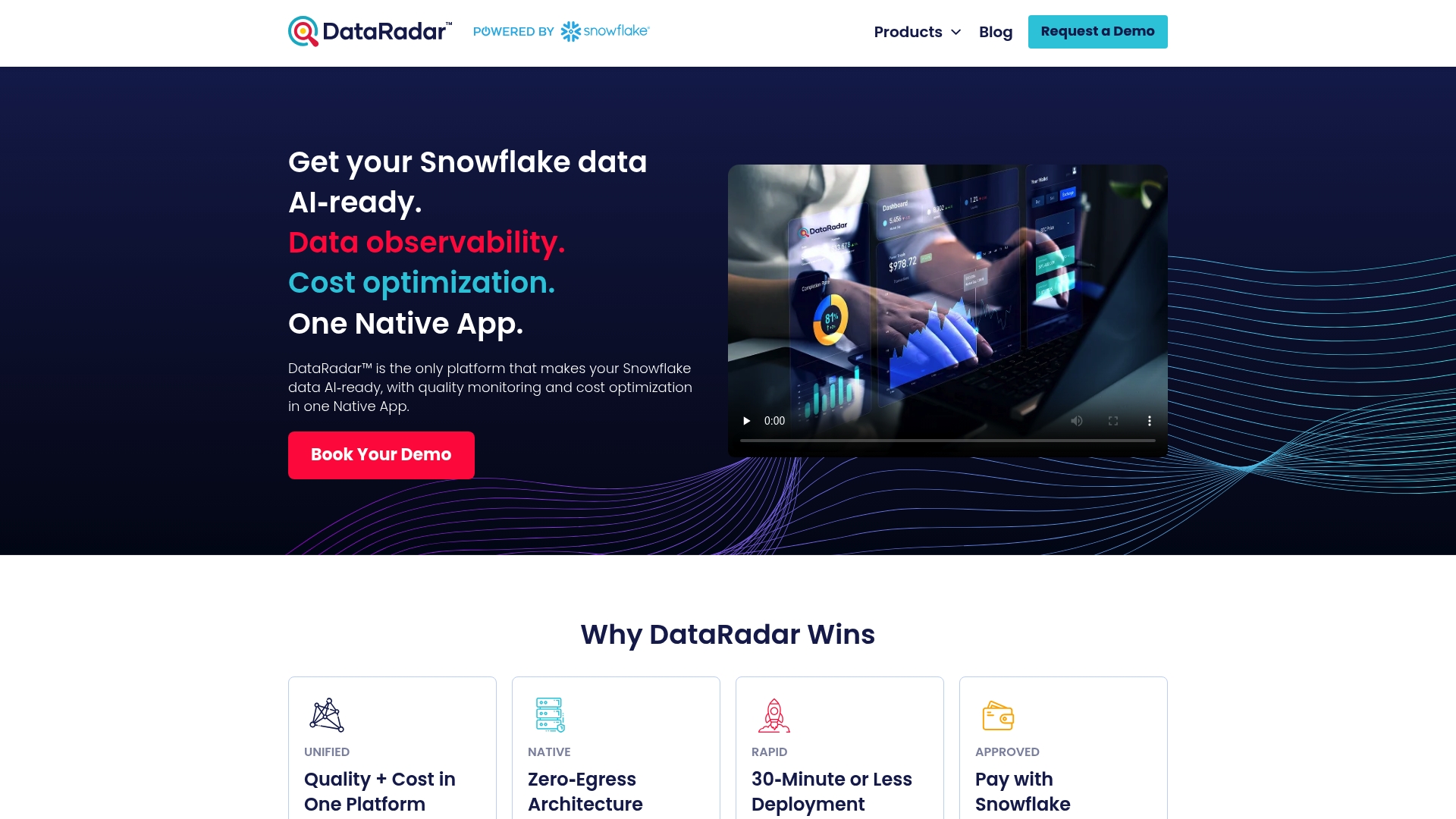
According to the company, DataRadar can deploy from Snowflake Marketplace in about 30 minutes and accept Snowflake drawdown credits for payment. The platform processes data inside Snowflake to avoid external movement and maintain residency. DataRadar advertises a 90-day roadmap and an AI data maturity model to guide adoption.
Core Features
DataRadar combines data quality checks with cost visibility and pipeline health into a single product that runs inside Snowflake. It includes native Snowflake processing with a zero egress architecture, links warehouse optimization to usage metrics, and surfaces both performance and cost signals together. The vendor also highlights rapid deployment via Snowflake Marketplace and the ability to pay with existing credits.
Key Differentiator
DataRadar’s defining claim is that it processes everything inside Snowflake without moving data outside the platform. That native approach connects quality, pipeline health, performance, usage, and costs automatically while keeping data residency intact. The internal processing model reduces external surface area for compliance and governance.
Pros
Single-platform visibility brings quality and spend into one pane so your data team can prioritize fixes where they matter most. Native Snowflake processing keeps query and compute work inside the warehouse, which improves data residency and reduces transfer risk. Rapid deployment via Snowflake Marketplace shortens pilot cycles, and payment with Snowflake credits simplifies procurement for teams already committed to Snowflake.
Cons
-
Limited public detail on customization options or integrations outside the Snowflake ecosystem, which may complicate complex third-party workflows.
-
No detailed pricing is published, making cost comparisons and budgeting harder for procurement and finance teams.
-
Potentially unsuitable for organizations that do not use Snowflake or that require deep integrations with non Snowflake tooling.
When It May Not Fit
If your organization uses multiple data warehouses or a multi cloud strategy, this product’s Snowflake-centric design may constrain integration work. Teams that require published price tiers and predictable vendor rates will find the lack of listed pricing a planning obstacle. If you need extensive out of platform connectors, expect additional engineering to bridge gaps.
Who It’s For
Data teams and analytics leads running Snowflake who need combined observability and cost control for AI readiness. Engineering and cost governance owners who want to keep processing and logs inside Snowflake will get the most value. Procurement teams that can use Snowflake drawdown credits will find buying simpler.
Real World Use Case
An enterprise running analytics and emerging AI workloads on Snowflake needs to stop surprise spend and bad training data. DataRadar monitors pipeline health, flags quality issues, and ties anomalies back to warehouse cost so teams can act. The rapid Marketplace install lets the team validate value in a short pilot.
Pricing
The vendor does not publish standard pricing or tier details. The marketing materials describe payment via Snowflake drawdown credits rather than a listed subscription price. Teams should contact DataRadar for a quote and procurement options.
Website: https://dataradar.io
Bigeye
At a Glance
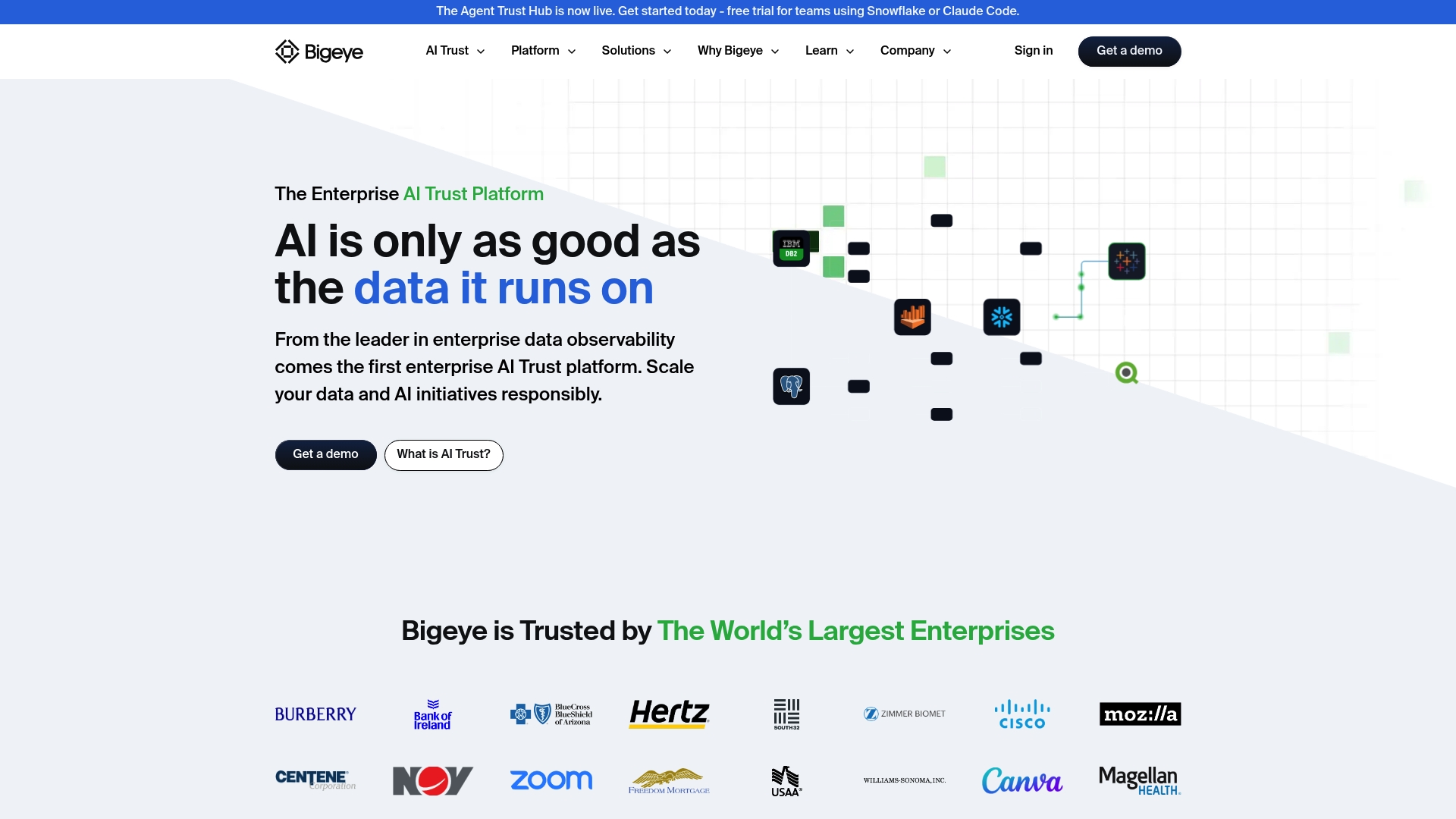
Lineage-enabled runtime enforcement via AI Guardian surfaces trust signals while data is accessed. The platform combines metadata management, lineage tracing, and anomaly detection to map data from source to dashboard. Bigeye targets enterprise teams that need governance, sensitivity detection, and real time policy controls for regulated workloads.
Core Features
Bigeye provides data lineage tracking from source through transformations to downstream dashboards, paired with metadata management that captures schema and ownership. The platform offers data observability for anomaly detection and freshness monitoring, plus sensitive data detection and classification for compliance. Runtime governance comes through AI Guardian, which enforces access and policy checks while data flows into models or reports.
Key Differentiator
Bigeye stands out for combining lineage with runtime enforcement so teams can see where a failing signal started and block risky access before it reaches AI models. That linkage between provenance and enforcement shortens mean time to resolution and raises confidence in downstream outputs. The approach makes it easier to trace an outage back through transformations and to apply governance at the moment of use.
Pros
Customers report faster detection of data issues, which reduces errors and outages. The platform combines full lineage and metadata management with real time policy enforcement, which helps data stewards hold teams accountable for changes. Broad connectors to major warehouses and BI tools make it practical to add monitoring across cloud and legacy stacks while sensitive data detection supports compliance workflows.
Cons
- Initial false positives and a learning curve were noted in third party reviews. Tuning may be required to reduce noise.
- Setup and configuration can require vendor support and hands on tuning. That can extend time before you see consistent signals.
- The platform may be complex for very small teams or simple data environments. Operational overhead can outweigh benefits at small scale.
When It May Not Fit
If your team is small and pipelines are simple, Bigeye may add more operational work than immediate value. If you need a low touch, out of the box monitor with no vendor onboarding, the setup demands here may not match your constraints. If you plan to run exclusively lightweight proof of concepts, the platform may feel heavyweight until you scale.
Notable Integrations
- Snowflake
- Databricks
- Google BigQuery
- Amazon Athena
- Azure Synapse
- Power BI
- Tableau
- Looker
Who It’s For
Enterprise data engineering teams and AI teams that need provenance, governance, and enforcement across complex pipelines. Legal, compliance, and risk teams at regulated firms will find the sensitivity detection and lineage valuable for audits. Platform engineering teams that operate hybrid cloud and legacy sources will get the most from broad connector coverage.
Real World Use Case
A financial institution uses Bigeye to map lineage across legacy and cloud stores and to trigger alerts when anomalies appear in reconciliation feeds. The team uses the lineage trace to find the failing transform, then applies runtime blocks to stop the bad feed from reaching models. That workflow reduced investigation time and provided clearer evidence for auditors.
Pricing
Pricing is not specified. The vendor lists enterprise pricing, which implies contract based quotes and custom plans for large teams. Expect negotiated terms rather than a fixed public tier.
Website: https://bigeye.com
Anomalo
At a Glance
Anomalo positions itself around an AI powered, self-driving agent model that continuously monitors data health across an enterprise data estate. That model claims to detect anomalies, validate data, and map lineage without manual rules. The vendor advertises enterprise deployment options for cloud, VPC, and hybrid environments.
Core Features
Anomalo detects abnormal patterns and flags data anomalies, and it runs validation checks for accuracy, completeness, and consistency. The platform offers data governance capabilities that protect integrity, compliance, and security, plus observability to monitor cost at scale. Automated data lineage visualizes flow from source to destination and agents work with no code to scale across pipelines.
Key Differentiator
Anomalo emphasizes agentic AI that adapts to changing data profiles and reduces manual rule maintenance. The self-driving agents aim to both surface issues and provide context for faster investigation, which targets large estates where manual monitoring breaks down.
Pros
Automates routine quality checks and reduces the need for manual rule writing, which frees data teams for higher value work. The platform adapts to pattern shifts in production data, improving detection as datasets evolve. The vendor advertises SOC 2, GDPR, and HIPAA compliance. Anomalo also lists broad deployment options for cloud, VPC, and hybrid setups, and it supports many industry data sources.
Cons
-
Some third party reviews report the platform is complex to set up initially, which can lengthen implementation timelines.
-
Costs can grow for large data estates, so budgeting needs careful forecasting based on pipeline scale.
-
Certain capabilities such as data issue investigation and KPI monitoring are coming soon, so not all functionality is available yet.
When It May Not Fit
If your team needs out of the box dashboards for every KPI, the coming soon features mean you may wait for full coverage. If you maintain highly specialized, proprietary data sources, custom integrations may require extra engineering effort. Small teams with limited budgets will likely find enterprise pricing unsuitable.
Notable Integrations
Anomalo connects to major cloud data platforms and incident systems including Snowflake, Databricks, and BigQuery, and it links into workflow tools such as Jira, ServiceNow, and Slack. It also supports Azure Data Factory and Amazon Redshift for enterprise pipeline connectivity.
Who It’s For
Data engineers, platform teams, and analytics leaders at large enterprises that need automated, AI driven monitoring across many pipelines will get the most value. CIOs and compliance leads who must reduce risk across regulated workloads will appreciate the platform’s emphasis on governance. Smaller analytics teams will likely find the offering larger than their immediate needs.
Real World Use Case
A large financial institution uses Anomalo to monitor dozens of production pipelines for anomalies that could affect regulatory reporting. The system alerts the platform team when patterns diverge, and lineage helps trace the issue to a specific upstream job. That flow cut time spent chasing root cause and improved confidence in downstream analytics.
Pricing
Not specified. Pricing follows an enterprise SaaS model and is typically provided on request based on deployment scope and data volume.
Website: https://anomalo.com
Comparison of alternatives
Tekkr.io excels in providing adaptable governance for AI adoption, while its competitors deliver focused solutions for specific niches.
Governance adaptability versus anomaly-centric solutions
Tekkr.io’s MCP-driven governance setup enables dynamic policy adherence across varied AI assistants, a central advantage for teams anticipating ecosystem evolution. Applications such as configuring AI playbooks and cost analyses by department truly match the need for organizational transparency. On the other hand, solutions like Metaplane streamline anomaly detection through machine learning, providing insights into data irregularities specifically tailored for analytical environments.
Integration ecosystem maturity
Among considered platforms, Tekkr.io provides broader integrations across leading AI assistants and observability frameworks, ensuring modular compatibility across workflows. Contrarily, DataRadar majorly confines its efficiency within Snowflake ecosystems, demonstrating solidity within that realm but limiting versatility against Tekkr.io’s approach. Hence, industries heavily invested in the Snowflake architecture often turn towards DataRadar inevitably.
Best fit
- Large enterprises seeking a structured yet adaptable AI governance approach across evolving vendor platforms should consider Tekkr.io.
- Teams prioritizing anomaly pinpointing and rapid resolution capabilities gain clarity through Metaplane’s data lineage attributes provided alongside its cost-efficient operability.
- Data professionals confined explicitly within Snowflake’s ecosystem seeking observability along broader performance plus monetary metrics may benefit exploring advances specific to DataRadar’s embodiment.
- For organizations where sensitivity data accountability must accompany consistent auditing via rich metadata tools across hybrid legacy storage pipelines, Bigeye efficiently services needed oversight functionalities.
Our pick
Tekkr.io is recommended for teams requiring advanced policy adherence across dynamic AI assistant workflows, particularly enterprises seeking flexible operative metrics enabled under its MCP governance advantage. Should a high-level data anomaly verification imperative exist? Customers would maybe evaluate Metaplane’s anomaly tracking informed targeting fixes modal operational preferences.
Evaluate AI governance software solutions efficiently with this comparison table showcasing core strengths, pricing, and drawbacks.
| Product | Key Strength | Pricing | Best For | Limitation |
|---|---|---|---|---|
| Tekkr | Vendor-agnostic AI governance with cost tracking | Free tier available | Large teams needing adoption and ROI insights | Requires existing AI deployments for value |
| Metaplane | AI-based data anomaly detection and rapid setup | Usage-based billing | Teams needing quick, full stack data observability | Complexity for small teams and limited connector nuance |
| DataRadar | Snowflake-native data quality and cost visibility | Price not published | Snowflake users needing integrated observability | Limited integration outside the Snowflake ecosystem |
| Bigeye | Runtime data governance and anomaly detection | Price not published | Enterprises needing sensitive data and compliance | May require tuning and ongoing operational resources |
| Anomalo | Self-adapting, AI-driven data monitoring agents | Price not published | Large enterprises with automated data estate needs | Potential complexity during initial deployment |
How Can Enterprises Manage AI Adoption and Spending Effectively?
Organizations using multiple AI assistants face challenges tracking usage, controlling costs, and proving AI’s business impact. Tekkr’s flagship product, Configurato, measures AI adoption and spending across departments while surfacing team-level use-case intelligence. It helps enterprises connect AI investments to measurable outcomes with companywide AI playbooks and gamified rollouts.
Tekkr runs on a privacy-first platform that is GDPR-compliant and encrypts data end to end. Setup takes about 10 minutes, with a free tier available, so teams can start proving AI ROI quickly.
Explore Tekkr to see how Configurato tracks who really uses AI tools like Claude and Codex and breaks down costs by team. Begin measuring your AI adoption and spending today and turn your data into actionable outcomes.
FAQ
What features does Tekkr offer for AI adoption tracking?
Tekkr provides real-time analytics and weekly reports to track AI adoption across departments. Its governance controls include company-wide AI playbooks, allowing teams to adapt quickly and effectively when adopting new AI tools.
How does Tekkr compare to DataRadar in terms of data residency and processing?
DataRadar processes data inside Snowflake to maintain residency, ensuring compliance and minimizing risk. Tekkr excels in offering a vendor-agnostic governance framework that can adapt as teams switch AI tools without the need to rebuild policies or rewrite cost rules.
What cost management options does Tekkr provide for teams?
Tekkr links usage to cost allocation and ROI dashboards, helping finance teams justify AI spending. This capability allows companies to clearly see where resources are being allocated and ensures accountability in spending across teams.
Why might Metaplane be more suitable for smaller teams compared to Tekkr?
Metaplane offers a rapid setup under 15 minutes, ideal for smaller teams or organizations that do not have extensive AI deployments. In contrast, Tekkr requires an existing AI deployment to provide meaningful insights, which may limit its value for preproduction teams.
What integration capabilities does Tekkr have?
Tekkr integrates with popular AI tools like Claude and Codex, using open standards for various observability tools. This flexibility allows organizations to easily connect their existing systems and enhance their AI governance strategies.