
Leadership quality is the single strongest predictor of AI adoption success, not budget size, tool selection, or technical talent. McKinsey’s 2025 research shows only 6% of organizations capture meaningful financial value from AI. High performers share one trait: senior leaders who actively use AI systems themselves are three times more likely to appear in that 6%. The role of leadership in AI adoption is not a soft factor. It is the decisive variable. Executives who treat AI as a technology project to delegate will watch their investments stall. Those who own it personally will see results.
What leadership behaviors actually drive AI adoption?
The five behaviors that separate high-performing AI leaders from the rest are specific and repeatable. Leadership strategist Shawn Kanungo’s 2026 analysis identifies them clearly: use AI tools publicly, pick 3–5 high-value bets, appoint a Chief AI Officer (CAIO) with real budget authority, mandate AI literacy across the organization, and tie AI KPIs directly to executive compensation.
Each behavior carries weight on its own. Together, they create a system of accountability that bottom-up AI experiments cannot replicate.
- Use AI tools publicly. When a CEO uses Claude or Microsoft Copilot in a leadership meeting and references the output, it signals that AI is a serious business tool, not a side experiment. Employees follow what leaders model, not what they mandate.
- Pick 3–5 high-impact workflows. Scattered pilots produce scattered results. Focused bets on specific workflows, such as contract review, customer support triage, or code generation, create measurable outcomes that justify further investment.
- Appoint a CAIO with authority. A Chief AI Officer without budget control is a figurehead. The role requires cross-functional authority to reallocate resources, retire legacy tools, and hold teams accountable.
- Mandate AI literacy programs. Fewer than 50% of CEOs feel confident building AI capabilities at the pace the market demands. Structured literacy programs close that gap at every level of the organization.
- Link AI KPIs to compensation. When executive bonuses depend on AI adoption metrics, the conversation changes. Accountability becomes real.
Pro Tip: Start your AI literacy program with the executive team before rolling it out company-wide. Leaders who cannot articulate what a large language model does will struggle to set credible expectations for their teams.
How does leadership shape trust and culture during AI rollout?

AI adoption is fundamentally a human transformation, not a technology implementation. Organizations fail when leaders treat the human factors as secondary to the technical rollout. The tools can be perfect. If employees do not trust them, or trust the leaders deploying them, adoption flatlines.
The cultural challenges executives face during AI rollout fall into three categories:
- Anxiety about job displacement. Employees fear AI will eliminate their roles. Leaders who avoid this conversation create a vacuum that rumors fill. Direct, honest communication about AI’s role and its limits is not optional.
- Loss of social connection. AI-assisted workflows can reduce the natural collaboration that happens when people solve problems together. Leaders must design for connection, not just efficiency.
- Resistance from high performers. Counterintuitively, your best people often resist AI hardest. They built their status on skills AI now partially replicates. Empathetic leadership that acknowledges this dynamic converts resistors into advocates.
Harvard Business Review’s April 2026 research confirms that empathetic leadership during AI adoption reduces employee anxiety and increases efficiency, collaboration, and idea generation. That is not a soft outcome. It is a productivity multiplier.
“Change management is not a parallel workstream to AI implementation. It is the implementation.” This distinction matters because most organizations staff their AI rollouts with engineers and product managers, then wonder why adoption stalls at 20%.
Pro Tip: Run a 30-minute “AI anxiety” session with each department head before launching new AI tools. Surface the real concerns early. The conversations you avoid become the adoption blockers you cannot explain six months later.
What is clean hands syndrome and why does it kill AI projects?
Clean Hands Syndrome is the leadership gap where decision-makers approve AI strategy but remain detached from operational reality. The leader signs off on the roadmap, attends the quarterly review, and never touches the system. The result is strategy built on slides rather than on how the technology actually performs in production.
The table below shows how detached leadership compares to hands-on leadership across the metrics that matter most.
| Factor | Detached Leadership | Hands-On Leadership |
|---|---|---|
| Strategy source | Vendor presentations and reports | Direct experience with live systems |
| Workflow redesign | Based on theoretical efficiency gains | Based on observed friction in production |
| Adoption accountability | Delegated to IT or a project manager | Owned by a named executive with KPIs |
| Employee trust | Low, because leaders cannot speak to specifics | High, because leaders demonstrate personal use |
| Time to measurable value | 12–24 months or never | 3–6 months with focused bets |
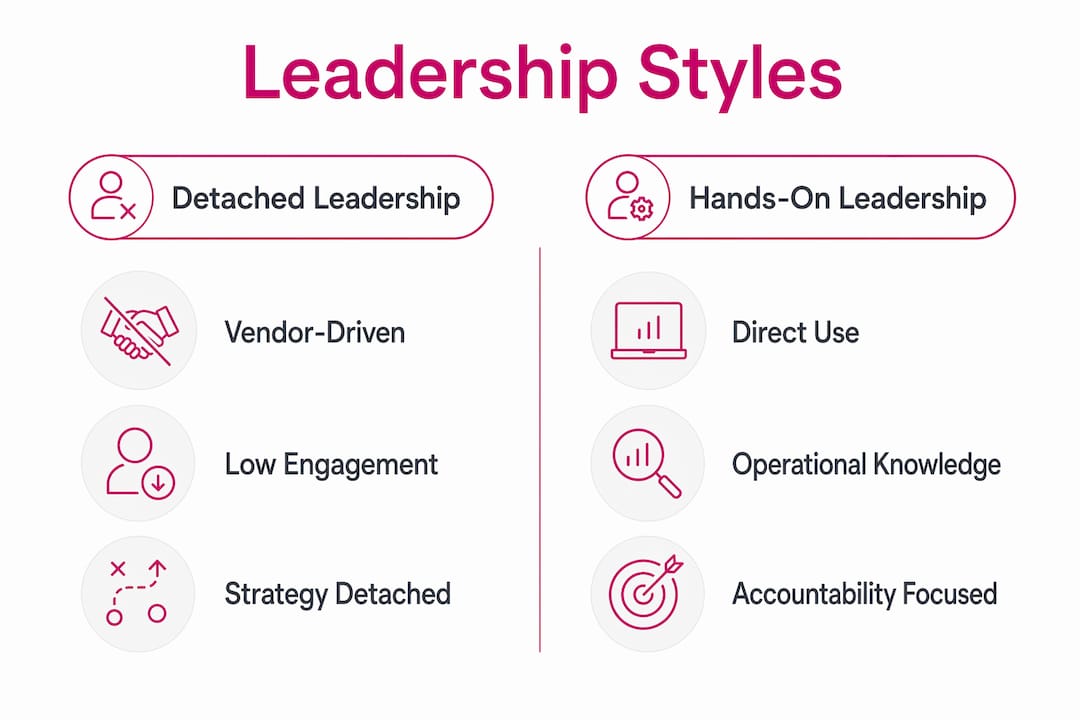
High-performing leaders engage directly with AI systems in production environments. They know what the tool gets wrong. They understand why a workflow that looked clean in a demo breaks down under real data conditions. That knowledge is not available from a status report.
The distinction between AI governance and AI ownership is critical here. Governance means setting rules. Ownership means being accountable for outcomes. Most organizations have governance. Very few have ownership.
Pro Tip: Block two hours per month to use your organization’s primary AI tool on a real work task. Not a demo. Not a test prompt. A task you would otherwise do yourself. The operational insight you gain will be worth more than any vendor briefing.
How should leaders align AI strategy with business outcomes?
84% of enterprises believe AI investments will yield competitive advantage, but most cannot name a specific business decision where AI changed an outcome within the past week. That gap between belief and evidence is a strategy problem, not a technology problem.
The most effective tool for closing that gap is what practitioners call an AI North Star. Successful leaders run a short alignment sprint to produce a one-page document covering four elements: objectives, value, guardrails, and accountability. The sprint takes days, not months. The output prevents the scattered pilot problem that consumes AI budgets without producing results.
Here is how top-down and bottom-up AI strategies compare in practice:
| Dimension | Top-Down Strategy | Bottom-Up Strategy |
|---|---|---|
| Focus | 3–5 prioritized workflows with executive ownership | Dozens of team-level experiments |
| Accountability | Named executive tied to business KPIs | Distributed, often unclear |
| Speed to value | Fast, because resources concentrate on proven bets | Slow, because learning is fragmented |
| Scalability | High, because governance is built in from the start | Low, because each team builds its own approach |
| Risk of “innovation theater” | Low | High |
Bottom-up AI strategies are no longer sufficient alone. They generate energy and surface ideas, but they do not produce the organizational change that justifies enterprise AI investment. Top-down leadership with focused bets creates the accountability structure that turns pilots into programs.
The practical starting point is mapping your current AI investments to specific business decisions. If you cannot answer “which decision does this tool improve, and by how much,” the investment is not yet strategic. That mapping exercise, done in a single working session with your CAIO and two or three business unit heads, will surface both your best bets and your wasted spend faster than any audit.
You can find a deeper breakdown of AI adoption strategies that connect leadership decisions to measurable enterprise value in Tekkr’s resource library.
Key takeaways
Leadership is the decisive factor in AI adoption: organizations with hands-on executive ownership are three times more likely to capture real financial value from their AI investments.
| Point | Details |
|---|---|
| Hands-on leadership multiplies results | Senior leaders who personally use AI tools are 3x more likely to appear among top AI performers. |
| Five behaviors define AI leadership | Public AI use, focused bets, CAIO appointment, literacy mandates, and KPI-linked compensation drive adoption. |
| Human factors determine adoption speed | Empathetic leadership that addresses anxiety and builds trust accelerates AI uptake across teams. |
| Clean Hands Syndrome stalls AI value | Leaders detached from operational reality produce strategies that fail in production environments. |
| An AI North Star prevents scattered pilots | A one-page alignment document with objectives, value, guardrails, and accountability focuses resources on outcomes. |
Why leadership will define AI winners in 2026
From where Tekkr sits, watching organizations deploy AI tools across hundreds of teams, the pattern is consistent. The technology is rarely the problem. The leadership model almost always is.
The most common mistake I see is executives who treat AI adoption as a transformation they sponsor rather than one they lead. They approve the budget, attend the kickoff, and then check in quarterly. By the time the quarterly review arrives, adoption is at 15%, the team is demoralized, and the vendor is being blamed for outcomes that were always a leadership problem.
The second mistake is optimism without accountability. Leaders announce AI transformation goals with genuine enthusiasm, then fail to assign a specific person with specific authority to deliver them. Visible executive commitment and explicit ownership by a senior leader with cross-silo authority are what separate transformation from theater. Without both, AI initiatives drift.
What actually works is unglamorous. It is a leader who blocks time to use the tools, who can speak credibly about what the AI gets wrong, who has named a CAIO and given that person real power, and who has tied their own performance review to adoption outcomes. That leader does not need a perfect strategy. They need discipline and personal accountability.
The executives who will define their organizations’ AI trajectories in 2026 are not waiting for the technology to mature. They are building the leadership muscle now, while their competitors are still debating governance frameworks.
— TekkrTools
How Tekkr helps executives lead AI adoption
Buying AI tools is the easy part. Proving they work is where most organizations get stuck.
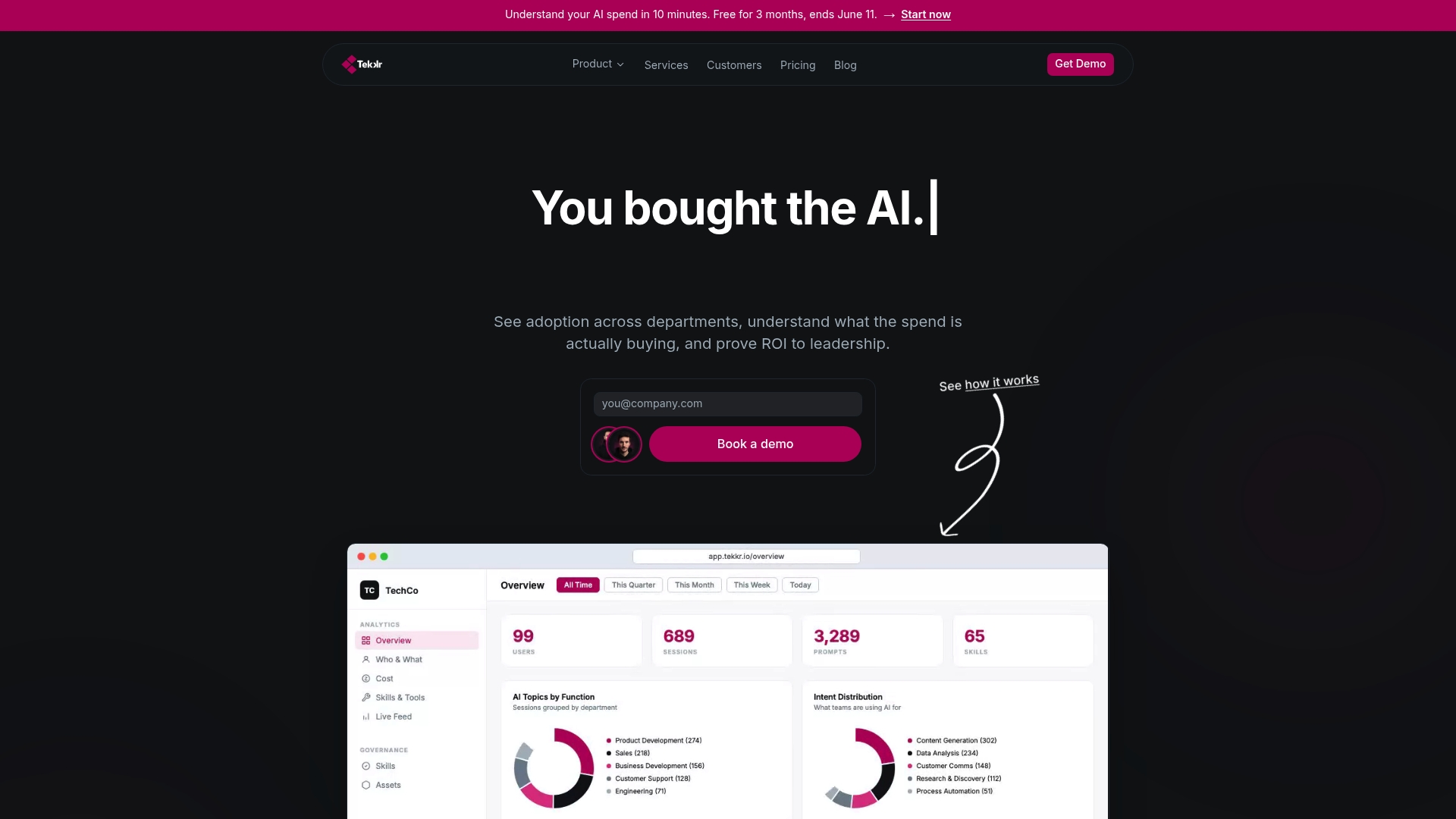
Tekkr’s flagship product, Configurato, gives executives the visibility they need to lead with confidence. It tracks real usage of tools like Claude and Codex across every team, breaks down AI spend by department, and surfaces which use cases are actually delivering value. Beyond measurement, Configurato drives adoption higher through gamified rollouts and company-wide AI playbooks, so your investment moves from licensed to actively used. Everything runs on a privacy-first, GDPR-compliant architecture with no browser extensions required. Setup takes 10 minutes, with a free tier and no credit card needed. If you are ready to turn your AI investment into a measurable result, explore Tekkr’s AI adoption solutions built specifically for executive-led transformations.
FAQ
What is the single biggest leadership failure in AI adoption?
Clean Hands Syndrome is the most common failure: leaders approve AI strategy without engaging with the systems in production. This creates strategies that look sound on paper but break down against operational reality.
How many AI workflows should an executive prioritize?
Focus on 3–5 high-impact workflows rather than spreading investment across dozens of pilots. Concentrated bets with named executive accountability produce measurable outcomes faster than distributed experimentation.
Does empathetic leadership actually affect AI adoption rates?
Yes. Harvard Business Review’s 2026 research confirms that empathetic leadership reduces employee anxiety and increases efficiency and collaboration during AI rollouts. Addressing human concerns is a productivity decision, not just a cultural one.
What is an AI north star and why does it matter?
An AI North Star is a one-page document produced during a short alignment sprint that defines objectives, value, guardrails, and accountability for AI initiatives. It prevents the scattered pilot problem that consumes budgets without producing results.
Should AI kpis be tied to executive compensation?
Linking AI transformation KPIs to executive compensation is one of the five behaviors that define top AI-performing CEOs. When personal incentives align with adoption outcomes, accountability becomes real and measurable.