
You deployed the AI tools. Adoption metrics look solid. But when the board asks what it’s actually done for the business, you hesitate. That’s the core challenge in knowing how to trace AI impact in business: usage data tells you people are touching the tools, not whether the work got better. Without a deliberate measurement framework, you’re flying blind on one of your biggest investments. This guide walks you through defining the right success metrics, instrumenting your workflows, attributing outcomes with confidence, and building governance that makes the results stick.
Table of Contents
- Key Takeaways
- How to trace AI impact in business: start with preparation
- Instrumenting AI workflows to capture real metrics
- Verifying results: attribution and ROI calculation
- Measurement governance: making traceability permanent
- My honest take on measuring AI impact
- See exactly where your AI is creating value
- FAQ
Key Takeaways
| Point | Details |
|---|---|
| Start with a baseline | Establish pre-AI performance metrics before deployment so you have a reliable comparison point. |
| Go beyond adoption rates | Track error-adjusted throughput, human time recovered, and decision accuracy to measure real productivity gains. |
| Isolate AI effects | Use controlled pilots or phased rollouts to attribute improvements to AI rather than other variables. |
| Calculate multi-layer ROI | Factor in cost reduction, revenue acceleration, risk avoidance, and compound effects for a full financial picture. |
| Institutionalize measurement | Adopt governance standards and regular audits to sustain traceability and drive continuous improvement. |
How to trace AI impact in business: start with preparation
Most measurement efforts fail before they begin. Teams deploy AI tools, wait 90 days, and then try to reverse-engineer whether anything improved. By that point, too many variables have changed, and the data trail is cold.
The fix is to treat measurement as a pre-deployment activity, not an afterthought. Before any AI goes live, you need three things locked down: a clear business goal tied to the AI initiative, specific KPIs that reflect that goal, and a documented baseline of current performance. Orange Business recommends integrating KPIs, baseline measurement, and Total Cost of Ownership into a single ROI framework from the start.
The KPIs worth tracking go well beyond “number of active users.” Think about what the business actually cares about: revenue growth, operational efficiency, customer satisfaction, error rates, or cycle times. Each AI initiative should map to one or two of those outcomes directly. If you can’t draw a straight line between the AI tool and a business metric, you’re measuring the wrong thing.
Pro Tip: Pull in finance, operations, and the people who actually run the workflows when you set KPIs. They know where the friction is, and their buy-in makes the measurement credible when you present results to leadership.
Here’s a sample framework to get you started:
| Business objective | KPI | Baseline example | Target |
|---|---|---|---|
| Reduce support ticket volume | Tickets resolved per agent/day | 22 tickets | 32 tickets |
| Accelerate content production | Draft-to-publish cycle time | 4.5 days | 2.5 days |
| Improve sales pipeline quality | Qualified leads per rep/month | 18 leads | 26 leads |
| Reduce software defect rate | Post-release bug count | 14 bugs/sprint | 7 bugs/sprint |
Total Cost of Ownership matters here too. Infrastructure, maintenance, ongoing prompt tuning, and the time employees spend reviewing AI output all belong in your cost baseline. If you ignore those, your ROI calculation will be flattering but wrong.
Instrumenting AI workflows to capture real metrics
Once your KPIs and baseline are in place, the next challenge is capturing data that actually tells you what’s happening inside your AI-augmented workflows. Adoption metrics are a starting point, nothing more. Meaningful measurement requires downstream impact tracking and detailed auditing of individual workflows, not just usage logs.

What does that look like in practice? You instrument the workflow itself. Every task that involves an AI assistant should generate a timestamped record that captures when the task started, what input went to the AI, what output came back, how much the human edited that output, and whether it passed review on the first attempt.
From that log, you can calculate the metrics that actually matter for measuring AI productivity gains:
- Error-adjusted throughput: Output volume divided by rework time. This captures whether AI is accelerating the work net of corrections, not just raw output volume.
- Human time recovered: Hours previously spent on a task minus hours spent after AI assistance, minus time spent reviewing AI output.
- Decision accuracy: For AI tools that support decisions, track whether downstream outcomes (customer churn, deal close rate, defect rate) improved.
- Escalation and reopen rates: When a task keeps cycling back for revision, that’s a workflow failure. It shows up clearly in event logs.
Process mining is one of the most underused tools for this kind of measurement. Run it on your ticket system, your document workflows, or your code review pipeline before AI deployment and again after. It will show you where the process actually improved and where new bottlenecks appeared.
Pro Tip: Focus your first measurement cycle on a single use case. When you measure everything at once, you end up explaining nothing. One workflow, fully instrumented, gives you the clean signal you need to build the business case for scaling.
AI workforce analytics tools can connect behavioral telemetry to real productivity outcomes across teams and roles, giving you the continuous analytics layer that spot-checks simply can’t provide.
Verifying results: attribution and ROI calculation
Good data collection sets you up. The verification step is where you turn that data into a defensible business case.
The strongest approach is a controlled experiment. Deploy AI to one team or business unit while a matched cohort continues with the existing workflow. Measure both groups on the same KPIs over the same time period. The delta between them is the AI effect, adjusted for external factors. Where a pure control group isn’t feasible, use phased rollouts and run pre/post comparisons with caution, supplementing them with controls wherever possible.
Once you have attribution, you can calculate ROI properly. ROI is multi-layered, and stopping at direct cost savings leaves significant value unaccounted for. The five layers worth calculating:
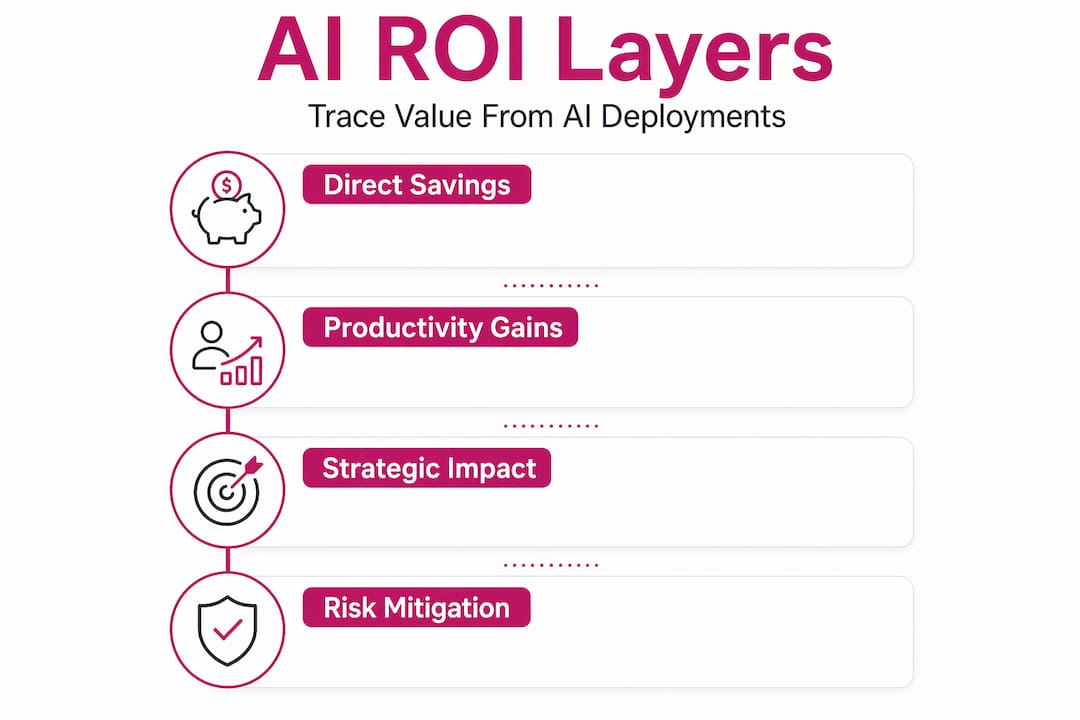
| ROI layer | What to measure | Common pitfall |
|---|---|---|
| Direct cost reduction | Labor hours saved, error rework eliminated | Ignoring review time in the savings calculation |
| Revenue acceleration | Faster deal cycles, higher rep productivity | Attributing pipeline gains to AI without controls |
| Risk avoidance | Compliance errors prevented, defects caught earlier | Hard to quantify without historical incident data |
| Capability premium | Work quality improvement enabling higher-value output | Subjective without clear quality rubrics defined upfront |
| Compound effects | Productivity gains that accumulate quarter over quarter | Typically excluded from early ROI models |
There’s also a concept worth putting in front of your CFO: Risk of Non-Investment, or RONI. When competitors are deploying AI and you’re still building the business case, the risk isn’t just the cost of the tools. It’s the compounding productivity gap that grows while you wait.
PwC research stresses that benchmarking AI investment intensity against automation penetration and inference accuracy helps validate whether your results are strong or merely average. Knowing that your AI-assisted support team handles 30% more tickets than industry peers is far more compelling than the raw number alone.
Pro Tip: When presenting ROI to a CFO or board, lead with the layer they already believe in: labor cost avoidance. Then add the others as supporting evidence. Starting with the hardest-to-verify number kills credibility before you get to the solid data.
Measurement governance: making traceability permanent
Getting one good measurement result is not the goal. The goal is a system that keeps producing reliable signal as your AI footprint grows and changes.
ISO/IEC 42001, the AI management system standard, requires organizations to monitor, measure, audit, and review AI performance against stated objectives as part of a continuous governance cycle. That’s not just a compliance checkbox. It’s the structural backbone that prevents your measurement effort from dissolving when the project team moves on.
Governance for AI measurement should include the following practices:
- Document every AI initiative with a clear statement of intended outcomes, the KPIs chosen to track them, and the baseline values at deployment.
- Schedule quarterly reviews where teams present performance data against those KPIs, not anecdotal wins.
- Run audit cycles on your workflow instrumentation to catch data quality issues before they corrupt your conclusions.
- Assign ownership explicitly. Someone in the organization needs to be accountable for AI performance measurement the way a finance team is accountable for revenue reporting.
- Use governance data to make scaling decisions. When a use case shows sustained, measurable improvement, that’s your signal to expand. When it plateaus or shows regression, investigate before scaling further.
Governance also builds the trust that makes AI adoption durable. When employees and stakeholders can see a transparent record of what the AI is doing, what it’s affecting, and how performance is trending, confidence in the program grows. That confidence is what separates organizations that sustain AI gains from those stuck in endless pilot cycles.
My honest take on measuring AI impact
I’ve worked with enough companies on operational performance to say this plainly: most AI measurement programs are theater. Teams report active users and time-on-platform, leadership nods approvingly, and no one asks whether the work actually got better.
The uncomfortable truth is that adoption metrics alone show activity and nothing else. I’ve seen organizations where AI adoption was near 80%, and throughput had barely moved because employees were spending as much time fixing AI output as they would have spent doing the work themselves. The tool was used. Value was not created.
What I’ve learned from the programs that actually work is that the discipline of measurement is almost more important than the AI itself. When teams know that error-adjusted throughput is tracked and reported, they prompt more carefully. They review AI output more critically. They escalate failures rather than quietly reverting to manual work. The measurement system changes the behavior, not just the reporting.
The other thing I’d push you on: don’t let good early results become a reason to stop measuring. The first 90 days of any AI deployment often show a bump driven by novelty and extra attention. The real test is whether you’re still seeing gains at month nine, and whether those gains are compounding. That only shows up if you keep the measurement system running.
My advice to any business leader reading this: treat AI measurement as a competitive advantage, not a reporting burden. The organizations that know exactly where their AI is creating value, and exactly where it isn’t, will make better investment decisions than those flying on intuition.
— TekkrTools
See exactly where your AI is creating value
If you’ve read this far, you already understand that tracing AI impact requires more than dashboard screenshots of user activity. You need workflow-level data, attribution methods, and governance that holds up under scrutiny.
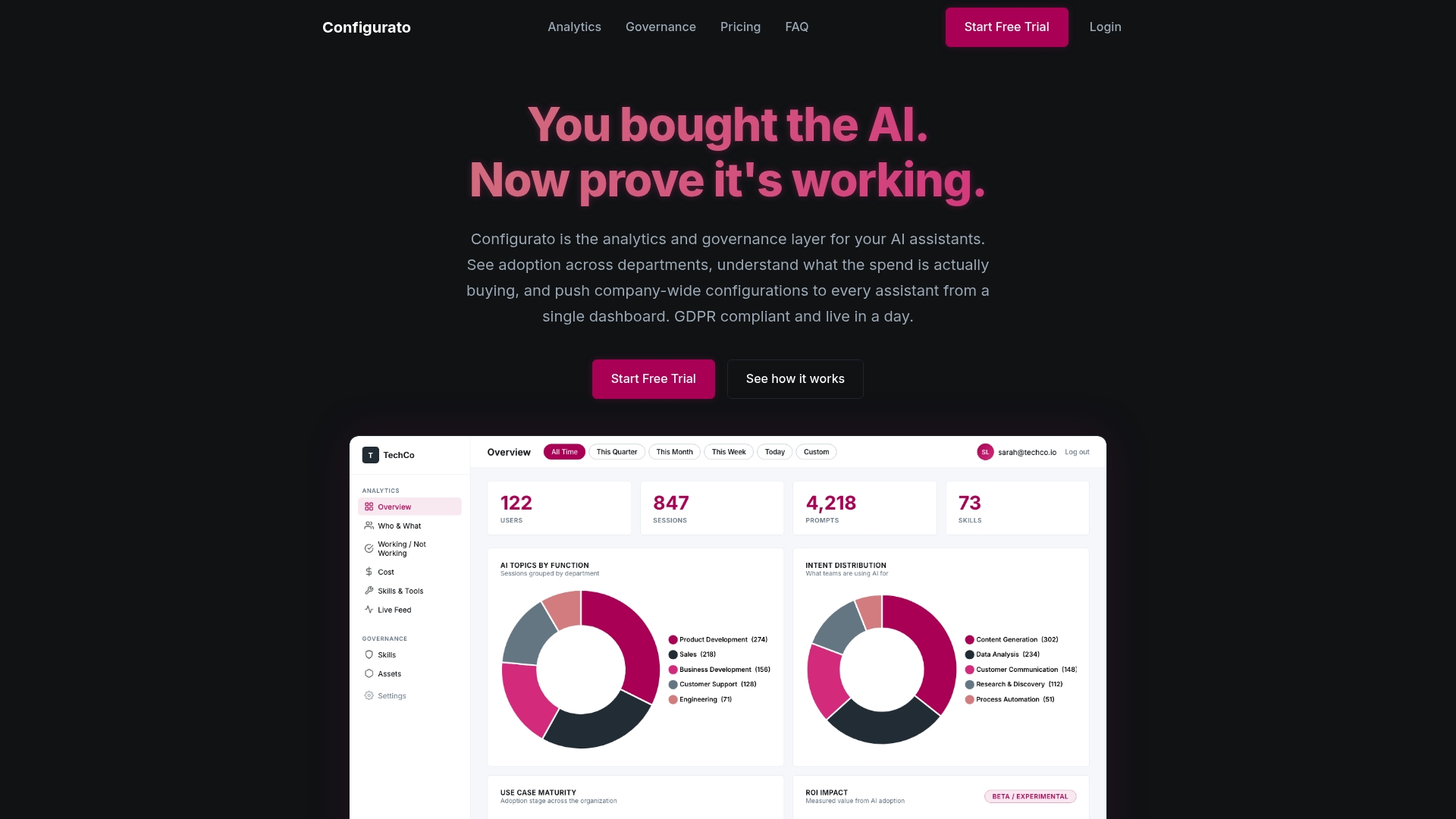
Configurato by Tekkr is built specifically for this problem. It tracks AI adoption, throughput, human time savings, and decision accuracy across your AI assistants, and ties those signals to the business outcomes you defined at the start. The governance layer supports auditability, giving you a clear record of what your AI is doing and how it’s performing over time. If you want to stop guessing and start knowing where your AI investment is actually paying off, explore Configurato and see what your measurement program could look like.
FAQ
How do you start measuring AI impact in business?
Start by defining clear business KPIs tied to the AI initiative and documenting a performance baseline before deployment. This gives you a reliable comparison point and makes attribution far more defensible.
What are the best KPIs for measuring AI productivity gains?
Beyond adoption rates, track error-adjusted throughput, human time recovered, decision accuracy, and downstream impact metrics like error rates or cycle times. These reflect actual work improvement, not just tool usage.
How do you attribute business improvements to AI specifically?
Use controlled experiments where a matched group continues without AI while the pilot group uses it. Where a control group isn’t possible, phased rollouts with pre/post comparisons and external controls are the next best approach.
What is RONI and why does it matter for AI investment decisions?
RONI stands for Risk of Non-Investment. It quantifies the compounding productivity and competitive disadvantage that accumulates when you delay AI deployment while peers move ahead.
How does governance support long-term AI impact tracing?
Standards like ISO/IEC 42001 provide a framework for monitoring, auditing, and reviewing AI performance against stated objectives on a continuous basis, so measurement doesn’t decay as programs scale or teams change.