
Most companies have an AI policy. Few actually enforce it. You wrote the guidelines, distributed the PDF, and checked the compliance box. But your employees are still prompting AI assistants with no context, ignoring your quality gates, and handing off output that needs a complete rewrite before it’s usable. That gap between policy creation and real enforcement is where AI adoption fails. Understanding how to enforce standards with AI is no longer optional. With autonomous AI agent governance becoming a regulatory compliance issue, the organizations that delay are the ones that will face the most liability.
Table of Contents
- Key Takeaways
- What you need before enforcement can work
- How to implement enforcement controls step by step
- Common pitfalls that will sink your enforcement effort
- Measuring whether your enforcement is actually working
- My take on where most enforcement programs get it wrong
- How Tekkr enforces your standards inside every AI interaction
- FAQ
Key Takeaways
| Point | Details |
|---|---|
| Documentation is not enforcement | A written AI policy means nothing without technical controls that activate at the point of use. |
| Five controls drive compliance | Policy acknowledgment, training verification, point-of-use enforcement, automated audits, and exception management form the foundation. |
| Granular rules outperform bulk context | Dynamically serving only relevant rules per task improves AI accuracy and compliance rates. |
| Exceptions must be tracked formally | Informal bypasses destroy audit readiness. Every exception needs an owner, a justification, and a time limit. |
| Enforcement data drives improvement | Metrics like acknowledgment rates and exception frequency reveal where your governance has gaps. |
What you need before enforcement can work
Enforcement without a foundation is theater. Before you build any technical controls, you need to get three things right.
The first is documented policies that are actually specific. “Use AI responsibly” is not a policy. A policy describes which tools are approved, what data classifications can and cannot be processed by AI, what output review is required before use, and who owns each of those decisions. Vague guidance creates gray areas that employees fill with their own judgment, which is exactly what enforcement is meant to prevent.

The second is a compliance framework that maps to real regulations. Unified AI policy enforcement across 30-plus security and regulatory frameworks, including GDPR and the EU AI Act, is now an operational expectation, not an advanced capability. Your policies need to be traceable back to the specific regulations they satisfy.
The third is governance structure. Someone needs to own AI compliance across your organization. That means a defined role, not just a committee. Cross-department coordination matters here too. Your legal, security, IT, and business operations teams each have a stake in how AI is used, and enforcement breaks down when they are working from separate assumptions.
Here is a quick checklist of what needs to be in place before you deploy any enforcement controls:
- Approved AI tools list with use-case scope for each
- Data classification rules that specify what AI can and cannot process
- Documented quality standards for AI-generated output by role or function
- Named AI governance owner with authority to enforce
- Regulatory mapping that ties internal policies to GDPR, EU AI Act, or sector-specific rules
- Employee acknowledgment mechanism for each active policy version
Pro Tip: Before rolling out enforcement tooling, run a one-week audit of how your teams are actually using AI today. You will almost certainly find use cases and tools you never approved. Fix that gap in your policy first, then enforce.
How to implement enforcement controls step by step
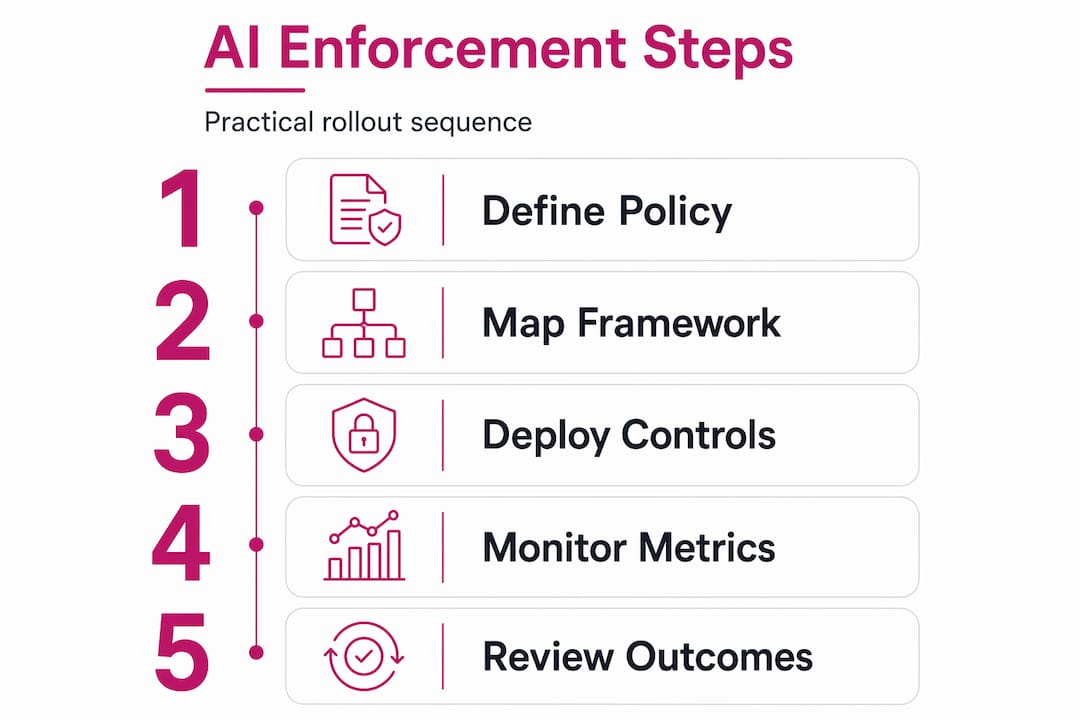
A well-structured AI compliance framework requires five core controls, and point-of-use enforcement is the most critical and most often missing. Here is how to deploy all five in a logical sequence.
-
Policy acknowledgment. Every employee who uses an AI tool needs to formally acknowledge the current version of your AI use policy. This is not a one-time onboarding check. Policies change, tools expand, and regulations evolve. Build a mechanism that re-triggers acknowledgment every time a policy is updated and logs the timestamp, employee ID, and policy version.
-
Training verification. Acknowledgment without understanding creates a false sense of compliance. Pair each policy version with a short, role-specific training module. Track completion as a prerequisite for AI tool access. This is especially important when you add new AI capabilities to existing workflows.
-
Point-of-use enforcement. This is where most organizations fail. A policy document in a shared drive does nothing at the moment an employee is asking an AI to process sensitive customer data or draft external communications. Point-of-use enforcement means the governance layer activates during the AI interaction itself, prompting the employee to confirm relevant policy requirements before the output is generated or used. Browser-based prompts and agent-to-agent governance layers are two practical ways to implement this at scale.
-
Automated audit logs. Every AI interaction that touches a governed use case should generate a structured log. That log needs to capture who initiated the request, which tool was used, what policy context was active, and whether any flags were triggered. AI output observability is the mechanism that makes your audit trail defensible when a regulator or internal auditor asks you to demonstrate compliance.
-
Exception management. Some employees will have legitimate reasons to deviate from a standard. Formal exception processes require explicit ownership, a written justification, compensating controls, and a time-bound expiration. Exceptions that are not logged become informal bypasses, and informal bypasses are the single fastest way to invalidate your compliance posture.
| Control | What it does | Common failure mode |
|---|---|---|
| Policy acknowledgment | Confirms employee awareness of current policy | Triggered only at onboarding, never updated |
| Training verification | Validates role-specific understanding | Generic training not tied to actual use cases |
| Point-of-use enforcement | Activates governance at the moment of AI use | Policy lives in a document, not in the workflow |
| Automated audit logs | Creates defensible compliance evidence | Logs exist but are never reviewed or structured |
| Exception management | Manages legitimate deviations formally | Exceptions granted verbally with no documentation |
Pro Tip: Do not build all five controls at once if you are starting from scratch. Deploy policy acknowledgment and audit logging first. These two give you a baseline you can actually measure. Add point-of-use enforcement and exception management in the second phase once you have real usage data.
Common pitfalls that will sink your enforcement effort
The pattern that kills AI governance programs faster than anything else is treating compliance as a documentation exercise. Most organizations fail at AI governance because they produce policies, distribute them, and then assume the work is done. It is not. The work starts when you connect those policies to the moment of actual AI use.
Four specific pitfalls are worth calling out by name.
- Governance that lives only in documents. If your policy enforcement depends entirely on employees choosing to consult a handbook before using AI, you do not have enforcement. You have suggestions.
- Overloading the AI context with every rule at once. Flooding AI context with all organizational rules in a single prompt degrades performance and reduces compliance accuracy. The better approach is to deliver only the rules relevant to the specific task being performed, dynamically.
- Ignoring the exception problem. When employees find that the formal exception path is too slow or too complicated, they route around it. Those informal bypasses accumulate and quietly erode your compliance posture.
- Siloed governance that does not connect to operations. If your AI governance team and your engineering, product, and operations teams are working from different assumptions about what AI is allowed to do, enforcement becomes inconsistent.
“Standards without enforcement are just suggestions. And suggestions do not satisfy a regulator.” This is the core tension every business leader needs to resolve before their next audit.
Transparent, evidence-based compliance is what regulators are moving toward, with self-disclosure and human review built into the process rather than blanket automated monitoring. That means your audit trail needs to be legible, not just long.
Measuring whether your enforcement is actually working
Deploying controls is not the same as verifying they are effective. You need a small set of metrics that tell you, at a glance, whether enforcement is holding.
| Metric | What it tells you | Review cadence |
|---|---|---|
| Policy acknowledgment rate | Percentage of AI users current on the active policy version | Weekly |
| Policy violation count | Number of flagged interactions per tool per week | Weekly |
| Exception request volume | How often employees formally request deviations | Monthly |
| Exception approval rate | Ratio of approved to denied exceptions | Monthly |
| Audit log coverage | Percentage of governed AI interactions with complete logs | Monthly |
Once you have data flowing, look for patterns rather than point-in-time snapshots. A spike in exception requests for a specific use case often signals that the policy for that area is too restrictive or poorly explained. Recurring violations from the same team usually indicate a training gap, not malicious behavior. AI regulation’s glass box approach emphasizes transparent impact assessment, which means your reporting structure should support that kind of qualitative review alongside the raw numbers.
Pro Tip: Build a monthly governance review meeting with a fixed agenda: acknowledgment rates, violation trends, and exception patterns. Keep it to 30 minutes. The discipline of reviewing the data regularly is more valuable than any single finding.
My take on where most enforcement programs get it wrong
I have seen organizations spend six months building a 40-page AI policy and then wonder why nothing changed. The answer is always the same. The policy existed in the wrong place. It lived in a document management system instead of inside the workflow where employees were actually making decisions.
The shift that changes everything is moving enforcement from a compliance function to a product function. Your AI governance layer needs to behave like a product that your employees interact with, not a legal artifact they are expected to have read. When a product manager asks an AI assistant to draft a brief, the governance layer should already know your PDLC, your output quality standards, and your data handling rules. The employee should not have to think about any of that. The output should simply reflect it.
The other thing I have learned is that enforcement without feedback is enforcement that erodes. If employees never see the consequences of a policy flag, those flags start to feel like background noise. Connect enforcement events to real conversations. When a violation is logged, someone should follow up. Not punitively. Educationally. The community standards and enforcement systems research is clear: governance without accountability mechanisms eventually stops working.
The organizations that will get this right are the ones that treat AI alignment as an operational priority, not a legal checkbox. The ones that are still treating it as documentation will face a hard reckoning when auditors or competitors start asking for proof.
— TekkrTools
How Tekkr enforces your standards inside every AI interaction
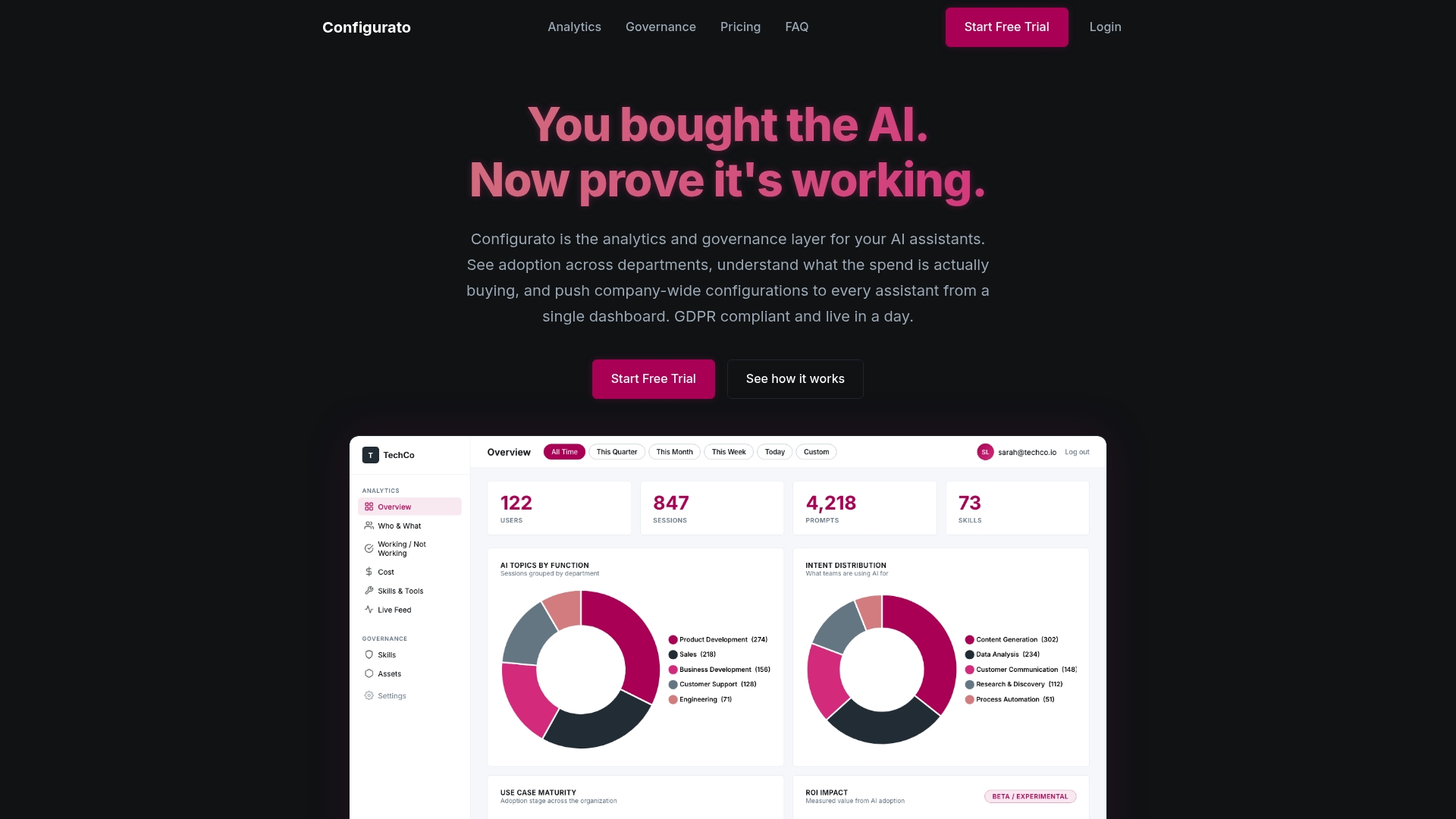
Tekkr’s Configurato embeds your company’s processes, quality gates, and compliance requirements directly into the AI assistants your teams already use. No retraining. No new workflows. When a policy changes, every AI interaction reflects it automatically. Tekkr’s governance layer operates agent-to-agent in the background, delivering only the relevant rules for each task so performance stays high and compliance stays tight. If you are ready to move from documentation-only governance to real enforcement, Configurato is built exactly for that.
FAQ
What is point-of-use AI enforcement?
Point-of-use enforcement means governance controls activate during the actual AI interaction, not before or after. It uses mechanisms like browser prompts or agent-to-agent governance layers to apply policies at the moment an employee uses an AI tool.
Why is enforcing AI standards important?
Delaying AI governance infrastructure before mandatory regulatory standards arrive significantly increases organizational liability. Enforcement also prevents operational failures caused by inconsistent or non-compliant AI output.
What are the five core AI compliance controls?
The five core controls are policy acknowledgment, training verification, point-of-use enforcement, automated audit logs, and exception management. Point-of-use enforcement is the most critical and the most commonly missing.
How do I handle AI policy exceptions without creating compliance gaps?
Every exception needs a named owner, a written justification, compensating controls, and an expiration date. Exceptions that are not formally documented become informal bypasses that undermine your entire compliance posture.
How do I know if my AI enforcement is working?
Track acknowledgment rates, policy violation counts, exception request volume, and audit log coverage on a regular cadence. Patterns in these metrics reveal whether your governance is holding or quietly breaking down.