
Convincing your team to adopt AI tools is the defining leadership challenge of this decade. High-skilled workers using generative AI can increase performance by nearly 40%, and 88% of office workers have already embraced AI in some form. Yet most organizations still struggle to get consistent, meaningful adoption across every department. The gap between buying AI and actually using it well comes down to human factors: fear, habit, and trust. This guide gives team leaders a concrete, people-centered approach to persuade teams to use AI and turn scattered experiments into lasting productivity gains.
Why do teams resist AI tools, and how can you address these barriers?
Resistance to AI is rarely about the technology itself. AI adoption stalls mostly due to fear of displacement and lack of context, not because the tools are hard to use. Your team members are asking a quiet but urgent question: “Will this replace me?” Until you answer that question directly, no demo or mandate will move them.
The scale of the problem is real. 70% of large-scale change initiatives fail primarily because of employee resistance. That number reflects a pattern: leaders focus on the tool, not the person holding it. The fix starts with framing.

Frame AI as a collaborator, not a replacement. Use specific language in team meetings: “This tool handles the first draft so you can focus on the judgment call.” Show your team that the goal is to remove the work they dislike, not the work that defines them. Transparent communication about AI’s role and human control over outputs shifts team sentiment faster than any feature walkthrough.
Common resistance factors and how to counter them:
- Job security fears. Address this directly in your first team session. Name the fear out loud and explain which tasks AI will assist with and which remain fully human.
- Workflow disruption. Start with one low-risk, high-frequency task. Do not overhaul existing processes on day one.
- Lack of trust in AI outputs. Let team members verify AI results against their own work first. Trust builds through experience, not promises.
- Surveillance anxiety. Avoid tracking usage or requiring adoption metrics early in the rollout. Frame the experiment as voluntary and curiosity-driven.
“Framing AI adoption as a collaborative experiment without heavy monitoring builds trust and curiosity. When people feel watched, they perform. When they feel safe, they learn.”
Pro Tip: Hold a 30-minute “AI fears” session before any tool demo. Let team members voice concerns anonymously using a shared doc. Address every concern by name in the next meeting. This single step removes more resistance than a month of feature presentations.
How to identify AI Champions and use peer influence to drive adoption
Peer influence is the most underused tool in any manager’s adoption playbook. A respected colleague demonstrating a real win with AI carries more weight than a top-down mandate from leadership. The peer “AI Champion” model drives adoption more effectively than directives precisely because trust already exists between peers.
The selection of your AI Champions matters more than the number of them. Choose one person per department who meets three criteria: they are curious about new tools, they are respected by their peers (not just liked), and they are willing to share both wins and failures publicly. Tech enthusiasm alone is not enough. Credibility is the asset you need.
Once selected, give your Champions a focused starting point. Do not ask them to master every AI feature. Instead, assign them one simple, high-frequency workflow where AI can save visible time. Meeting summary generation, first-draft writing, and data formatting are strong starting points because the time savings are immediate and obvious to anyone watching.
Here is a practical sequence for standing up an AI Champion program:
- Identify one Champion per department. Prioritize credibility over technical skill.
- Assign one workflow. Pick a task the Champion already finds tedious and time-consuming.
- Give them two weeks. Let them use the tool privately before presenting to the team.
- Host a peer demo. The Champion shows the before-and-after in a 15-minute team meeting.
- Create a shared channel. Set up a Slack or Teams channel where Champions post weekly wins, prompts, and lessons learned.
- Rotate the spotlight. Invite non-Champions to share their own experiments as confidence grows.
Pro Tip: Ask your AI Champions to document their three biggest time savings in the first month. Concrete numbers (“I saved 4 hours on the monthly report”) are far more persuasive than general enthusiasm. Post these wins in your company-wide channel, not just the AI channel.
How to demonstrate tangible wins and embed AI in daily workflows
The fastest way to get buy-in for AI tools is to show a win your team already cares about. Abstract promises about productivity do not move skeptics. A 10-minute live experiment using real data from their actual job does. Running short experiments on tedious tasks with real data delivers immediate time savings that convince skeptics far better than any slide deck.
The data on daily use versus occasional use is stark. Employees who fully integrate AI into daily workflows report an 83% productivity boost, compared to just 20% for sporadic users. That gap exists because habit compounds. A team member who uses AI once a week gets occasional value. One who uses it every morning builds speed, prompt skill, and confidence that multiplies over time.
| Usage pattern | Reported productivity boost |
|---|---|
| Full daily AI integration | 83% |
| Sporadic AI use | 20% |
To build daily habits, connect AI to tasks your team already does every day. Do not introduce AI as a separate workflow. Attach it to an existing one.
High-impact starting points for daily AI integration:
- Meeting prep. Use AI to generate agendas from previous meeting notes.
- Status updates. Use AI to draft weekly team updates from bullet points.
- Email responses. Use AI to write first drafts of routine client or stakeholder emails.
- Data summaries. Use AI to turn raw spreadsheet data into plain-language summaries.
- Research briefs. Use AI to compile background reading before strategy sessions.
The goal is not to mandate a tool. Successful leaders prioritize building the habit of daily AI workflows over requiring use of specific tools. When AI becomes the path of least resistance for a task your team already does, adoption follows naturally.
What step-by-step phased rollout strategies increase AI adoption success?
A phased rollout prevents the resistance that comes from overwhelming change. Introducing AI to an entire organization at once creates noise, confusion, and the feeling that something is being done to the team rather than with them. A structured phased rollout with small measurable wins reduces resistance and builds momentum in a way that a company-wide mandate never can.
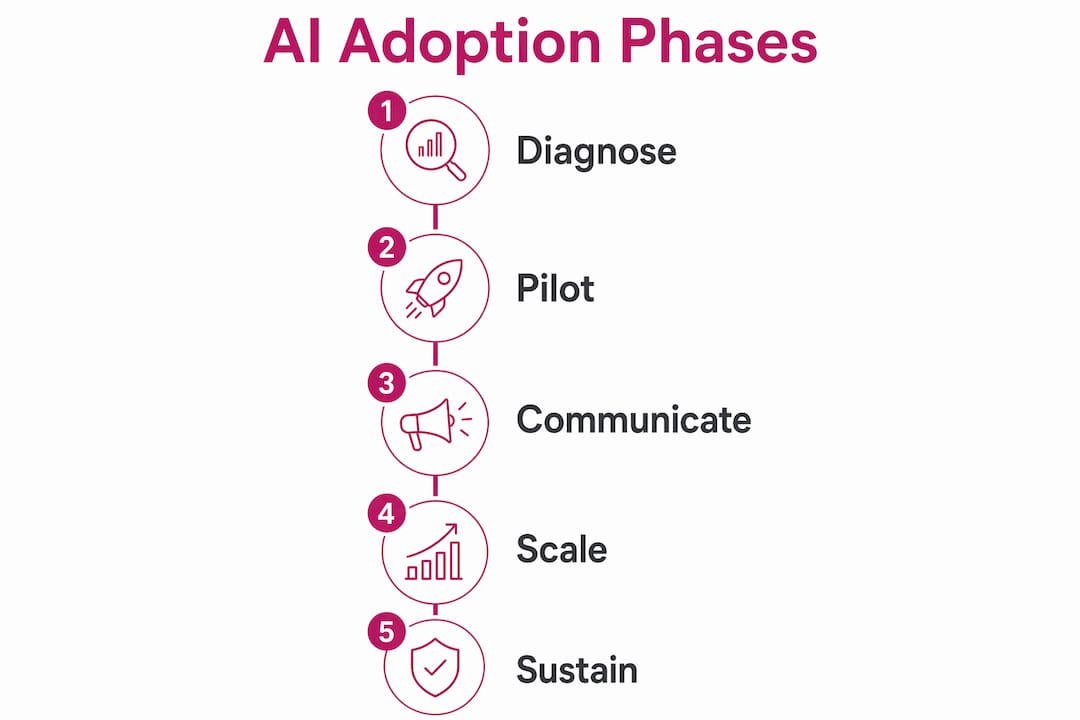
A practical 30-to-90-day rollout follows four phases:
- Diagnose (Days 1–14). Survey your team to identify their most time-consuming, repetitive tasks. Map where AI could save the most time without disrupting critical workflows. Do not select the use case yourself. Let the team surface it.
- Pilot (Days 15–30). Select a small group of 5–10 early adopters, including your AI Champions. Focus on one use case per role. Measure time saved and quality of output. Keep participation voluntary.
- Communicate (Days 31–45). Share pilot results openly. Host a session where pilot participants present their experience. Address fears that surfaced during the pilot. Reinforce that human judgment remains central to every output.
- Scale (Days 46–90). Roll out to the broader team with training, shared prompt libraries, and clear success benchmarks. Benchmarks should measure improvement, not compliance.
| Phase | Timeline | Focus |
|---|---|---|
| Diagnose | Days 1–14 | Identify pain points and high-frequency tasks |
| Pilot | Days 15–30 | Small group, one use case per role |
| Communicate | Days 31–45 | Share results, address fears, build safety |
| Scale | Days 46–90 | Broader rollout with training and benchmarks |
The most common mistake at the scale phase is reverting to a mandate. Keep the voluntary framing even as you expand. Teams that choose to adopt AI outperform teams that are required to.
How to sustain momentum and keep AI adoption growing over time
Getting initial buy-in is only half the work. Adoption fades without ongoing support, recognition, and iteration. The teams that sustain high AI use share a few consistent practices.
Strategies that keep adoption growing after the initial rollout:
- Maintain a shared prompt library. Collect the best prompts from across the team in a shared doc or wiki. Update it monthly. This reduces the effort barrier for new users and spreads best practices without training sessions.
- Create a dedicated AI channel. A Slack or Teams channel for AI questions, wins, and experiments gives team members a low-stakes place to learn from each other.
- Celebrate early adopters publicly. Recognition is more persuasive than top-down mandates or general announcements. Name specific wins in team meetings and company updates.
- Gather feedback every 30 days. Ask your team what is working, what is not, and what tasks they wish AI could help with. Use this to refine your use case list and training focus.
- Set improvement-focused metrics. Track time saved per task, not login frequency. Metrics tied to surveillance kill psychological safety. Metrics tied to improvement build it.
Pro Tip: Run a monthly “AI win of the month” nomination in your team channel. Ask members to nominate a colleague who used AI in a way that saved real time or improved a real output. The winner gets public recognition in the next all-hands. This costs nothing and creates more adoption momentum than any training program.
For a deeper look at how to structure these ongoing efforts, Tekkr’s guide on AI productivity improvements for teams covers practical frameworks for sustaining gains after the initial rollout.
Key Takeaways
The most effective way to convince your team to adopt AI tools is to address human fears first, build daily habits through peer influence, and scale only after small wins prove the value.
| Point | Details |
|---|---|
| Address resistance early | Name job security fears directly before any tool demo to remove the biggest adoption barrier. |
| Use peer Champions | Appoint one respected peer per department to demonstrate real wins and drive peer-to-peer learning. |
| Start with one task | Pick one high-frequency, tedious task per role to build daily AI habits before expanding scope. |
| Run a phased rollout | Use a 30-to-90-day plan with diagnose, pilot, communicate, and scale phases to reduce resistance. |
| Sustain with recognition | Celebrate concrete wins publicly and maintain shared prompt libraries to keep adoption growing. |
The uncomfortable truth about AI adoption most leaders miss
Most AI adoption failures I have seen share the same root cause: the leader treated it as a technology project. They bought the tools, scheduled the training, and waited for productivity to follow. It never did.
The teams that actually adopt AI are the ones where a leader took the human side seriously first. They held the awkward conversation about job security. They picked the right Champion, not the most tech-savvy person, but the most trusted one. They ran the 10-minute experiment on a real task instead of presenting a roadmap.
Peer influence consistently outperforms mandates. I have watched teams resist AI for months after a company-wide rollout, then adopt it within two weeks after a respected colleague showed them one concrete win. The technology did not change. The messenger did.
Transparency about AI’s role and human control builds trust faster than any feature. When team members understand that they review, edit, and own every AI output, the fear of replacement drops significantly. The framing is not “AI will do your job.” It is “AI will handle the part of your job you like least.”
Patience matters more than most leaders expect. Adoption is not a switch. It is a habit, and habits take weeks to form. Respect your team’s pace. Coercion creates compliance, not capability.
— TekkrTools
Tekkr’s approach to measurable AI adoption
Getting teams to genuinely use AI requires more than a rollout plan. It requires visibility into what is actually happening after the tools go live.
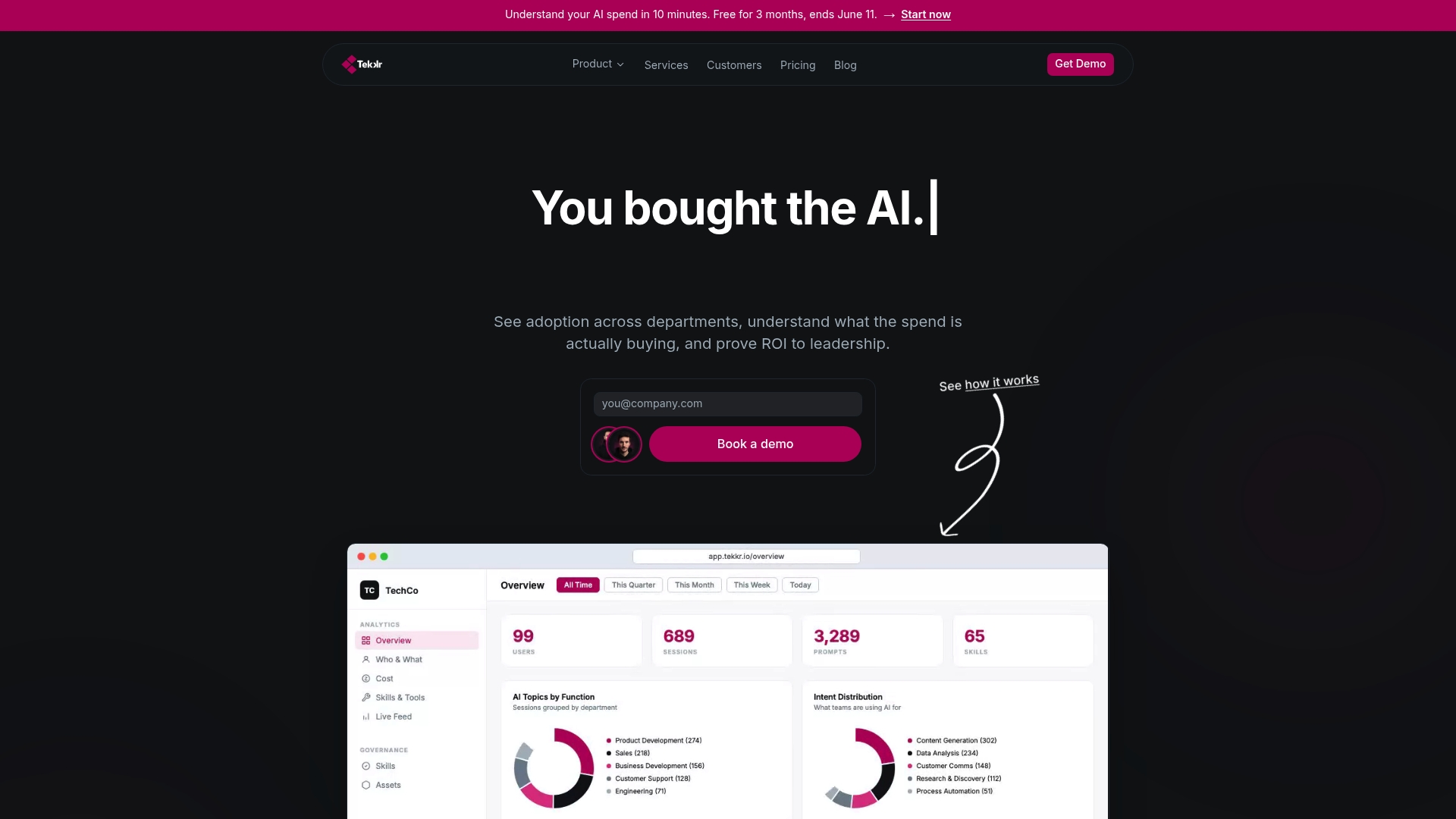
Tekkr’s platform, Configurato, tracks real AI usage across your organization, breaks down adoption by team, and surfaces which use cases are delivering results. It runs on a privacy-first architecture with end-to-end encryption, automatic PII stripping, and no browser extensions required. Setup takes about 10 minutes, with a free tier and no credit card needed. For organizations that want both the strategy and the measurement layer, Tekkr’s AI adoption solutions combine consulting with the Configurato platform to turn AI investments into results you can actually see. You bought the AI. Tekkr helps you prove it is working.
FAQ
Why do employees resist AI tools at work?
Resistance comes primarily from fear of job displacement and lack of context about how AI will change their role. Adoption stalls most often due to these human factors, not the technology itself.
What is an AI Champion and why does it matter?
An AI Champion is a respected peer appointed to demonstrate AI wins and drive adoption through peer-to-peer influence. This model works because trust between colleagues accelerates acceptance faster than top-down directives.
How long does a successful AI rollout take?
A phased rollout covering diagnosis, piloting, communication, and scaling typically runs 30–90 days. Rushing this timeline increases resistance and reduces the quality of adoption.
What is the difference in productivity between daily and occasional AI users?
Daily AI users report an 83% productivity boost compared to 20% for sporadic users. The gap reflects the compounding effect of habit and growing prompt skill over time.
How do you measure AI adoption without creating surveillance fears?
Track improvement metrics like time saved per task rather than login frequency or usage volume. Avoiding heavy monitoring early in the rollout preserves psychological safety and keeps adoption voluntary and genuine.