
A company AI playbook is a strategic framework that aligns AI initiatives with business goals, governance, and operational execution to produce measurable results. Without one, over 80% of AI pilots fail before they reach production. Mid-sized companies face a specific trap: they buy tools like Claude, Copilot, or Codex, then watch adoption stall because no one defined what success looks like. To build a company AI playbook that actually works, you need leadership alignment, audited workflows, structured pilots, and governance baked in from day one. This guide gives you the framework to do exactly that.
What must be in place before you build an AI playbook
Most AI initiatives fail before the first line of code runs. The reason is almost always the same: companies skip the foundation and jump straight to tooling.
Leadership alignment is non-negotiable
AI adoption must be CEO-led to avoid siloed experiments that never scale. When AI is treated as an IT project, it gets scoped like one. When it’s treated as a business transformation mandate, executives fund it, prioritize it, and hold teams accountable for results. The difference in outcomes is not marginal. It’s the gap between a proof of concept that dies in a committee and a capability that reshapes how your company operates. Read Tekkr’s executive leadership guide for a detailed breakdown of what CEO sponsorship looks like in practice.

The four foundational prerequisites
Before you design a single pilot, confirm these four elements are in place:
- Documented, machine-legible workflows. Unstructured workflows cannot be automated effectively by AI agents. Every process you plan to automate must be written down in a structured format with clear inputs, outputs, decision points, and exception handling.
- Data governance and quality pipelines. AI is only as good as the data it runs on. Audit your data sources for completeness, accuracy, and access controls before selecting any tool.
- An AI readiness assessment. Score your organization across people, process, and technology. Identify where the highest-value automation targets actually sit, not where they feel obvious.
- A clear audit of automation candidates. Rank processes by impact and feasibility. The build-first mentality is the most common and most expensive mistake in AI implementation. Audit before you build.
Pro Tip: Document your top ten workflows as structured procedures before any vendor conversation. Each workflow should fit on one page: trigger, steps, decision logic, and output. If you cannot write it down clearly, an AI agent cannot execute it reliably.
How do you design and run AI pilots that prove value?
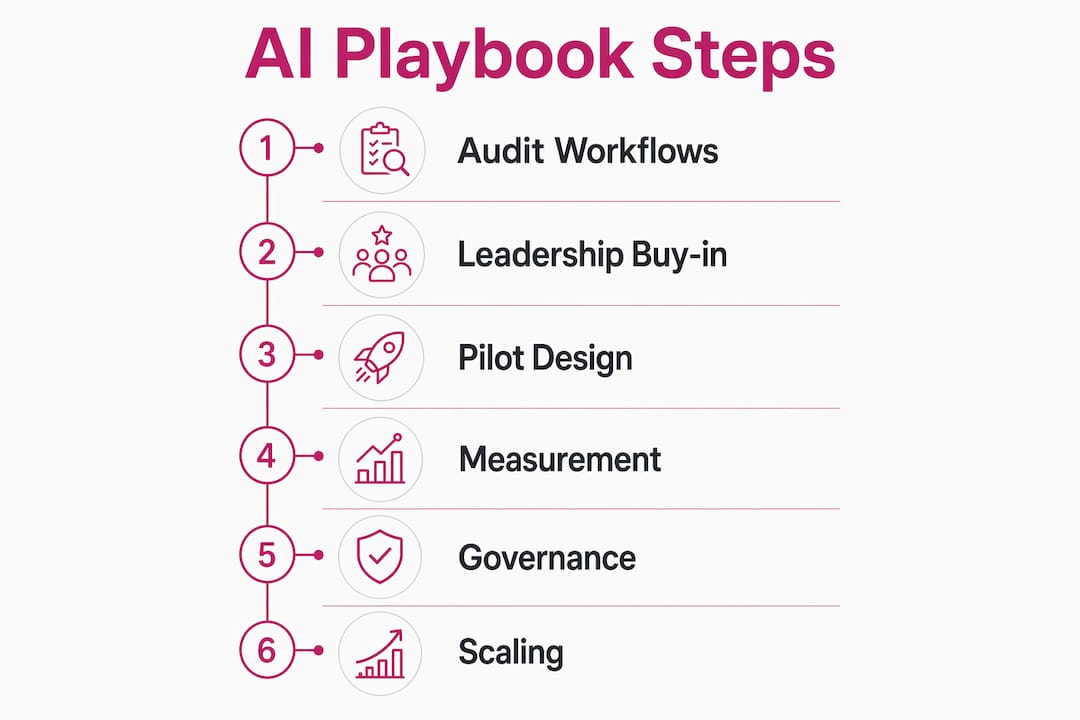
Pilots are where AI playbooks live or die. A well-structured pilot proves value in weeks. A poorly structured one burns budget and kills organizational confidence.
Step-by-step pilot design
- Select use cases with an impact-feasibility matrix. Plot every candidate on two axes: business impact (revenue, cost, risk) and implementation feasibility (data readiness, process clarity, team capacity). Start in the high-impact, high-feasibility quadrant.
- Define your baseline, target, and minimum viable improvement before launch. If you cannot state what “good” looks like in numbers, you cannot declare success. Set a specific metric: hours saved per week, error rate reduction, cost per transaction.
- Build a production-shaped MVP, not a demo. A demo runs on clean data in a controlled environment. A production-shaped MVP runs on real data, with real users, in real workflows. The gap between the two is where most pilots collapse.
- Use shadow-run mode for validation. Run the AI system in parallel with the existing process for two to four weeks before switching over. This surfaces edge cases without operational risk.
- Set kill criteria before you start. Define minimum viable improvements upfront and commit to stopping the pilot if those thresholds are not met within the agreed window. This prevents pilot purgatory, the state where a failing project keeps consuming resources because no one wants to call it.
Pilot measurement framework
| Metric | What to Measure | Success Threshold |
|---|---|---|
| Time savings | Hours saved per employee per week | Minimum 2 hours per week |
| Error rate | Reduction in process errors vs. baseline | At least 20% reduction |
| Cost impact | Change in cost per transaction or output | Measurable reduction within pilot window |
| Adoption rate | Percentage of target users actively using the tool | Above 60% by week six |
| ROI timeline | Projected months to full return on investment | Full ROI within 12–18 months |
A successful initial deployment typically takes 6–8 weeks. That timeline is tight enough to maintain momentum and short enough to limit downside if the pilot fails.
Pro Tip: Assign one pilot owner per initiative. This person owns the baseline data, the weekly measurement, and the go/no-go recommendation. Shared ownership means no one is accountable when results are ambiguous.
How do you embed governance into your AI playbook?
Governance is not a compliance checkbox. It’s the operating system that keeps your AI playbook trustworthy, auditable, and scalable.
Governance practices must be embedded from day one, including risk assessments, policy enforcement, and continuous monitoring. Companies that treat governance as a post-launch concern discover the problem the hard way: a model making decisions no one can explain, or a data pipeline that violated privacy rules six months ago.
Core governance elements to build in from the start
- Risk assessment per use case. Before any pilot launches, score it for data sensitivity, decision impact, and regulatory exposure. A customer-facing AI that affects credit decisions carries different risk than an internal document summarizer.
- Automated audit trails. Every AI-assisted decision should generate a log: what input it received, what output it produced, and what human reviewed it. This is not optional in regulated industries and is good practice everywhere else.
- Policy enforcement at the workflow level. Define what AI tools are approved for which data types. Enforce those boundaries technically, not just through policy documents.
- Continuous monitoring. Model performance drifts over time. Build monitoring into your playbook from launch, not as an afterthought when something breaks.
“Responsible AI frameworks ensure trust and compliance and should be operational from day one, not retrofitted after deployment.” — Microsoft AI Strategy Framework
Tekkr’s guide on AI governance strategies covers how to balance innovation speed with compliance requirements in practical terms. For a forward-looking view, the AI governance trends for 2026 article is worth reading before you finalize your framework.
What does scaling AI adoption actually require?
Only 11% of companies have scaled AI beyond pilots. That number reflects a structural problem: most organizations treat scaling as a bigger version of piloting. It is not. Scaling requires a different set of capabilities.
The scaling infrastructure your playbook needs
- Shared data pipelines and feature stores. Each new AI initiative should not rebuild its data infrastructure from scratch. Invest in shared components that every team can use.
- An AI center of excellence. This is a small, cross-functional team that owns standards, tooling decisions, vendor relationships, and knowledge transfer. It prevents every department from solving the same problems independently.
- Hybrid human-AI team design. Hybrid human-AI teams accelerate adoption and maximize productivity gains. The goal is not to replace roles but to redesign workflows so humans handle judgment and AI handles volume.
- Continuous training programs. Skills decay faster than tools change. Build a training cadence into your playbook, not a one-time onboarding session.
- Ruthless prioritization. Scattered AI efforts produce scattered results. Limit active initiatives to what your organization can genuinely support with data, talent, and executive attention.
The 10-20-70 investment principle is the most useful budget heuristic for scaling: 10% on technology and tools, 20% on training and change management, 70% on data and workflow integration. Most companies invert this ratio and wonder why their tools underperform. Investing heavily in integration rather than software licenses is what separates companies that scale from those that stall.
Pro Tip: Run a quarterly playbook review with your AI center of excellence. Score each active initiative on adoption rate, ROI progress, and strategic fit. Kill or pause anything scoring below threshold. This keeps your roadmap honest and your resources focused.
For a broader view of where enterprise AI is heading, the 2026 AI trends guide from Ysloo Tahtech covers the strategic shifts mid-sized companies should prepare for now.
Key takeaways
A company AI playbook succeeds when it combines CEO-led commitment, audited workflows, structured pilots with kill criteria, and governance embedded from day one.
| Point | Details |
|---|---|
| Audit before you build | Map and document top workflows before selecting any AI tool or vendor. |
| Define pilot success upfront | Set baseline metrics, targets, and kill criteria before launching any pilot. |
| Embed governance from day one | Risk assessments, audit trails, and monitoring must be operational at launch, not added later. |
| Invest 70% in integration | Allocate the majority of AI budget to data and workflow integration, not software licenses. |
| Scale with shared infrastructure | Build reusable data pipelines and an AI center of excellence to avoid redundant effort across teams. |
The uncomfortable truth about AI playbooks in mid-sized companies
Most executives I work with arrive at the playbook conversation after a failed pilot. They bought a tool, ran a proof of concept, got promising demo results, and then watched adoption flatline when the initiative hit real workflows with real users and real data quality problems.
The pattern is consistent enough to be predictable. The failure is almost never the AI model. It’s the absence of the boring, unglamorous work that has to happen first: documenting workflows, auditing data, aligning leadership, and defining what success actually means in numbers.
The counterintuitive insight is that the companies making the most progress with AI are not the ones with the most sophisticated tools. They are the ones with the most disciplined processes. A mid-sized company with well-documented workflows, clean data pipelines, and a governance framework will outperform a larger competitor running expensive models on messy infrastructure.
The other thing I see consistently: governance gets treated as a legal department problem. It is not. Governance is what allows you to move fast without breaking things you cannot afford to break. Companies that embed it early scale faster, not slower, because they are not stopping every six months to clean up a compliance mess.
Treat your AI playbook as a living document. The first version will be wrong in places. The goal is to build the feedback loops that let you correct it quickly.
— TekkrTools
How Tekkr helps you put your AI playbook into practice
Building the playbook is one challenge. Proving it’s working is another.
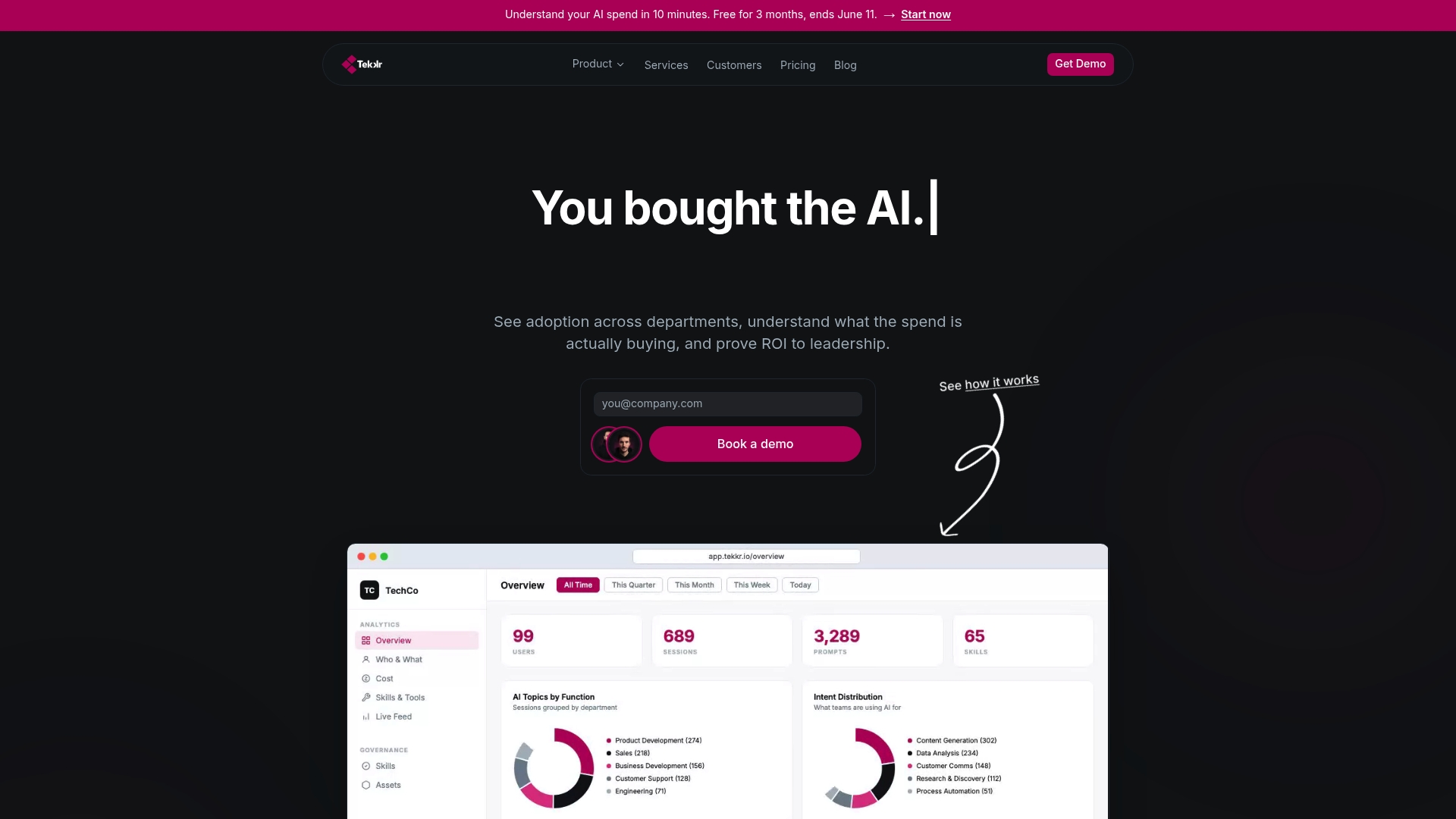
Tekkr’s Configurato platform is built for exactly this problem. It tracks who is actually using tools like Claude and Codex across your organization, breaks down AI spend by team, surfaces which use cases are delivering results, and drives adoption higher through gamified rollouts and company-wide AI playbooks. You get the visibility to know where your playbook is working and the tools to fix it where it is not. Setup takes about 10 minutes, there’s a free tier, and no credit card is required. If you’re ready to move from strategy to measurable results, explore Tekkr’s AI adoption solutions or see the full Configurato product to understand what adoption measurement looks like in practice.
FAQ
What is a company AI playbook?
A company AI playbook is a strategic framework that aligns AI initiatives with business goals, governance policies, and operational workflows to drive measurable adoption and ROI.
Why do most AI pilots fail?
Over 80% of AI pilots fail because companies skip the pre-implementation audit and launch without clear automation targets or success metrics.
How long does an AI pilot typically take?
A well-structured AI pilot runs for 6–8 weeks, with full ROI typically realized within 12–18 months of initial deployment.
What is the right budget split for an AI initiative?
The 10-20-70 principle recommends allocating 10% to tools, 20% to training and change management, and 70% to data and workflow integration.
How do you prevent pilot purgatory?
Set kill criteria and minimum viable improvement thresholds before the pilot launches. If those thresholds are not met within the defined window, stop the project and reallocate resources.