
The future of AI assistants in 2026 looks nothing like the chatbot era most enterprises built their early pilots around. These systems no longer wait for a prompt. They plan, execute, and complete multi-step tasks across your tools and data while you focus on decisions that actually require human judgment. For technology leaders and decision-makers, this shift from reactive assistant to autonomous operator is not a trend to monitor from a distance. It is a structural change in how work gets done, and the window to build advantage from it is already open.
Table of Contents
- Key takeaways
- The future of AI assistants in 2026: from copilot to operator
- AI assistants and the 2026 workforce transformation
- Practical applications of next-gen virtual assistants in 2026
- Deployment risks and best practices that matter in 2026
- The outlook beyond 2026: where this goes next
- My take on AI assistants after watching deployments up close
- How Tekkr helps you move from deployment to real productivity
- FAQ
Key takeaways
| Point | Details |
|---|---|
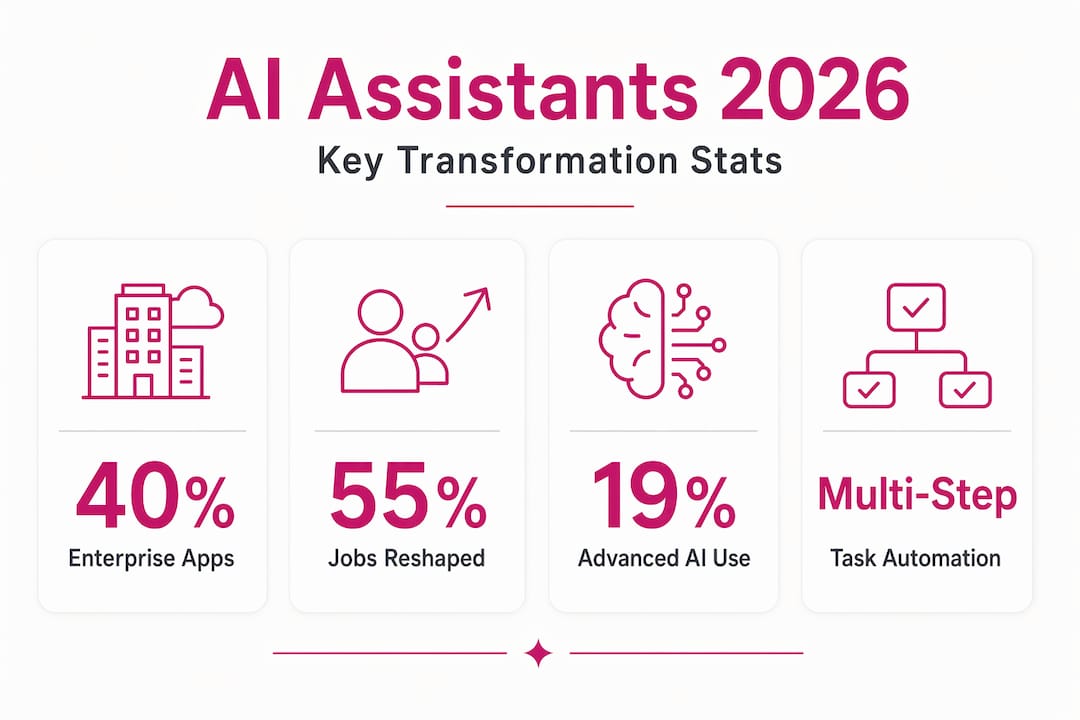
| AI agents are replacing copilots | By 2026, 40% of enterprise apps will embed task-specific AI agents, up from under 5% in 2025. |
| Workforce reshaping, not replacement | AI will alter how tasks are performed across 50-55% of US jobs, making upskilling a strategic priority. |
| Agentic commerce is live | AI assistants now execute autonomous purchases within user-defined constraints, moving beyond recommendations. |
| Human oversight is non-negotiable | Skipping human-in-the-loop checkpoints in high-stakes workflows remains the leading cause of failed deployments. |
| Most enterprises are still catching up | Only 19% of organizations operate at advanced AI maturity levels, which means the gap between leaders and laggards is widening fast. |
The future of AI assistants in 2026: from copilot to operator
There is a meaningful difference between an AI assistant and an AI agent, and it matters more now than it did twelve months ago.
A traditional AI assistant, think early-generation chatbots or first-wave copilots, operates reactively. You ask, it responds. The intelligence lives in the answer, not in any sustained workflow. An AI agent, by contrast, holds a goal, decomposes it into steps, calls the right tools, monitors progress, and adapts when something changes. It acts. That distinction shapes every architectural and operational decision you will make in 2026.
The infrastructure enabling this shift includes three major components. Orchestration layers coordinate sequences of tasks across multiple AI models and external services. On-device AI processes sensitive or latency-sensitive workloads locally, without routing data to the cloud. And managed agent runtimes provide provisioned sandbox environments for deploying agents without the DevOps complexity that plagued earlier integrations.
| Capability | Chatbot | Copilot | Agentic AI |
|---|---|---|---|
| Interaction type | Single-turn Q&A | Prompt-driven assistance | Goal-directed multi-step execution |
| Context retention | Minimal | Session-based | Persistent across tasks and systems |
| Tool use | None | Limited | Native, multi-tool orchestration |
| Autonomy level | Zero | Low | High, within defined guardrails |
| Enterprise readiness | Low | Medium | High with governance layer |
Pro Tip: When evaluating AI assistant platforms, ask vendors specifically whether their agents use managed sandboxed runtimes. It will tell you immediately whether they have solved the operational complexity problem or just deferred it to your engineering team.
AI assistants and the 2026 workforce transformation
The workforce impact of smart assistants in 2026 is frequently misread. The dominant narrative oscillates between “AI replaces jobs” and “AI creates jobs.” Both framings miss the point. The more accurate picture, and the one that should drive your talent strategy, is augmentation at scale.

Research from BCG projects that AI will reshape 50-55% of US jobs within the next two to three years, primarily by altering how tasks are performed rather than eliminating roles outright. A software engineer does not disappear. She spends less time on boilerplate and more time on architecture decisions. A customer service lead does not become redundant. He shifts from handling tier-one tickets to managing the AI systems that resolve them.
The catch is that this productivity transfer only materializes when organizations actively build the conditions for it. Effective AI adoption depends on embedding workforce strategy into competitive planning, not treating it as an HR initiative that runs parallel to the real work.
Key changes already visible in tech-forward organizations include:
- Role redesign around AI oversight rather than task execution, with employees becoming reviewers and directors rather than producers
- Upskilling programs focused on prompt quality, output evaluation, and AI-specific critical thinking
- New leadership metrics that measure AI output quality and governance compliance alongside traditional KPIs
- Cross-functional working groups tasked with identifying which workflows are ready for agentic automation and which still require human judgment
The uncomfortable data point: only 19% of organizations currently operate at what Microsoft labels “Frontier” AI maturity. About 50% are still in emergent stages. If your competitors are in that top quintile and you are not, the productivity gap will compound monthly, not annually.
Practical applications of next-gen virtual assistants in 2026
The gap between what AI assistants can do in demos and what they do inside your business has narrowed significantly this year. Several capabilities have crossed from experimental to production-ready.
Agentic commerce is the clearest example. Mastercard’s agentic commerce framework allows AI assistants to execute end-to-end purchasing autonomously within user-defined budget and rule constraints. This is not a recommendation engine. The AI identifies the vendor, validates the price, and completes the transaction. AI shopping assistants now proactively shop across merchants, price-compare in real time, and surface deals before users even articulate the need. For procurement teams and AI in e-commerce, this rewrites the buying workflow entirely.
On the productivity side, Google’s Gemini Spark operates as a 24/7 cloud-based agent that proactively manages tasks like summarizing notes, drafting email responses, and monitoring action items even when your devices are offline. This “always-on” model represents a structural change: the AI does not wait for you to open an app. It surfaces finished work when you return.
Other production-ready applications worth your attention:
- Automated code review with architecture-aware feedback embedded directly in developer workflows
- Customer service orchestration where AI handles tier-one resolution and escalates edge cases with full context already attached
- Contract and document review pipelines that extract obligations, flag risks, and generate summaries before a human ever opens the file
- Meeting intelligence systems that track decisions, assign follow-ups, and update project management tools without manual input
Pro Tip: Evaluate every AI assistant use case through two lenses: task fit (is this task well-defined enough for autonomous execution?) and human-in-the-loop design (where does approval or review need to happen?). Use cases that fail either test are not ready for agentic deployment.
Deployment risks and best practices that matter in 2026
The optimism around AI assistant capabilities is justified. The caution around deployment practices is equally justified. Most failures in 2026 are not technology failures. They are design and governance failures.
Agentic AI is still early-stage, and ease of use, security, and reliability remain the three areas where real-world deployments most frequently fall short. The organizations that are getting this right have adopted a specific set of practices that separate their deployments from the ones generating expensive rework or reputational damage.
“Human approval checkpoints are not a limitation of AI capability. They are a feature of responsible system design. The deployments that skip them in the name of speed are the ones that end up in incident reviews.”
Here is what effective agentic AI deployment actually looks like in practice:
- Define scope boundaries explicitly. Every AI agent should have a written scope document specifying what it can act on autonomously, what requires human approval, and what it should refuse entirely.
- Build human-in-the-loop checkpoints at high-stakes decision nodes. Financial commitments, customer communications, and data deletions should always require approval, regardless of AI confidence scores.
- Use managed sandboxed runtimes for agent deployment. Avoid giving agents direct production access during initial rollouts.
- Log all agent actions with structured audit trails. You need to reconstruct exactly what the AI did, when, and why, especially for compliance-sensitive workflows.
- Conduct red-team exercises on your agentic workflows before go-live. Test what happens when the AI receives ambiguous instructions, conflicting data, or adversarial inputs. Given the risks of AI security breaches, this step is not optional.
- Review and update agent configurations quarterly. The underlying models change. Your business processes change. Static configurations degrade in quality faster than most teams expect.
The ethical dimension deserves direct attention. Autonomous AI systems acting on behalf of users create accountability questions that your legal and compliance teams will raise whether you plan for them or not. Build those conversations into your deployment process before launch, not after an incident surfaces the need.
The outlook beyond 2026: where this goes next
The agent era is early. That framing, used by multiple practitioners and researchers covering AI assistant trends, is not false modesty. It is an accurate description of where the technology sits relative to its eventual capability ceiling.
| Trend | Current state (2026) | Likely direction |
|---|---|---|
| Multi-agent collaboration | Experimental in enterprise settings | Standard architecture for complex workflows |
| On-device AI processing | Limited to specific models and tasks | Broader capability with privacy-preserving design |
| API-driven agent deployment | Accelerating via managed runtimes | Commodity infrastructure for any enterprise |
| AI maturity across organizations | 19% at advanced levels | Rapid bifurcation between leaders and laggards |
| Agentic commerce at scale | Live in select verticals | Cross-industry standard within 24 months |
The rise of API-driven managed agents is lowering the barrier to deploy AI at scale in ways that were genuinely impractical eighteen months ago. What required a dedicated ML engineering team in 2024 can now be configured and deployed by a product team with the right platform. That accessibility is accelerating the density of AI in everyday enterprise tools.
The challenges that remain for wide adoption are predictable: data quality, organizational change management, cross-system interoperability, and the ongoing difficulty of embedding company-specific context into generic AI outputs. None of these are unsolvable. All of them require deliberate investment. The organizations that treat them as configuration problems rather than cultural problems will move faster.
My take on AI assistants after watching deployments up close
I have watched enough AI assistant deployments go sideways to form a strong opinion on where the real difficulty lives. It is not the model. It is not the infrastructure. It is the absence of institutional context in the AI’s outputs.
The pattern repeats: a company deploys a capable AI assistant, usage climbs, and then someone in leadership asks why the outputs still need so much rework before they are usable. The answer, almost every time, is that the AI has no idea how that company works. It does not know the process. It does not know the quality bar. It does not know the terminology or the exceptions or the judgment calls that experienced employees apply automatically.
The competitive advantage in 2026 is not owning the best AI tool. It is being the company whose AI already knows how you operate. The skill of directing AI effectively, setting the right constraints, reviewing outputs with expertise, and catching errors before they compound is becoming the most transferable professional skill in technology organizations.
My honest assessment: the companies still debating whether to adopt AI assistants have already lost ground. The ones deploying generically without embedding operational context are one step behind the ones who are doing this right. If you are in either of those positions, the gap is closable. But it requires treating AI configuration as a strategic function, not an IT task.
— TekkrTools
How Tekkr helps you move from deployment to real productivity
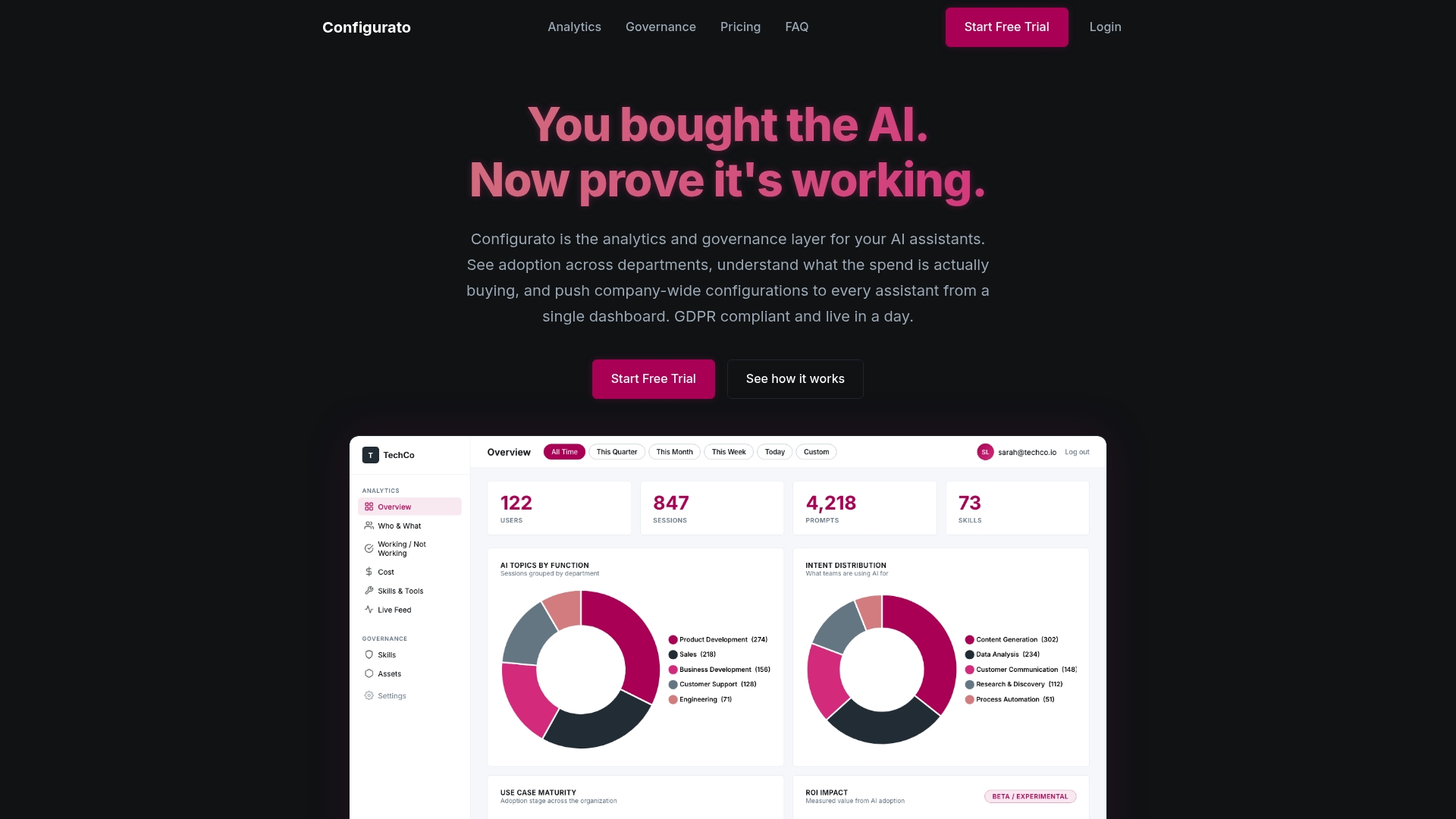
Most enterprises deploying AI assistants right now are seeing adoption metrics that look good on paper and productivity gains that do not show up in output quality. The gap is almost always the same: AI tools running without company context, producing generic output that requires heavy human rework before it can be used.
Tekkr’s Configurato platform closes that gap by embedding your processes, quality standards, and domain knowledge directly into the AI assistants your teams already use. It works agent-to-agent in the background. Your engineers get Copilot output that already follows your architecture standards. Your product managers get specs that already reflect your PDLC. No new tools, no training, no rework. If you are serious about turning AI adoption into actual competitive advantage, Configurato is where that work starts.
FAQ
What is the key difference between AI assistants and AI agents in 2026?
AI assistants respond to prompts reactively, while AI agents hold a goal and execute multi-step tasks autonomously across tools and systems. By 2026, most enterprise-grade deployments are shifting toward agentic architectures.
Will AI assistants replace human workers by 2026?
Not replace. Reshape. BCG research projects AI will alter how tasks are performed across 50-55% of US jobs, primarily through augmentation. The roles most at risk are specific task categories, not entire positions.
What is agentic commerce?
Agentic commerce is when an AI assistant executes purchasing decisions autonomously on a user’s behalf, including vendor selection, price comparison, and transaction completion within user-defined budget rules.
How many enterprises are operating advanced AI at scale in 2026?
Only 19% of organizations operate at advanced “Frontier” AI maturity levels, according to Microsoft’s 2026 Work Trend Index. About half of enterprises are still in early, emergent AI adoption stages.
What is the most common reason AI assistant deployments fail?
Skipping human-in-the-loop checkpoints in high-stakes workflows is the leading cause of failed agentic AI deployments. Without defined approval steps at critical decision nodes, errors compound before any human can catch them.