
Finance team AI adoption oversight is the disciplined governance of AI deployment across finance functions to ensure trustworthiness, regulatory compliance, and measurable business value. Without it, AI tools generate outputs that no auditor can trace and no CFO can defend. The COSO 2026 guidance now frames generative AI as an internal control issue, not just a technology project. Finance leaders who treat oversight as a governance discipline, rather than an IT checkbox, are the ones scaling AI with confidence. This guide gives you the frameworks, measurement practices, and execution steps to do exactly that.
What governance frameworks are essential for finance team AI adoption oversight?
Governance is not a brake on AI adoption. It is the foundation that makes scaling AI possible without creating audit liabilities. KPMG research confirms that organizations with strong AI audit readiness report 3 to 6 times more significant performance improvements than those without it. That gap is not about technology. It is about structure.
The COSO framework for AI internal controls
COSO’s 2026 guidance gives finance teams a concrete roadmap. It covers four stages: building an inventory of AI use cases, ranking them by risk, designing controls for each tier, and running ongoing monitoring. Each stage produces documentation that supports audit trails and regulatory review. Finance leaders who skip the inventory stage typically discover blind spots during external audits, not before.
The key governance elements every finance team needs are:
- AI use case inventory: Catalog every AI application touching financial data, from FP&A forecasting models to accounts payable automation.
- Risk tiering: Classify use cases by materiality and consequence of error. A model that flags duplicate invoices carries less risk than one that generates revenue forecasts.
- Control design: Assign human review checkpoints at every decision point involving material financial outputs.
- Decision logging: Record every AI action with associated data, model version, and the name of the human who reviewed and approved it.
- Ongoing monitoring: Schedule periodic revalidation of models, especially after data or process changes.
The shift COSO signals is significant. Finance teams must move from deterministic automation rules to probabilistic control frameworks with structured human-in-the-loop checkpoints. A rule either fires or it does not. An AI model produces a probability distribution. Governance must account for that difference.
Pro Tip: Build your audit trail infrastructure before you deploy any AI tool, not after. Retrofitting decision logs onto a live system is far harder than designing them in from day one.
66% of middle-market finance leaders rate human oversight as extremely or very important for AI deployment. That consensus reflects a practical reality: finance outputs carry legal and regulatory weight, and AI cannot yet be held accountable in a courtroom.
How can finance teams measure and demonstrate ROI from AI adoption?
Measurement is the proof layer that separates a funded AI program from one that gets cut at the next budget review. Finance leaders need KPIs that connect AI activity to outcomes the CFO already tracks.
Primary value drivers to measure
Three categories produce the clearest evidence of AI impact in finance:
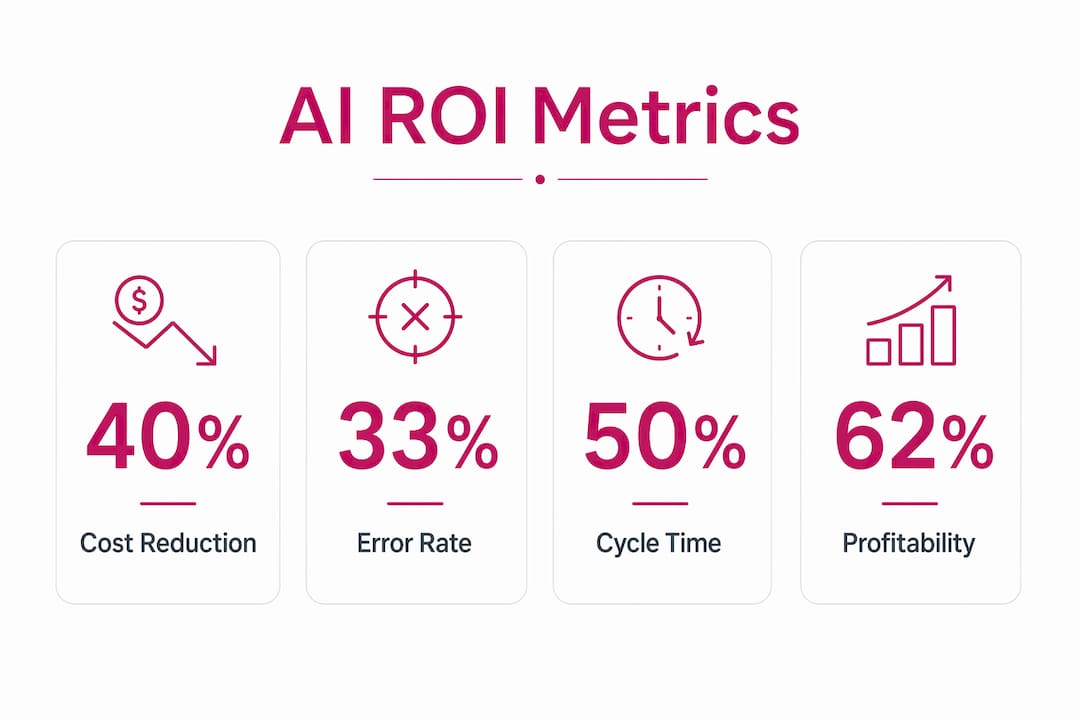
- Cost reduction: IBM research shows experienced finance AI adopters achieve a median 8% reduction in total annual finance costs. Organizations that embed AI end-to-end reach 18%. That is not a rounding error. It represents millions of dollars in large finance functions.
- Accuracy improvement: KPMG data shows audit-ready organizations achieve 33% error reduction versus 6% for those without governance structures. The governance investment directly drives the accuracy gain.
- Cycle time: Track how long key processes take before and after AI deployment. Close cycle time, invoice processing time, and variance analysis turnaround are all measurable baselines.
Embedding measurement into execution
Measurement only works when it is built into the workflow, not bolted on quarterly. Assign a KPI owner for each AI use case at launch. Set a 90-day baseline review, then quarterly checkpoints. Tie each KPI back to a line item in the finance cost structure so the CFO can see the number directly.
62% of organizations spending $100,000 or more annually on AI report increased profitability, compared to 39% of lower spenders. The correlation between investment maturity and financial benefit is real. Finance teams that measure rigorously are also the ones that justify continued investment. For a deeper look at connecting AI spend to results, Tekkr’s guide on AI adoption best practices covers the ROI measurement layer in detail.
What prerequisites and tools does effective AI oversight in finance require?
The most common reason AI governance fails in finance is not bad technology. It is weak foundations. Three prerequisites determine whether oversight is possible at all.
Data quality and fluency
Trusted data is the non-negotiable starting point. AI models trained on inconsistent or incomplete financial data produce outputs that cannot be validated. Finance teams need a data governance layer that defines authoritative sources, data lineage, and refresh cadence before any AI model goes live. Data fluency across the finance team matters equally. Analysts who cannot interpret model outputs cannot catch errors before they reach a financial statement.

Platform integration
Governance that lives outside your core ERP or CPM system loses data context and cannot enforce controls in real time. AI oversight must be embedded in the systems where financial decisions are made, not managed in a separate spreadsheet. This means configuring your ERP to capture AI-generated outputs alongside human-reviewed approvals, with timestamps and version references.
Workforce skills
Finance teams need two types of capability. The first is AI literacy: understanding what a model does, where it can fail, and how to interpret its outputs. The second is governance literacy: knowing what a control is, why it exists, and how to document a review. Neither skill is optional when AI touches financial assertions. Hiring plans and training programs should address both explicitly.
Pro Tip: When evaluating AI tools for finance, ask the vendor for a sample audit log before you sign. If they cannot show you one, the tool is not ready for a regulated finance environment.
The technology requirements for oversight are specific. You need automated decision logging, exception monitoring with alert thresholds, model version tracking, and a human confirmation record for every material output. Tools that cannot produce these artifacts create audit liabilities, not efficiency gains. For a structured view of governance frameworks and the risks they address, Tekkr’s resource on AI governance frameworks is a practical starting point.
What step-by-step process should finance teams follow to build AI oversight?
Building oversight capabilities requires a phased approach. Trying to govern everything at once produces bureaucracy. Sequencing by risk and process maturity produces results.
IBM data shows that high-performing finance organizations start AI adoption with FP&A, where 95% of advanced adopters have deployed AI, before moving to more complex workflows like procure-to-pay, where adoption sits at 58%. That sequencing is not accidental. FP&A has cleaner data, clearer KPIs, and more tolerance for model iteration than transaction processing.
The phased oversight build
- Build your AI use case inventory. List every AI application in use or under evaluation. Include vendor tools, internal models, and any AI features embedded in existing platforms. Tier each use case by risk: high (material financial outputs), medium (process efficiency), and low (administrative support).
- Define materiality thresholds. Set a dollar or percentage threshold above which every AI output requires human review before it enters a financial record. Document the threshold and get sign-off from the audit committee.
- Design human review checkpoints. For each high-risk use case, assign a named reviewer, a review cadence, and a documentation requirement. The reviewer must confirm the output, not just receive a notification.
- Implement continuous validation. Schedule model revalidation at least quarterly. When underlying data changes, trigger an immediate review. Log every revalidation with its findings.
- Engage the audit committee early. Early audit committee involvement aligns risk appetite with governance design and prevents surprises during ICFR reviews. Brief them on the AI inventory, the risk tiers, and the control design before the first external audit that covers AI-assisted processes.
The most common mistake finance leaders make is treating governance as a bottleneck. It is not. Building the oversight architecture first is the shared trait of every successful finance AI program. Teams that skip it spend more time unwinding problems than they saved by moving fast.
Key Takeaways
Effective finance team AI adoption oversight requires governance architecture, measurable KPIs, and human review checkpoints built before AI tools scale, not after.
| Point | Details |
|---|---|
| Governance enables scale | Audit-ready organizations report 3 to 6 times more performance improvement than those without structured oversight. |
| ROI is measurable | Finance AI adopters achieve a median 8% cost reduction, reaching 18% with end-to-end process embedding. |
| COSO sets the standard | The COSO 2026 roadmap covers inventory, risk ranking, control design, and ongoing monitoring for AI in finance. |
| Data and platform integration are prerequisites | Governance outside your core ERP loses data context and cannot enforce controls in real time. |
| Sequence adoption by risk | Start with FP&A, where data is cleaner, before moving to higher-complexity transaction workflows. |
The governance advantage most finance leaders are not taking
The finance leaders I see struggling with AI oversight share one pattern: they treat governance as something that happens after deployment. They buy the tool, run a pilot, get excited about the results, and then scramble to build controls when the auditors ask questions. That scramble is expensive and avoidable.
The more interesting shift I am watching is the move from automation governance to decision governance. Early AI in finance automated repetitive tasks. The controls were simple: did the process run, and did the output match the rule? Agentic AI changes that completely. When an AI agent is making sequences of decisions across a financial workflow, the accountability question becomes genuinely hard. Who is responsible when the agent’s fifth decision in a chain produces a material error? The answer is always a human, but only if you designed the checkpoints to make that human visible and accountable.
The finance teams building real competitive advantage right now are the ones treating AI oversight as an operational capability, not a compliance exercise. They are investing in data fluency, embedding controls in their ERPs, and briefing their audit committees before they are required to. That proactive posture is what separates organizations that scale AI confidently from those that keep it in perpetual pilot mode. The governance work is not glamorous. It is also not optional if you want the ROI to show up on the income statement.
— TekkrTools
How Tekkr helps finance teams govern AI adoption
Finance leaders who have built the governance framework now face a different problem: proving that AI tools are actually being used, and by whom, and to what effect.
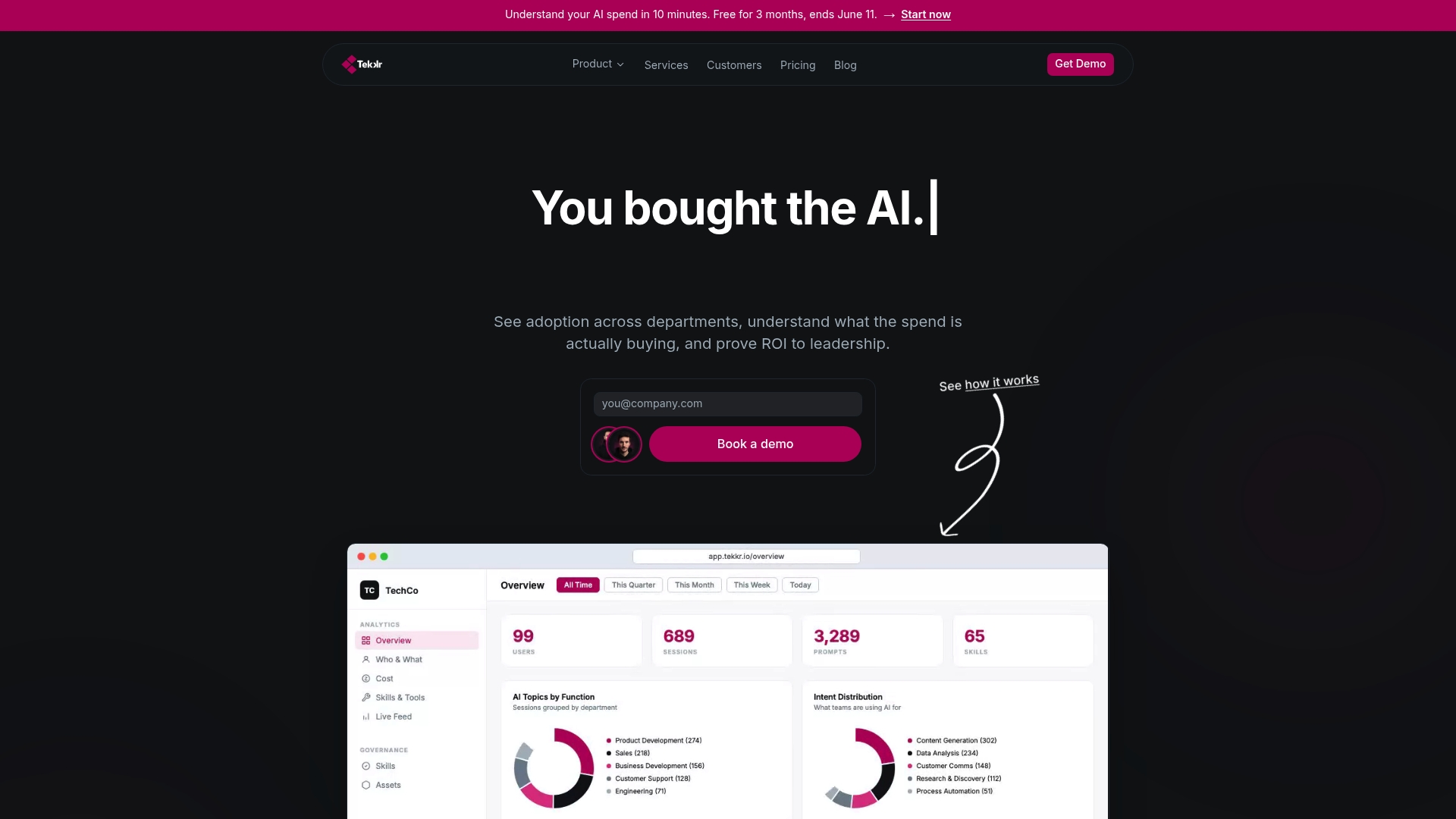
Tekkr’s flagship product, Configurato, measures AI adoption, spending, and return across your organization, then actively drives adoption higher. It tracks real usage of tools like Claude and Codex, breaks costs down by team, and surfaces use-case intelligence that tells you where AI is delivering and where it is not. For finance teams specifically, that visibility is the missing link between a governance framework on paper and measurable AI adoption in practice. Setup takes about 10 minutes, there is a free tier, and no credit card is required.
FAQ
What is finance team AI adoption oversight?
Finance team AI adoption oversight is the structured governance of AI tools deployed in finance functions, covering risk assessment, human review checkpoints, audit trails, and performance measurement to ensure compliance and measurable value.
Why does AI governance matter for finance teams specifically?
Finance outputs carry legal and regulatory weight under frameworks like ICFR and PCAOB standards. AI-generated financial data without traceable human review creates audit liabilities and undermines financial assertions.
What does COSO say about AI in finance?
COSO’s 2026 guidance frames generative AI as an internal control issue, requiring finance teams to inventory AI use cases, rank them by risk, design controls, and run ongoing monitoring with documented evidence retention.
How do finance teams measure AI ROI?
The three primary metrics are cost reduction, error rate improvement, and cycle time. IBM research shows experienced adopters achieve a median 8% reduction in total annual finance costs, reaching 18% with deep process integration.
What is the biggest mistake in AI oversight for finance?
The most common failure is deploying AI tools before building governance infrastructure. Retrofitting audit trails and decision logs onto live systems is significantly harder than designing them in from the start.