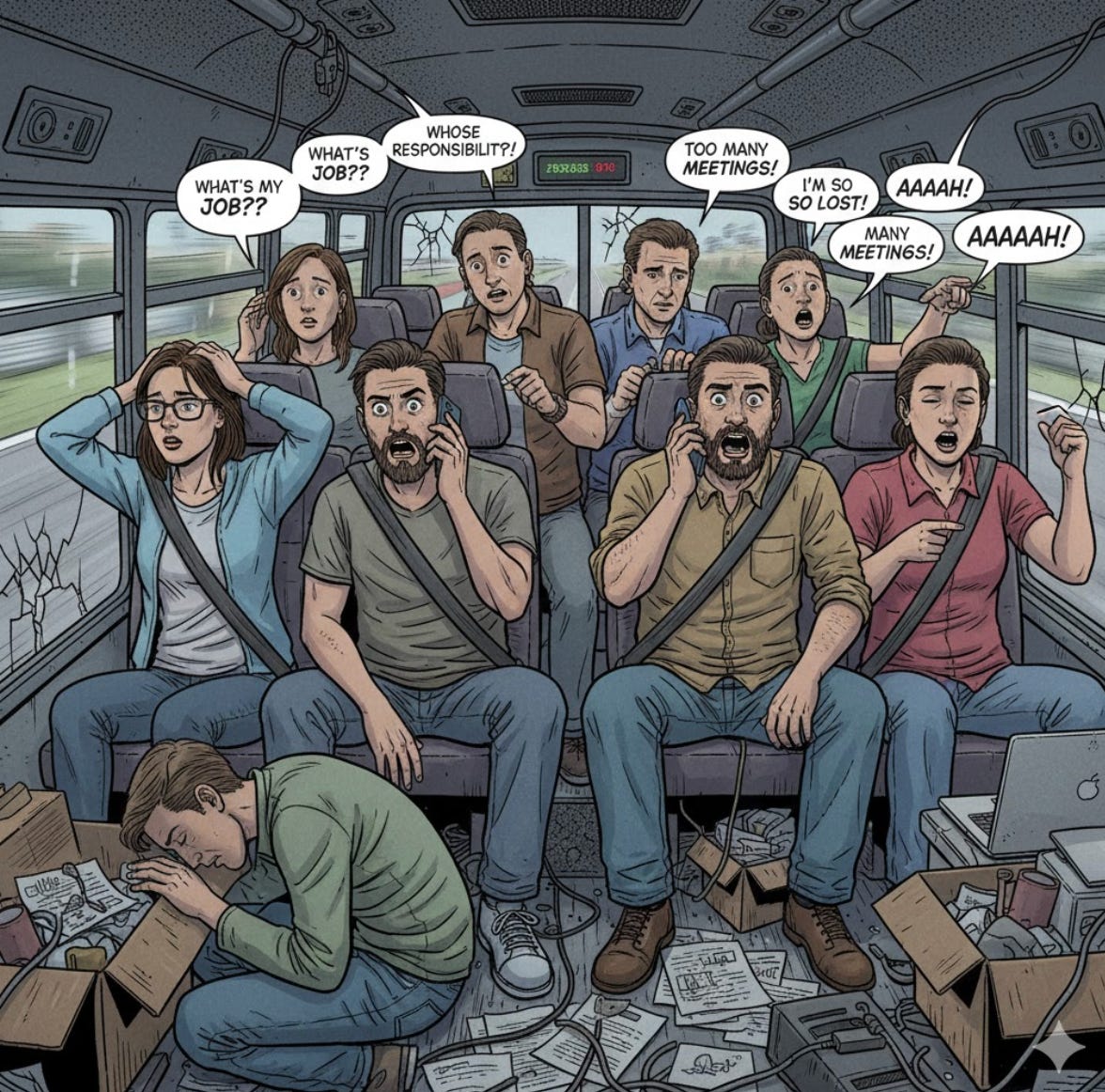
In Part 1, we talked about surviving “The Great Shift” from pre-PMF to scale-up. In Part 2 we identified the urgent need to build and especially re-communicate “The Strategy”. Part 3 introduced “The Operating Model”. Now in Part 4 we cover - probably the most crucial - aspect to scale your startup and your tech organization successfully: your team. A critical struggle founders encounter again and again is what we call “loyalty debt”. The team - that you built, that you love - which got you to this point in the company’s journey, might not be (all of) the team you need to get to the next stage. However, if you delay making changes on critical dimensions - such as Head of Engineering/Product roles - you might risk the survival of your company. This article unpacks how to deal with that tricky situation. In other words: “Who’s On Your Bus?”.
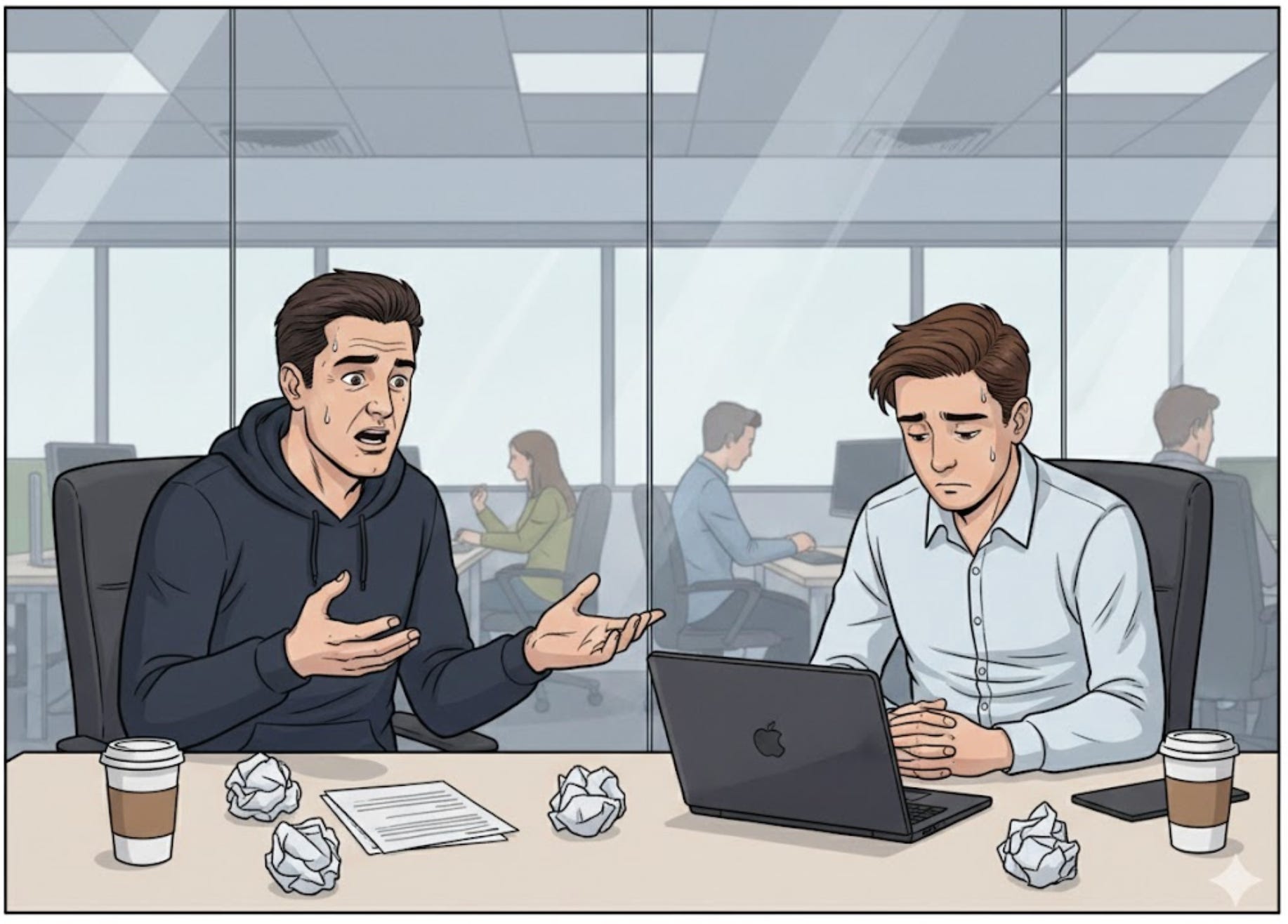
It’s 9 AM on Monday, and your week is already broken. Your calendar is a sea of overlapping meetings, leaving you with maybe an hour of free time. You face the grim task of canceling one-on-ones with your key people—again. When you finally connect with one of your top performers, the 30 minutes feels like a failure. Their energy is low, their list of critical topics is too long, and a heavy realization sets in: they are drowning, and you, their leader, are the anchor.
This article is for you if you’re a founder or tech leader in a scaling startup who recognizes this feeling. It’s a playbook for navigating one of the hardest transitions a founder must make: evolving your team by bringing in new leadership. This process involves tough conversations and even tougher decisions. I’ve been there, both as a VP Product scaling a team and as a founder building my own company. This guide is designed to help you handle it with clarity and humanity.
Top Learning Summary For Busy Founders
Top three learnings for tech leaders who need to “bring new people on the bus”:
The personal heroics that built your company eventually make you the primary bottleneck; your first step in scaling your leadership is to recognize the solution is organizational design (hiring experienced managers), not more night shifts.
When hiring “a new boss” over an employee who gave their all to your startup, the truly catastrophic mistake is giving ambiguous information to “be nice”; you must honor their contribution with extreme clarity, separating the delivery of the hard decision from the conversation about their future
To retain your best early talent through a leadership transition, you should leverage the great power of your growing startup: this company is still their single greatest growth opportunity. Then you need to back your words with tangible investments in their development (money, time, training)
The Signal: When You Become the Bottleneck
For a first-time founder, the cycle of being overwhelmed feels like a personal failure. Your instinct is to fight it with brute force. You tell yourself, “I just need to be more disciplined,” but the fires never stop—a customer escalation, a critical bug, an investor meeting you can’t miss. Your well-intentioned calendar blocks are the first casualty.
The breaking point often comes from the outside. A board member or a coach gives you the blunt feedback: “You are trying to solve an organizational design problem with personal heroics. What you need isn’t another productivity hack; it’s a management layer.”
Accepting this is tough. It means admitting that the very skills that created the early magic are now holding the company back. Your role has shifted from player to coach, and that requires building a strong management team.
The Internal Hurdles: Preparing for the Hard Conversation
Before you can act, you have to overcome a series of emotional hurdles. This is the internal work you must do before you say a single word to your team.
The loyalty debt: You grapple with a profound sense of guilt. You’re thinking: “The people who got us here have contributed so much. This decision might hurt them personally, and that makes it incredibly hard to move forward.” It feels less like a business decision and more like a betrayal.
The fear of the conversation: This guilt fuels a deep, human fear of conflict. The thought of telling a loyal, high-performing employee that you’re hiring their new boss is terrifying. The temptation to put it off becomes immense.
The catastrophe of ambiguity: Because you’re afraid, you might try to soften the blow by speaking in hypotheticals or “floating the idea.” This is a huge mistake. The employee walks away thinking it was a debate, not a decision. This ambiguity breeds mistrust and makes the final outcome even more painful.
A Playbook for Delivering Hard News: The Two-Part Conversation
To avoid the catastrophe of ambiguity, you need a clear process. The goal isn’t to avoid a hard decision; it’s to execute it with transparency and respect. I recommend a simple, two-part conversation.
Part 1: Deliver the news & listen
The only objective of this first meeting is to deliver the decision with absolute clarity and then create space for their reaction.
State the decision directly: “To help us scale to the next level, I’ve decided to hire a [Job Title] to lead the team. This person will be your new manager.”
Stop talking: This is the most important and difficult step. Let the silence hang. Your job is to listen, acknowledge their disappointment, and validate their feelings (”I understand this is difficult to hear”).
Resist the urge to “sell”: They won’t hear any talk of “opportunity” or “the future” until their initial emotional reaction has been heard. Trying to sell them on it now will feel dismissive.
A personal story illustrates this:
As VP of Product at Forto during its hyper-growth phase, the founder, Erik, told me he was hiring a more experienced CPO. My initial reaction was anger. However, because he gave me the space to process it, I realized it was the right move for the company. Had he just installed someone above me without that honest conversation, I would have been resistant.
Part 2: Frame the future
Schedule a follow-up meeting a few days later. Now, you can shift the focus to the future.
Explain the “Why”: Connect the decision back to the company’s growth and the new capabilities required to succeed.
Reiterate their value: Be specific about their contributions and why they remain critical to the company’s future.
Outline their new path: This is where you begin to frame what this change means for them. The conversation isn’t about what they’ve lost, but what they stand to gain.
The 90-Day Plan: Re-Engaging Your High-Potential Talent
Once the new leader is in place, the work continues. Your goal over the next 90 days is to re-engage your high-potential employees and turn this change into a positive outcome for them and the company.
Step 1: Maintain consistency and grace. Your immediate job is to continue the rhythm of effective management—weekly one-on-ones, collaborative goal-setting—but with an added layer of empathy. Understand their motivation may dip, and give them space.
Step 2: Watch for signals. Pay close attention. Are they still pushing and contributing in meetings? Or are they withdrawn and disengaged? The former is a sign of constructive processing; the latter are red flags.
Step 3: Address red flags immediately. If you see red flags, address them directly in your next one-on-one. Don’t let resentment build. Have a frank conversation to understand where they stand.
Step 4: Reframe the opportunity & invest in growth. This is crucial. Counter their feeling of being sidelined with a powerful, consistent message: a fast-growing scale-up is the single greatest growth opportunity of their career. Explain that as the company scales, so will their scope, responsibility, and impact. Back this up with tangible investments: a budget for an executive coach, access to specialized courses, or a paid week off for a learning seminar. These aren’t perks; they’re signals that you are investing in their future.
Step 5: Draw a clear line. After you’ve had these conversations, you must also respectfully close the loop. It’s healthy to say something like: “We’ve talked about this, and I’m committed to your growth here. I also need to focus on the broader business, so I won’t be proactively bringing this up again, but my door is always open in our one-on-ones.” This gives them agency while allowing you to move forward.
The Other Side of the Coin: Setting the New Leader Up for Success
While managing the emotions of your existing team is critical, you must also ensure the new leader can actually lead. I see founders sabotage their new hires by failing to do two things:
Give a crystal-clear mandate: There can be no ambiguity about roles. Do not create parallel structures (e.g., keeping the old “Head of Engineering” title alongside a new “VP of Engineering” without defining the reporting line). Ambiguity breeds confusion and resentment. Define exactly who owns what from Day 1.
Allow for quick wins: Set the new leader up to demonstrate value immediately. Give them a meaningful problem—one you never had time to fix—that they can resolve in their first week. When your team sees the new leader unblocking them and solving problems that have been stalling progress, their initial resistance will quickly turn into relief.
Summary
Scaling a team from Series A to C means facing difficult people decisions. Trying to solve organizational problems with personal heroics only makes you the bottleneck.
Recognize the signal: Constant firefighting and a chaotic calendar are signs you need a dedicated management layer.
Prepare internally: Acknowledge your feelings of loyalty and fear, but don’t let them lead to ambiguity.
Use the two-part conversation: Deliver the news with clarity first, then frame the future in a separate follow-up meeting.
Re-engage your talent: Use the 90 days after the change to reinvest in your key people, reframe the opportunity for them, and address any red flags immediately.
Navigating this transition is one of the defining challenges of a founder’s journey. By handling it with a clear, humane process, you not only strengthen your company but also honor the people who helped you get there.
Tekkr helps Executive tech leaders in VC-backed startups scale their tech organizations successfully. We provide a digital chief of staff that delivers critical organizational improvements and business outcomes. Learn more at www.tekkr.io.