Liabilities can come from unexpected places in scale-ups. Why star players can become your biggest bottlenecks and how you can unblock them again.
Wednesday morning: Your star Product Manager is giving an update on a critical cross-functional initiative. This is the person who has been with you from the start. You trust them implicitly.
“We’re working on it,” he says for the third week in a row. “Progress is slow, but it’s happening.” An hour later, your CRO pings you for a 1:1.
“My team is completely blocked on the new product release,” they tell you. “The demo for our biggest prospect is in two weeks, and we’ve got nothing. I keep hearing it’s in progress, but nothing is shipping. What is going on?”
And just like that, your most reliable and effective employee has officially become a business-critical bottleneck.
Top learning summary for busy founders
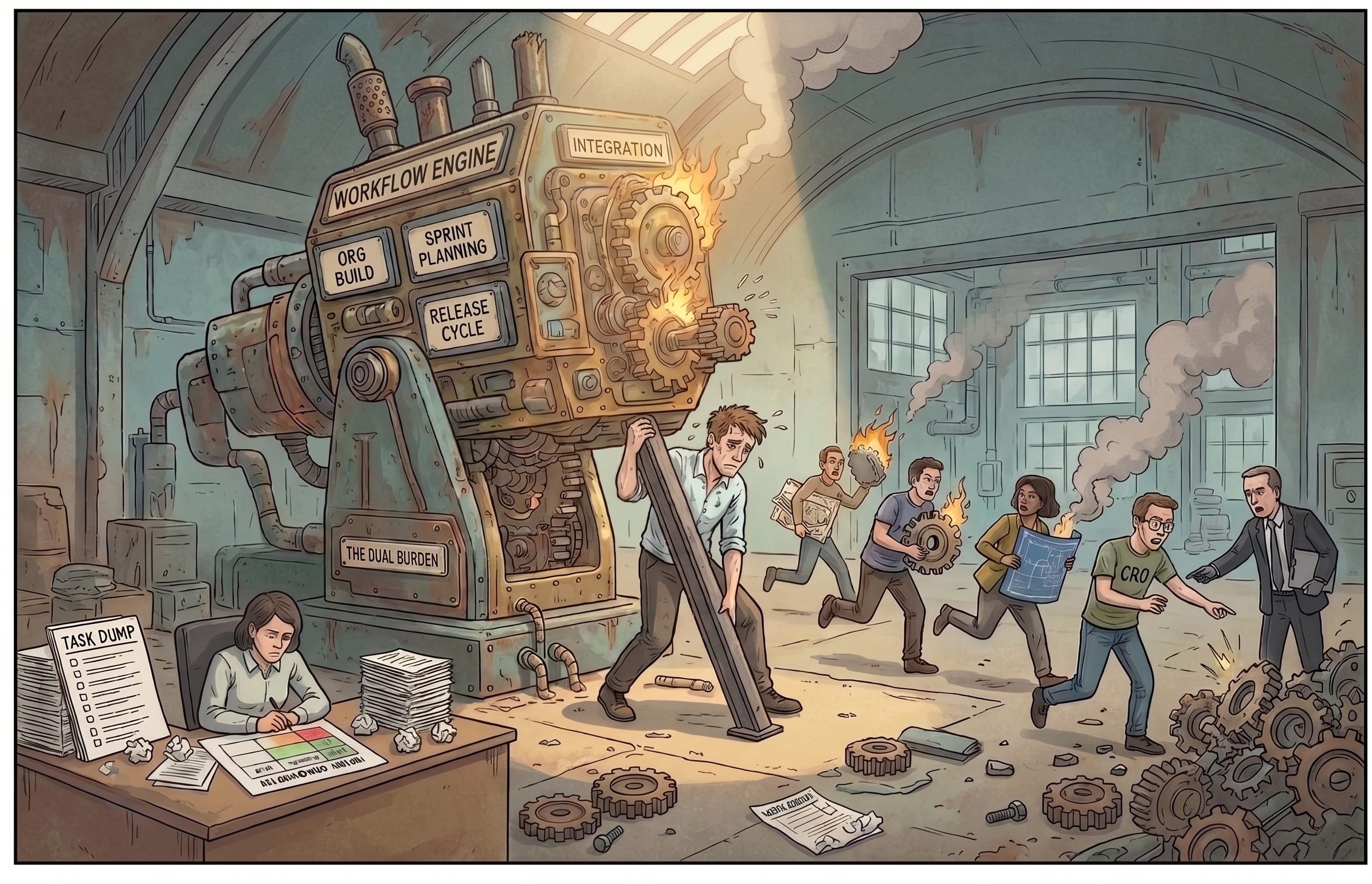
The Dual Burden: Your best people are failing because they are doing two jobs. Their core day-to-day work, plus the unspoken job of building organizational processes they have no training for.
Misdiagnosed Problems: Founders treat this as a capacity problem (too much work) rather than a capability problem (lacking org-building skills), leading to failed fixes like time management training or hiring junior support.
The Structural Fix: Unblocking your team requires a transition from individual heroics to scalable systems. You need to identify critical people and capability gaps to relieve the pressure and sustain momentum.

Anatomy of a Breakdown: The Dual Burden
Your first instinct is frustration. But the truth is, your star player isn’t failing. They are being failed by the very success of the company.
In the Series A-to-C journey, this is one of the most painful and predictable breaking points. You promoted this person because they were a world-class problem solver. Now, as the company scales, they have been handed a dual burden without anyone ever naming it.
First, their core job has become exponentially harder. Managing a product or leading an engineering team is vastly more complex with 70 people than it was with 15.
Second, because they are trusted, they have been put in charge of solving new cross-functional organization-building problems. You ask them to design a new scalable SDLC, create a hiring process for three new pods, or fix the sales-to-product feedback loop.
Here is the fatal flaw. This new job requires a completely different skill set. They are experts at their core job, but amateurs at this new, high-stakes org-building work.
Founder Misdiagnosis
As a founder, you see the symptom: overwhelm. Your best person is drowning. Because you are a builder, you try to fix it. But you misdiagnose the problem. You think it is a capacity problem, but it is actually a capability problem. They are being forced to do a new job they have not been trained for.
This leads to a series of well-intentioned fixes that are doomed to fail.
The Prioritize Better Fix: You tell them to focus on what is important. This fails because they are focusing on their core job, while the new org-building work is what is actually on fire.
The Training Fix: You offer a leadership course. This is the equivalent of sending them to night school when the building is already burning.
The Junior Hire Fix: You hire a junior PM to take things off their plate. This fails because a junior person cannot take on the senior, strategic work of designing a company-wide process.
“We lost six months waiting for a brilliant Head of Engineering to grow into a VP role. The problem was, we didn’t need a student; we needed a teacher. We were burning our runway on their on-the-job training.” — Series B Founder
This leads to the biggest mistake a founder can make. Freezing into inaction. In a high-growth startup, inaction is not a wait-and-see strategy. The clock is always ticking.
Here are three steps to take to fix this short- and long-term.
Step 1: The 2-Hour Triage to Stop the Bleeding
You cannot solve this long-term problem today. But you can stop the bleeding in two hours. Get your star player in a room. Frame the meeting not as an accusation, but as a support mission.
Run a simple 3-step triage.
The Task Dump: Open a document. Write down absolutely everything they are doing. Writing software, gathering requirements, on-call duties, recruiting. Get it all out of their head.
The 4Ds: Go through the list line by line and force a decision. Drop what you can kill immediately. Defer what can wait 30 days. Delegate what can be handed off today. Do only what must be done.
The Matrix: For the few critical tasks that remain, put them on an Eisenhower Matrix. They are now only allowed to work on the urgent and important items.
The emotional relief from this single exercise is massive. It gives your leader the security to breathe. But it only buys you time.
Step 2: Identify the Structural Fix Relevant to Your Stage
To get out of this situation permanently, you first have to understand why it happens. Young, ambitious founders keep giving operational work to their top performers simply because it used to work. You trust the people who have always delivered. At the same time, your top performers usually have extreme ownership. They like having power, they learn fast, and they want to do the “important” stuff.
But if they refuse to let go, and you refuse to take things off their plate, they become the bottleneck. Founders often resist hiring project managers or operations people because it feels like “overhead”—a cost that doesn’t directly build the product. Usually, they only agree to build these systems when the pain becomes unbearable: top people burn out, threaten to quit, or you repeatedly miss massive deadlines.
You can avoid that breaking point. After the Eisenhower triage stops the immediate bleeding, you must look at your organizational setup and execute specific unlocks as you scale.
Unlock 1 (Seed to Series A): The Dedicated PM
In the early days, it is just founders and engineers. The breakdown starts to happen because engineers are constantly blocked waiting for founders to answer questions, but the founders are too busy selling and fundraising.
The first major unlock is a dedicated Product Manager. This is not just a scrum “product owner” moving tickets around.
This PM unblocks the engineering organization by answering their questions quickly because they have the bandwidth to hold all the context from the founders AND are available quickly.
These PMs also execute the founders’ ideas (they are NOT the “owner of the product”) —since founders are still closest to the market—but they also bring their own ideas on sprint organization, discovery, and moving the product forward.
Unlock 2 (Scaling tech): Engineering Managers
In any engineering organization, there are three distinct activities: delivery, technical decision-making (architecture, legacy system integration, …), and people management (actual career growth, not just vacation approvals).
In small startups, you usually have very strong individual contributors (ICs) who are brilliant technically, but who lack management experience or simply don’t want to manage people. Forcing them to bear the risk of breaking them.
The unlock is often to bring in an Engineering Manager to own delivery and people management. Your strong IC then becomes the “Technical Lead,” co-owning the technical decisions.
Crucial warning: Ensure the EM and Tech Lead get along well. If they don’t, you have essentially introduced two conflicting technical leads and created a new bottleneck.
Unlock 3 (Series A, doubling from 15 to 30 people): Product Operations
When you hit Series A, you are likely trying to double your team. The breakdown here is the usually the Tech<>HR interface, recruiting, hiring and the onboarding process.
If your senior people are doing ad-hoc interviews and unstructured onboarding, they will drown. You need product operational capacity to optimize these processes.
You need someone to standardize the candidate profiles, the testing, the interview pool, and the closing process. Your HR team is usually understaffed and overworked and lacks the technical expertise to take care of this for you. You need somebody who knows tech and can deliver process improvements and results fast.
Read more here about managing tough team conversations.The impact here is massive: getting a new hire fully operational in one month versus three or six months fundamentally changes your bottom line.
Unlock 4 (~30 people): Product and/or Engineering Leadership
As you approach 30 people, the founders can no longer be the sole managers of the daily roadmap. You need a counterpart to the C-suite.
This is the time to bring in a Head, Director, or VP of Product/Engineering.
The founders still own the overall company vision and direction setting, sometimes the technical direction (if they are very technical). Product leaders can completely take over the complex, time-consuming process of target-setting and roadmap organization. VPs of Engineering often take all the management aspects of a growing Eng organization, as well as organizing for compliance/certifications required for growth, security and resilience. Both take on all aspects of people management which can massively unblock founders.
Unlock 5 (Continued growth to 100+ people): Advanced Roles
As you keep growing, your Directors and VPs will hit their own capacity limits trying to coordinate across massive departments. You need to introduce specialized roles to handle the scale.
This often means bringing in a Chief of Staff or Founder’s Associate to take care of specific product operations (sometimes acting as an alternative to a Director early on).
Eventually, beyond 120 people, it might pay off to introduce dedicated Program or Delivery Management to ensure large-scale, cross-functional delivery actually happens.
(Self-check: Look at your current headcount. If you have 25 people and still haven’t implemented Unlocks 1 and 2, you now know exactly why your top people are overwhelmed and your roadmap is stalled.)
Phase 3: The Execution and Your 3 Options
You know what needs to happen. But how do you actually build these systems when your top people are already maxed out just keeping the lights on? You have three distinct options.
Option 1: The Scrappy Move (internal fix) You bring in an internal helper, like an ops person or a junior PM, to take over the busy work.
Pros: It is cheap and fast.
Cons: You have only bought time, not experience. You are still betting on your overwhelmed, exhausted leader to slowly figure out the complex skill of org-building on their own.
Option 2: The Permanent Move (the long-term hire) You start the search for the specific, seasoned leader your stage requires—whether that is your first Product Ops manager or a VP of Engineering.
Pros: This is the correct structural solution for the long term.
Cons: It takes six to nine months to source, hire, and onboard this person (in Europe, US is faster). You still need an interim solution to survive the stall right now.
Option 3: The Accelerator Move (outside help) Executed well, this can be a bridge. You bring in an outside expert, an interim chief of staff, somebody from Tekkr ;) or dedicated product ops experts while you look for your long-term hire.
Typically, what you can expect in this hybrid approach in the first 14 days is something like this:
Day 1: You instantly generate a concrete execution plan for your organizational gaps or missing capabilities (e.g., your new SDLC or hiring process).
Day 2: You review this plan with your internal experts and your consultant. You gain the confidence that the chaos will end.
Days 2-5: Your star players feel the weight lift. They can refocus on their core jobs because they know the organizational and operational heavy lifting is being managed by AI agents and seasoned experts.
Weeks 1-2: Vague bottlenecks get clarified into clear system gaps. You gain full visibility into your biggest operational levers, and work is already in progress to advance on the biggest levers.
It Is a System Problem, Not a Person Problem
Unblocking your most critical people is never just about time management. It is the painful, necessary signal that you must transition from leading a team to building an organization.
Your star player didn’t fail. The system that got you to Series A failed them.
The solution is not to ask them to try harder. The solution is to give them a new operating model that allows them, and the entire company, to win.
Tekkr helps Executive tech leaders in VC-backed startups scale their tech organizations successfully. We provide a digital chief of staff that delivers critical organizational improvements and business outcomes. Learn more at www.tekkr.io.