A strategy on a slide deck is just imagination. The real test is when that strategy hits the chaos of your daily operations.
This is where I’ve seen founders lose their jobs. Mostly tech founders.
Not because they weren’t smart or hardworking. But because they were trying to scale into a 100+-person company with the same setup that built the first version of their product. This doesn’t work. You’ve raised money, hired more people and still your delivery is getting slower.
Recap: In Part 1, we talked about surviving “The Great Shift” from pre-PMF to scale-up. In Part 2 we identified the importance and need to re-communicate “The Strategy”. Part 3 introduced “The Operating Model”, Part 4 showed the most important people dimension “Who’s On Your Bus?”.
Now. You know where you are going.
And you have the right people on the bus. What’s next?
How to get s**t done with that team, that is what’s next. We are going to turn that beautiful strategy into specific, achievable quarterly targets to align everybody for efficiency. Strategy alone won’t get anything done.
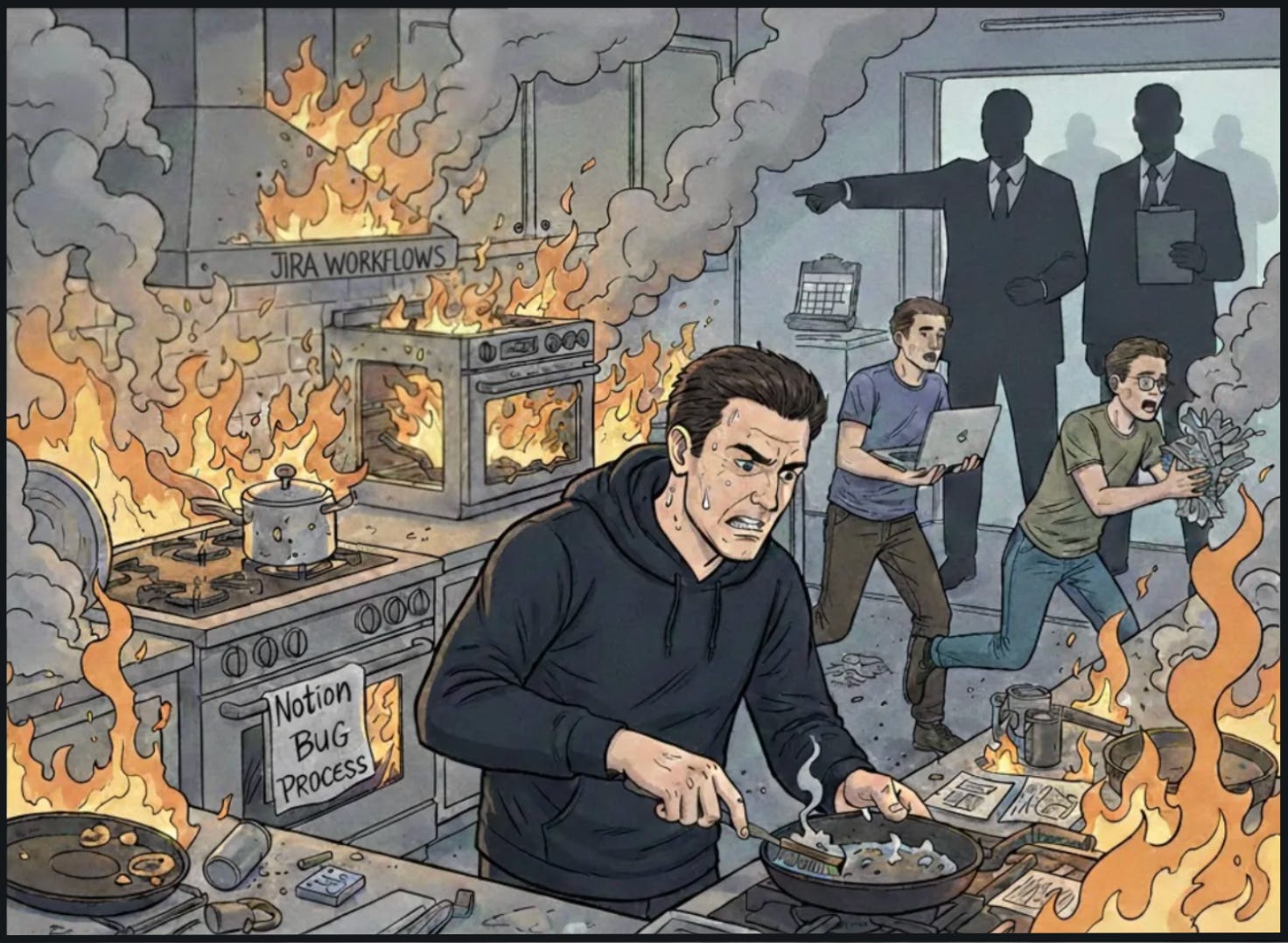
When you are scaling, founders often - in well-intentioned panic - start “micro-fixing” the wrong problems. They see the friction between Commercial and Tech, the missed deadlines, and the rising complaints. Then they go and try to optimize Jira workflows, redesigning Product Launch Notion templates or try to “fix the bug process.”
If this is you, you’re not fixing the problem. You’re just scrubbing a pan while the kitchen is burning down. The real problem isn’t your bug process. It’s that your entire operating model—the one built on two-week sprints and hallway conversations—is collapsing under its own success. If you don’t change your approach, you will go under. Your kitchen will burn down. You will escalate with your co-founders. At some point your key investor on the board will ask you for a 1:1. Then they tell you, that it would be best for the company and yourself to step to the side.
Don’t let that happen to you. It’s time to shift from sprints to systems. It’s time to start an effective target setting process in your scale-up.
Top Learning Summary For Busy Founders
Top three learnings for tech leaders changing from sprinting to scaleable systems:
Stop fixing tasks, build a system. Your company’s chaos is a systemic problem, not a task-level one. Tweaking Jira workflows is like “scrubbing a pan while the kitchen burns down.” A key system you need very early on, is a predictable target setting process, ideally in a 90-day operating rhythm.
Your job is to make invisible work visible. A typical challenge in tech startups is the negotiation between new feature work and technical debt. The (technical) founder’s most critical role in planning is to empower tech leads before the alignment meetings. They should be armed with data to quantify “Keeping The Lights On” (KTLO) and tech debt, turning it from a “tech problem” into a “business conversation.”
Reframe conflict as “Revenue vs. Revenue.” When Sales (new features) and Tech (stability) clash, it’s not “Sales vs. Tech.” It’s a “Revenue vs. Revenue” conflict. New feature revenue is fighting retention revenue. Your job is to make the strategic trade-off for the good of the whole business, not to pick a side.
The Fear vs. The Reality: Why “Process” Isn’t a Dirty Word
For a founder, the phrase “quarterly planning” is terrifying. It sounds slow. It sounds bureaucratic. It sounds like everything you’ve been fighting against.
This is the most critical reframe: This new process isn’t about red tape. It’s about buying calm, peace, and breathing room.
Your commercial team is desperate for a 90-day view because their customers work in quarters and they want to be able to say: “we don’t have that feature yet, but we will in Q4”. Your tech team is desperate for a 90-day view so they can stop the whiplash of constant reprioritization. And you, the founder, are desperate for a system that stops you from being the single point of failure for every decision.
This “system” is also what builds trust. It gives your counterparts in other departments a sense of calm—a feeling that you are available, structured, and thinking about the whole business, not just the next sprint.
But this is also - often - a moment of intense personal challenge. Your team, your peers, and your other leaders have a “preconceived conception” of you. They’re used to the frantic kitchen-scrubber founder. Even if you present a clear, calm strategy, they may be waiting for you to panic and override it. (If you are a calm, always-in-control founder in your company and never overwhelmed - please call me, I want to talk!)
Evolving your company’s system requires you to evolve your personal one first.
The First Painful Run: Setting Expectations
If you’re going for a run for the first time in years, those first 20 minutes are exhausting. You’ll spend 10 minutes just looking for your running socks. Your legs will be heavy. It will feel awful.
Your first attempt at a quarterly planning process will feel exactly the same.
That is the expectation you must set for yourself and your team. The first time you run this, it will be messy, painful, and imperfect. The first plan will be crap. That is not a sign that the process is wrong; it’s a normal part of building a new muscle.
This three-month rhythm is simply the standard for a reason. Businesses, from Series A to IPO, operate on this cadence. You’re just buying yourself breathing room by aligning with it.
“You can achieve incredible progress if you set a clear goal and find a measure that will drive progress toward that goal.” - Bill Gates
A Pragmatic 4-Week Planning Playbook
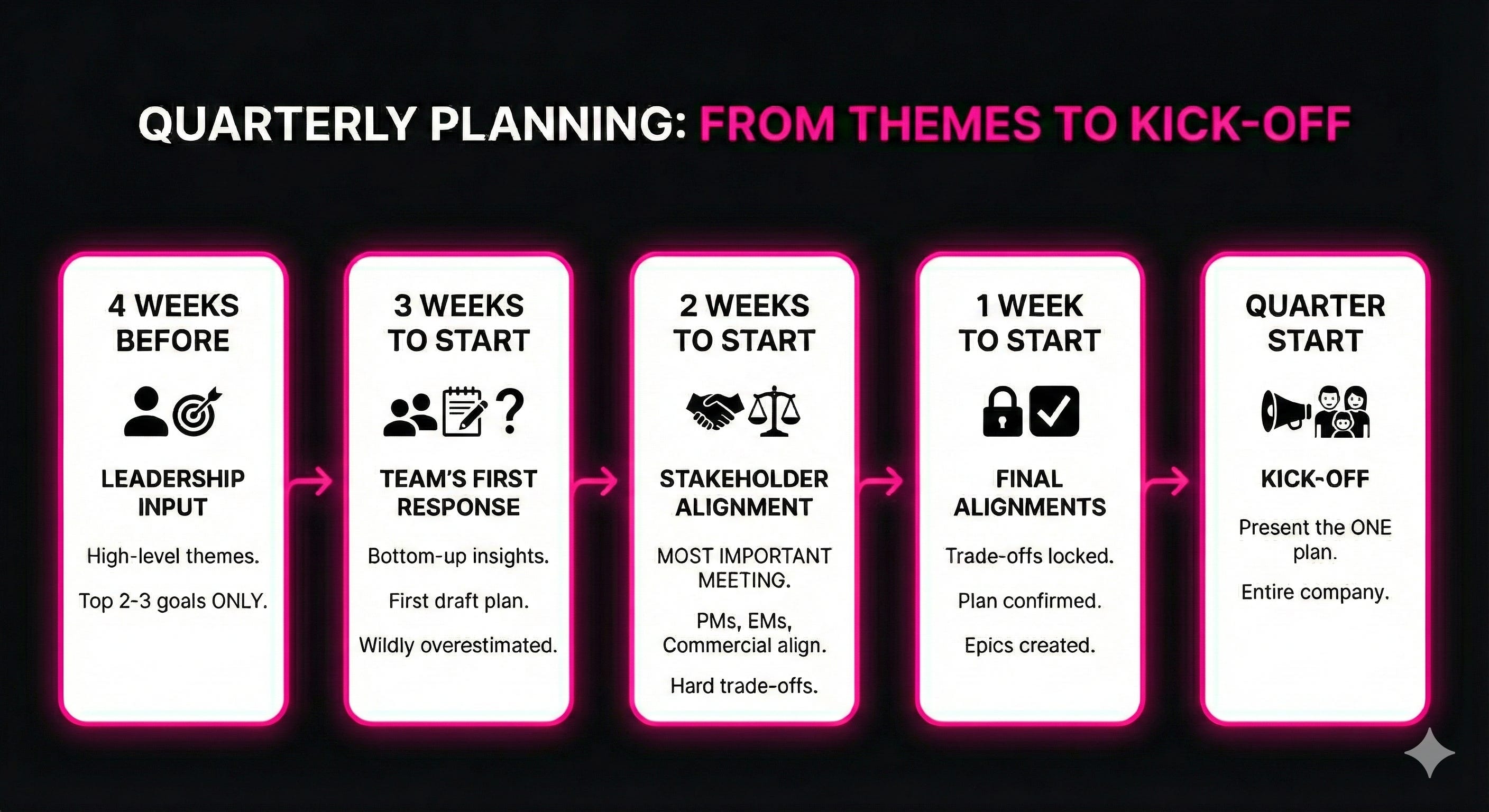
So, how do you start that first, painful run? With a pragmatic, 4-week alignment cycle leading up to your quarter-kick off. This isn’t a massive, top-down project.
4 Weeks Before New Quarter Starts - Leadership Input: You, as the founder or leader, provide the high-level themes. What are the top 2-3 things we must achieve as a company this quarter? Not 10 things. Three.
3 Weeks To Quarter Start - Team’s First Response: Teams collect bottom-up insights and present their first version of a plan (e.g., team OKRs) to hit those 2-3 goals. This plan will be 95% wrong. It will be wildly overestimated. That’s the point. It’s a starting draft, not a final contract.
2 Weeks To Quarter Start - Stakeholder Alignment: This is the most important meeting. Your PMs, EMs, and other leaders get in a room with their commercial counterparts. This is where the plan meets reality. This is where the hard trade-offs are made.
1Week To Quarter Start - Final Alignments: The trade-offs are locked. Leadership confirms the final, aligned plan. The epics are created.
Quarter Start - Kick-Off: You present the one, single, committed plan to the entire company.
This process seems simple, but it often fails when it hits the Stakeholder Alignment meeting. Here’s why.
The Founder’s Real Job: Making the Invisible, Visible
In that “Team’s First Response,” your engineering team will present a beautiful, wildly optimistic plan that is 100% “visible” new features.
Your Head of Sales will love it.
But you, and your Head of Engineering, know it’s a fantasy. It’s missing all the “invisible” but non-negotiable work: the maintenance, the bug fixes, the “Keeping The Lights On” (KTLO) and the tech debt.
As a founder you should absolutely avoid to embarrass your team in front of the stakeholders. Don’t ask “Where’s the tech debt?” in front of the Head of Sales. It undermines your teams and forces them to be defensive.
Your real job happens in in the very first part: the leadership input
You must pre-brief your tech leader. You take them aside and say:
“For the stakeholder alignment meeting, I need you to come prepared with the real cost of ‘Keeping The Lights On.’ I am backing you. But you need to bring the data.
I don’t care what it is—DORA metrics, the number of messages in the #bugs Slack channel, the P1 incident count—find a pragmatic way to quantify it. We must present a complete plan that includes this ‘invisible’ work, not just a feature list.”
This is an act of leadership. You are empowering your tech lead to have a data-driven, non-emotional conversation about reality.
The Showdown: How to Handle a “Revenue vs. Revenue” Conflict
Now it’s the Commercial-Stakeholder meeting. Your Head of Engineering, fully prepared, says, “To maintain stability and support our top 10 accounts, we’ve analyzed last quarter’s incidents. We must formally protect 25% of our capacity for KTLO.”
Your Head of Sales, understandably, says, “I get it, but 25% is huge. My $5M pipeline depends on this new enterprise feature list. Can’t you do it with 10% this quarter?”
This is the moment of truth. This isn’t a “tech vs. sales” argument. It’s a “Revenue vs. Revenue” conflict. The revenue from new features is fighting the revenue protected by retention and stability.
Your job as the founder is to elevate the discussion from features to business outcomes. You must step in and make the trade-off call.
You listen, and then you lead.
You could say: “Okay. We will protect 20% for KTLO. The Head of Sales’ enterprise feature is P0, but we will deliver an MVP version this quarter, not the full-spec. The new hires in next month’s budget are earmarked for the Head of Engineering’s tech debt backlog. This is the plan we’re committing to.”
Or you could say: “Actually, new revenue is P0. All energy on new feature work.”
I can’t tell you your business priorities, but you need to make sure the trade-off discussion happens and everybody understands the trade-off.
Alternative Approach. At Tekkr we think the 4 weeks process is a great start for any scale-up looking to introduce more planning-rigor. But there are alternatives: a few companies I’ve talked too use multi-day offsites to plan & align everyone “in batch”. This reduces context switching and has a clear forcing function to finish by end-of-day-3.
The “Black Belt” Move: Handling the Inevitable CEO Exception
You’ve done it. You have a plan. You have a system (Jira, Linear) to track it and a ritual (a bi-weekly, 30-min check-in) to inspect it.
But this new, fragile system will be tested.
Your co-founder or CEO will walk over to your desk and say, “Hey, I just had a great call with our new Series B investor. I need your best engineers to build a quick prototype for [New Shiny Idea]. It’s super important.”
This request bypasses your entire quarterly plan.
A junior manager, clinging to the process, will say, “Sorry, that’s not on the quarterly plan.” They’ll be “right,” and they’ll be completely ineffective.
A true leader knows the process is a tool to serve the company, not the other way around.
The investor’s $20M term sheet might actually be the new, company-wide P0. Your job isn’t to defend the process; it’s to use the process to show the blast radius of the decision.
You do the research and you might say, “Absolutely. Let’s make that happen. Let’s agree that this is now the company’s P0.”
Then, you immediately go to your team. Not with an apology, but with a transparent explanation.
“Team, the quarterly plan we all agreed on is paused. The CEO’s prototype is now the company’s P0. We are doing this because it’s critical to our Series B. To make space, the enterprise feature we were building is now P1. Here is the new plan.”
That act of transparent, decisive re-prioritization builds trust, it doesn’t break it. It shows the team you’re all playing the same game, guided by the same business outcomes.
From Architect to Janitor
This shift—from a reactive, sprint-level focus to a proactive, quarterly system—is one of the hardest transitions a founder has to make. It requires you to stop being the best doer and start being the best architect.
You’re no longer just scrubbing a pan. You’re designing the whole kitchen. And that is how you scale.
Next up: We’ve built the target setting system. But how do you make sure that you deliver? In Part 6, we’ll dive into introducing another key process for scale-ups: The (AI-)Software Development Lifecycle.
P.S. I’ve changed my go-kart analogy for a kitchen this time. I was getting tired of all the racing metaphors. What do you think about it? Do you feel like your startup is more like a burning kitchen or a go-kart with 10 people giving everybody whiplash? :D
Tekkr helps Executive tech leaders in VC-backed startups scale their tech organizations successfully. We provide a digital chief of staff that delivers critical organizational improvements and business outcomes. Learn more at www.tekkr.io.