
AI adoption blockers are the organizational, technical, and cultural forces that prevent companies from turning AI investments into real productivity gains. Nearly 79% of organizations report significant AI adoption challenges as of 2026, a double-digit increase from the year prior. That figure means the problem is getting harder, not easier, even as AI tools improve. The most common examples of AI adoption blockers include data privacy failures, skill shortages, trust deficits, legacy system conflicts, and cultural resistance. Each one is specific, measurable, and solvable when you know what you are actually dealing with.
1. Examples of AI adoption blockers: data privacy and security fears
Data privacy and security concerns are the single most cited barrier to AI implementation. 58% of professionals name privacy and security as their primary reason for resisting AI tools. That number reflects a real pattern: employees and legal teams worry that AI tools will expose sensitive customer records, proprietary business data, or personally identifiable information.
The risk is not hypothetical. Enterprises without formal data governance policies often discover that employees are pasting confidential data into public AI interfaces. This creates compliance exposure under frameworks like GDPR and SOC 2, and it forces legal teams to issue informal bans on AI tool use rather than structured policies.
- Unregulated AI tool use creates gaps in data lineage and audit trails
- Cloud-based AI tools may conflict with network security policies on locked corporate desktops
- Siloed data across departments prevents AI models from accessing the full context they need
- Poor data quality produces unreliable outputs, which erodes user confidence faster than any other factor
Pre-implementation data readiness assessments reduce expensive post-deployment fixes and improve adoption success. Running a data audit before deployment is not optional; it is the difference between a working AI rollout and a stalled one.
Pro Tip: Require SOC 2 Type II compliance documentation from every AI vendor before procurement. This single step filters out tools that cannot meet enterprise security standards and gives your legal team a concrete framework to evaluate risk.
2. Skill shortages blocking AI at scale
A shortage of AI-related skills is the primary barrier to scaling AI programs in mature organizations. Between 34% and 53% of organizations with established AI programs report that lack of specialized talent is their biggest obstacle. This is not a problem limited to early-stage companies. Even enterprises with dedicated AI budgets stall because their workforce cannot operate the tools effectively.
The skill gap shows up in two distinct ways. First, technical teams lack the machine learning and data engineering expertise to build and maintain AI pipelines. Second, and more damaging to adoption, business users lack the prompt engineering and workflow redesign skills to use AI tools productively in their daily work.
- Employees default to old workflows because they are faster and more familiar
- Managers cannot coach AI adoption when they have not adopted it themselves
- Training programs focus on tool features rather than workflow integration
- No internal champions exist to demonstrate practical wins to skeptical colleagues
Harvard Business School research shows that employees fear “role compression,” the loss of the interesting, varied parts of their jobs to automation. That fear drives passive resistance even when employees are not openly opposed to AI.
Pro Tip: Identify three to five employees per department who are already experimenting with AI tools and give them formal recognition and time to share what they have learned. Individual first wins spread faster than top-down mandates.

3. Trust and transparency deficits that halt deployment
Trust is the most underestimated AI deployment obstacle in enterprise settings. Nearly 60% of business leaders have delayed or canceled AI deployments because they do not trust how the tools handle data. This is not irrational caution. It reflects a real gap between what AI vendors promise and what organizations can verify.
The explainability gap makes this worse. When an AI tool produces a recommendation, most systems cannot show the reasoning behind it in plain language. Business users cannot validate outputs they do not understand, so they ignore them or override them manually.
“Trust is not a feeling organizations can manufacture through marketing. It is a structural outcome of transparent governance, explainable outputs, and consistent controls. Organizations that treat transparency as an operational requirement, not a nice-to-have, close the adoption gap faster than those that rely on vendor assurances alone.”
According to PwC, 80% of business leaders distrust agentic AI for autonomous decision-making, citing transparency and explainability as their core concerns. That level of distrust effectively blocks any AI use case that requires the system to act without human review at every step.
- Lack of audit logs makes it impossible to trace AI-driven decisions
- Inconsistent outputs across similar inputs signal unreliability to end users
- No review process for AI recommendations leaves employees without a safety net
- Ethical concerns about bias in AI outputs create legal and reputational hesitation
4. Legacy system integration failures
Legacy system integration is one of the most concrete and costly AI deployment obstacles organizations face. AI projects routinely stall at proof-of-concept because the existing IT architecture cannot support the data flows the AI tool requires. This is not a vendor problem. It is an infrastructure problem that no amount of software configuration can fix without IT involvement.
The typical failure pattern looks like this: a business unit purchases an AI writing or analytics tool, deploys it to a team, and discovers within weeks that the tool cannot connect to the internal data sources it needs. The tool runs in isolation, producing generic outputs that add no value over what the team already had.
Network security policies compound the problem. Many enterprise environments restrict outbound data transfers to cloud services, which is exactly how most AI tools operate. Locked desktops and VPN configurations block the browser-based interfaces that AI tools rely on. The result is a technically purchased tool that employees physically cannot use.
Pro Tip: Involve your IT security and infrastructure teams in AI vendor evaluations before any purchase decision. A 30-minute technical review session can identify integration blockers that would otherwise surface six months into deployment.
5. Organizational culture and governance gaps
Culture and governance failures are the most common reason AI projects fail, and they have nothing to do with the technology itself. Research confirms that organizations treat AI as a software purchase rather than an organizational transformation, leaving workflows and incentives unchanged. The tools arrive, but the conditions for using them never do.
The governance vacuum creates a specific and dangerous pattern. Without clear AI ownership and policy, employees make their own decisions about which tools to use and how. 79% of organizations report siloed AI deployments, and 67% believe their company has suffered data breaches from unapproved AI tool use. Shadow AI is not a fringe behavior. It is the default when governance is absent.
Misaligned incentives make cultural resistance structural. Only 13% of employees are rewarded for redesigning their workflows with AI, while 45% feel safer sticking to their existing goals. When the incentive system punishes experimentation and rewards the status quo, adoption stalls regardless of how good the tools are.
The role of leadership in AI adoption is decisive here. Leaders who use AI tools visibly and talk about their own learning curve give employees permission to experiment. Leaders who delegate AI entirely to IT send the opposite signal.
- No designated AI owner means no one is accountable for adoption outcomes
- Competing departmental priorities push AI initiatives to the bottom of the queue
- Informal bans emerge when employees self-restrict tool use out of compliance fear
- Performative AI strategies, announced publicly but not resourced internally, destroy credibility
Pro Tip: Assign a named AI champion in each department with a defined mandate and a quarterly review. Shared accountability converts governance from a policy document into a living practice.
6. Measurement gaps that make ROI invisible
Organizations cannot sustain AI adoption when they cannot measure it. Without visibility into who is using which tools, how often, and to what effect, executives have no basis for doubling down on what works or cutting what does not. This is one of the most overlooked factors hindering AI adoption in otherwise well-resourced organizations.
The measurement gap creates a specific executive problem: AI spending grows, but the business case for continued investment weakens because no one can prove the return. Teams that are using AI effectively get the same budget scrutiny as teams that are not using it at all. That parity kills motivation.
Tracking AI adoption across teams requires more than usage dashboards. It requires connecting tool activity to workflow outcomes, cost per team, and productivity benchmarks. Without that connection, adoption data is just a vanity metric.
7. Performative AI strategies that produce no real change
A performative AI strategy is one where leadership announces AI adoption publicly but does not resource it internally. The announcement satisfies board expectations and press inquiries. The actual adoption rate stays flat. This pattern is more common than most executives admit.
The tell is in the workflow. If employees are still completing the same tasks in the same way six months after an AI tool was deployed, the strategy was performative. The tool purchase was real. The organizational change was not.
Why AI tools go unused almost always traces back to this gap between announcement and implementation. Purchasing a license is not adoption. Adoption requires changed workflows, updated incentives, and visible leadership behavior.
Key Takeaways
The most persistent AI adoption blockers are not technical. They are organizational, cultural, and governance-related failures that no AI tool can fix on its own.
| Point | Details |
|---|---|
| Data readiness comes first | Audit data quality and governance before deploying any AI tool to avoid costly post-launch failures. |
| Skills gaps require targeted action | Identify internal champions and reward workflow redesign to convert passive users into active adopters. |
| Trust requires structure | Build explainability and audit controls into every AI deployment, not as features but as requirements. |
| Governance prevents shadow AI | Assign named AI owners per department and publish clear usage policies before tools go live. |
| Measurement sustains adoption | Track tool usage, cost by team, and productivity outcomes to maintain the business case for AI investment. |
What I have learned about AI blockers that most articles miss
The blockers that kill AI adoption are rarely the ones that get the most attention. Data privacy and skill shortages are real, but they are also solvable with budget and time. The blockers that actually end AI programs are the ones no one wants to name out loud.
The first is leadership theater. Executives who announce AI strategies without using AI tools themselves create a credibility gap that no training program can close. Employees watch what leaders do, not what they say. When the CEO still sends manually drafted emails and the AI writing tool sits unused on the executive desktop, the signal is clear.
The second is the incentive trap. Organizations redesign their AI strategy without redesigning what they reward. If your performance review system still measures output volume rather than output quality, employees will optimize for volume. AI tools that improve quality but reduce visible activity will be abandoned.
The third is the measurement void. Most organizations I have seen cannot tell you which teams are actually using their AI tools, what those teams are using them for, or what the cost per productive output looks like. Without that data, every conversation about AI ROI is speculation. Tekkr’s Configurato platform exists specifically to close this gap, tracking adoption, spend, and use-case intelligence across every team in a privacy-first architecture.
The organizations that get AI adoption right treat it as an ongoing operational discipline, not a one-time deployment event. They measure continuously, reward experimentation, and hold leaders accountable for visible use.
— TekkrTools
How Tekkr helps organizations move past AI blockers
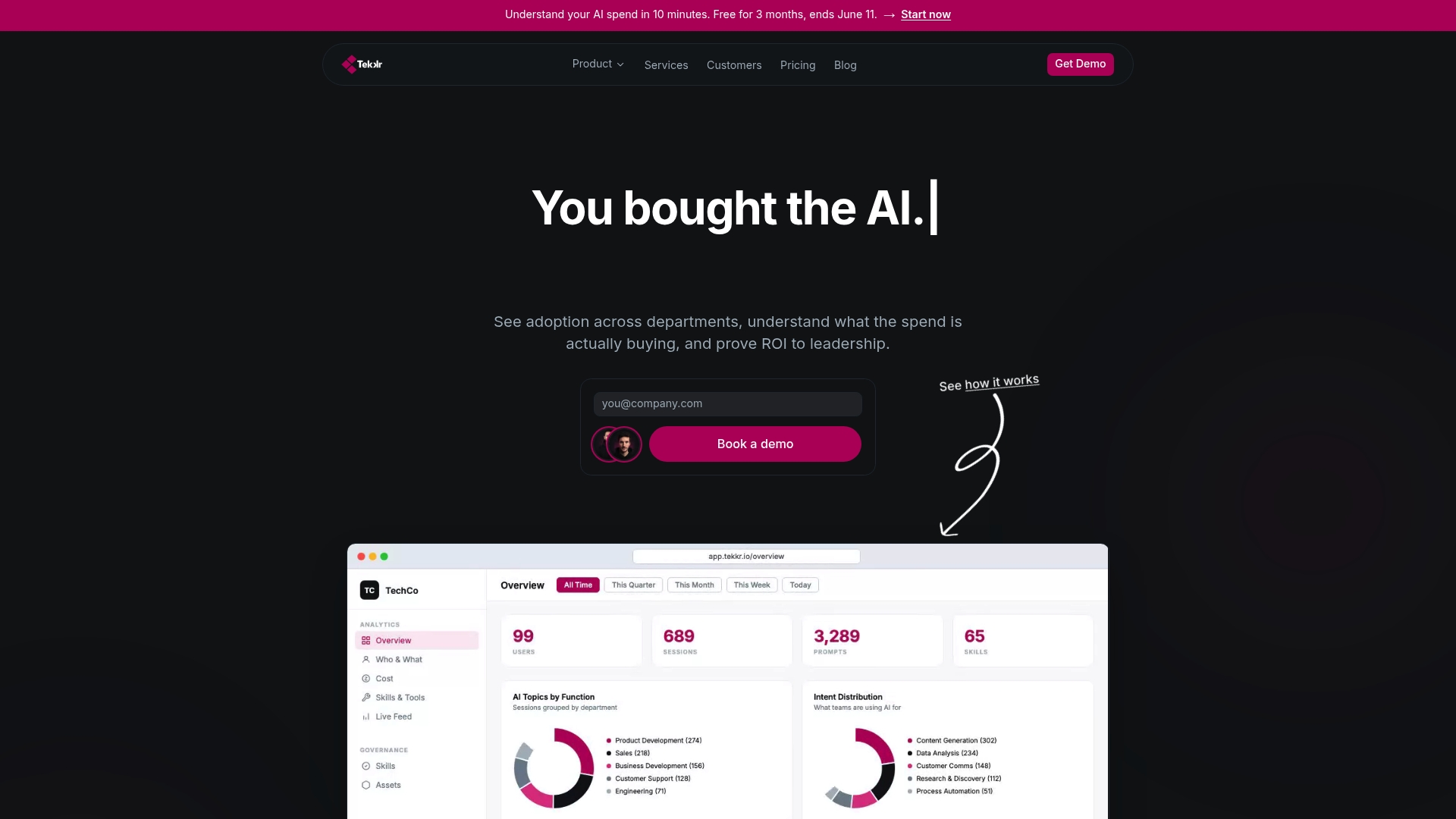
Tekkr built Configurato specifically for organizations that have purchased AI tools and cannot prove they are working. The platform tracks who is using tools like Claude and Codex, breaks down costs by team, and surfaces use-case intelligence that tells you where AI is generating real value and where it is sitting idle. Gamified rollouts and company-wide AI playbooks drive adoption without requiring browser extensions or lengthy IT onboarding. Setup takes about 10 minutes, with a free tier and no credit card required. If your organization is ready to move from AI investment to measurable AI results, Tekkr’s AI adoption solutions give you the visibility and enablement tools to get there.
FAQ
What are the most common examples of AI adoption blockers?
The most common blockers are data privacy concerns, skill shortages, trust deficits, legacy system integration failures, and cultural resistance to workflow change. Each one operates independently but compounds the others when left unaddressed.
Why do 79% of organizations struggle with AI adoption?
79% of organizations report significant AI adoption challenges because most treat AI as a software purchase rather than an organizational transformation, leaving incentives, workflows, and governance structures unchanged.
How does poor data quality block AI implementation?
Poor data quality produces unreliable AI outputs, which erodes user trust quickly. Pre-implementation data readiness assessments fix quality and accessibility issues before deployment, reducing costly post-launch corrections.
What is the explainability gap in AI adoption?
The explainability gap is the inability of most AI systems to show users the reasoning behind their outputs in plain language. This gap causes business users to distrust and override AI recommendations, which effectively blocks adoption.
How can executives measure AI adoption progress?
Executives need platforms that track tool usage by team, cost per department, and productivity outcomes tied to specific AI use cases. Without this data, AI investment decisions rely on anecdote rather than evidence.