
Enterprise AI adoption is the systematic integration of artificial intelligence into core business workflows to produce measurable operational and financial outcomes. It is not a technology project. It is an organizational transformation that touches processes, people, governance, and decision-making at every level. Most business leaders understand this in theory. Far fewer execute it in practice. This article breaks down what enterprise AI adoption actually involves, where organizations consistently get stuck, and what the highest-performing companies do differently to move from scattered pilots to scaled impact.
What is enterprise AI adoption and why do most organizations stall?
Enterprise AI adoption, known in practice as AI implementation in enterprises, is the process of embedding AI capabilities into workflows across an organization so they generate consistent, measurable business value. The standard industry term is “enterprise AI transformation,” and it goes well beyond deploying a chatbot or running a proof of concept in one department.
The gap between activity and impact is striking. Only 39% of organizations achieve enterprise-level EBIT impact from AI, even though 88% use AI in some function. That means the majority of companies have AI running somewhere but are not seeing it move the needle on revenue or operations. Only 20% report revenue growth attributable to AI, and just 34% have used AI to reimagine how their business actually operates.

The root cause is almost always the same: organizations treat AI as a tool to add on top of existing work rather than a reason to rethink how work gets done. A product team adds Copilot to their workflow but keeps the same review cycles, approval chains, and output standards. The AI saves a few minutes here and there. The transformation never arrives.
Common failure patterns include:
- Lack of workflow redesign before AI deployment
- Data fragmentation across systems that prevents AI from accessing relevant context
- Governance gaps that slow approvals and create compliance risk
- Vanity metrics like “number of AI interactions” instead of operational baselines like queue reduction or cycle time
Pro Tip: Before deploying any AI tool, document the current state of the workflow it will touch. Measure throughput, error rate, and time per task. Without that baseline, you cannot prove impact, and you will not know whether to scale or kill the initiative.
Deloitte’s AI Pulse Check research confirms that avoiding pilot purgatory requires measuring before-and-after operational metrics, not usage statistics. Organizations that track throughput and time savings rather than login counts are the ones that build the business case to scale.
How workflow redesign separates AI leaders from laggards
Layering AI on existing processes yields limited value. The organizations seeing real gains are the ones that use AI as a forcing function to redesign work end to end. This is the hardest part of AI adoption, and it is where most enterprises underinvest.
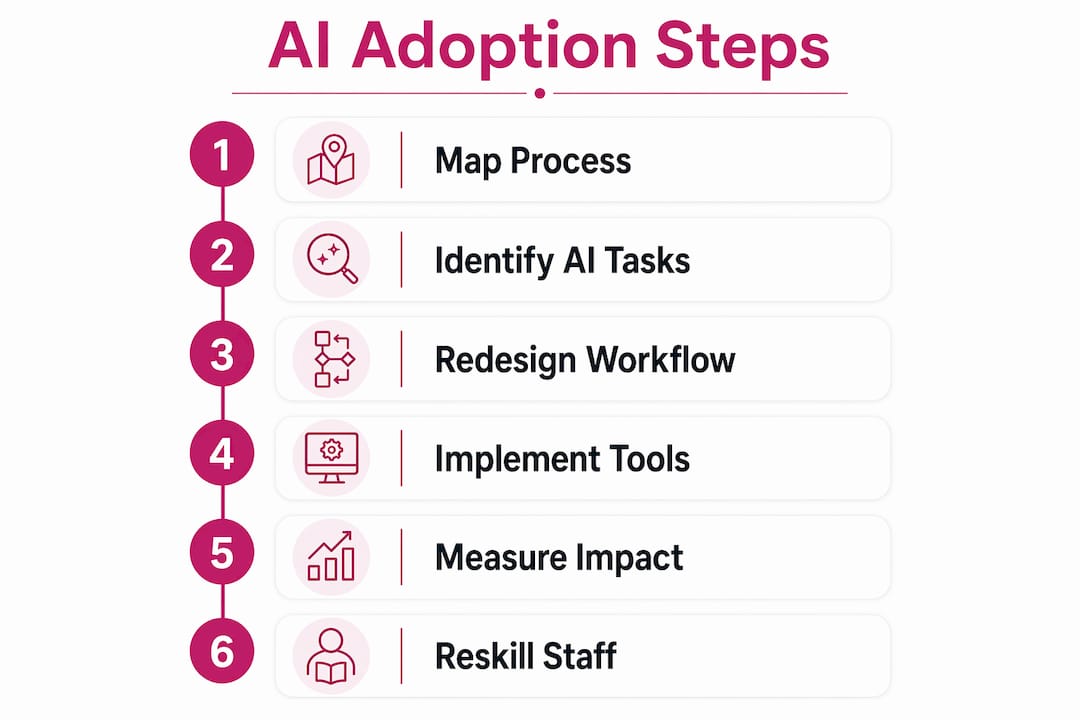
Consider what workflow redesign actually means in practice. A legal team that uses AI to draft contracts faster is layering. A legal team that redesigns its intake process so AI handles first-pass review, flags risk clauses, and routes only exception cases to attorneys is embedding. The second approach changes decision ownership, reduces cycle time, and improves output quality. The first approach saves a few hours a week.
| Approach | What changes | Typical outcome |
|---|---|---|
| Layering AI on existing workflows | Tool access added; process unchanged | Marginal time savings, low ROI |
| Embedding AI into redesigned workflows | Decision ownership shifts; steps removed | Cycle time reduction, measurable quality gains |
The governance model must evolve alongside the workflow. As AI takes on more autonomous tasks, the accountability structure needs to reflect that. Who owns the output when AI drafts a customer proposal? Who reviews it, and at what threshold does human sign-off become mandatory? CMU’s Software Engineering Institute frames this clearly: AI requires governance as a runtime discipline, not a static policy document. Governance that lives in a PDF nobody reads does not protect you when an AI agent makes a consequential error.
Practical workflow redesign follows a clear sequence. Map the current process at the task level. Identify where AI can take ownership of a step entirely, not just assist with it. Redesign the handoff points. Then build the governance checkpoints into the new process before you deploy, not after.
Pro Tip: When redesigning a workflow for AI, ask which steps exist only because a human needed to do them. Those are your highest-value targets for AI ownership. Steps that exist for quality, compliance, or judgment are where you build oversight in, not where you remove it.
DocuPOW’s analysis of enterprise AI API integration shows that organizations achieving the strongest results treat AI as an operational layer woven into their systems of record, not a separate tool employees switch to when they remember.
What role do governance, measurement, and reskilling play?
Governance, measurement, and employee reskilling are not supporting activities in enterprise AI adoption. They are the primary determinants of whether AI delivers lasting value or fades into shelfware.
On governance: only 21% of organizations report mature governance for autonomous AI, and 69% actively limit AI autonomy because they lack the frameworks to manage it responsibly. Microsoft’s responsible AI principles provide a starting point, but governance maturity is an organizational capability, not a checklist. It requires clear policies on data classification, role-based access, audit trails, and escalation paths when AI output is wrong or harmful.
Measurement deserves the same rigor you apply to any business investment. The goal is not to track whether employees are using AI. The goal is to track whether AI is changing outcomes. Structure your measurement around outcome hypotheses: “If AI handles first-pass code review, we expect a 20% reduction in review cycle time within 90 days.” Then measure it. Treat the result as a learning input, not a report card.
Reskilling is where many organizations take shortcuts that cost them later. Telus trained 57,000 employees with mandatory AI programs and achieved verified time savings of 40 minutes per AI interaction. That result did not come from optional lunch-and-learns. It came from structured, role-specific training that taught employees how to use AI for their actual work, not generic prompting exercises.
A practical governance and measurement framework for enterprise AI looks like this:
- Define data classification tiers and which AI tools can access which data
- Assign ownership for every AI-assisted workflow, including accountability for errors
- Set outcome hypotheses before deployment, with measurable targets and timelines
- Review results at 30, 60, and 90 days and make explicit decisions to scale, iterate, or stop
- Build reskilling into the workflow itself, not as a separate training event
“AI must be managed as an organizational transformation capability with strong governance and risk management from the start.” — CMU Software Engineering Institute
Leadership modeling matters more than most executives expect. When senior leaders visibly use AI tools and share what they learned from the output, adoption rates across the organization increase significantly. The signal it sends is that AI proficiency is a professional expectation, not an optional experiment.
How to move from pilots to scaled AI deployment
Moving from pilots to scaled AI deployment is a capacity and prioritization problem as much as a technology problem. The organizations that scale fastest are the ones that connect AI spending directly to existing business goals with clear ownership and defined metrics from day one.
Start with an honest readiness assessment across three dimensions:
- Data readiness: Is the data AI needs clean, accessible, and properly governed?
- People readiness: Do employees have the skills and context to work with AI output effectively?
- Governance readiness: Are policies, oversight structures, and accountability models in place?
Most organizations find gaps in all three. The answer is not to wait until everything is perfect. The answer is to scope your first scaled deployments to areas where readiness is highest and the business case is clearest.
Prioritization is where discipline pays off. Rigorous project prioritization accelerates AI scaling from pilot to production by 3x. Specifically, 75% of carefully chosen projects deploy enterprise-wide, compared to 30% without a selection framework. That gap exists because undisciplined prioritization produces pilots that were never connected to a real business problem, and those pilots die in committee.
Avoid tool sprawl. The instinct to evaluate every new AI release is understandable, but it fragments your governance effort and confuses employees about which tool to use for which task. Standardize one tool per use case category. Use Claude or GPT for drafting and analysis. Use Copilot for code. Use a dedicated tool for data querying. Then embed your company’s standards and context into those tools so the output reflects how your organization actually works.
monday.com’s AI adoption framework and Kersai’s 90-day roadmap both emphasize the same principle: companies with connected data, AI-fluent teams, and embedded governance scale AI impact exponentially compared to those treating AI as a series of isolated experiments.
Pro Tip: Build your 90-day roadmap around one workflow per business unit, not one tool across all business units. Depth of integration in a single workflow produces more measurable impact than shallow deployment across many.
Kill failing pilots fast. Sentimental attachment to an experiment that is not producing results delays scaling and wastes the organizational attention you need for initiatives that are working. Set explicit kill criteria before you start, and honor them.
Key takeaways
Successful enterprise AI adoption requires workflow redesign, embedded governance, and role-specific reskilling, not just tool deployment.
| Point | Details |
|---|---|
| Adoption does not equal impact | 88% of organizations use AI, but only 39% achieve meaningful EBIT impact from it. |
| Redesign before deploying | Layering AI on unchanged workflows produces marginal gains; redesigning workflows produces measurable transformation. |
| Governance is a runtime discipline | Static policies are insufficient; governance must be embedded into how AI operates day to day. |
| Prioritize with rigor | Carefully chosen AI projects are 3x more likely to scale from pilot to production than unscreened ones. |
| Reskilling drives ROI | Structured, role-specific training like Telus’s program produces verified productivity gains that generic training does not. |
The uncomfortable truth about enterprise AI adoption
Most AI adoption programs are failing quietly. Usage dashboards look healthy. Employees are logging in. Prompts are being submitted. But the competitive advantage never materializes because nobody redesigned the work around the AI. They just added a new tool to an old process and called it transformation.
What I have seen consistently is that the organizations making real progress treat AI adoption as an operational and organizational change program, not a technology rollout. They assign business owners to AI initiatives, not IT owners. They measure outcomes, not activity. They kill experiments that are not working, even when someone is emotionally invested in them.
The governance problem is real, but it is often used as an excuse to delay rather than a problem to solve. You do not need a perfect governance framework before you start scaling. You need a clear data classification policy, defined accountability for AI-assisted decisions, and a process for reviewing output quality. Build that in 30 days and start moving.
The hardest conversation in most organizations is about workflow redesign. People are attached to how they work. Telling a team that their current process exists because humans had to do it, and that AI can now own three of the five steps, feels threatening. The leaders who handle that conversation well, with empathy and clarity about what the redesign means for each role, are the ones whose AI programs actually deliver.
The companies that win with AI will not be the ones that deployed the most tools. They will be the ones that taught AI how they work. That distinction is everything.
— TekkrTools
See how Tekkr embeds your standards into every AI interaction
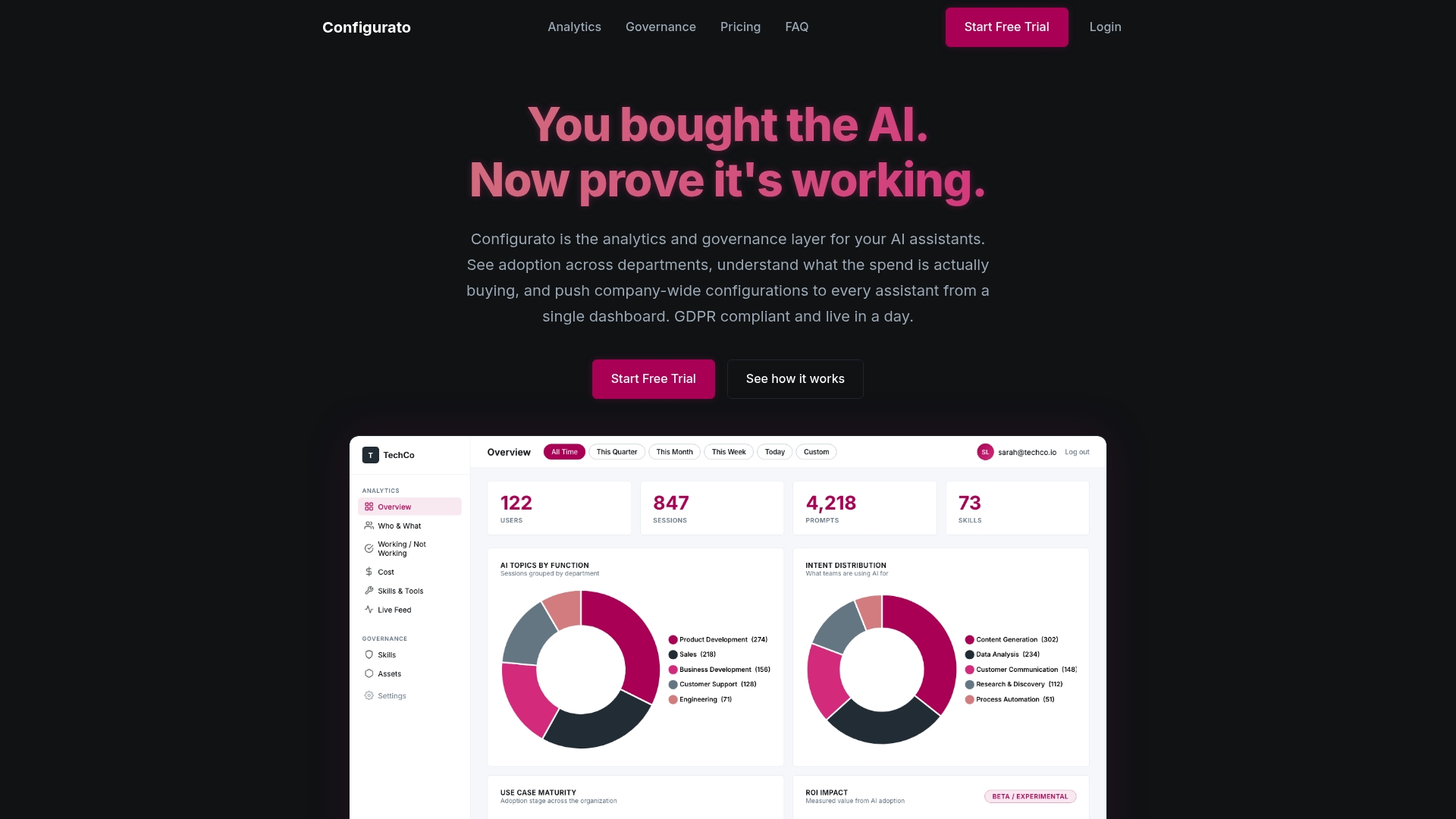
Most enterprise AI programs stall not because of the tools but because employees prompt generically and produce output that needs heavy rework. Tekkr’s AI governance platform closes that gap by embedding your company’s processes, quality standards, and domain knowledge directly into the AI assistants your teams already use. When a product manager asks Claude to draft a spec, the output already reflects your PDLC. When an engineer asks Copilot to scaffold a service, it follows your architecture standards. No training required. No workflow changes. Tekkr also gives you the traceability and benchmarking data to see exactly where AI is accelerating work and where it is not. That is how you build a real business case for scaling. Explore Configurato by Tekkr to see how it works for your organization.
FAQ
What is enterprise AI adoption?
Enterprise AI adoption is the systematic integration of AI into organizational workflows to produce measurable business outcomes. It goes beyond individual tool deployments to include workflow redesign, governance, and workforce readiness across the entire organization.
Why do so many AI pilots fail to scale?
Most pilots fail to scale because they are not connected to clear business metrics and lack workflow redesign. Rigorous prioritization increases the rate of enterprise-wide deployment from 30% to 75% of projects.
How important is governance in AI implementation?
Governance is critical. Only 21% of organizations have mature governance for autonomous AI, which is why 69% limit AI autonomy. Without clear data policies, accountability structures, and audit trails, AI adoption creates compliance and operational risk at scale.
How long does it take to scale AI from pilot to production?
A focused 90-day roadmap targeting one high-impact workflow per business unit is the most effective starting point. Organizations that set explicit outcome hypotheses and review results at 30, 60, and 90 days make faster, better-informed scaling decisions than those running open-ended pilots.
What is the role of employee training in AI adoption?
Structured, role-specific training is a direct driver of ROI. Telus’s mandatory program for 57,000 employees produced verified time savings of 40 minutes per AI interaction, demonstrating that generic AI awareness training does not produce the same results as targeted reskilling tied to actual job tasks.