
Competitive AI advantage is defined as the ability to build proprietary, compounding AI capabilities that competitors cannot easily replicate, not simply the ability to use AI tools. Nearly 90% of organizations now use large language models, which means AI access is no longer a differentiator. The real separation happens when companies embed AI into unique data, workflows, and customer trust relationships that compound over time. Frameworks like the Alpha Thesis and the data flywheel model give strategy executives a concrete way to think about enabling competitive AI advantage. This article explains both, with examples and a practical roadmap you can act on.
What distinguishes a competitive AI advantage from basic AI adoption?
The Alpha Thesis draws a sharp line between Beta AI use and Alpha AI advantage. Beta is what everyone has: access to GPT-4, Claude, Copilot, or Gemini. Alpha is what you build on top of those tools using proprietary data, unique workflows, and decision memory that accumulates over time.
Consider two companies running AI-powered customer support. The first deploys a generic support bot trained on public documentation. The second builds a context-aware retention system that remembers each customer’s product usage history, past frustrations, and communication preferences. Both use AI. Only the second builds a moat. The generic bot is replaceable in a week. The context-aware system gets sharper every month.

The same logic applies to content operations. A content agent running on a public model produces passable output. A content agent embedded with your brand’s editorial standards, audience personas, and proprietary research archive produces output that reflects years of institutional knowledge. That second system is genuinely hard to copy.
The tactical implication is direct: stop measuring AI adoption by tool deployment and start measuring it by proprietary loop creation. Ask yourself what data only your company has, what workflows only your team executes, and what customer contexts only your relationships have generated. Those are your Alpha inputs.
Pro Tip: Map your existing workflows and identify the three that generate the most proprietary data. Those are your first candidates for Alpha-level AI integration, not your most visible or glamorous processes.
How do data flywheels create durable AI moats?
The only durable AI moat is a data flywheel that compounds inference quality through proprietary data and customer trust. Raw data volume alone does not create advantage. The key variable is inference quality, which is built on zero-party data that customers share deliberately because they trust you with it.
The flywheel cycle works in five stages:
- Better proprietary data feeds sharper AI inference.
- Sharper inference produces more precise, personalized experiences.
- More precise experiences increase customer trust and satisfaction.
- Higher trust leads customers to share more deliberate, high-quality data.
- That data feeds back into the model, improving inference further.
Each rotation of this cycle widens the gap between you and competitors who rely on commoditized datasets. The critical design requirement is a consent architecture. Customers must understand what data they are sharing and why. Transparency is not just an ethical requirement; it is the mechanism that keeps the flywheel spinning. Without trust, customers stop sharing, the data quality degrades, and the moat collapses.
One counterintuitive reality: data flywheels take 18 to 36 months to mature into defensible advantage. That timeline is actually a feature, not a bug. It means competitors who start late cannot catch up quickly, even with superior tools. The compounding effect is time-locked.
“Incremental data has diminishing returns. The moat is not the data itself. It is the inference quality you build with trusted, consented, proprietary data over time.” — Rohit Prabhakar
Operationally, this means building closed-loop feedback systems from day one. Every AI interaction should generate a signal. Every signal should feed back into your inference layer. Companies that treat AI outputs as endpoints rather than data sources are burning potential flywheel fuel.
What organizational capabilities enable sustained AI advantage?
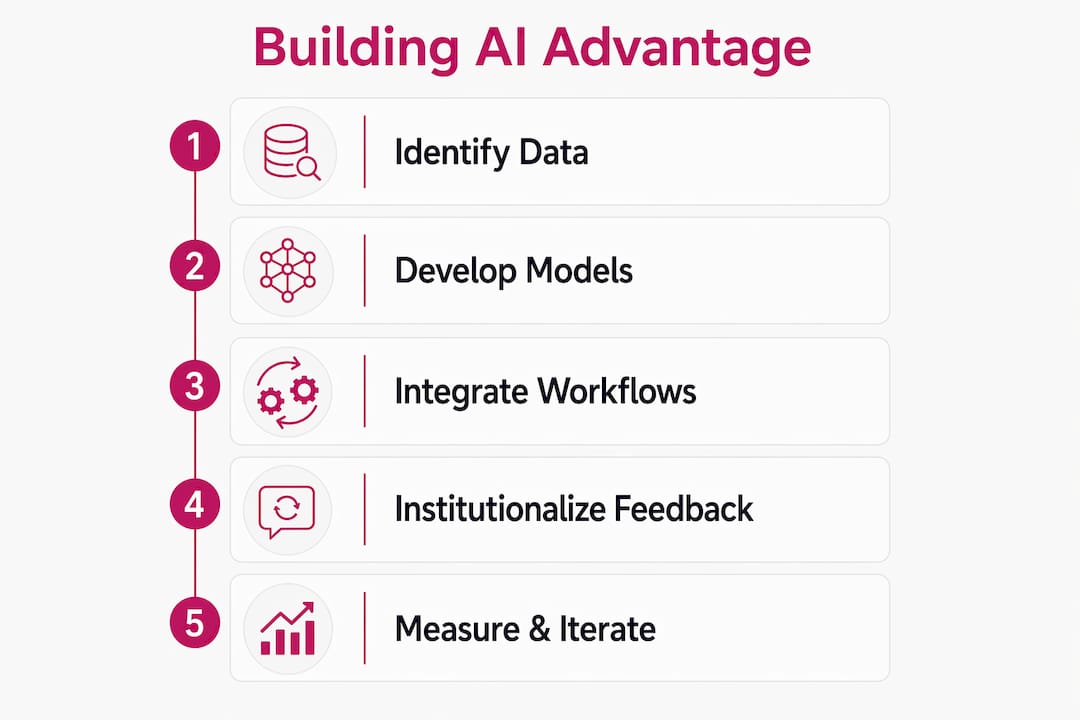
McKinsey identifies six strategic moats accelerated by AI: privileged data, network effects, business model innovation, regulatory position, trust, and distribution. Alongside those, three capability moats determine whether a company can actually exploit them: organizational learning velocity, execution speed, and management systems.
The comparison below shows how these moats differ in nature and durability:
| Moat type | Source | Time to build | Imitability |
|---|---|---|---|
| Privileged data | Proprietary data collection and consent | 12 to 36 months | Low |
| Network effects | User base and interaction density | 24 to 48 months | Very low |
| Trust and transparency | Governance, explainability, track record | 18 to 36 months | Low |
| Execution velocity | Organizational agility and iteration speed | 6 to 18 months | Medium |
| Business model innovation | AI-native revenue or delivery models | 12 to 24 months | Medium |
Organizational agility and execution velocity are the moats most executives underestimate. The bottleneck in most enterprises is not the AI platform. It is the operating model. Slow approval cycles, siloed teams, and risk-averse governance structures prevent fast iteration. Companies that can deploy, test, and refine AI applications in weeks rather than quarters break the imitation cycle before competitors can respond.
Customer relationships and trust matter more than technical sophistication. A company with mediocre models but deep customer trust and rich consent-based data will consistently outperform a technically superior competitor that lacks those relationships. This is why building AI trust through transparent, explainable AI and embedding compliance early accelerates adoption and sustains advantage.
Pro Tip: Assign a cross-functional team, not a single AI department, to own each strategic moat. Moat-building requires product, data, legal, and operations working in parallel. Sequential handoffs kill velocity.
How can existing enterprise strategies be augmented with AI?
AI investments that reinforce existing where-to-play and how-to-win choices create more durable competitive advantage than standalone AI experiments. The mistake most leadership teams make is treating AI as a separate initiative rather than an accelerant for the strategy already in place.
John Deere is the clearest example of this principle in practice. The company did not pivot to become an AI company. It embedded AI into precision agriculture, the core of its existing value proposition. The result is a proprietary data asset built from millions of acres of field data that makes its equipment recommendations sharper with every season. Competitors cannot replicate that data without replicating decades of customer relationships.
JPMorgan Chase took a similar path internally. Its generative AI tools augment analyst judgment rather than replace it. Analysts using AI-assisted research tools produce more thorough work faster, but the output still reflects JPMorgan’s institutional standards and risk frameworks. The AI does not operate independently. It operates within the firm’s existing decision architecture.
The practical lessons for your organization are direct:
- Identify your two or three strongest existing competitive positions and ask where AI can sharpen them, not where AI can create new ones from scratch.
- Embed AI into management processes and governance cycles, not just front-line operations. Strategy reviews, resource allocation, and risk assessment all benefit from AI augmentation.
- Build trustworthy foundations from the start: logging, traceability, and transparent governance. These are not compliance overhead. They are the infrastructure that makes AI outputs credible enough to act on.
- Link every AI initiative explicitly to a named strategic priority. If you cannot draw a direct line from an AI project to a where-to-play or how-to-win choice, the project is probably a distraction.
An empirical study of 43 global firms confirms that companies with mature, higher-order AI capabilities show significantly higher long-term revenue growth and market valuations compared to peers with basic AI adoption. The gap is not about which tools you use. It is about how deeply AI is integrated into your strategic architecture.
What practical steps should leaders take to protect their AI advantage?
Building a defensible AI position requires a sequence, not a checklist. The Alpha Engine operating sequence gives leaders a clear framework: define your Beta, state your Alpha Thesis, build and measure the Alpha Engine, protect and compound your moats, and reinvest returns continuously.
Here is how that translates into execution:
- Define your Alpha Thesis. Write one sentence that names the proprietary AI loop your company will build. “We will build an AI system that compounds inference quality using consented usage data from our 2 million active users” is an Alpha Thesis. “We will use AI to improve customer service” is not.
- Invest in consent architecture. Design data collection so customers understand the exchange. Consent-based data is more accurate, more durable, and more legally defensible than scraped or inferred data.
- Build for agility. Create cross-functional teams with the authority to deploy and iterate without waiting for quarterly planning cycles. Slow companies lose their AI advantage quickly. Speed is a moat.
- Measure economic impact rigorously. AI leaders achieve 3x greater cost reduction, 1.6x higher EBIT margins, and 2.7x higher return on invested capital compared to peers. Track these metrics from the first deployment, not after the fact.
- Commit board-level resources to a multiyear horizon. Flywheels take 18 to 36 months to mature. A 90-day budget cycle will kill a flywheel before it spins.
The most common pitfall is mistaking tool adoption for advantage. High AI adoption rates on paper mean nothing if the outputs require heavy rework, ignore company context, or fail to feed back into a learning loop. The second pitfall is ignoring trust. AI systems that cannot explain their outputs will not be used consistently, and inconsistent use breaks the flywheel.
Pro Tip: Run a quarterly “moat audit.” For each AI initiative, ask: is this getting harder to copy over time? If the answer is no, you are building Beta, not Alpha.
You can also explore AI strategies for startup growth and AI-powered revenue frameworks to see how other organizations are structuring their AI investment decisions.
Key takeaways
Enabling competitive AI advantage requires proprietary data loops, organizational agility, and trust-producing governance working together over a multiyear horizon.
| Point | Details |
|---|---|
| AI is table stakes, not advantage | 90% of firms use LLMs; advantage comes from proprietary loops, not tool access. |
| Data flywheels compound over time | Inference quality built on consented, zero-party data creates moats that take 18 to 36 months to mature. |
| Agility is a strategic moat | Execution velocity and fast iteration separate winners from followers in the AI era. |
| Augment existing strategy first | AI embedded in your strongest competitive positions creates more durable advantage than standalone AI experiments. |
| Measure financial impact from day one | AI leaders achieve 3x cost reduction and 2.7x higher return on invested capital compared to peers. |
The uncomfortable truth about AI advantage
From where I sit, the biggest mistake leadership teams make is treating AI adoption as the finish line. You roll out Copilot, you see usage numbers climb, and the board presentation looks good. But the competitive advantage never materializes. The building is not on fire yet, so no one feels the urgency to do something different.
The companies I have seen pull ahead are not the ones with the most tools or the biggest AI budgets. They are the ones that decided, early, what proprietary loop they were going to build and then committed to it through the uncomfortable middle period when the flywheel is spinning but not yet producing visible results. That 18-month window is where most organizations lose their nerve and pivot to the next shiny deployment.
Culture matters more than technology in that window. Teams that treat every AI output as a data point to feed back into the system, rather than a deliverable to ship and forget, are the ones building real moats. Trust, transparency, and institutional patience are not soft factors. They are the actual mechanism of compounding advantage.
The shift from Beta to Alpha is not a technology decision. It is a leadership decision. You have to decide that your company’s way of working is worth encoding, protecting, and compounding. That decision is harder than buying a software license, and it is exactly why most competitors will not make it.
— TekkrTools
How Tekkr helps you build proprietary AI advantage
If your teams are using Claude, GPT, Copilot, or Gemini but producing output that needs heavy rework or ignores your company’s standards, the gap is not the tools. It is that your AI assistants do not know how your company operates.
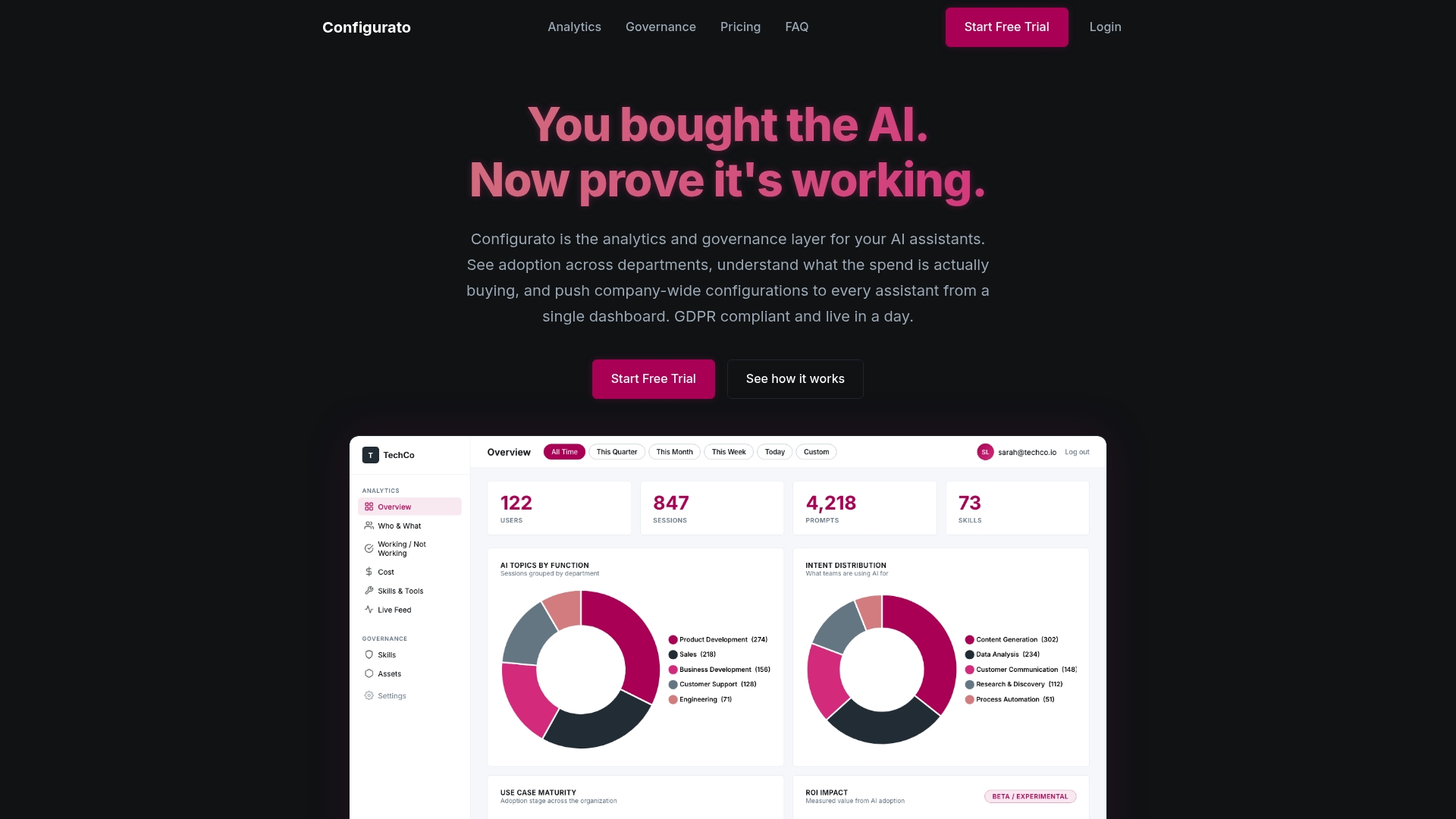
Tekkr closes that gap through Configurato, its analytics and governance layer for AI assistants. Tekkr embeds your processes, quality standards, and domain knowledge directly into whatever AI tools your people already use. The output is already aligned before anyone reviews it. No new training. No workflow changes. Just AI that works like someone who already knows your company. Configurato also gives you the traceability and benchmarking data to see exactly where AI is accelerating work and where it is not, so you can measure and protect your moat over time.
FAQ
What does enabling competitive AI advantage actually mean?
Enabling competitive AI advantage means building proprietary, compounding AI capabilities tied to unique data, workflows, and customer trust, not simply deploying AI tools that any competitor can also access.
How is the Alpha Thesis different from standard AI strategy?
The Alpha Thesis distinguishes between Beta AI use, which is commoditized tool access, and Alpha AI advantage, which is a proprietary loop built on unique data and decision memory that compounds over time.
How long does it take to build a defensible AI moat?
Data flywheels, the most durable AI moats, typically take 18 to 36 months to mature into defensible competitive advantage, which is why early commitment and consistent investment are critical.
What is the biggest risk to losing an AI competitive edge?
The biggest risk is mistaking tool adoption for advantage. High AI usage rates mean nothing if outputs require heavy rework, ignore company context, or fail to feed back into a learning loop that improves over time.
How do AI leaders measure their advantage financially?
AI leaders achieve 3x greater cost reduction, 1.6x higher EBIT margins, and 2.7x higher return on invested capital compared to peers, according to BCG research on AI-first cost advantage.