
A cross-team AI adoption strategy is a coordinated, infrastructure-backed approach that enables multiple departments to deploy AI collaboratively, share data consistently, and measure outcomes against shared goals. Without this coordination, organizations end up with siloed AI stacks where engineering uses one set of tools, marketing uses another, and neither team’s outputs connect. AI usage in team meetings is projected to more than triple within three years, according to a Capgemini survey of 500 executives. That growth makes a deliberate, multi-departmental AI strategy not optional but necessary for any organization serious about return on its AI investments.
What does a cross-team AI adoption strategy actually require?
The most common failure mode in cross-functional AI implementation is skipping the infrastructure phase. Organizations buy tools, assign licenses, and expect adoption to follow. It does not. Investing 4–6 weeks in cross-functional infrastructure before expanding an AI program prevents duplication and inefficiency that compounds over time. That preparation window is where the real work happens.
The AI Center of Excellence
An AI Center of Excellence (CoE) is the organizational unit responsible for setting standards, evaluating tools, and coordinating AI efforts across departments. It is not a committee that approves requests. It is an active team that defines what good AI implementation looks like, maintains a catalog of approved use cases, and ensures that teams are not solving the same problem in five different ways. The CoE owns the shared data standards that make cross-department AI outputs comparable and trustworthy.

The AI Coordination Council
Beyond the CoE, organizations need a governance layer that operates at the executive level. An AI Coordination Council maintains shared metrics, resolves conflicts between department-level AI initiatives, and prevents siloed efforts from undermining enterprise goals. Without this body, teams optimize locally and create friction at every integration point.
The table below compares the two governance structures and their functions:
| Structure | Primary function | Key output |
|---|---|---|
| AI Center of Excellence | Standards, tooling, use-case catalog | Approved frameworks and shared data standards |
| AI Coordination Council | Executive alignment, conflict resolution | Shared KPIs and cross-team decision authority |
| Department AI Champions | Workflow integration, local troubleshooting | Faster adoption and reduced escalation delays |
Pro Tip: Define shared metric definitions before any pilot launches. If engineering measures AI productivity in tokens processed and marketing measures it in content output, you will never produce a unified ROI picture.
Without a common data spine and governance, team AI tools produce conflicting outcomes and undermine enterprise goals. That is not a technology problem. It is an organizational architecture problem.
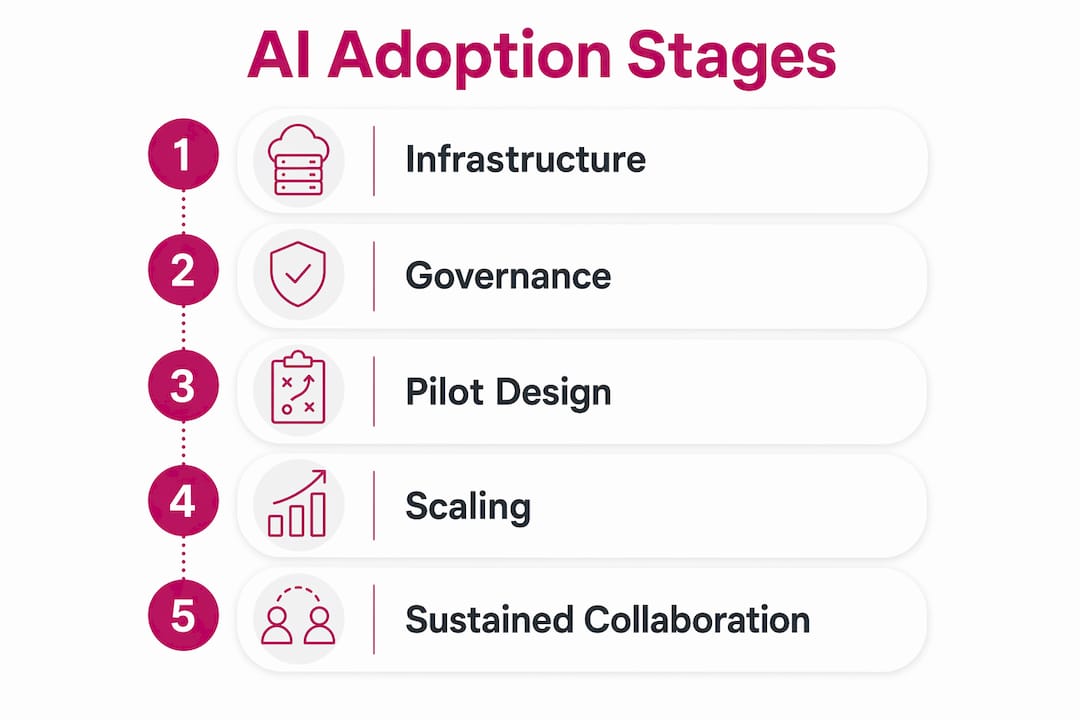
How do you build and scale AI pilots across departments?
Pilot selection is where most organizations make their second major mistake. They pick the most visible use case, not the most instructive one. A structured pilot-to-scale pipeline with stage gates forces discipline into a process that naturally drifts toward enthusiasm over evidence.
The five-phase pipeline below reflects how leading cross-functional AI programs operate:
- Discovery. Map existing workflows, identify high-friction tasks, and shortlist three to five use cases per department. Prioritize cases where AI output feeds into another team’s input.
- Pilot design. Define success criteria, assign an AI champion per team, and set a fixed evaluation window of four to eight weeks. Budget controls go in place here, not later.
- Gate one evaluation. Assess whether the pilot produced measurable output improvement. Projects that show no signal get retired. Projects with signal move to limited scaling.
- Pilot-to-scale gate. This is the critical filter. Approximately one-third of AI pilots are retired at this stage in leading cross-functional programs. Retiring a pilot is not failure. It is resource discipline.
- Embedding into business as usual. Surviving pilots get integrated into standard workflows, documented in the CoE catalog, and handed to operations with clear ownership.
A clear stage-gate process with spend controls is critical to scaling AI and controlling resource waste. Without gates, organizations accumulate a long tail of half-deployed tools that consume budget and attention without producing results.
Pro Tip: Embed AI champions at the pilot design phase, not after deployment. Champions who understand the actual daily workflow catch integration problems before they become rollback events.
The transition from pilot to scale is the most critical phase in any AI strategy for teams. Organizations that treat it as a formality consistently overspend on tools that never reach full adoption.
What leadership and cultural practices drive sustained AI collaboration?
Leadership alignment is the single most reliable predictor of cross-team AI adoption success. Leadership alignment, operator training, and ongoing change management drive higher adoption rates and fewer rollbacks, according to Accenture research. The mechanism is straightforward: when leaders articulate a clear purpose for AI beyond the tools themselves, teams understand what they are working toward and why it matters.
The practices below separate organizations that sustain AI adoption from those that stall after the first wave of pilots:
- Shared knowledge documentation. Every AI use case that works gets documented in a format any team can replicate. This reduces what Atlassian researchers call the “fragmentation tax,” the cost of teams solving the same problems independently.
- Bottom-up experimentation with top-down guardrails. Employees closest to the work often identify the best AI applications. Leadership’s job is to create a safe structure for that experimentation, not to prescribe every use case from above.
- Regular cross-team AI reviews. Monthly or quarterly reviews where teams share what is working and what is not build the shared knowledge base that accelerates adoption organization-wide.
- Psychological safety around AI errors. Teams that fear being penalized for AI mistakes stop experimenting. Organizations that treat errors as learning inputs sustain higher adoption over time.
“Teams adopting systems for teamwork reduce fragmentation tax by 68% and greatly increase AI collaboration and trust.” — Atlassian, 2026
The AI speed paradox is the counterintuitive reality that faster individual AI use does not translate to organizational speed without shared knowledge infrastructure. One engineer using Claude at peak efficiency while the rest of the team works without shared context produces local speed and organizational drag. The fix is not slowing down the fast users. It is building the shared infrastructure that lets the whole organization move together.
Pro Tip: Recognize AI champions publicly in company-wide forums. Recognition signals to the rest of the organization that AI adoption is a valued skill, not just an IT initiative.
How should you integrate AI into existing workflows?
AI integration across teams works best when it is embedded into the workflows people already use, not bolted on as a separate tool. Embedding AI into existing workflows rather than relying on separate custom API builds significantly improves adoption and context retention, according to HBR research. The reason is simple: when AI has access to project scope, contracts, time tracking, and communication history, its outputs are relevant. When it operates in isolation, its outputs require manual translation back into the actual work context.
The table below compares the two primary integration approaches:
| Approach | Setup complexity | Context quality | Adoption rate |
|---|---|---|---|
| Custom API integration | High | Variable | Lower without training |
| Workflow-layer embedding | Low to medium | High | Higher with existing tools |
Before selecting any AI tool, map the cross-department data flows that the tool will touch. Identify where data is created, where it moves, and where decisions are made. Tools selected after this mapping fit the workflow. Tools selected before it create new integration problems.
Common mistakes in AI integration include:
- Tool-first adoption. Selecting a tool because it is popular, then searching for a use case, produces low adoption and high frustration.
- Siloed implementations. Deploying AI within a single department without considering upstream and downstream data dependencies creates outputs that other teams cannot use.
- Skipping user feedback loops. AI tools that are not adjusted based on actual user experience degrade in relevance over time.
The highest-ROI AI integration areas are consistently those where AI is embedded in core business processes rather than added as a standalone capability. Measure adoption with shared metrics across teams, not just individual usage statistics, to get an accurate picture of organizational impact.
Pro Tip: Use a platform like Tekkr’s Configurato to track which teams are actually using AI tools versus which teams have licenses. The gap between those two numbers is your real adoption problem.
Key takeaways
A cross-team AI adoption strategy succeeds when organizational architecture, governance, and workflow integration are prioritized over tool selection.
| Point | Details |
|---|---|
| Governance before tools | Establish a CoE and Coordination Council before expanding AI across departments. |
| Stage-gate discipline | Retire roughly one-third of pilots at the scale gate to protect resources for high-impact use cases. |
| Workflow embedding | Integrate AI into existing tools and data flows to improve context quality and adoption rates. |
| AI champions matter | Embed champions in daily workflows to resolve friction before it becomes a rollback event. |
| Shared metrics are non-negotiable | Define cross-team KPIs before pilots launch to produce a unified ROI picture. |
The architecture problem most executives miss
Most AI transformation programs I have observed fail at the same point. They treat the technology selection as the hard problem and the organizational design as the easy problem. It is exactly backwards.
The organizations that scale AI across multiple departments successfully are not the ones with the best tools. They are the ones that spent time before the first pilot defining who owns what, how data flows between teams, and what success looks like at the organizational level rather than the departmental level. That work is unglamorous. It does not generate a press release. But it is the reason some organizations are compounding AI value while others are accumulating a graveyard of unused licenses.
The AI champions model is the clearest example of this principle in practice. AI champions embedded in daily workflows resolve friction quickly and reduce escalation delays. They work because they understand the actual work, not just the tool. That understanding cannot be purchased. It has to be cultivated through deliberate organizational design.
My honest advice to any executive starting this process: resist the pressure to show tool deployment numbers in the first 90 days. The metric that matters is coordinated adoption across teams, and that takes longer to build correctly than it takes to fake. Build the architecture first. The adoption numbers will follow.
— TekkrTools
How Tekkr helps you prove cross-team AI adoption is working
Buying AI tools is the easy part. Knowing whether your teams are actually using them, and where the gaps are, is where most organizations go blind.
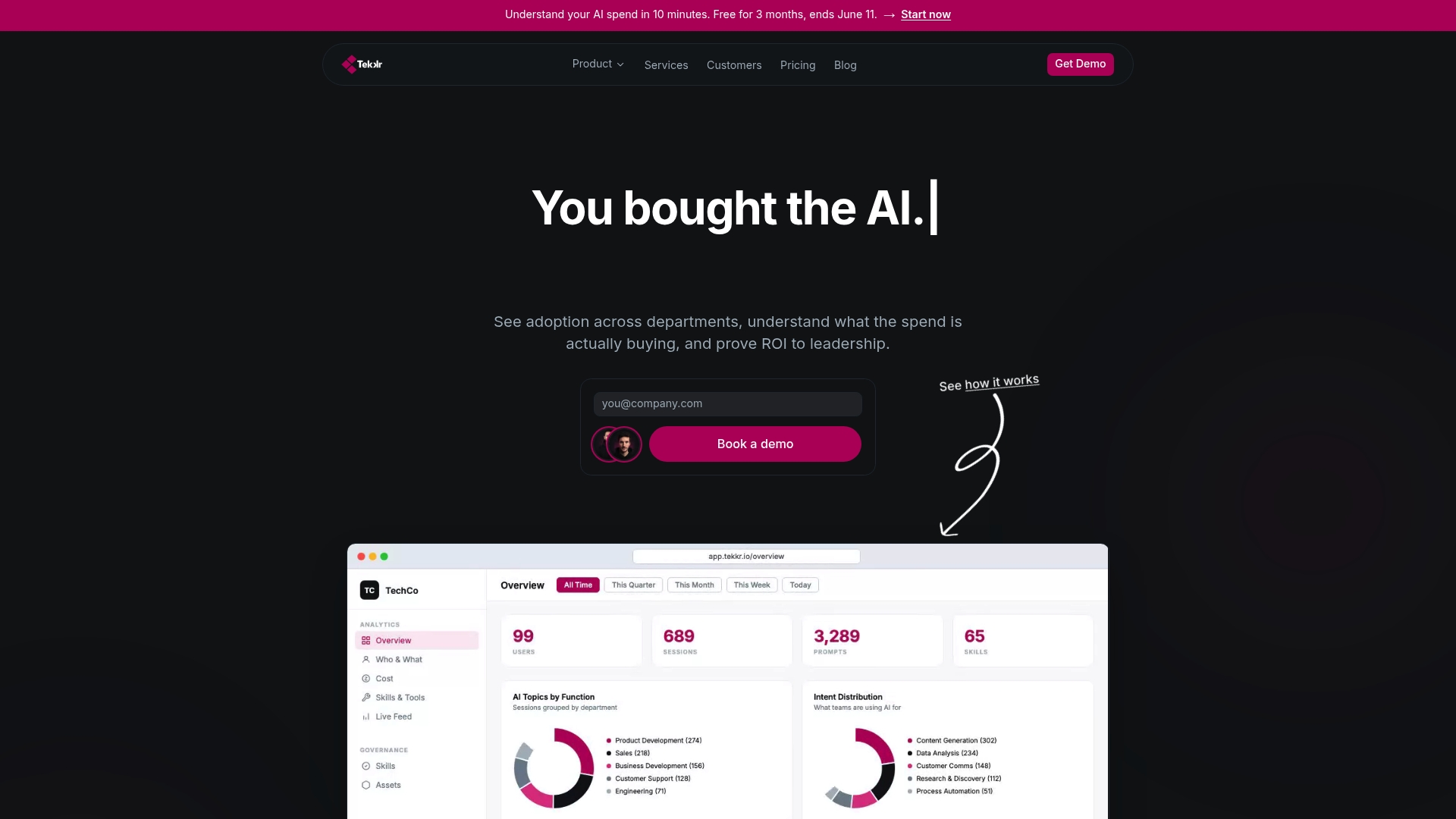
Tekkr’s Configurato platform tracks real AI adoption across every department, breaks down costs by team, and surfaces the use-case intelligence you need to make scaling decisions with confidence. It measures tools like Claude and Codex at the organizational level, runs gamified rollouts to lift adoption, and delivers company-wide AI playbooks so every team knows how to use AI well. Setup takes about 10 minutes, with a free tier and no credit card required. If you are ready to turn your AI investments into measurable results, explore Tekkr’s AI adoption solutions and see what coordinated adoption actually looks like.
FAQ
What is a cross-team AI adoption strategy?
A cross-team AI adoption strategy is a coordinated organizational approach to deploying AI across multiple departments using shared governance, data standards, and workflow integration. It differs from individual tool rollouts by treating organizational architecture as the primary design challenge.
How long does it take to build cross-functional AI infrastructure?
Investing 4–6 weeks in cross-functional infrastructure before expanding an AI program is the industry standard for preventing duplication and inefficiency at scale.
Why do so many AI pilots fail to scale?
Approximately one-third of AI pilots are retired at the pilot-to-scale gate in leading programs. The most common causes are unclear success criteria, missing stage-gate discipline, and tools selected before workflows were mapped.
What is an AI champion and why do they matter?
An AI champion is an employee embedded in a team’s daily workflow who is responsible for driving local AI adoption and resolving friction quickly. AI champions embedded in workflows reduce escalation delays and improve adoption rates across the organization.
How do you measure cross-team AI adoption effectively?
Measure adoption with shared metrics defined before pilots launch, tracking both usage rates and output quality across departments. Platforms like Tekkr’s Configurato provide cross-company AI data visibility that individual tool dashboards cannot deliver.