
Centralizing governance and compliance for AI agents across departments becomes unmanageable when each platform uses different reporting standards and manual audit processes. Many legacy tools require vendor-specific connectors or offer only basic inventory tracking without live risk scoring or board-ready analytics. This side-by-side comparison covers features like deployment time, transparency, integration scope, and regulatory mapping so you can select an AI agent governance platform that satisfies your organization’s oversight and reporting needs.
Table of Contents
Configurato
At a Glance
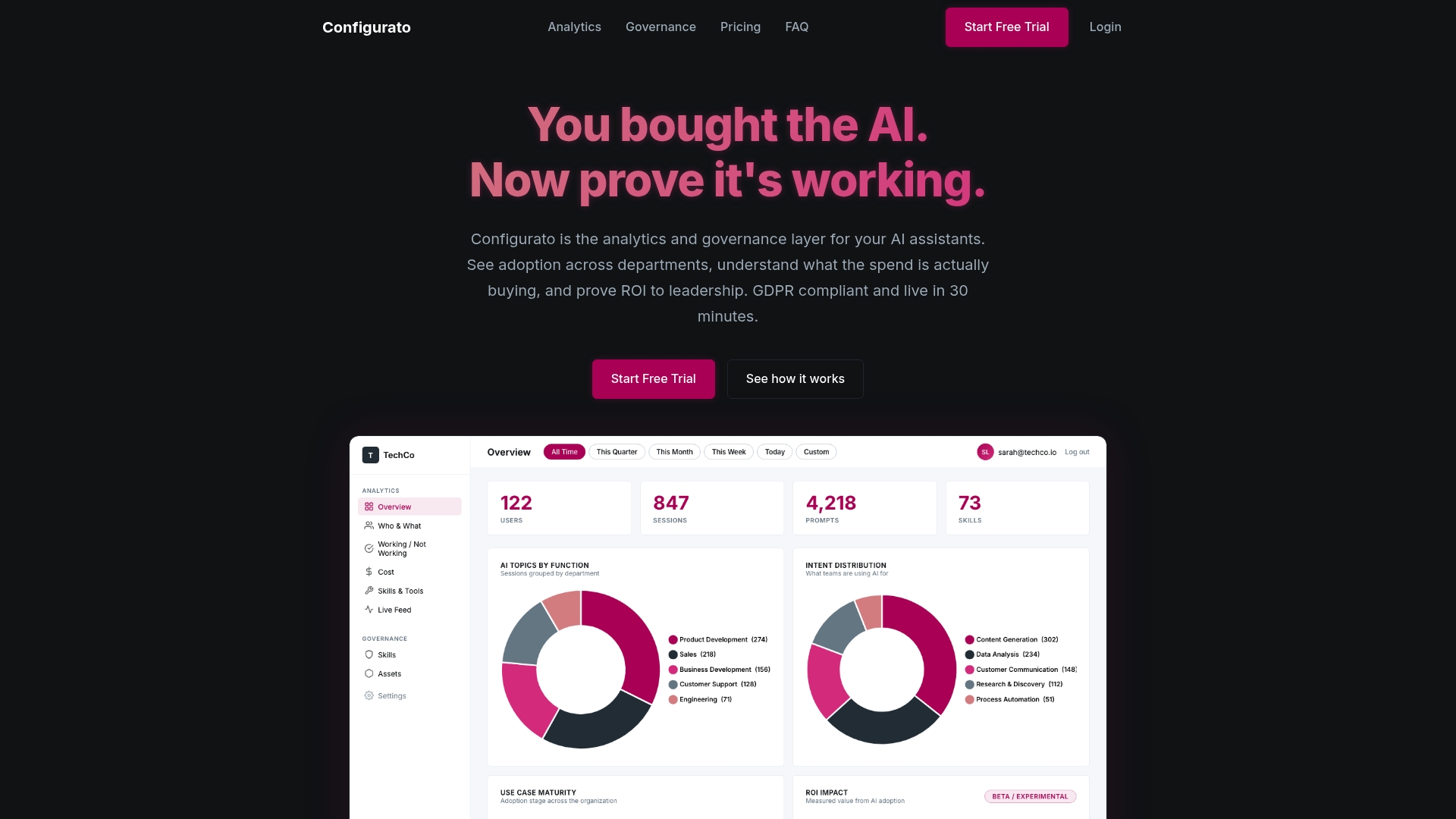
The vendor advertises a 30-minute deployment process that gets dashboards live without a long integration cycle. Configurato combines real-time rollout monitoring with department-level cost and ROI analytics to help leaders see AI adoption and spend in one place.
Core Features
- Adoption analytics by department so you can see which teams actually use which assistants.
- Use case distribution and insights to prioritize where your AI spend delivers impact.
- Cost allocation and ROI dashboards that roll up to board-level reports automatically.
- Real-time rollout monitoring and automated reporting for leadership and boards.
- Role-based configuration management and privacy safeguards to support compliance.
Key Differentiator
Configurato relies on open standards such as MCP and OpenTelemetry to remain vendor independent. That approach means you can govern Claude, Gemini, Microsoft Copilot, and other assistants from a single control plane without vendor SDK lock-in.
Pros
- The deployment claim above reduces project risk for IT teams. Short setup times mean the first dashboards are available during the same procurement cycle.
- Vendor-independent support lets procurement consolidate licensing conversations instead of juggling multiple vendor contracts across departments.
- Built-in privacy posture and GDPR compliant controls let privacy teams limit data flow while still producing aggregated operational metrics.
- Department-level visibility gives finance and product leaders defensible numbers for cost allocation and ROI conversations.
- Automated executive reports remove the manual consolidation step that typically delays board-level signoff.
Cons
- Only aggregate prompt data at the department level; Configurato does not provide detailed raw prompt analysis for individual users.
Who It’s For
Large organizations running multiple AI assistants that need centralized oversight, cost control, and compliance reporting. If you manage distributed teams and must show leadership concrete ROI and adoption trends, this product matches that operational need.
Unique Value Proposition
Automated, board-ready ROI and rollout reports remove the manual spreadsheet work. Instead of stitching logs from different assistants, you get standardized, role-aware reports that let finance and legal sign off faster and free up product teams to focus on usage improvement.
Real World Use Case
A multinational consolidates AI usage across regional teams. Configurato tracks adoption by department, allocates costs to business units, highlights low-quality use cases, and produces the quarterly ROI pack the CFO and CIO need to approve further investment.
Pricing
Free tier available, with a paid Pro tier offered by quote. Pricing details are provided on request, which means procurement should factor vendor engagement time into initial budgeting.
Website: https://configurato.tekkr.io
Phinite
At a Glance
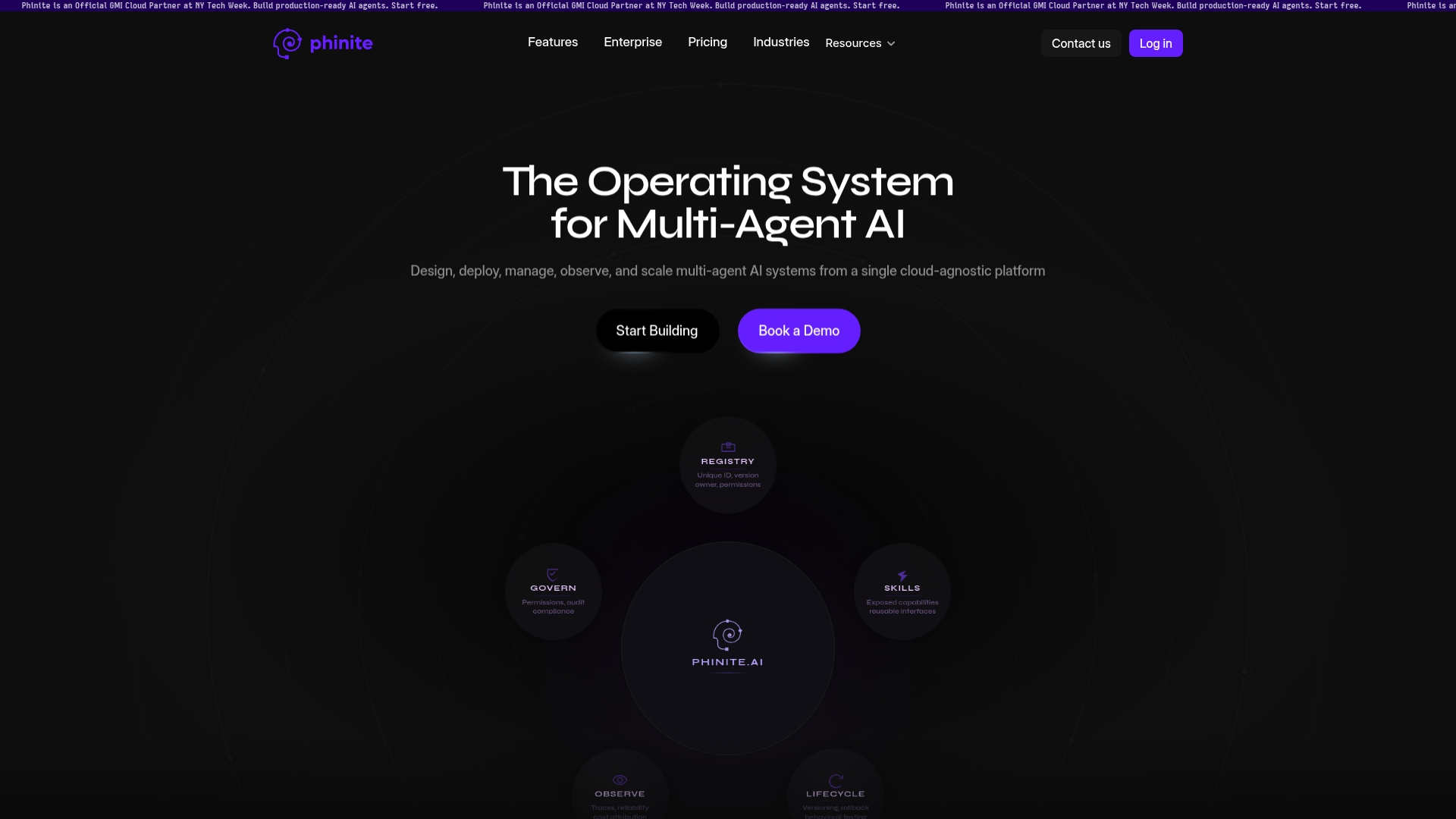
The vendor positions Phinite as an enterprise Agentic OS that covers the full agent lifecycle from visual design to live supervision. That pitch emphasizes lifecycle governance and cloud agnosticism rather than a single-model play, which is rare in enterprise tooling.
Core Features
Phinite offers a drag-and-drop Canvas for agent topology called Graph Studio and an automated builder named Phinite Aura to accelerate agent creation. The platform supports multi channel deployment across voice, Slack, Teams, WhatsApp, and email.
Phinite also provides orchestration for tool coordination, lifecycle versioning, testing and rollback, plus observability primitives such as traces and reliability cost attribution and live supervision for governance.
Key Differentiator
The product’s central claim is a single control plane for design, deployment, observation, and governance of multi agent systems. That unified lifecycle focus positions Phinite as an orchestration and governance layer for enterprises running many interacting agents rather than a point solution for one assistant.
Pros
-
The platform targets full lifecycle needs: design, versioning, testing, rollback and observability reduce the gap between prototypes and production agents.
-
Cloud agnostic architecture makes it possible to deploy across providers without retooling core orchestration logic, which suits teams with hybrid cloud commitments.
-
Multi channel delivery means the same agent topology can be active in Slack, Teams, voice, and messaging channels without rebuilding the flow.
-
Enterprise security features include audit logging, PII protection, secure APIs and live supervision, which align with typical compliance requirements for regulated teams.
-
The vendor claims adoption by prominent organizations and cloud providers; that marketing signal suggests enterprise usage patterns and integration readiness.
Cons
-
There is limited third-party user feedback and few independent reviews to validate day to day reliability or support responsiveness.
-
The product’s enterprise focus implies a steeper implementation curve and likely professional services for initial deployments, which raises upfront cost and timeline.
-
Public documentation about specific prebuilt integrations is sparse; teams will need to validate connector coverage for their stack during evaluation.
When It May Not Fit
If your team is a solo project or an early stage startup with minimal cloud ops, Phinite’s enterprise orientation and governance features will likely be overkill. Also avoid it if you need a lightweight, out of the box assistant without planning for integration and lifecycle engineering.
Who It’s For
Large organizations and engineering-led teams deploying many production agents that require version control, testing, observability, and strict governance. Ideal for companies that operate across clouds and need enterprise security and auditability built into agent orchestration.
Real World Use Case
A large enterprise runs multiple agents for customer support, internal automation, and security monitoring. Phinite orchestrates those agents, enforces compliance with audit logs and PII rules, and lets operators roll back to known-good agent versions during incidents.
Pricing
Free tier available for initial evaluation. Paid plans start at $20/month for small teams, with customizable enterprise options and pricing for large deployments and support packages.
Website: https://phinite.ai
Masche
At a Glance
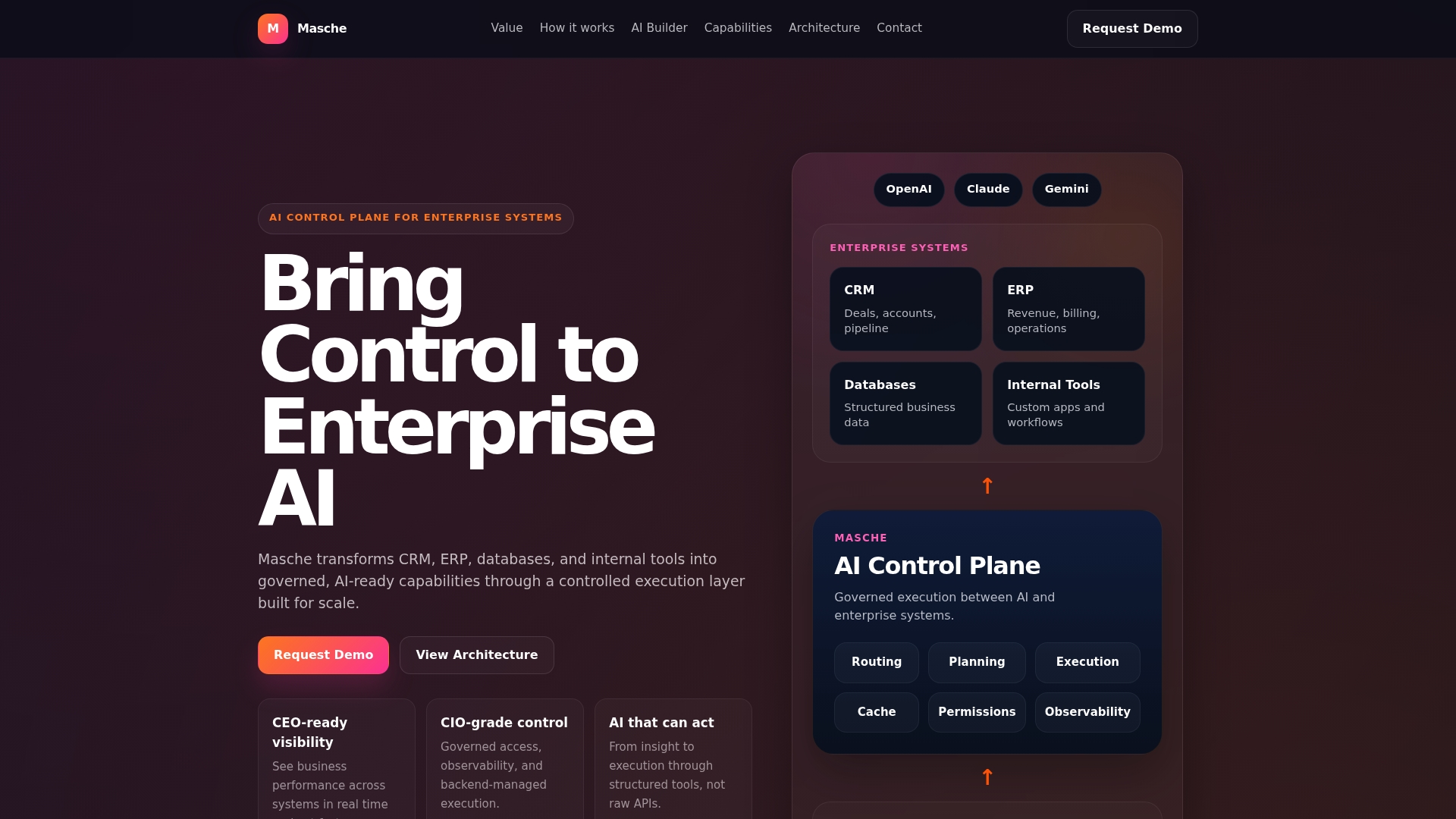
Masche positions itself as an enterprise AI control plane that maps CRM ERP databases and internal tools into a governed execution layer. The product pitches real time traces and logs for visibility while enforcing role based access across operational AI actions.
Core Features
Masche offers backend managed integration of enterprise systems and converts raw APIs into structured business tools. It runs a routing planning and governed execution engine that coordinates actions across services.
The platform enforces role based permissions and environment separation and delivers full observability with traces and logs surfaced in real time.
Key Differentiator
Masche focuses on turning fragmented systems into a single governed operational layer where AI can act under policy and audit controls. That orientation makes it more about safe execution and traceability than about simple connectors or dashboards.
Pros
-
Provides governance and control suited to regulated environments. The control plane model centralizes policy so auditors and compliance teams can inspect decisions.
-
Real time visibility into AI actions gives engineering and ops teams live traces and logs rather than delayed reports. That helps diagnose automation errors faster.
-
Supports multiple models behind a standard control layer so teams can switch or test models without rewiring downstream systems.
-
Strong separation of environments and role based access reduces blast radius when an automated action goes wrong.
-
Moves beyond reporting by enabling operational AI actions such as orchestrated updates across CRM ERP and internal tools.
Cons
-
Public third party reviews are scarce which makes independent assessment of usability and operational maturity difficult.
-
Some vendor pages and feature documentation appear inaccessible which limits how fully you can evaluate the platform before engagement.
-
Implementation will likely be complex for organizations that lack mature enterprise systems or stable data schemas.
When It May Not Fit
If your company lacks established CRM ERP or consolidated internal tooling Masche will add integration overhead that outweighs its governance benefits. Small teams with lightweight automation needs will find the control plane model heavyweight.
If you need plug and play connectors for marketing stacks rather than a governed execution layer this is the wrong fit.
Who It’s For
Enterprise CTOs CIOs and AI governance teams that need controlled scalable AI integration across finance sales operations and customer success. It suits organizations that require auditability and policy enforcement for automated actions.
Real World Use Case
A large corporation implements Masche to coordinate AI driven workflows across CRM ERP and internal tools. The control plane routes requests enforces permissions records traces and lets ops roll back or audit decisions without hunting distributed logs.
Pricing
Pricing information is not available on the vendor site and the pricing page returns a page not found message. Expect enterprise licensing and professional services given the platform scope and implementation complexity.
Website: https://masche.io
governr
At a Glance
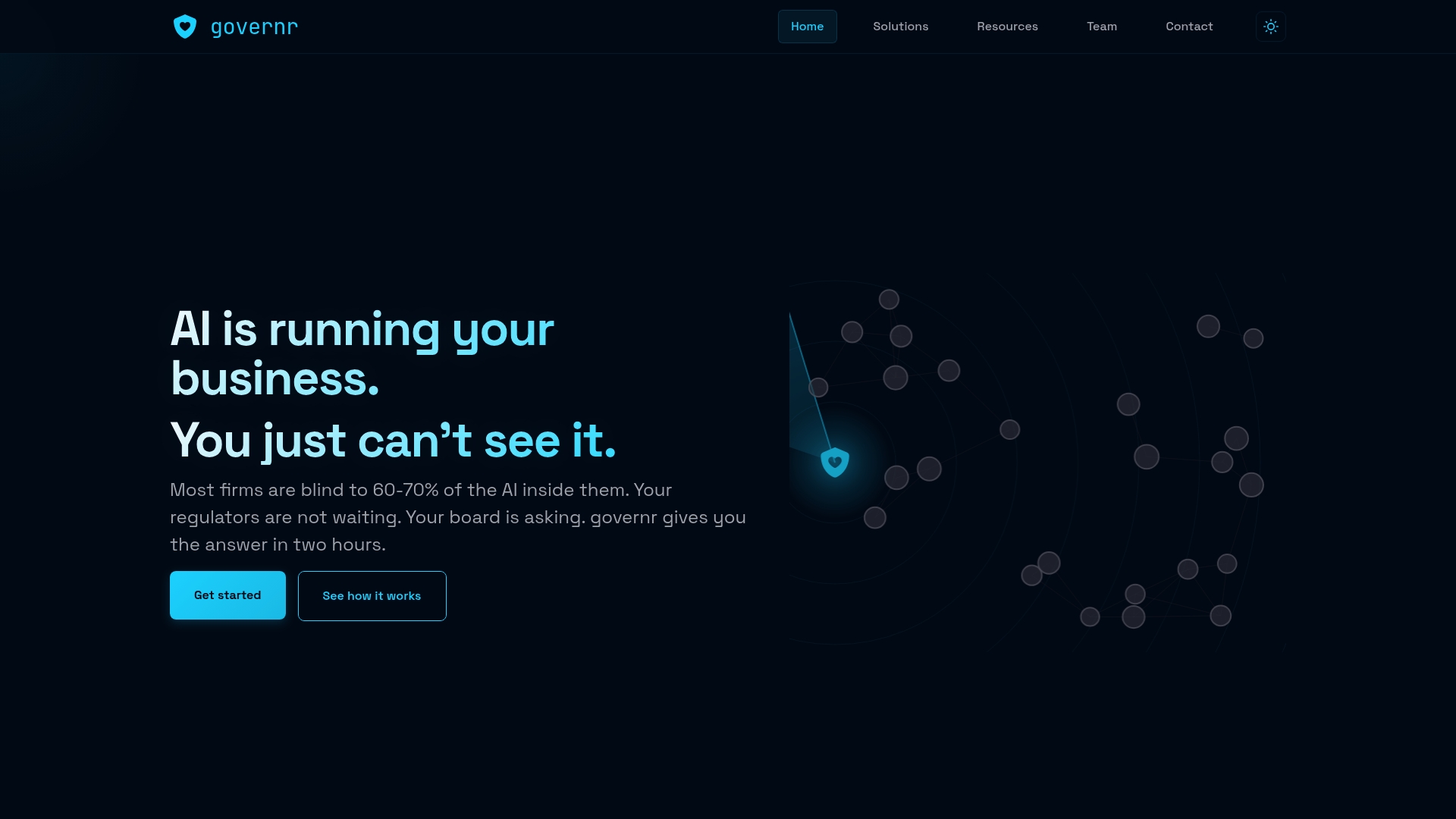
The vendor advertises audit-ready evidence within two hours of deployment, a specific claim that positions governr as a rapid-start compliance tool for regulated firms. It builds a live, connected inventory of internal, third-party, shadow, and agentic AI assets for continuous oversight.
Core Features
- Connected AI network graph that maps assets and dependencies so you can see system relationships rather than isolated tools.
- Dynamic risk scoring across multiple dimensions to rank exposures and focus remediation efforts.
- Continuous real-time monitoring that detects configuration drift, new third-party calls, or agentic behavior as it emerges.
- Audit-ready evidence generation and compliance mapping to EU AI Act, DORA, FCA, and similar frameworks.
- Automated discovery that claims no data movement and a ~two hour implementation workflow according to vendor materials.
Key Differentiator
What sets governr apart is turning a static inventory into a live, connected AI landscape that the vendor says is audit-ready in hours. That operating model treats governance as ongoing observation rather than a point-in-time checklist, which changes how you prioritize remediation and vendor oversight.
Pros
- Provides a unified view of every AI asset and its dependencies, which reduces blind spots during audits and incident responses.
- Continuous risk scoring makes prioritization practical for small governance teams by surfacing highest impact items first.
- The platform advertises rapid deployment, so you can show regulators an active inventory quickly instead of starting with long questionnaires.
- Automated evidence export saves manual report assembly and supports audit trails across multiple regulatory frameworks.
- Focused on regulated industries, the product vocab and mappings align with compliance workflows used by Risk and Legal teams.
Cons
- Independent user reviews are not available in public sources, so real-world usability and long term reliability remain unclear.
- The feature set and ease of use are primarily described in marketing materials rather than independent evaluations.
- Deployment and depth of integrations will vary by your existing environment; compatibility with bespoke systems may require additional work.
Who It’s For
Risk, compliance, legal, and AI or ML leaders at financial services, healthcare, and similar regulated organizations that need continuous governance and audit evidence. Best where a central team must inventory third-party and shadow AI quickly and present regulators with traceable proof.
Real World Use Case
A financial firm deployed governr to discover AI systems running across business units, assign risk scores, and generate an audit packet for regulators. The firm used the connected graph to trace a third-party model call back to a vendor contract and to produce time-stamped evidence for the examiners.
Pricing
The vendor does not publish pricing. The product data is informational only and suggests enterprise procurement and integration planning. Contact governr for licensing models, deployment scopes, and any professional services estimates.
Website: https://governr.ai
AI Governance Platforms Compared
When selecting an AI governance platform, focus on tools that streamline adoption monitoring, compliance reporting, and integration flexibility to meet organizational needs.
| Product | Key Differentiator | Best For | Pricing | Notable Limitation |
|---|---|---|---|---|
| Configurato | Vendor-independent AI assistant governance support | Multinationals seeking centralized AI compliance | Free tier; Pro by quote | Limited to aggregate prompt data insights |
| Phinite | Unified enterprise agent lifecycle management | Large enterprises with multi-agent environments | Free; Pro from $20/month | Professional services often needed for initial setup |
| Masche | Governance-oriented control layer for AI actions | Enterprises needing traceable operational actions | Not disclosed | Limited public documentation for prebuilt connectors |
| governr | Rapid governance with audit-ready asset inventory | Regulated industries requiring prompt compliance | Not disclosed | Lack of independent user reviews for feature validation |
Unlock True AI Value Beyond Configur.ai Alternatives
Many organizations exploring configur.ai alternatives face the challenge of disconnected AI assistants that generate outputs lacking company context and require constant rework. The real obstacle is not the number of AI tools but how effectively they reflect your company’s processes, standards, and domain expertise across teams and roles. Tekkr solves this with a vendor-agnostic governance layer that seamlessly embeds your unique ways of working into every AI assistant your employees use.
Experience rapid, measurable AI adoption that drives real productivity gains without forcing workflow changes or new tools. Tekkr lets your teams get better results from Claude, Copilot, Gemini, and more — with no guesswork on configurations.
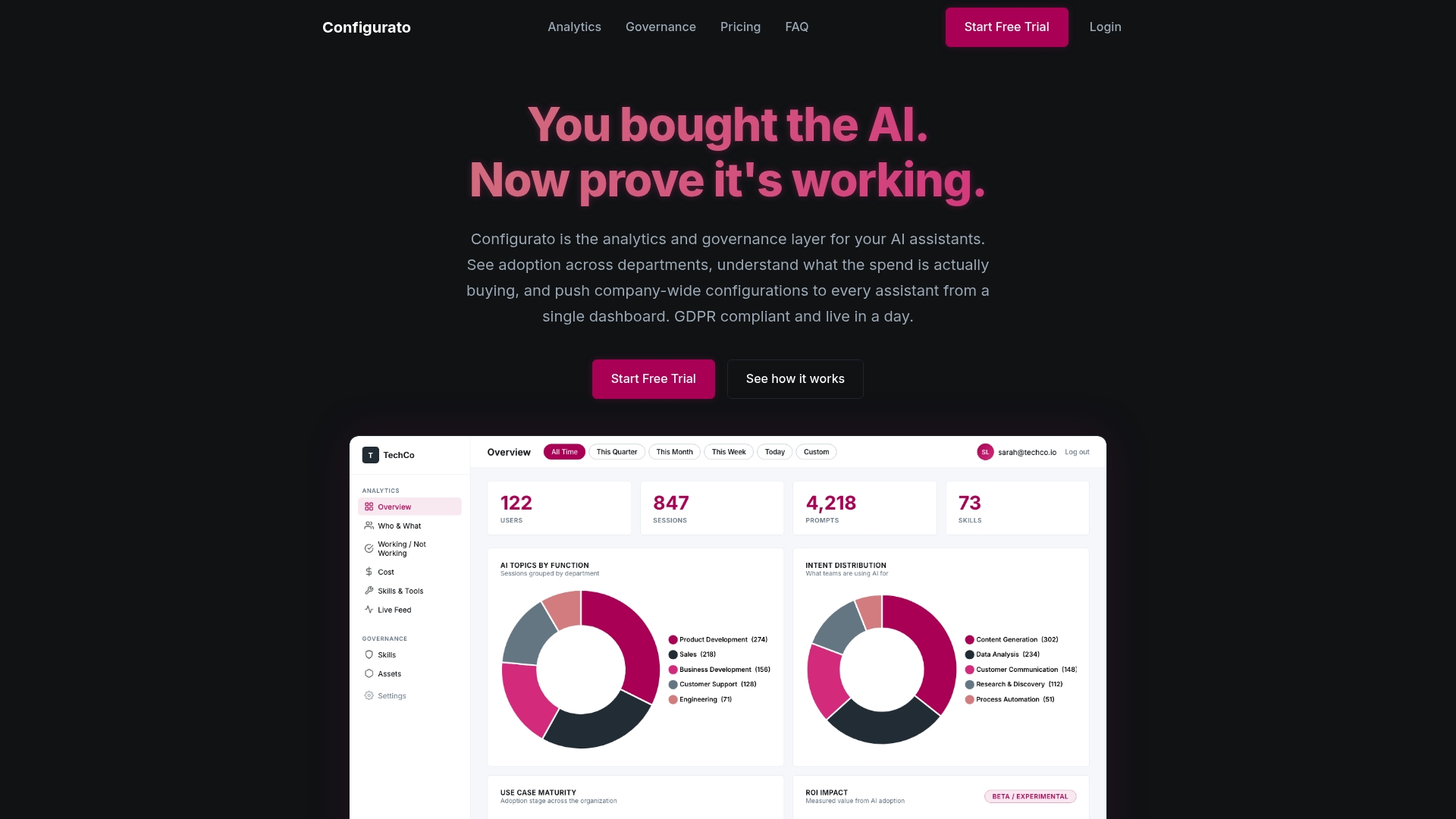
Discover how Tekkr can close the gap between AI deployment and meaningful impact. Visit Tekkr Configurato today and take charge by defining, distributing, and enforcing your AI configurations. Book a 20-minute demo and see tailored AI outputs aligned with your company’s standards — no spreadsheets or delays involved.
Frequently Asked Questions
How does Tekkr streamline the implementation of AI governance within organizations?
Tekkr reduces project risk with its fast deployment of dashboards in just 30 minutes. This allows organizations to have their governance and compliance frameworks up and running without prolonged integration cycles, as highlighted by its real-time rollout monitoring and automated reporting for leadership. Organizations can quickly demonstrate AI adoption and spend to their stakeholders.
What is the difference between Tekkr and Phinite regarding multi-channel deployment?
Phinite excels with its multi-channel delivery, allowing the same agent topology to function across various platforms such as Slack, Teams, and voice without requiring reconfiguration. In contrast, Tekkr focuses on integrating different AI assistants under a unified governance framework. Businesses seeking a cohesive experience across multiple communication tools may prefer Phinite, while those needing centralized oversight and cost-management will find Tekkr more aligned with their goals.
Which platform provides better cost allocation and ROI analytics for finance teams, Tekkr or Masche?
Tekkr offers board-level reports and departmental cost allocation, making it easier for finance teams to track ROI and justify AI investments. This is supported by its automatic generation of ROI dashboards that roll up valuable insights for leadership. Companies focused on detailed financial accountability will benefit more from Tekkr compared to Masche, which is more centered on operational execution and control.
Can I evaluate Tekkr if my organization is just starting with AI governance?
Yes, Tekkr provides a free tier that can help organizations test its capabilities before committing to a paid plan. This allows businesses with limited experience in AI governance to explore compliance and visibility features without heavy initial investments and gauge how it fits their needs.
Does Tekkr support compliance with GDPR and similar regulations?
Tekkr has built-in privacy controls and GDPR compliance measures, which enable organizations to enforce data flow limitations while still generating operational metrics. This is crucial for businesses in regulated industries that need to adhere to strict compliance requirements while managing their AI tools.