
Most enterprises already have AI assistants deployed. Engineers are using them. Product managers are prompting away. And yet the productivity numbers look underwhelming, the outputs need heavy editing, and nobody can quite explain why the technology that promised transformation is delivering incremental gains at best. The problem is not the model. The problem is that the AI has no idea how your company works. Company-specific AI explained simply means AI that has been given your context, your rules, and your operational standards so it can perform work that actually fits, rather than work that merely approximates. This guide will show you exactly how that works and what it takes to get there.
Table of Contents
- What is company-specific AI and why it matters for enterprises
- Architectural patterns for building company-specific AI
- Aligning company-specific AI with business operations through context engineering
- Building a competitive moat with context architecture
- Practical steps for deploying and governing company-specific AI assistants
- Why most AI implementations fail without strong context architecture
- Enhance your company-specific AI with Configurato’s analytics and governance
- Frequently asked questions
What is company-specific AI and why it matters for enterprises
Company-specific AI is not a different type of model. It is a different relationship between the model and your organization. A generic AI assistant is trained on broad internet data and answers questions competently but without any awareness of your architecture standards, your approval workflows, your compliance constraints, or your domain-specific terminology. Company-specific AI closes that gap by embedding those elements into how the AI operates, not just what you prompt it with.
The AI productivity benefits are real, but they only materialize when the output does not require a human to spend twenty minutes correcting it. That correction cost is where most enterprise AI programs bleed value. When an engineer prompts a coding assistant without any embedded context, the scaffold that comes back follows public conventions, not your internal architecture. When a product manager asks an assistant to draft a spec, it reads like a generic template, not something that reflects your product development lifecycle. You end up with plausible output that is wrong in the specific ways that matter.
Agentic AI is the form company-specific AI most often takes in enterprise environments. It is semi- or fully autonomous, integrates with enterprise software via APIs and tools, and perceives, reasons, and acts to complete tasks with minimal supervision. This is not chatbot behavior. It is AI that calls your internal systems, retrieves governed data, and takes actions inside your environment according to defined parameters.
Key characteristics that distinguish company-specific AI:
- Deep integration with internal systems via APIs, not just retrieval from a knowledge base
- Operational guardrails that reflect company policy, risk tolerance, and compliance requirements
- Role-specific context that shapes outputs for engineers, PMs, finance analysts, or legal teams differently
- Governance mechanisms that allow analytics and governance for AI assistants at scale, so you can trace what the AI did and why
The shift from generic to company-specific is less a technical upgrade and more an organizational commitment to treating AI context as infrastructure.
Architectural patterns for building company-specific AI
Once you accept that context is the differentiator, the next question is how to engineer it. Two dominant architectural patterns have emerged in enterprises, and both are worth understanding.

The first is the multi-agent MCP (Model Context Protocol) server approach. Cloudflare built internal MCP servers with centralized rule sets, using multi-agent review coordinators and specialized agents to enforce engineering standards and risk tiers. Their architecture routes tasks to specialized agents based on the sensitivity and complexity of the request. A routine code comment goes to a low-risk agent. A security-adjacent change goes through stricter tooling with tighter permissions. This risk tier classification is a governance mechanism, not just an engineering choice.
The second is the foundation model insights approach. Mastercard trains a foundation model on billions of anonymized transactions as an insights engine, rather than deploying a generic chatbot. The result is a model that understands transaction patterns, fraud signals, and loyalty behaviors in ways no public model can replicate. This powers cybersecurity tools, loyalty programs, and predictive analytics specific to Mastercard’s business context.
Here is how those two approaches compare:
| Dimension | Multi-agent MCP approach | Foundation model insights approach |
|---|---|---|
| Best suited for | Operational task automation across software tools | Deep domain intelligence from proprietary data |
| Context delivery | Rule sets, permission tiers, agent routing | Model weights trained on company data |
| Governance mechanism | Centralized coordinator with specialized agents | Data governance at training and inference stages |
| Time to value | Faster iteration cycles | Longer upfront investment, durable advantage |
| Example use case | Code review, spec generation, ticket routing | Fraud detection, transaction intelligence, risk scoring |
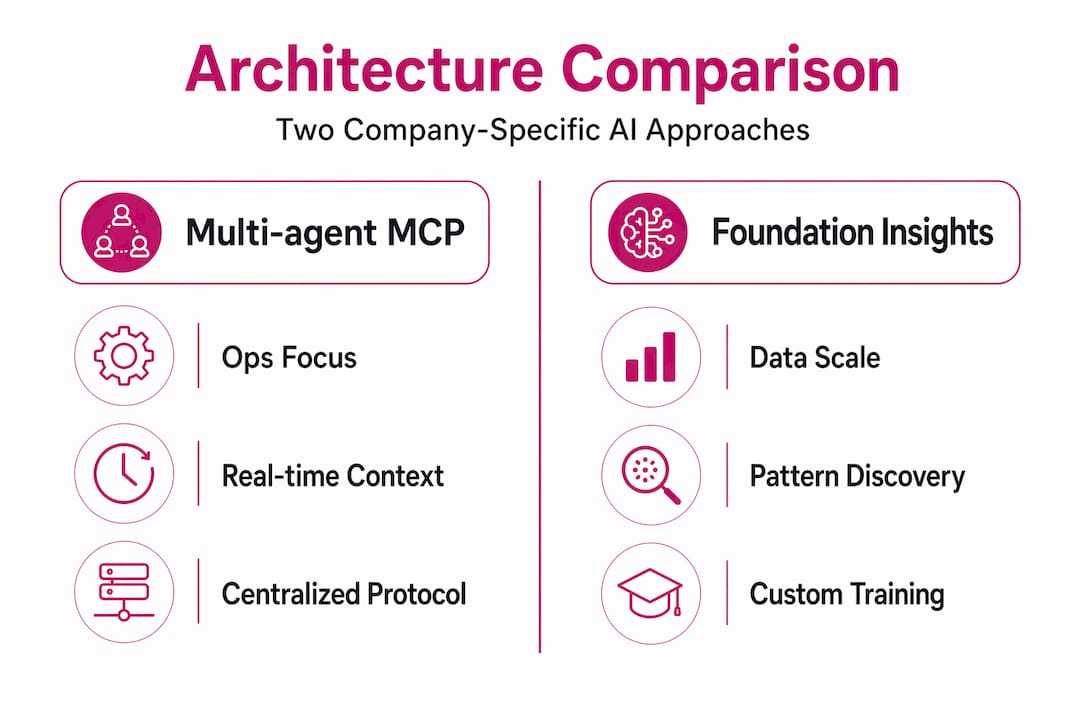
Both approaches can coexist. Most organizations at scale will end up using both.
Steps to select your starting architecture:
- Map your highest-value AI use cases by business function
- Identify which use cases require real-time system interaction versus deep domain inference
- Choose multi-agent MCP for workflow automation; choose foundation model training for proprietary data intelligence
- Apply governance for AI assistants across both patterns from day one
- Build risk tier classifications into your agent routing before you scale
Aligning company-specific AI with business operations through context engineering
Architecture tells you how to build the system. Context engineering tells you what to put inside it. And most enterprise AI programs underinvest here in ways that create problems later.
Context engineering involves centralized ownership of meaning with distributed accountability as AI agents operate across ERP, CRM, HR, and collaboration systems. That phrase deserves unpacking. When your AI assistant touches a sales record, an engineering ticket, and a finance report in the same workflow, those three systems may define “customer” differently. If the AI is not given a governed definition, it will infer one, and that inference may be wrong in ways that are invisible until they cause a compliance issue or a bad decision.
Context is not about raw data access. It is about defining the meaning and relationships of data entities across your organization. Who owns that definition? In most enterprises, nobody does. That is the governance gap that turns promising AI programs into trust problems.
Core elements of effective context governance:
- Designated data owners responsible for canonical definitions across systems
- Security owners who define what the AI can and cannot access by role and risk tier
- Business owners who validate that AI behavior aligns with operational intent, not just technical accuracy
- Regular audits to detect definition drift as systems and processes evolve
- AI assistants governance tooling that makes these definitions enforceable at inference time
Pro Tip: Treat context engineering as ongoing infrastructure, not a one-time setup. Every time your systems change, your context layer needs to update. Organizations that skip this end up with agent output drift, where AI behavior gradually diverges from current company standards without anyone noticing until the damage is done.
Building a competitive moat with context architecture
The companies that will sustain AI advantages over the next decade are not the ones with the biggest GPU budgets. They are the ones that have built context architecture as a durable organizational asset. Most AI competitiveness comes from distinctive company context: organizational identity, operational constraints, knowledge, and retrieval systems that ensure relevant information access at inference time.
Context architecture has three practical layers:
| Layer | What it contains | Role in company-specific AI |
|---|---|---|
| Foundation context | Mission, values, operational decision limits, tone of voice | Grounds AI behavior in organizational identity |
| Intelligence layer | Institutional knowledge, domain expertise, decision frameworks, RAG pipelines | Delivers the right knowledge at the right moment |
| Execution layer | Task definitions, tool access, action protocols, quality standards | Drives consistent, compliant output on every task |
The Foundation Context layer is where most organizations have surprisingly little documented. You know your engineering principles exist, but are they written in a form an AI agent can use? Cloudflare’s AGENTS.md files in repositories are an example of making implicit standards explicit for AI consumption. The Intelligence Layer is where retrieval-augmented generation (RAG) pipelines live, pulling relevant internal documents, past decisions, and domain expertise dynamically rather than stuffing everything into a prompt. The Execution Layer is where task-level instructions, tool permissions, and output quality criteria live.
One critical principle: progressive disclosure. Do not attempt to load every layer into every interaction. Overloading the AI with context degrades performance and increases latency. Design your context architecture for AI so that relevant context is surfaced when it is needed, not pre-loaded as a flat document dump.
Pro Tip: Budget for context architecture the way you budget for data infrastructure. It is not a side project. It is the operating system your AI runs on. Organizations that treat it as a one-time prompt engineering exercise will rebuild it from scratch within eighteen months.
Practical steps for deploying and governing company-specific AI assistants
Understanding the architecture is one thing. Shipping it safely at scale is another. Successful deployments require continuous validation, robust API management, regulatory controls, guardrails against model drift, and KPIs aligned with business goals. Here is a sequenced roadmap:
- Define business objectives and success metrics before writing a single line of configuration
- Identify two or three high-value, bounded use cases for your pilot, where failure is recoverable
- Build a test environment with representative data and staged rollouts, not production-first deployment
- Implement risk tier classification and policy gates before enabling autonomous actions
- Deploy multi-agent coordination where tasks span multiple systems or require cross-functional validation
- Instrument everything: track output quality, user acceptance rates, and compliance flag frequency
- Run a formal review cycle every quarter to update context, adjust risk tiers, and retire outdated guardrails
- Scale only after your monitoring infrastructure can surface problems faster than they compound
Common pitfalls to avoid:
- Ignoring context quality in favor of model capability, which is where most ROI is lost
- Launching without a governance owner, which creates accountability gaps when the AI makes a bad call
- Insufficient auditability, leaving you unable to explain an AI-driven decision to a regulator or a board
- Treating deployment as the finish line, when it is actually the start of an ongoing operational commitment
- Skipping AI assistant analytics and monitoring in early stages, which removes your ability to improve systematically
Foster collaboration across data, security, and business teams from the start. AI is a cross-functional initiative, not an engineering project. The organizations that fail most publicly are the ones where the CTO shipped the system and the business teams found out what it was doing later.
Why most AI implementations fail without strong context architecture
Here is the uncomfortable truth most AI vendors will not tell you: the model is the easy part. Any capable engineering team can integrate a frontier model into enterprise software. What they cannot do quickly, and what money alone cannot buy, is your organization’s accumulated operational knowledge, your defined standards, your governance structures, and your ability to surface the right information at the right moment. That is context. And without engineered context, AI agents produce plausible but incorrect outputs at scale, damaging business trust and ROI.
The tech community has developed a near-obsessive focus on prompt engineering and model selection while treating context as an afterthought. Prompt engineering is useful at the individual level. At enterprise scale, it is ungovernably fragile. Prompts drift, employees improvise, and the AI produces inconsistent results that erode confidence. Context architecture is the antidote. It makes good AI behavior the default, not the exception.
The real failure mode is not dramatic. It is a slow erosion of trust. Finance stops using the AI assistant because it keeps getting cost center codes wrong. Legal opts out because outputs do not reflect current regulatory language. Engineering routes around the tool because it does not know internal conventions. Each team that abandons the system is a signal that context architecture failed them.
CTOs need to champion cross-functional context governance bodies the same way they champion data governance or security compliance. It is not glamorous work. It does not get announced at industry conferences. But it is the difference between AI that compounds in value over time and AI that plateaus the week after launch.
Invest early in context architecture. The cost of rebuilding it after adoption has stalled and trust has eroded is an order of magnitude higher than building it right the first time.
Enhance your company-specific AI with Configurato’s analytics and governance
You can have the right architecture on paper and still struggle to know whether it is actually working. That is the operational gap Configurato is built to close.
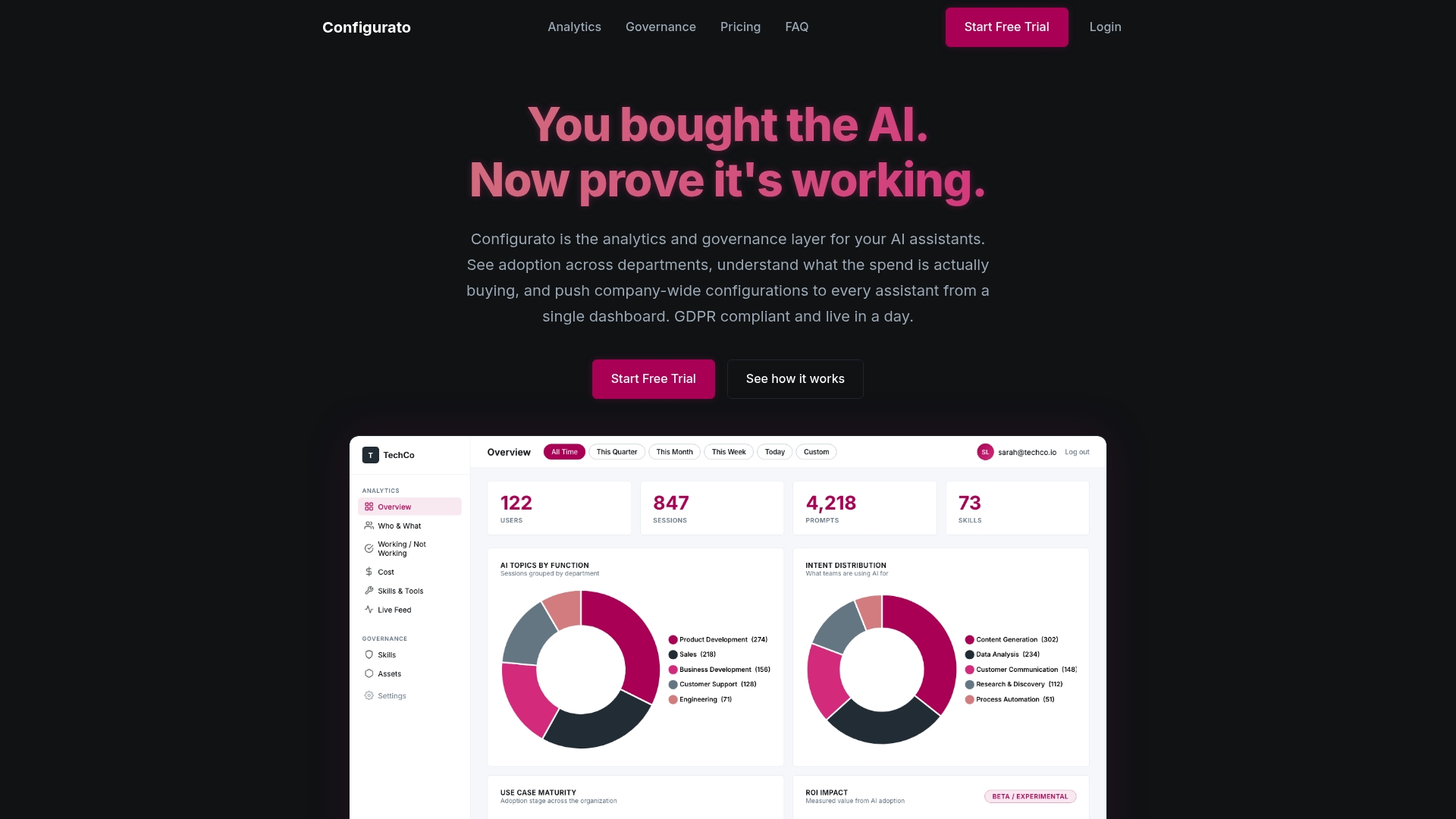
Configurato AI governance platform gives you centralized visibility into how AI assistants are performing across your enterprise, what context they are using, where outputs are drifting from your standards, and which teams are seeing real productivity gains versus which ones have quietly stopped using the tools. Governance tools handle policy gates, risk tiering, and context management workflows so your AI stays aligned with company standards without requiring manual oversight at every step. You get transparency, auditability, and the data to make smart decisions about where to invest next in your AI program.
Frequently asked questions
What exactly differentiates company-specific AI from general AI models?
Company-specific AI integrates with internal data, business rules, and APIs to perform tasks aligned with organizational goals, whereas generic models provide broad, uncustomized responses with no awareness of your operational context.
How does context engineering improve AI assistant reliability?
Context engineering manages ownership of meaning as a shared enterprise capability, ensuring consistent, governed definitions across systems so AI assistants make accurate decisions and stay compliant across workflows.
What are common challenges when deploying company-specific AI in enterprises?
The hardest challenges are aligning AI outputs with complex company policies, managing semantic inconsistencies across systems, and monitoring for model drift while maintaining clear KPIs tied to actual business outcomes.
How can CTOs prioritize investments for successful AI implementation?
Allocate budget across model access, compute, and context architecture in roughly equal thirds. Balanced investments in context reduce costs and improve performance more reliably than chasing the newest foundation model.
Are there industry examples of successful company-specific AI implementations?
Yes. Cloudflare uses multi-agent MCP servers with centralized rule sets and multi-agent review coordinators to enforce engineering standards, while Mastercard’s foundation model trained on billions of transactions enables predictive insights powering cybersecurity and loyalty tools across the business.