
Bootstrapping AI adoption without a dedicated IT team is defined as implementing AI tools through operational systems, no-code platforms, and designated ownership rather than engineering resources. 82% of small and mid-sized businesses use AI tools, yet fewer than 40% achieve measurable profit impact. That gap exists because most teams treat AI as a technology problem when it is actually an operations problem. The businesses that close that gap share three traits: documented workflows, a named AI system owner, and leadership that uses AI daily. None of those require a single engineer.
What are the operational prerequisites for AI adoption without an IT team?
Operational maturity is the real prerequisite for self-service AI adoption, not technical headcount. Before you install any tool, your business needs to meet four baseline conditions.
Documented workflows. AI cannot improve a process that exists only in someone’s head. Every workflow you plan to automate must be written down, step by step, before you touch a tool. Tribal knowledge produces inconsistent outputs and makes it impossible to train an AI model or prompt template reliably.

Data hygiene above 80%. Teams with data completeness above 80% have a 90% chance of hitting their AI goals. Below 60% completeness, that success rate drops to 15%. Data hygiene is the silent killer of AI projects, and it costs nothing to fix before you start.
Leadership using AI daily. Leadership’s daily AI use sets the cultural standard for every team below it. When a founder or department head uses an AI writing tool, a summarization tool, or a research assistant every day, adoption spreads faster and with less resistance.
An AI system owner with protected time. This role does not require a technical background. It requires operational judgment and 5–8 hours per week of protected time to manage documentation, run feedback loops, and update training materials. Assigning this role to an already overloaded employee or to an IT generalist without operational context significantly reduces your chances of success.
Pro Tip: Pick your AI system owner before you pick your first tool. The owner shapes how the tool gets used, not the other way around.
Which no-code platforms enable AI adoption without engineering resources?
73% of successful small-team AI implementations rely entirely on no-code integration platforms, avoiding custom development altogether. That number reflects a real shift in what is possible without engineers.
No-code platforms like Zapier, Make, and Workato connect AI tools to the apps your team already uses. A customer service team can route incoming emails through an AI classifier and into the right inbox without writing a single line of code. A sales team can trigger AI-generated follow-up drafts directly from their CRM when a deal moves stages. These connections take hours to build, not weeks.
The four most productive categories for no-code AI adoption are:
- Customer service automation: AI triage, response drafting, and ticket categorization connected to support platforms
- Sales enablement: AI-generated outreach, deal summaries, and follow-up sequences triggered by CRM events
- Content and communications: Draft generation, editing assistance, and brand-voice enforcement for marketing teams
- Data operations: Automated report generation, data extraction from documents, and spreadsheet population from unstructured inputs
| Feature category | Typical use case | No-code tool type |
|---|---|---|
| Email triage | Auto-classify and route inbound messages | Workflow automation platform |
| CRM enrichment | Pull company data into contact records | Data connector |
| Document processing | Extract fields from PDFs or invoices | AI extraction layer |
| Content drafting | Generate first drafts from a brief | Prompt-based AI app |
| Report generation | Summarize data into weekly digests | Scheduled workflow |
The cost advantage of no-code is real. Multi-model AI architectures that route tasks to cheaper or specialized models reduce costs by 40–60% compared to single-model setups. No-code platforms make this routing accessible without a machine learning engineer.
Pro Tip: Start with one no-code connection between a tool your team already loves and an AI capability. A single working automation builds more confidence than a five-tool rollout that half the team ignores.
How to structure a step-by-step AI implementation plan
A phased approach is the most reliable AI implementation guide for teams without dedicated engineering staff. The goal is a working prototype in 2–4 weeks and measurable results within 60–90 days.
-
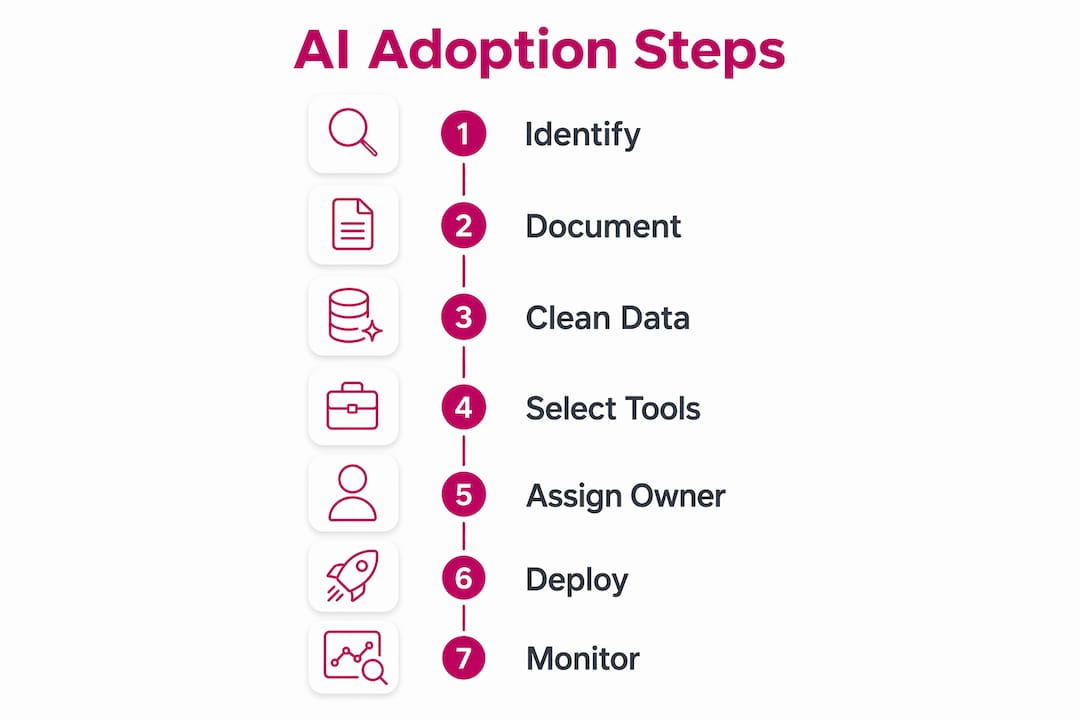
Identify one painful, measurable problem. Do not start with “we want to use AI.” Start with “our sales team spends four hours a week writing follow-up emails.” Specificity determines whether you can measure success. Defining clear success metrics before implementation correlates with an 85% success rate. Starting without defined metrics drops that rate to 30%.
-
Set your evaluation criteria. Before you test any tool, write down what “good” looks like. For the email example, good might mean drafts that require fewer than two edits before sending. This standard becomes your context pack, the document that tells the AI what quality looks like for your business.
-
Build a prototype in 2–4 weeks. Connect one no-code tool to one workflow. Run it with a small group of willing users. Do not announce it company-wide yet. Collect real feedback on output quality, time saved, and friction points.
-
Measure and document the quick win. After 30 days, quantify the result. Time saved, errors reduced, or volume handled are all valid metrics. A documented win gives you the internal case to expand. A realistic timeline to reach measurable AI value without an IT team is 60–90 days, with prototypes ready in 2–4 weeks.
-
Expand to a second workflow, not a second department. Scope creep kills momentum. After your first win, go deeper in the same workflow before going wide. Add a second AI step to the same process rather than launching a parallel project in a different team.
-
Run a monthly feedback loop. The AI system owner collects user feedback, updates the context pack, and adjusts prompts or workflow logic. This loop is what separates a tool that sticks from one that gets abandoned after the first bad output.
What common pitfalls should you anticipate and how do you fix them?
Most AI failures are adoption failures, not technical failures. Generic training leads to 70–80% of employees reverting to old methods after one poor output. The technology works. The rollout does not.
The most common failure modes in no-IT-team AI adoption are:
- Shadow AI: Departments buy tools independently, creating fragmented data and redundant contracts. Shadow AI accounts for over 50% of informal AI usage in SMBs and directly harms ROI. Centralized oversight, even a simple shared spreadsheet of approved tools, prevents this.
- Missing context packs: Skipping the step of documenting output standards causes widespread adoption failure. Users get generic outputs, lose confidence in the tool, and return to manual work. A context pack does not need to be long. Two pages of examples and standards is enough to anchor quality.
- Generic demos instead of targeted training: A 30-minute all-hands demo does not change behavior. One-on-one sessions tied to a specific person’s workflow do. Train the sales rep on their follow-up emails, not on AI in general.
- No adoption tracking: If you cannot see who is using the tool and how often, you cannot fix the problem. Monitoring adoption metrics and adjusting workflows based on real usage data is what separates teams that sustain AI gains from those that stall.
“The primary bottleneck in non-technical teams is leadership capacity and the ability to set quality standards, not the technology itself. When leaders define what good looks like and use the tools themselves, adoption follows. When they delegate without standards, the tools collect dust.”
Governance does not require a policy document on day one. It requires one person who knows what tools are approved, what data can flow through them, and what the output standards are. That is your AI system owner’s job.
Key Takeaways
Bootstrapping AI adoption without an IT team succeeds when operational clarity, a named system owner, and no-code tools replace the need for engineering resources.
| Point | Details |
|---|---|
| Operational prerequisites first | Document workflows and achieve data hygiene above 80% before selecting any tool. |
| Appoint an AI system owner | Assign an operations-minded person with 5–8 hours per week of protected time to manage adoption. |
| Use no-code platforms | Zapier, Make, and Workato connect AI to existing apps without custom development. |
| Target 60–90 days to value | Build a prototype in 2–4 weeks and measure a real business outcome within 90 days. |
| Track adoption, not just output | Monitor who uses the tools and how often to catch stalls before they become failures. |
Why operational leadership beats technical capacity every time
The uncomfortable truth about AI adoption for SMBs is that the teams winning with AI are not the ones with the best tools. They are the ones with the clearest standards and the most engaged leaders.
I have seen well-funded teams buy enterprise AI licenses and watch adoption flatline within 60 days. I have also seen a 12-person operations team at a logistics company build a working AI workflow in three weeks using Zapier and a shared Google Doc as their context pack. The difference was not budget. It was that their COO used the tool every morning and told the team exactly what a good output looked like.
The cross-team AI adoption playbook that actually works is boring by design. Pick one problem. Define the standard. Assign the owner. Measure the result. Repeat. There is no shortcut that bypasses those steps, and no amount of technical sophistication that replaces them.
The teams that treat AI as a focused tool for a specific pain point consistently outperform the teams chasing the newest model release. Operational maturity compounds. Every documented workflow, every trained prompt, every feedback loop makes the next implementation faster and cheaper. That is the real return on AI investment for a business without an IT team.
— TekkrTools
How Tekkr supports AI adoption without a dedicated IT team
Tekkr is built for exactly this situation. You have bought the AI tools. Now you need to prove they are working.
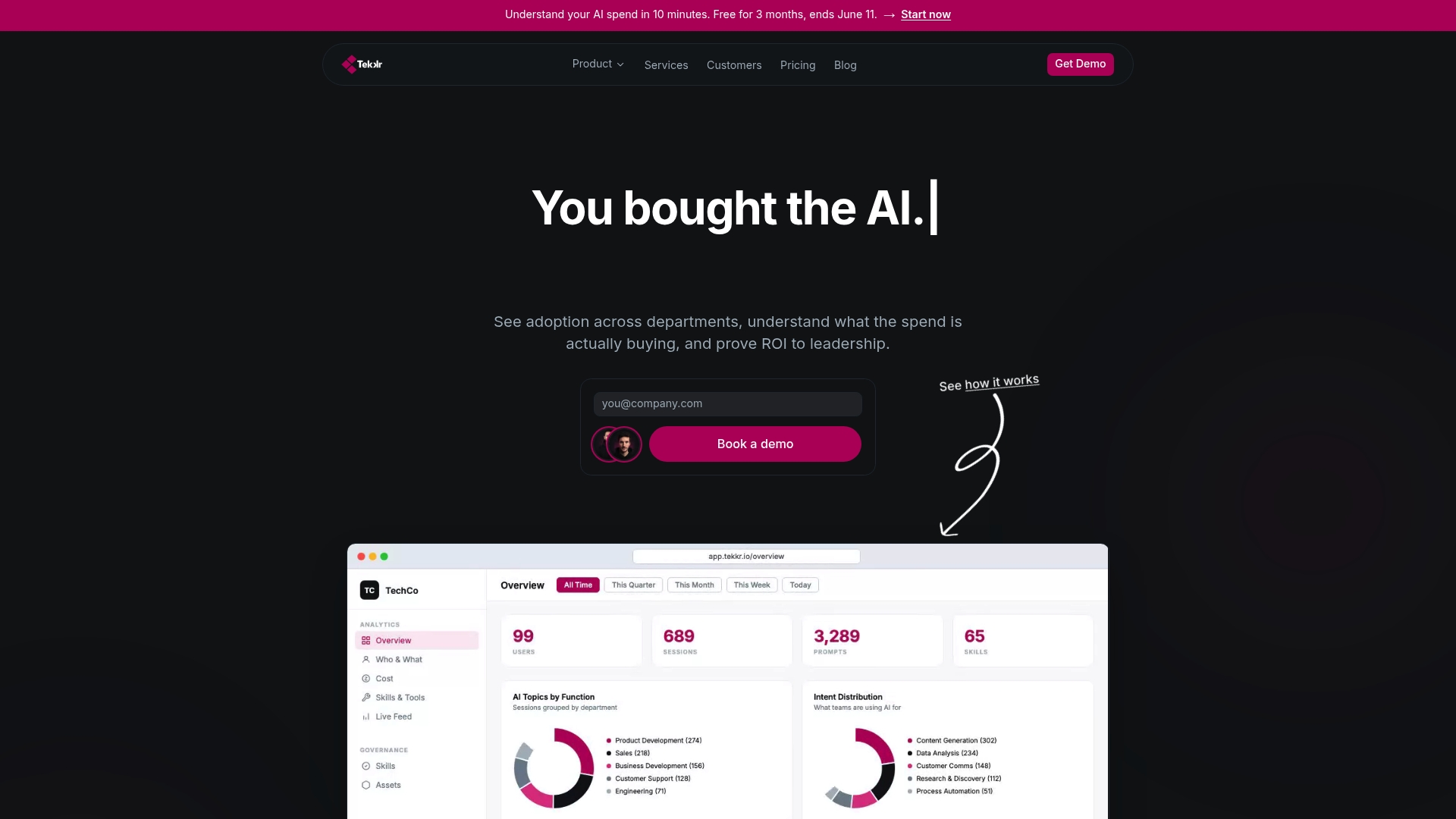
Tekkr’s flagship product, Configurato, tracks who is actually using tools like Claude and Codex, breaks down costs by team, and surfaces which use cases are delivering real value. It runs gamified rollouts and company-wide AI playbooks so your team does not just have access to AI. They use it well. Setup takes about 10 minutes, with a free tier and no credit card required. For teams that want guided frameworks alongside the platform, Tekkr’s AI adoption solutions combine consulting with the product to get you from zero to measurable results faster. No engineering overhead required.
FAQ
What does it mean to bootstrap AI adoption without an IT team?
Bootstrapping AI adoption without an IT team means implementing AI tools through operational systems, no-code platforms, and a designated internal owner rather than relying on engineers or a dedicated IT department.
How long does it take to see results from AI adoption without engineers?
A realistic timeline is 60–90 days to measurable results, with a working prototype ready in 2–4 weeks. Teams that define success metrics before they start hit their goals at an 85% rate.
What is shadow AI and why does it matter for small businesses?
Shadow AI occurs when departments buy AI tools independently without central oversight. It affects over 50% of SMBs and leads to fragmented data, redundant costs, and reduced ROI.
Do I need clean data before starting AI adoption?
Yes. Teams with data completeness above 80% have a 90% chance of achieving their AI goals. Below 60%, that success rate drops to 15%, making data hygiene a prerequisite, not an afterthought.
What is an AI system owner and who should fill that role?
An AI system owner is the internal person responsible for managing tool documentation, user training, and feedback loops. The role requires 5–8 hours per week and operational judgment, not a technical background.