
Most organizations that deploy AI tools believe they are making progress. Adoption rates climb, dashboards fill with usage data, and executives get comfortable pointing to those numbers in quarterly reviews. But the productivity leap never quite arrives. Revenue growth stays flat relative to the investment. Teams still rework AI output before it is usable. The competitive edge everyone expected remains out of reach. The uncomfortable truth is that deploying AI without anchoring it to specific business objectives is how companies spend significant capital and generate very little return. This article gives you a clear path from that confusion to genuine, measurable results.
Table of Contents
- The real risks of unaligned AI: Productivity and ROI pitfalls
- Frameworks for aligning AI with business strategy
- Measuring success: Choosing the right KPIs and avoiding metric pitfalls
- From alignment to workforce results: Turning AI strategy into productivity gains
- Why conventional AI program management leaves value on the table
- How Configurato helps you align AI with business goals
- Frequently asked questions
Key Takeaways
| Point | Details |
|---|---|
| Prioritize business alignment | AI projects succeed when directly mapped to business goals and measurable results. |
| Avoid metric pitfalls | Choosing the right KPIs prevents gaming and ensures accountable progress. |
| Measure true ROI | Focus on business outcomes, not just tool adoption or technical milestones. |
| Empower organization-wide influence | CTrOs who prioritize influence over authority drive better enterprise AI outcomes. |
The real risks of unaligned AI: Productivity and ROI pitfalls
With that context, let’s examine what can go wrong when business alignment is missing.
The most common mistake is treating AI deployment as the finish line. Teams celebrate when a tool is rolled out to a department, but celebration is premature if no one defined what business problem that tool was solving. You end up with high adoption numbers that tell you almost nothing about whether the organization is actually better off.
This is where Goodhart’s law becomes dangerous. When a measure becomes a target, it stops being a good measure. If your team knows that AI usage frequency is being tracked, they will use AI tools more often, whether or not the output improves their work. The metric looks healthy. The underlying problem does not move.
Here are the most common ways unaligned AI initiatives backfire:
- Prioritizing adoption rates over actual ROI, leaving executives guessing whether the investment was worth it
- Building AI programs around technology capabilities rather than business pain points, resulting in solutions looking for problems
- Measuring activity (prompts submitted, documents generated) instead of outcomes (cycle time reduced, error rate dropped, revenue per rep improved)
- Skipping stakeholder alignment early, which creates siloed tool adoption that never scales across the organization
- Confusing busy work with productive work, especially when AI activity vs. outcomes are not clearly separated in your measurement framework
“The difference between a useful AI metric and a misleading one often comes down to whether you’re measuring what the AI is doing or what the business is achieving because of it.”
You can run an AI ROI assessment to establish a baseline before deployment, but only if you know what business outcome you are measuring against. Without that anchor, even a rigorous assessment produces noise rather than signal.
The technology-first mentality is particularly costly because it inverts the correct order of operations. You should start with a business problem, then ask which AI capability addresses it. Starting with a shiny AI feature and hunting for a use case is a reliable way to burn budget and disappoint stakeholders who expected a competitive advantage.

Frameworks for aligning AI with business strategy
Having exposed the risks, let’s turn to frameworks that help organizations properly align AI with their business strategy.
The core choice every organization needs to make is whether it will take a technology-first or business-first approach. These are not just philosophical differences. They produce fundamentally different program designs, different KPIs, and different outcomes over time.
| Dimension | Technology-first | Business-first |
|---|---|---|
| Starting point | AI tool capabilities | Business objectives |
| Success metric | Adoption rate, usage frequency | Revenue impact, productivity gain |
| Ownership | IT or engineering | Cross-functional with CTO and business leads |
| Stakeholder buy-in | After deployment | Before deployment |
| ROI timeline | Unclear | Defined upfront |
| Governance | Technical | Business-driven |
As research on AI program value consistently shows, technology-first approaches tend to create impressive demos and underwhelming long-term results. Business-first approaches take longer to design but compound in value over time.
Here is a five-step process for mapping your business objectives directly to AI capabilities:
- Identify your top three to five business priorities for the next 12 months. Be specific: “reduce time-to-hire by 20%” is a priority; “improve HR efficiency” is not.
- For each priority, map the workflows that currently limit progress. Where do people spend disproportionate time? Where do errors cluster? Where does handoff friction slow things down?
- Evaluate AI capabilities against those specific workflow bottlenecks. Not all AI tools are right for all problems. Match the capability to the constraint.
- Define the before and after state in measurable terms. What does success look like in 90 days, 6 months, and 12 months? Write it down before you start.
- Assign cross-functional ownership, making sure business leaders (not just technical leads) are accountable for outcomes.
Pro Tip: Bring in stakeholders from sales, operations, HR, and finance during step one, not step four. The earlier you involve diverse voices, the less likely you are to end up with governing AI projects that only one team actually uses and cares about. Siloed adoption is the silent killer of AI programs. It looks like progress from the outside but creates tool fragmentation and inconsistent quality at scale.
The business-first framework also forces a conversation that most organizations avoid: what are we willing to stop doing, or do differently, to actually realize the value AI can provide? That is often where the real resistance lives, and surfacing it early is far better than encountering it after you have already committed the budget.
Measuring success: Choosing the right KPIs and avoiding metric pitfalls
Effective alignment requires measurement. Next, we’ll focus on how to track what matters.
Measuring only adoption metrics is like judging a restaurant’s quality by the number of customers who sat down rather than by how many left satisfied and came back. The count looks encouraging. It tells you almost nothing about what you actually care about.
Choosing the right KPIs means separating activity-driven metrics from business-driven metrics. Both have a role, but only the latter should drive executive decisions about AI investment and program direction.
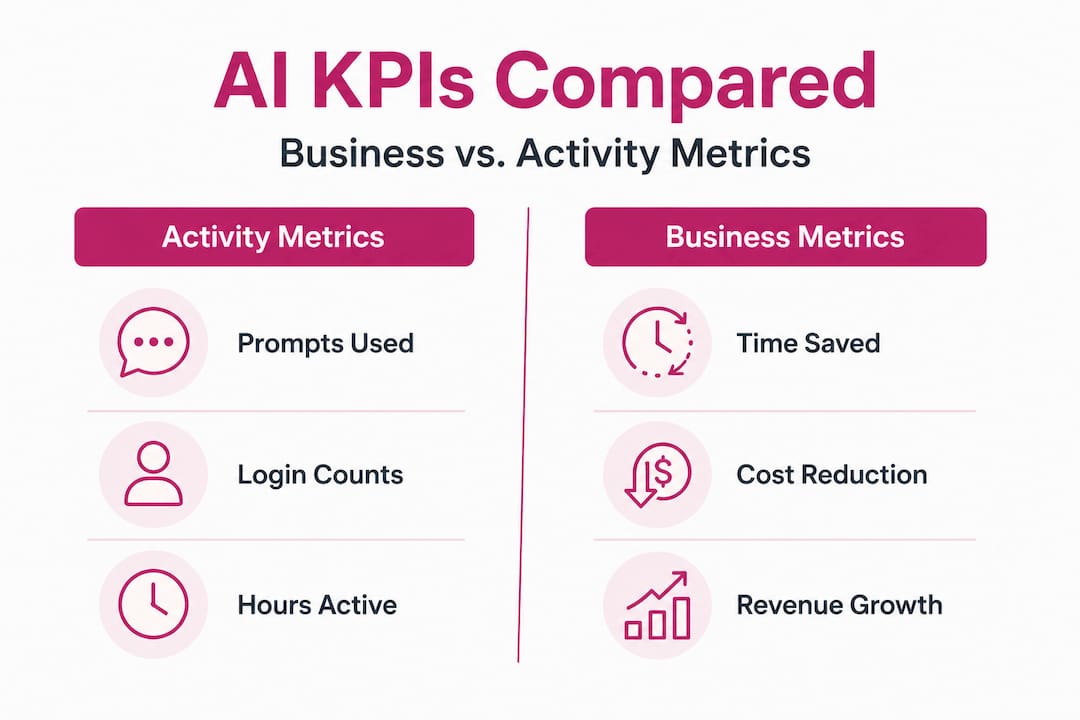
| Activity-driven KPIs | Business-driven KPIs |
|---|---|
| Number of AI prompts submitted per week | Time saved per completed task |
| Percentage of employees using AI tools | Reduction in document rework rate |
| Number of AI features activated | Revenue per sales rep (before/after) |
| Volume of AI-generated content | Customer response time reduction |
| Training completion rate | Error rate in AI-assisted workflows |
| Tool license utilization rate | Cycle time for product delivery |
The activity-driven column is not useless. It helps you diagnose adoption issues and identify where rollout is lagging. But if these are the metrics you are reporting to the board, you are measuring AI adoption vs. outcomes and calling it ROI. That is a problem that will catch up with you when the board asks why the investment has not moved the top-line numbers.
Another common trap is setting KPIs once and never revisiting them. AI capabilities evolve. Business priorities shift. A metric that was meaningful six months ago may now incentivize the wrong behavior. This is Goodhart’s law operating slowly in the background, gradually decoupling your measurement from your actual goals.
Pro Tip: Schedule a quarterly KPI review with both technical and business stakeholders. The question is not just “are we hitting our targets?” but “do these targets still reflect what we actually care about?” Adjusting metrics is not a sign of failure. It is a sign of a mature measuring AI governance process that prioritizes learning over optics.
One more thing worth saying plainly: vanity metrics are politically convenient. They make it easy to report progress without having to explain why the harder business outcomes have not moved. If you catch yourself defaulting to activity metrics in leadership reports, that is a signal to ask why. Usually it is because the business-driven metrics are not yet showing improvement, and the honest conversation about that is uncomfortable. Have it anyway. Early.
From alignment to workforce results: Turning AI strategy into productivity gains
Once you know what to measure, how do you actually move the needle? Let’s see how alignment powers workforce gains.
Clear business alignment does something counterintuitive: it actually makes AI adoption easier, not harder. When people understand why a tool is being introduced and how it connects to goals they already care about, resistance drops. They are not being asked to change how they work because of a technology trend. They are being given a better way to achieve something they were already trying to do.
Here is how alignment accelerates workforce results in practice:
- Training becomes shorter and more relevant because it is anchored to specific role-based workflows, not generic tool walkthroughs
- Adoption accelerates because employees see output that already reflects their context, rather than generic AI responses that need heavy editing
- Operational change becomes a natural consequence of better output, not a separate change management program bolted on top
- Cross-team collaboration improves because shared AI standards replace fragmented, inconsistent usage patterns across departments
- Feedback loops tighten because employees can connect AI output quality to measurable work outcomes, making continuous improvement instinctive
The AI productivity examples that actually stick in organizations are almost always the ones where alignment came first. A product manager who sees a spec drafted in their company’s exact format on the first attempt does not need to be convinced to use the tool again. The quality of the output makes the case better than any internal communications campaign ever could.
As research on cross-functional AI success makes clear, the CTO’s role in this is not purely technical. It is fundamentally about influence across teams that do not report to you. You need finance to tie AI initiatives to budget outcomes. You need HR to connect AI adoption to performance frameworks. You need operations to map AI capabilities to process improvement priorities. None of that happens through technical authority alone.
Pro Tip: Make wins visible and specific. When a team cuts their weekly reporting time by three hours using AI, share that story in an all-hands. Attach a name and a number to it. Abstract ROI projections rarely move culture. Concrete, relatable wins do. Building AI confidence across the workforce is a leadership responsibility, and it is one of the highest-leverage things you can do to sustain momentum beyond the initial rollout.
Why conventional AI program management leaves value on the table
Informed by these actionable practices, here is what most experts miss about unlocking AI’s true business value.
Most AI program management frameworks focus heavily on the technical layer: model selection, infrastructure, security, vendor evaluation. These are necessary. They are not sufficient. The organizations that consistently extract the most value from AI are not always the ones with the most sophisticated models. They are the ones that figured out how to drive organizational behavior change at scale.
The conventional playbook underestimates this by a wide margin. Technical KPIs dominate early AI program reviews. Adoption dashboards get more attention than outcome tracking. Engineering leaders carry disproportionate influence in decisions that are fundamentally about how people work, not how systems function. That imbalance quietly limits the ceiling on what AI can actually deliver.
The research is pointed on this: AI strategies succeed when the person leading the AI transformation focuses on influence across the organization rather than relying on direct authority. That is an orchestrator role, not a builder role. It requires different skills than most technical leaders were promoted for. It requires political savvy, communication discipline, and a willingness to let business outcomes, rather than technical elegance, define what counts as a win.
The honest implication is that many organizations need to rethink who is actually leading their AI transformation, not just the reporting structure but the mindset, the priorities, and the success criteria. The companies seeing real competitive advantage from AI are not the ones with the biggest models or the most tools deployed. They are the ones where someone in a leadership role made a deliberate, sustained effort to connect AI capabilities to business outcomes, and then held the organization accountable to that connection over time. That is less glamorous than building cutting-edge infrastructure. It is also where most of the value actually lives.
How Configurato helps you align AI with business goals
If you are ready to apply these principles at scale, here is a solution aligned with your goals.
Building AI-business alignment from scratch is genuinely hard. Codifying your organization’s processes, standards, and domain knowledge so that AI tools consistently reflect how your company works takes time and expertise most teams do not have in abundance. That is the problem Tekkr’s AI business alignment tools are designed to solve.
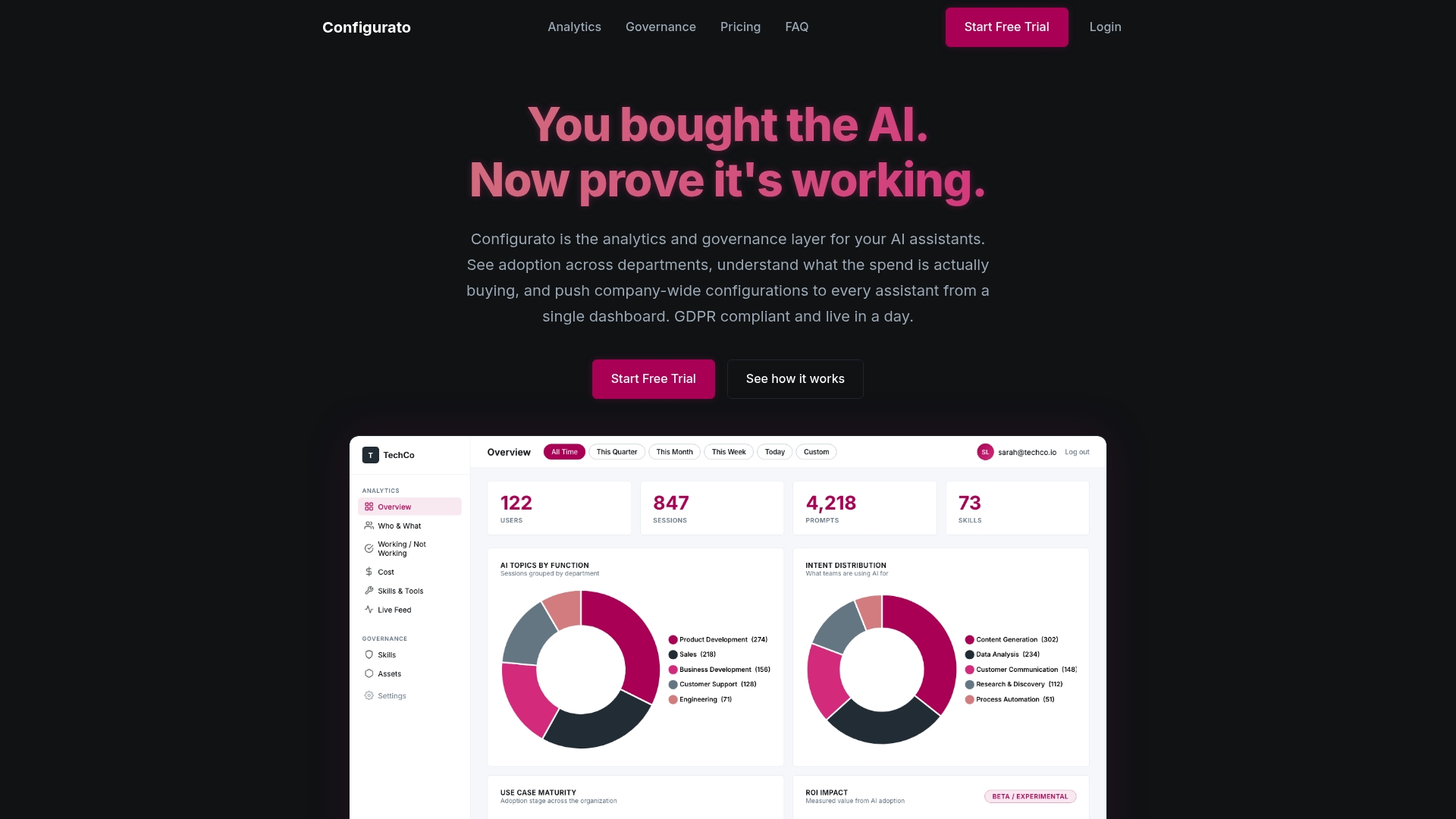
Configurato embeds your company’s way of working directly into the AI assistants your teams already use, without requiring them to change their workflow or learn a new platform. When engineers ask Copilot to scaffold a service, it follows your architecture standards. When product managers draft specs with Claude, the output already reflects your development lifecycle. The alignment happens in the background, agent to agent, so employees simply get better output from day one. Configurato also gives you the governance dashboards and productivity tracking you need to move from activity metrics to real business outcomes, so your next executive review tells the story that actually matters.
Frequently asked questions
What does aligning AI with business actually mean?
It means structuring AI projects to achieve specific business goals and measurable outcomes, not just implementing technology for its own sake. Every AI initiative should trace directly to a business priority with a defined success metric.
How do I know if our AI tools are delivering real ROI?
Track business-driven KPIs like revenue growth or productivity improvements rather than just adoption rates or technical outputs. As research on AI activity vs. outcomes shows, confusing usage frequency with business impact is one of the most common and costly mistakes in AI program management.
Why can tracking the wrong metrics hurt my AI strategy?
Using poorly chosen metrics leads to gaming, superficial progress, and wasted effort without real business value. The risk of Goodhart’s law is that teams optimize for the measure rather than the outcome it was supposed to represent.
Who should lead the business alignment of AI initiatives?
Business leaders and the CTO or CTrO should collaborate, with a strong emphasis on influence across the organization rather than technical authority. Research shows that AI leadership effectiveness hinges on the ability to orchestrate cross-functional priorities, not just manage technical execution.